
https://iclfi.org/pubs/wr/47/emily
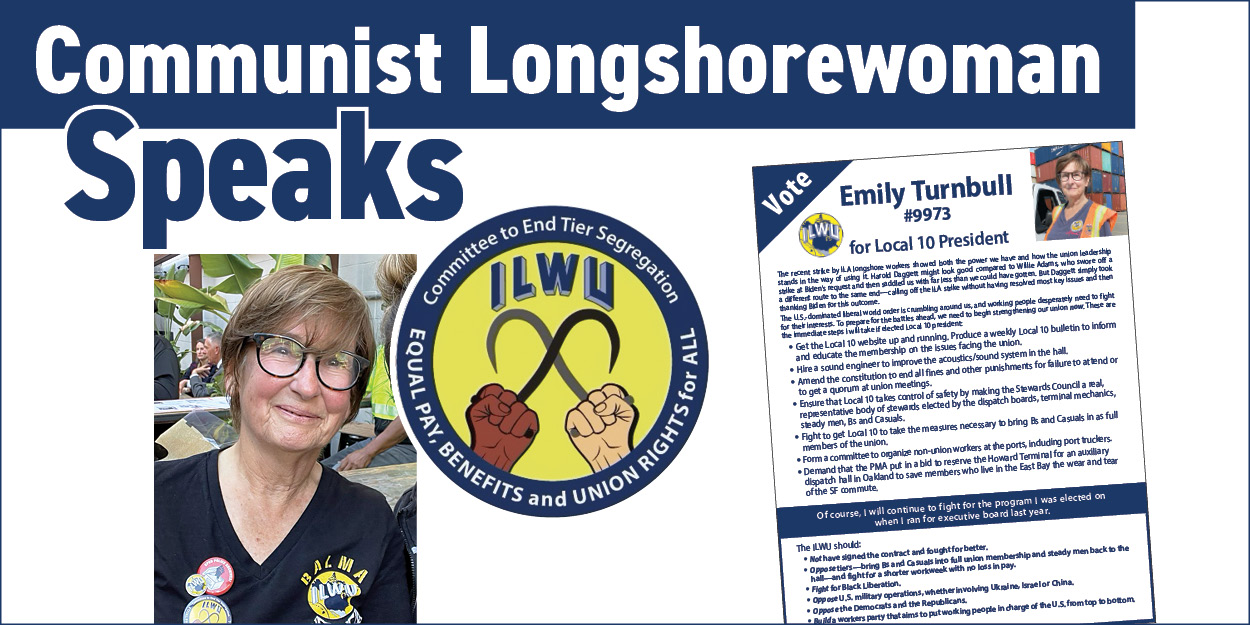
We are proud to publish this excerpt of an interview with Emily Turnbull, retired longshorewoman (dock worker) and founder of ILWU Local 10’s Committee to End Tier Segregation. Emily was elected to the local executive board in late 2023 on a program that committed her to using her elected post to mobilize members against the divisions that cripple the union’s power. (See “Equal Pay, Benefits and Union Rights for All!” Workers Vanguard (WV) No. 1183, 18 December 2024.) She ran for Local 10 president in late 2024, receiving 20 percent of the vote, on a platform that calls for the working class to form its own party and fight for power.
Tell us what you did in the industry.
I just retired after 22 years as a longshorewoman in the International Longshore and Warehouse Union Local 10 in the San Francisco Bay Area. In the Bay Area the longshore workforce is majority black and some 20 percent female—the percentage of women may be a bit higher now. I wasn’t as much an oddity for being a woman as I was for being white.
As ILWU longshoremen, we report to a hiring hall to pick up our job assignment every day. As an entry-level worker (casual or B-man) I often got the job of installing twistlocks on the ship containers. Sometimes I had to go onto the ship to “lash” the containers to the deck using long, heavy iron rods and big metal fasteners called turnbuckles. After I graduated to B status, I mostly worked driving tractor trailers to and from the big cranes. Eventually as an A-man, I got enough seniority to regularly work as a clerk. This job often requires computer work and pays almost as much as a heavy equipment operator.
WV published a letter about Amber Czech’s murder. What were your thoughts? Did you experience anti-woman bigotry in your time at the job and, if so, how did you deal with it?
I was horrified by Amber Czech’s murder. I thought the letter to WV made some powerful points, especially that “workplace violence” rules can make work more dangerous for women. I know of cases where men have stood up and defended women being harassed. But there is always the danger that they themselves will be charged with “workplace violence.”
There have been two ILWU women’s conferences of late, but they are geared toward grooming women for positions in the union bureaucracy, rather than dealing with the problems they face on the job. The exception is of course the issue of sexual harassment and workplace violence. There is always a session about that, and the bureaucrats preach not union action, but cooperation with and reliance on the PMA [bosses].
There are special grievance procedures, known as the “13.2s,” developed for workplace discrimination and violence cases. These 13.2 grievances go directly to a hearing before a special arbitrator. I’ve been told that these hearings consist of a lot of “he said, she said.” The arbitrator decides and metes out the punishment.
When I was on the executive board the Business Agents (BAs) and other bureaucrats would complain in meetings that there were too many “13.2s” being filed, that people should settle their “personal” issues on their own, that the union was being weakened, etc. Yes the union is being weakened by what are often, I’m told, show trial proceedings, which threaten the livelihoods of those accused.
But it’s the union leadership’s inaction on the issue that provides grist for the 13.2 mill. They have done nothing to create a union where sexual harassment is just not tolerated. Unfortunately most women think they have no alternative but to file a 13.2 grievance, which goes automatically to the company and to pro-company arbitrators. Though there is supposed to be absolute secrecy about these hearings, word gets out. Women are gossiped about and vilified for it.
I myself never faced any threats or sexual harassment. But I have spoken with many who have. I always argued that 13.2s were not the way to go, and that I personally would never file a 13.2. Instead, harassers should be excoriated and punished by the union. When I was on the executive board, I offered to bring the case of one woman up and fight to bring it to the union meeting floor. But that was the last thing she wanted, since that would only have opened her up to even more scrutiny.
The hush-hush secrecy only creates a rumor mill and just makes the situation worse. I would advise women being harassed to go to the BA or other union official and ask them to tell the brother to lay off. If a harasser wouldn’t quit and I was in a leadership position so that I could back the woman up, I would bring the guy up on charges before the union membership of “conduct unbecoming a member.”
Before containerization, longshore work was very physically challenging. But now most of the work is driving equipment and women are generally accepted. Some jobs, like lashing, still require real physical strength. I could not handle the very tall lashing poles and had to rely on my male co-workers. But I could handle the shorter lashing poles and I worked hard otherwise (some women shirk and just expect the men to cover). When I finally got my A book and could freely choose my jobs some of the guys said to me, “Are you going to come flex lashing with us?” I replied, “No, I have a medical condition...I’m testosterone-deficient.” That got a big laugh. But there are some women who are strong enough to hold their own. I admire them.
Just as it gets whiter the higher up the skill level you go, it also gets more male. I can count the number of women crane drivers on the fingers of one hand. I admire them too. It used to be that women were actively discouraged. One woman I know who signed up for crane training was told—by the union trainer, no less—that she should apply to the clerks local instead! A union leadership that fights for women’s equality would organize special training and recruitment programs for women.
Black liberation was also part of your program when you ran for office. How was that received?
Well no one was surprised. I had a reputation as a fighter for black rights.
In 2017, when nooses appeared at the SSA [Marine] terminal, I gathered together a group of mostly black workers who confronted the Local 10 president. He originally said that to mobilize against the nooses would be “divisive.” But we argued him down and forced him to put out a statement telling members that the union had their backs. It was a really liberal statement that wrongly advocated collaboration with the PMA bosses in combating discrimination in the workplace, but at least it made the point that the union would fight to defend its members against racist violence.
The role of the labor bureaucracy is to preach reliance on the bosses’ parties and state and to sabotage any move toward mobilizing labor’s power independently. I am best known in Local 10 for my opposition to voting for the Democrats and my advocacy of a workers party to fight for workers power.
It was relatively easy for me to get Local 10 on board with the Open the Police Archives campaign; we passed a motion and the Local 10 president wrote letters to a number of local city councils demanding that the archives be opened and the 100 worst cases be revealed. As part of that campaign, I mobilized to get the ILWU to support Terry Lovett’s campaign to get an independent autopsy for her son, Jalani, who was killed in the L.A. Central Jail. She has spoken several times at union gatherings.
But I lost when I waged a fight on the floor of a union meeting against giving money to so-called “progressive” Democratic Party district attorney Pamela Price. She had done nothing to bring murderous cops to justice, but she was facing a racist recall campaign. Most Local 10 members still think the only way to fight for black rights is to rely on the Democrats.
The argument I have the most with black co-workers is about black liberation—most believe that white workers will never fight for it. They have never seen that in their lifetime, but they have seen betrayals. It will take some real class battles, with white workers championing the defense of black workers, in order to prove in practice that it can be done. White workers need to learn they cannot advance their own conditions unless they fight in defense of black people’s rights as well.
Workers, black and white, have no sense of their real social power and no idea that if they act together, they can bring down the capitalist system. The misleaders of the labor movement want to keep it that way. But that is exactly why it is so important to fight within the unions to strengthen them so workers can wage even small defensive fights and get a sense of their own social power.
If there is one piece of advice from your time in longshore, what would it be?
Whether your union leaders are open supporters of Donald Trump, like the ILA’s Dennis Daggett, or they trend toward Bernie Sanders progressivism, like in ILWU Local 10, they are still the main obstacles. You can’t ignore them. You have to work patiently in the unions, mobilizing the membership around its own interests to defeat the bureaucracy in practice. You can never lose sight of that.