
https://iclfi.org/pubs/wr/47/australia
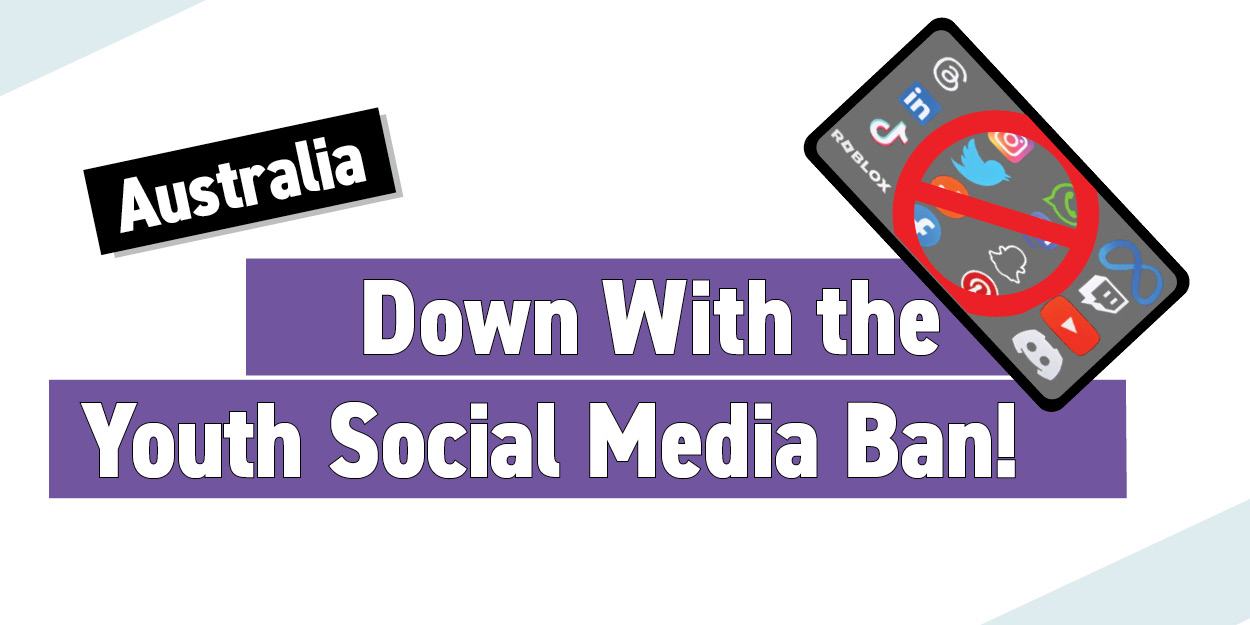
Last December, the Australian government introduced a ban on youth under 16 holding social media accounts across all major online platforms. Millions of accounts have been banned since the minimum age came into effect and the government continues to promote its policy as a test run to be emulated internationally. Now, countries from the UK to Spain, Greece and France are considering similar age restrictions. In the U.S., both Trump and Democrats like Gavin Newsom are eyeing them.
These laws are totally reactionary. They will do nothing to protect kids from the deep social pressures bearing down on them. What they will do is further restrict open space for young people’s autonomy and self-expression, bolster the state’s social regimentation of youth and deepen resentment.
It goes without saying that social media platforms, interested only in extracting data and profit from their users, are no friends of young people. The fact that harm does take place through and on them, as well as their deliberately addictive nature, is exactly why age restriction is such a popular policy among parents. Politicians say they want to get kids back into the “real world.” But for so many youth, the real world ahead of them seems like a futureless horror show of war, devastation and personal social instability.
Young people need space to live and make mistakes, economic stability and real community (both offline and online) to develop into adults with a healthy social existence. The current social order cannot provide this.
Schools across Australia are falling apart. Kids are treated like prisoners. The cost-of-living and housing crises, and generalised social decay, hit kids hard, particularly those in immigrant working-class communities. Suicide is the major cause of death for youth between 15 and 24 years old and unemployment for that cohort is almost double-digit.
The response of state governments from Victoria to the Northern Territory has been to launch an anti-crime frenzy, particularly centered on youth. “Adult time for violent crime” legislation now allows courts to impose penalties previously reserved for adults on children as young as ten. A 14-year-old in Victoria can legally be sent to prison for life…but of course can’t have an Instagram account.
Restricting social media is a cynical and futile political tool for governments unable to address the actual crises facing young people, or to improve conditions for anyone for that matter. These measures cynically appeal to parents by falsely blaming apps and algorithms for the problems of youth. For the Labor government, the ban means it can present itself as doing something to maintain “social cohesion” and “save” youth by bolstering the family. Spokespeople promote age restrictions explicitly as a “weapon in the arsenal” of parental authority, a way to “protect” kids from the unknown. For those family-first right-wingers who back them, this also fits in with culture-war grievances over supposedly eroding parental authority.
The drive to keep youth away from corrupting influences online continues to deepen, with the government in recent weeks introducing mandatory age verification for porn, R-rated video games and AI chatbots. The ban on social media thus complements the framework of repression. Such laws serve, at least in part, to further the regimentation of the young generation as the capitalist rulers prepare to crack down on social unrest and ultimately line up the population for war.
For teenagers, the relative autonomy afforded by social media fills the gaps in a restricted social existence. For better and (often) for worse, it is the primary space for communication, for finding a modicum of community, for coming into political awareness and for exploring sexuality. The latter is especially true for LGBTQ+ youth, who are even more likely to be isolated by restrictions on social media.
Young people who want to use social media will work around whatever system is implemented, and so they should. But it is crucial that there be a fightback against the whole ideological basis for these restrictions. Marxists must take a firm political stand: Down with the youth social media bans!