
https://iclfi.org/pubs/wr/47/argentina
Last November, ICL comrades participated for the first time in the Plurinational Gathering of Women and LGBTQ+ activists in Corrientes, Argentina. Now in its 38th year, this feminist event brought together over 70,000 activists from around the country for three days of political debate. The event included opening and closing mass rallies, two marches, a host of cultural activities and 116 workshops on topics ranging from abortion rights, gender violence, healthcare, sex education and prostitution to unemployment, racism, indigenous peoples, Palestine, anti-imperialism and union organizing.
Unions, particularly in education and healthcare, were heavily represented alongside organizations ranging from the Peronists to Trotskyists and Maoists (often in the form of their affiliated women’s, trans and/or sexual diversity groups). Community organizations, artists and youth also participated.

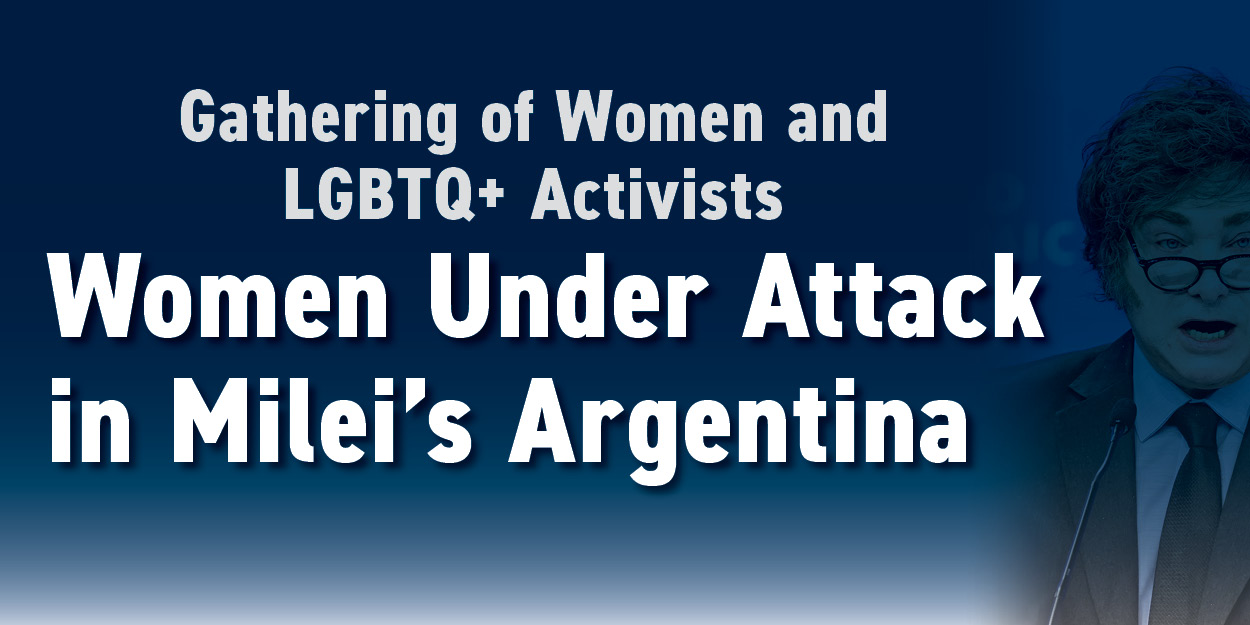
Davos, January 2025: Argentina’s president Javier Milei leads the charge against abortion rights, feminism, diversity and inclusion.
The backdrop for the gathering was the drastic attacks on living standards carried out by the right-wing Milei government in the last two years. In his speech in Davos in January 2025, Milei led the charge for the far right internationally, denouncing the “murderous abortion agenda,” likening gender ideology to child abuse and declaring war on feminism, all forms of diversity and inclusion, immigration and environmentalism. These aren’t empty words. In Argentina itself, funding has been slashed for education, public health and social programs. One of Milei’s first acts in government was to close the Ministry of Women, Gender and Diversity.
While the impact is felt by the entire population, women are bearing a heavier brunt since they are disproportionately employed in sectors subject to austerity, and it is women who have to pick up the slack for cuts to social services like day care, soup kitchens and care of the elderly. The government, backed by the Church, is threatening to roll back abortion, access to hormone treatments for trans people and sex education.
In a climate of economic and social crisis, violence against women is growing while the paltry means that exist to combat it are being slashed. In 2025, there were 266 killings of women and trans people. Most were victims of domestic abuse. Meanwhile, widespread cuts have affected the government’s Acompañar program, which provided psychological, social and economic support to women and LGBTQ+ people fleeing domestic violence. This included a monthly subsidy equivalent to the minimum wage for six months. Insufficient as this was, it did allow victims of abuse to move away from violent partners and pay rent elsewhere. In 2023, over 100,000 women and LGBTQ+ people used these services, but in 2024 this dropped to 3,500 before being practically eliminated in 2025.
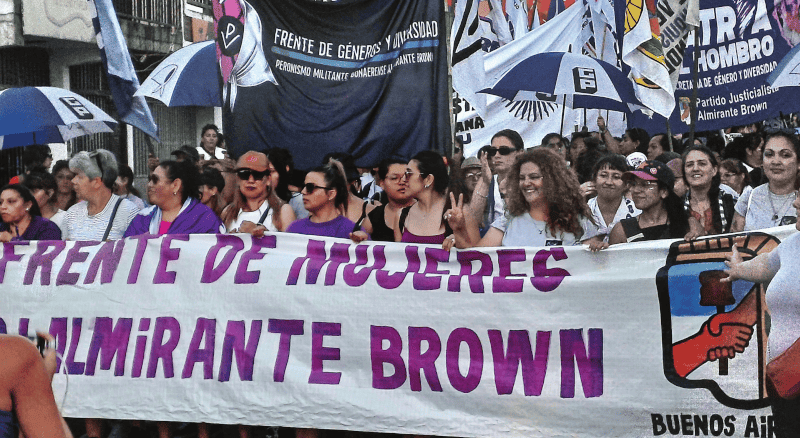
November 2025: Demonstration held as part of women’s gathering in Corrientes.
The gathering had quite a contradictory character. On the one hand, the event is unique in the world in bringing together women from a range of backgrounds to debate political strategy. For some, coming to this event meant they could set aside their childcare and other domestic responsibilities for three days and take part in political discussion to shape the fight for their own interests. Some attendees had never spoken in public before; the event helps build confidence in their own strength and is therefore a real gain.
On the other hand, the political solutions on offer were hugely inadequate. The general tenor of the event was feminist and liberal, and it was dominated by the Peronists through their political organizations and through the unions. Their central perspective is to push hope in a new Peronist government in the 2027 presidential elections. This was a common refrain in the workshops, as many women think this will ensure that their rights enshrined in law will be protected and that resources will be restored to social programs. But in the two years of Milei’s government, the Peronists have shown that they’re not capable of defending the gains they themselves introduced, let alone winning new ones.
The Fight for Women’s Liberation Must Be Anti-Imperialist
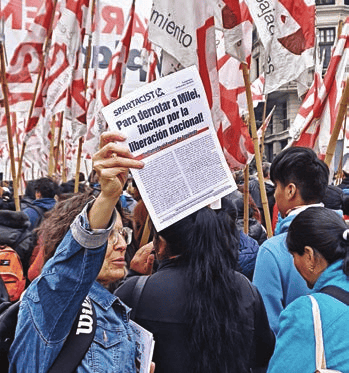
To the Peronist perspective of confronting Milei at the ballot box, the Marxist left counterposes struggle in the streets. Many argue that what’s necessary is to revive the Green Tide movement—the large mobilizations of the late 2010s, which resulted in abortion through the 14th week being legalized in 2020. Obviously, such mobilizations are sorely needed. However, it is also necessary to understand that the global context in which we are struggling today has changed significantly. U.S. imperialism is hell-bent on squeezing oppressed countries like Argentina, particularly through the IMF debt, mandating mass austerity and seizing the country’s mineral resources. This oppression conditions every aspect of Argentina’s economy, and Trump is fully prepared to use the U.S. military to carry out the imperialists’ will when they face a serious challenge. Demonstrations, however large they may be, won’t be sufficient to counter this. It is necessary to put forward a program to confront U.S. imperialism, starting with the repudiation of the foreign debt. This is what the leadership of the workers movement has so far refused to do. Our 19 January 2024 Spartacist supplement, “To Defeat Milei, Fight for National Liberation,” was hugely popular at the gathering.
As we wrote in “Anti-Imperialism & Women’s Liberation” (Women & Revolution No. 46, February 2025):
“To combat conservative social reaction that strives to roll back gains for women, it is necessary to attack the material foundations that give rise to it: the imperialist oppression of the nation. This means that the fight for the advancement of women must be part of fighting for the overall development of society in opposition to imperialist subjugation.”
The fight for women’s emancipation is inseparable from the struggle for national and social liberation. Significant resources are needed to provide free, quality healthcare, education for all, childcare and assistance to women fleeing domestic violence. These resources cannot be obtained while Argentina’s entire economy is subordinated to repaying the imperialist debt. They must be wrested from the imperialists’ hands.
This was the problem of the Peronists in government. They were able to introduce some supportable reforms, and the Kirchner governments are often credited with paying down the IMF debt. They did temporarily get the IMF off Argentina’s back, but they did it by handing over nearly US$10 billion to the imperialists, money that could have been used to develop the country. More importantly, because the Peronists represent the class interests of a wing of the bourgeoisie, they were and are not willing to actually confront U.S. imperialism. They are incapable of breaking the endless cycle of Argentinian politics: Peronist governments introduce social reforms but simultaneously drive the economy into the ground, only to be replaced with rightwing governments that further enslave the country to the IMF while reversing many of the gains achieved in the past.
Women: Look to the Working Class
To unify the working class for the necessary fight against imperialism, it is necessary to reject legalistic and divisive solutions. The feminist movement in Argentina—both the Peronist and the socialist components—suffers from many of the same problems as the liberal feminists in the imperialist countries. One of these, widespread at the gathering, is to look to the courts and state institutions to protect women’s rights. This includes calls to strengthen the penalties for femicide or for the laws on abortion and gender identity to actually be implemented. While many of these demands are supportable, the perspective they stem from relies on government institutions, which are in the hands of the ruling class and are used to enforce rapidly deteriorating social conditions.
More importantly, as Marx explained, the legal structure of a society can never rise above the economic foundations that sustain it. The higher the level of economic and social development, the more rights and resources women gain. Conversely, in times of major economic crisis, social services are the first thing to be cut and women are disproportionately affected by austerity, a rise in violence, etc. While it’s important to defend every gain women have fought for, the idea that major advances can be secured through the courts and government institutions while the capitalists are waging a brutal austerity drive is a dangerous illusion.
Another widespread idea at the gathering was that women’s oppression can be overcome by fighting machista ideas in men’s heads, or by symbolic measures such as encouraging the use of inclusive language. Backward ideas—pushed by the ruling class to divide the oppressed—are a product of poverty, overcrowded housing, unemployment, and the brutalization of daily existence under capitalism. Moral appeals and consciousness-raising campaigns cannot substitute for transforming the social conditions that generate oppression in the first place. In fact, they often end up fueling reactionaries like Milei, who appeal to men’s resentment for being blamed for the oppression of others.
To advance their struggles, women must turn to the working class because it is the only social force with the power to confront Milei’s government and the imperialist interests behind its austerity program by shutting down the country. This requires maximum unity: every attempt to divide the working class—between women and men, employed and unemployed, unionized and non-unionized—strengthens the ruling class. Women must fight alongside their male co-workers. This does not mean setting aside the fight for women’s liberation. It means men must be won to actively support and defend the full emancipation of women, just as women must play a leading role in the struggle to liberate the working class as a whole.
Overcoming the Divide Between the Left and the Peronist Unions
May Day 2024: ICL intervening at Trotskyist demonstration in Buenos Aires.
A major obstacle to building the necessary unity against the ruling class is the hostility we saw between women trade unionists and the Marxist left. This was sharply posed in a workshop we attended on union organizing, which included workers from different regions of Argentina, most of whom were Peronists, as well as supporters of Pan y Rosas, the feminist organization linked to the Trotskyist PTS. When the discussion turned to the obstacles to uniting the left and the unions to fight Milei, Pan y Rosas speakers accused the unions of being undemocratic and not sufficiently combative (which is certainly true), while the Peronists complained that the left refuses to recognize that Peronism introduced real gains that, for example, got their kids free education and access to healthcare.
At the center of the conflict was the left’s attitude toward the unions themselves. Several Peronist trade unionists criticized the left for dividing the unions by splitting away and forming competing structures when they lose a vote. One woman forcefully raised the slogan “No to the fragmentation of the unions!”, arguing that this division only weakens the working class. For communists, there is no substitute for working within the existing unions to build a different leadership through patient, consistent struggle. Undermining class unity, or seeking shortcuts by elevating other social sectors as substitutes for the organized working class, can only further disorganize the workers movement and strengthen the hand of the ruling class.
When a speaker called for a united front of the trade unions against imperialism, the room erupted in applause—with the notable exception of Pan y Rosas. The workingclass women came away with the impression that Pan y Rosas was not committed to either trade-union unity or the fight for national liberation.
There is a communist answer that can bridge this gap between the unions and the left. The left must recognize and defend the real gains won under Peronism and understand that the fight for national liberation in countries oppressed by imperialism is not a diversion but is, in fact, central to the fight for social liberation. At the same time, workers must confront the fact that successive Peronist governments have presided over economic decline, disillusionment and decay, creating the conditions for Milei’s victory. It is urgent to mount an effective resistance to Milei based on mobilizing the unions, which are now being directly attacked by his labor reform law, and the Peronists are not doing this. The way forward is to fight within the existing unions for a communist leadership in which women will have a central role.
Free Cristina Fernández de Kirchner!

Corrientes, November 2025: Rally to free Cristina.

At the November 2025 Women’s Gathering in Corrientes, Argentina, there were many illusions in former Peronist president Cristina Fernández de Kirchner, who addressed a rally calling for her freedom via audio link from house arrest. One of the reasons for her popularity is that she was part of the Peronist governments that introduced welcome reforms such as mandatory sex education in 2006, the Gender Identity Law in 2012 and legalized abortion in 2020. All these gains are now under attack.
Following Trump’s re-election, Cristina was barred from entering the U.S. and placed under house arrest on old corruption charges at the behest of the U.S. Embassy—a blatant move to prevent her from running for office. While Cristina may well be guilty of corruption, her detention is clearly a political move by U.S. imperialism and its loyal servant, the Milei government, to suppress opposition.
We call for Cristina’s release! Her politics do need to be defeated, but not by the imperialists. What we need to win lasting gains for women is a consciously organized revolutionary party prepared to confront both the imperialists and its lackeys in the national bourgeoisie.