
https://iclfi.org/pubs/wr/47/china
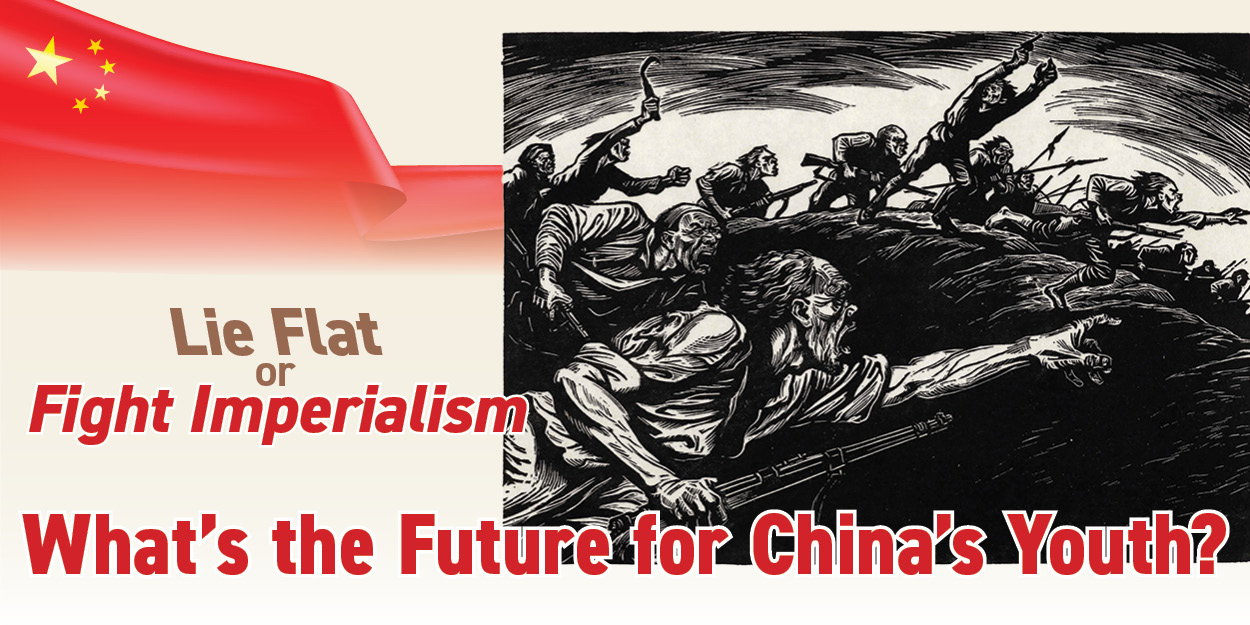
Artwork above: Arise Suffering Slaves by Li Hua, post-1945. The print shows armed peasants rising in rebellion as civil war and social misery deepened under Guomindang rule.
“Lying flat” has become one of the sharpest expressions of the rampant mood of disillusionment among China’s youth, depicting how they are choosing to opt out of intense competition in schools and brutal work conditions. Faced with relentless pressure in school, work, housing and family life, many young people no longer believe that grinding harder will bring a better future. This is not simply burnout. It marks a turning point in consciousness.
From the outside, this can seem paradoxical. China is not a failed society but the world’s second-largest economic power. The very fact that youth can “lie flat” rather than have to fight for bare subsistence says something about the material gains won since the 1949 Revolution. What has changed the situation is the breakdown of the bargain the Communist Party of China (CPC) offered in the “reform and opening up” era. For decades, students and young workers accepted grueling conditions in schools and industry with the expectation that China’s booming economy would lead to higher living standards. That prospect is now very dim.
Struck by the Covid epidemic and the CPC’s draconian lockdowns, China’s growth rate fell to 2.3% in 2020 and 3.1% in 2022, far below the previous pace. Even as growth rebounded, living standards and job prospects did not keep pace with the country’s technological rise. The sense among many young people was not renewed confidence but blockage: even as China advanced, their prospects were narrowed by debt and stagnation.
This shift coincided with a sharp rise in imperialist pressure on the People’s Republic of China (PRC). Previously, the U.S. rulers believed that China’s integration into the liberal world order would eventually lead to the collapse of the CPC and the workers state. Instead, China became a strategic rival that had to be contained. Among other measures, Washington imposed higher tariffs and strengthened export controls in order to restrict the PRC’s access to advanced semiconductors and related technologies.
The fundamental problem is that the CPC has no strategy to defeat imperialism. The way it seeks to ensure that China will not suffer another “century of humiliation” is to defend the free-trade system to the death. But even while China’s massive industrial growth inside that system gave it some cards to play, this came at an unbearable social cost: inhuman work hours, sweatshop conditions, depressed consumption and hellish competition. And now, as Trump takes an ax to the neoliberal order, prospects for Chinese youth are becoming even dimmer.
That is the framework within which youth oppression in China today has to be understood. The CPC bureaucracy is trying to preserve the workers state while fearing any prospect of mobilizing the Chinese proletariat to fight against imperialist domination, which would threaten its own privileges. The current disenchantment and despair among youth reflect the fact that the CPC’s course is leading to a dead end. To turn this situation around, they need a perspective to unite the exploited and oppressed masses in China and internationally in an anti-imperialist struggle. This is our starting point for analyzing some of the key problems facing Chinese youth today.
Gaokao: The Bureaucratic Sorting Machine
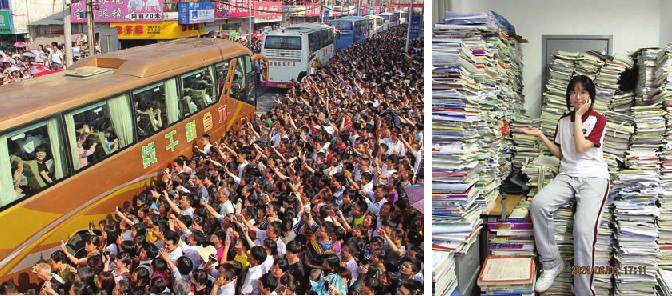
Liu’an, Anhui Province, June 2013 (left): Students travel by bus to the gaokao, as family and friends crowd the streets to see them off. Right: A Chinese student poses beside stacks of notebooks and exam papers from years of gaokao preparation.
One cannot talk about the oppressive conditions facing Chinese youth without starting with education. At the pinnacle of this system is the gaokao exam, which high-school students take to determine their place in the scramble for university seats.
Reinstated in 1977, the gaokao replaced the Maoist policy of preferential placements in higher education for workers, peasants and soldiers. Under Deng Xiaoping, this change was justified by the need to develop technical specialists who would help China catch up with the advanced capitalist countries. On paper, the gaokao looks like a planned, meritocratic method of developing the workers state. In reality, its framework created hellish competition for spots at the top universities, favoring those with the means to best prepare their children for the exam. Thus the system has reinforced social and regional inequality.
A major part of this process is the hukou household registration system, which regulates a child’s access to public schooling. By tying educational opportunity not to where one lives and studies but to one’s registered birthplace, the hukou effectively divides the population into rural and urban castes. Even where equal access is promised on paper, the best schools favor urban hukou holders and families with stable housing, while the children of migrant workers are pushed into underfunded schools or forced back to their home counties. The best schools attract wealthier families to buy into particular school districts, pushing working-class families out and deepening social divisions.
What is presented as an orderly way to administer schools and boost local finances is in fact a way to ration life chances from childhood onward. The vocational track is where this sorting becomes especially naked. At the end of junior secondary, millions of students are pushed off the academic route—with Jiangsu Province’s cutoff excluding about one-half of the test takers—and are funneled into vocational and technical schools. The state praises this setup as “multiple pathways to success.” In reality, these schools disproportionately absorb rural and working-class youth, often offering neither a strong general education nor meaningful technical training. Too often, “internships” amount to little more than a pipeline into cheap labor. Whether one is pushed into vocational school early or survives long enough to face the gaokao, education is organized to allocate scarce credentials and sort youth into social strata fixed for life.
The gaokao is the most refined form of this system. Though formally standardized within provinces, access to top universities is largely determined by provincial quotas, family resources and regional privilege. The problem is not simply that the system is harsh or opaque. It is that one’s future is decided far too early, when family background overwhelmingly determines one’s preparation, confidence and room to maneuver. The bureaucracy presents this as meritocracy, but it is a managed competition whose outcomes are heavily shaped before the gaokao is ever taken.
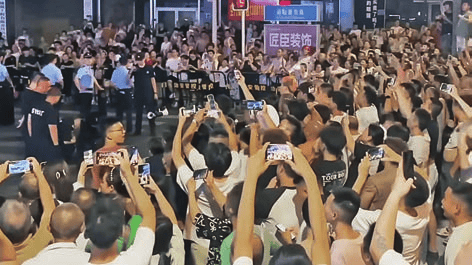
Jiangyou, Sichuan Province, 5 August 2025: Residents raise phones at mass protest demanding justice for a 14-year-old girl after a school bullying case triggered public outrage.
This is why the Jiangyou incident last year mattered far beyond one school scandal. After a video of three teenage girls beating and humiliating a 14-year-old classmate went viral, public outrage spread rapidly, especially as the attackers reportedly boasted that their parents “have connections” and would protect them. What followed exposed the bureaucracy’s governing method in miniature. Promises that the case was being handled “according to law” quickly gave way to repression once protests grew—riot police, arrests and online suppression. The deeper issue was not school violence but the broader sense that you live in an educational and political order that breeds humiliation, shields privilege and treats popular anger as a threat to stability.
Bureaucratic reforms cannot solve the problem at its root. For example, the 2021 “Double Reduction” policy targeted real grievances—excessive homework, cram schools and the tutoring arms race. But these were just Band-Aids on the gaping wound of social inequality bred by “socialism with Chinese characteristics.” As long as the stakes are the same, the system will create incentives for rich bureaucrats and capitalists to pay for private tutors and find other workarounds.
As socialists, we do not propose to fine-tune this machine. What is needed is to take education out of bureaucratic hands and subordinate it to the democratic needs of working people. That means fighting to weaken the tyranny of birth and early sorting by equalizing resources between elite and ordinary schools, guaranteeing higher education for industrial workers and rural youth and fusing academic and technical training.
A socialist education system should develop all-sided human potential, not lock youth into the fate assigned to them by family background, hukou and other bureaucratic measures. The more that youth see the system discriminate against them, the less stake they will have in defending New China. But if they and the entire working class mobilize to fight inequality and take control of their fate, this would be the best defense of the workers state.
From Iron Rice Bowl to “Gig Work”
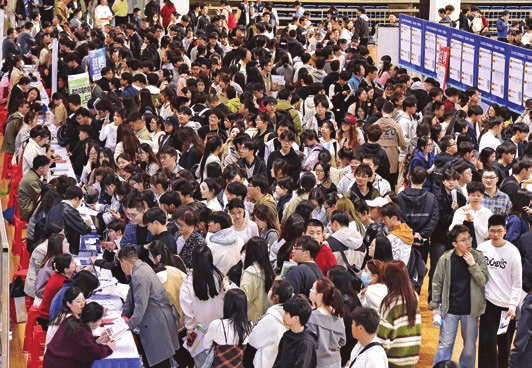
Fuyang, Anhui Province, 22 March 2025: Students attend a job fair.
Soaring youth unemployment in recent years shows the problems of inequality and scarcity from another angle. For many youth, factory work no longer appears as a way to a stable future but as exhausting, insecure labor with few rewards and protections. The education system reinforces biases against factory work by advocating white-collar salvation: study hard, escape the workshop, get the office job. But secure white-collar positions are themselves increasingly restricted as the economy hits strong headwinds.
The expansion of China’s higher-education system has not gotten rid of the employment bottleneck; it has simply widened the entrance to it. While the official urban unemployment rate was 5.2% last year, youth joblessness peaked that August at 18.9%. This is one reason that “flexible work” (short-term employment) and gig work have swollen so rapidly. Official figures put the number of short-term workers at 200 million, while those in gig work—delivery drivers, couriers, ride-hail drivers, etc.—is around 84 million. The gig sector has become a means to absorb those pushed aside in the rush to technologically upgrade production and by the ever-higher level of credentials needed to get jobs.
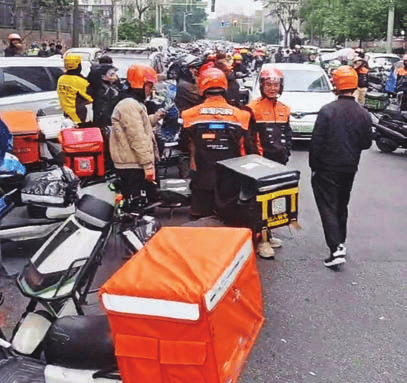
Changsha, Hunan Province, 22 December 2025: Delivery riders protest outside the HeNeng PuLi residential complex, circling and honking until late at night after a conflict over delivery access rules.
This situation poses a basic political question: Why, in a society born of a revolution that overturned capitalism, is it not good enough to be an industrial worker? Why does the road to a decent life appear to run only through joining the bureaucracy or clawing your way up the corporate ladder, leaving the mass of youth oscillating between bad factory jobs, unemployment and precarious service labor?
The answer lies in the CPC’s development strategy. The regime seeks to keep China competitive and able to stand up to its enemies while suppressing the self-activity of the working class and accepting imperialist world hegemony. So it pours resources into technological upgrading and “whole industrial chains” (self-sufficient production networks) while supporting unprofitable factories that keep churning out exports. For workers this means brutally long hours while wages and social security lag behind industrial development. What youth feel as hopelessness is the result of a bureaucratic structure that degrades labor while reducing the chances of landing good white-collar jobs.
Home Is Where the Debt Is
In recent years, one of the most revealing memes about family and marriage among Chinese youth has been ligong siwei (manual laborer mindset). On the surface, this mocks a certain kind of blue-collar man who grinds for years and hoards every yuan, then throws all his savings into a down payment for an apartment, bride price and wedding in the hope of “locking in” a wife once and for all. The “laborer all-in law” variant jokes that such men “go all in” on a wife the way one pushes all one’s chips into the pot in poker. In the West, some young men twist their despair that building a family is out of reach into reactionary black pill and incel misogyny instead of criticizing the system that produces the situation.
What the ligong siwei meme captures is not simple contempt for workers. It is the bitter recognition that marriage and family have become a life sentence of mortgage payments, bride-price debt, childcare and elder care that falls hardest on those with the least security. When young men sneer at ligong siwei and young women recoil from being cast as the “investment target” in this script, both express the truth that family has been turned from a shelter into a high-risk financial project.
Addressing the situation in the Soviet Union, Leon Trotsky argued in Problems of Everyday Life that under conditions of scarcity, the family was forced to function as a little private welfare office, carrying burdens that a socialist society would take on collectively. In China today, that logic is reproduced as the CPC praises family responsibility while refusing to build the necessary social housing, nurseries, canteens and elder-care facilities that would make such sloganeering anything other than moral blackmail.
The Chinese bureaucracy treats housing as a speculative asset and source of government revenue, and there remains a strong expectation that a couple, especially the man, must buy an apartment before marriage. In big cities, the value of that apartment is tied not only to square meters but also to school-zone status. The “right” home is thus supposed to pay for itself twice—as a place to live and as a ticket to a decent public school for a future child. Pensions and welfare remain patchy, so parents expect their only child to be their main insurance in old age.
Ligong siwei is a warped adaptation to these pressures. When the state will not guarantee adequate housing, childcare or retirement, men are driven to treat marriage as a one-shot investment while women are pressured to weigh suitors by their ability to shoulder an impossible burden of costs. Raising the next generation is shoved into the narrow framework of the family, and that becomes a source of anxiety and demoralization.
For decades, the Chinese bureaucracy has zigzagged on family policy to suit its own needs. Under Mao, while the state provided rudimentary collective childcare and kitchens, the low level of those services kept the burden of domestic labor on women’s shoulders. When the CPC later imposed a one-child limit on families, the same apparatus resorted to fines, work-unit discipline and invasive reproductive monitoring in the name of modernization.
Today, facing population decline and a shrinking labor force, the regime has lurched into pro-natalist panic. Women are urged to have more children, “good mothers” are celebrated and youth are called selfish if they refuse to follow course. Young people who were told that their parents did their duty by limiting families are now lectured that they must save the nation by building larger families they can’t afford.
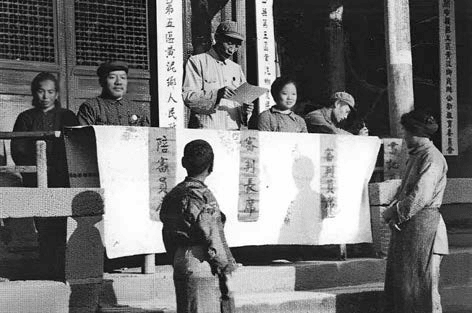
Langzhong, Sichuan Province, 1950: A woman files for divorce from her underage husband after the promulgation of the Marriage Law.
The CPC’s response to youth who don’t respond to this appeal can be seen in its new judicial interpretation of the Civil Code’s Marriage and Family section. Rather than changing the conditions that make family life unbearable, it mostly clarifies how divorce, debt and property should be handled. The rules make divorce hard to reverse and protect creditors when division of property undermines debt collection. They also specify how housing should be divided and allow the spouse who bore more responsibility for child-rearing and elder care to claim compensation at divorce.
At first glance, this looks like progress. But nothing in this package touches the fact that housing remains a commodity tied to school-zone competition, that pensions and childcare remain underfunded and that youth are financially crushed before they even consider children. The bureaucracy props up the family as the basic unit responsible for survival, then tells women and men that with the right contracts, deeds and lawyers they can negotiate a fair outcome. The ruling caste turns these problems, which are based on structural oppression, into a question of one’s choice of a spouse.
Nobody under 40 in China needs a lecture on why marriage feels like a trap. Young men’s disgust with ligong siwei reflects their fear of being turned into a “walking ATM” and still being told that any failure is personal. Young women’s refusal of marriage and childbearing is not a mysterious “values crisis” but a rational form of self-defense in a system that expects them to patch every hole with unpaid care work, endless emotional support and tolerance for discrimination and violence while sacrificing their careers.
If young people are to have a way out, the answer has to begin with material change, not moral sermons. Only the socialization of domestic and care labor, under workers democracy, can provide the material basis for the liberation of women and youth.
What Is To Be Done?
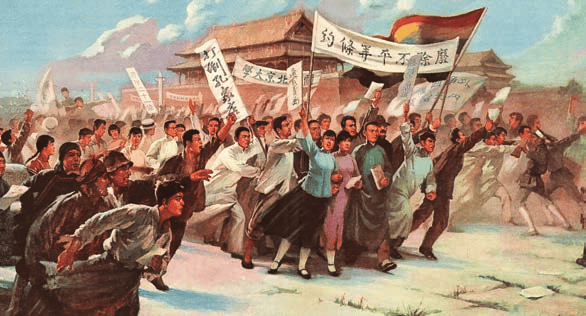
May Fourth Movement by Liang Yulong, 1976. The painting evokes the militancy of student youth in anti-imperialist struggle.
The false alternatives offered to youth today are to lie flat or grind harder. Neither solves anything. Lying flat retreats from a rigged system but leaves it standing. Grinding harder accepts the bureaucracy’s terms and turns every other young person into a rival. One path ends in resignation, the other in dog-eat-dog competition.
The question is what force can offer a progressive alternative. Youth by themselves do not have the power to do that. The decisive force is the working class, above all the enormous industrial proletariat created by the development of the People’s Republic. The task is to link youth discontent to working-class power. To do that requires breaking workers from the illusion that the PRC can be defended by following the CPC’s path of peaceful coexistence and national competition, with its corollary that the masses must sacrifice even as they get decreasing returns for their labor.
A revolutionary answer would mean much more than better policies. It would mean taking education out of the hands of self-interested bureaucrats, even the “enlightened” ones, and subordinating it to the task of socialist construction under workers’ control. It would mean opening paths for retraining later in life rather than fixing destinies in adolescence. It would mean reducing work hours; expanding public housing, childcare and elder care; minimizing the family’s role as the default shock absorber of social crisis. It would also mean encouraging the independent organization of youth and workers, because it is the socialist consciousness of the proletariat that is the best defense of the workers state.
Above all, it would mean breaking with the CPC’s conciliation of imperialism. China cannot free its youth while remaining trapped in a strategy that accepts the world market’s terms and merely tries to compete better within them. Anti-imperialism must not remain patriotic theater. It must become class struggle from below, guided by proletarian internationalism. Otherwise, the desire to fight imperialism will either be captured by Han nationalism or trapped in despair.
Here is the progressive way out for China’s youth: not lying flat, not grinding harder, but fighting imperialism by linking their fate to the independent political power of the working class, in China and internationally. When workers and youth bring that power to bear, they could break the bureaucracy’s political stranglehold on the masses and take a great leap forward on the path to world socialism.