
https://iclfi.org/pubs/wr/47/greece
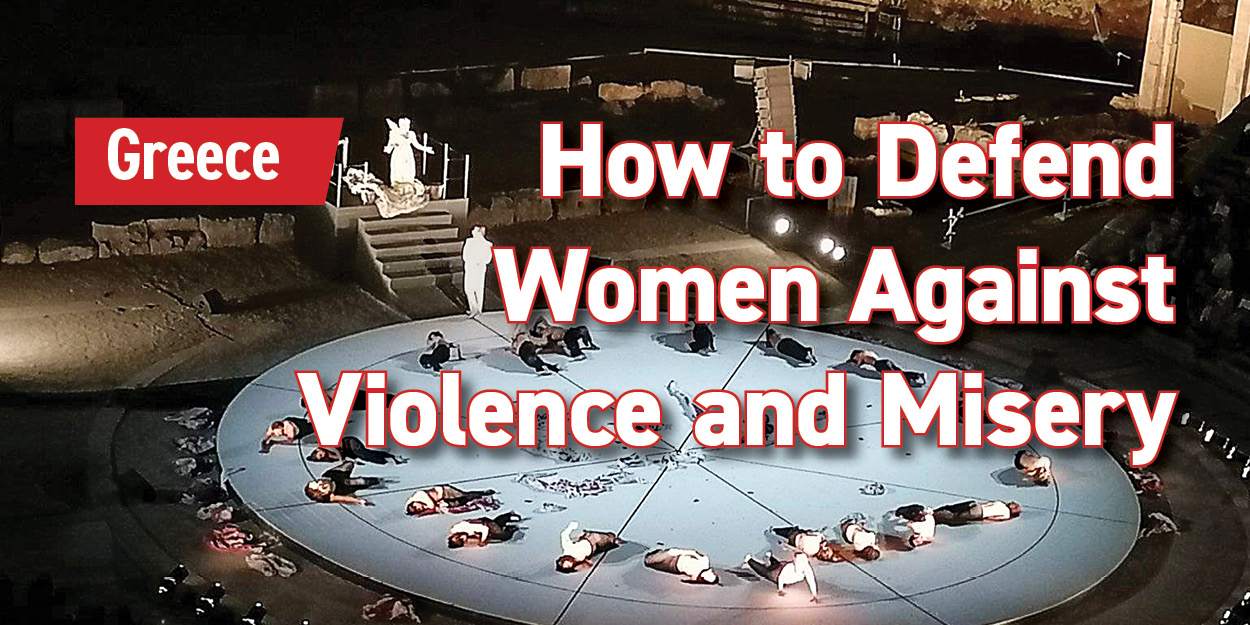
As living conditions collapse, women in Greece are being pushed ever deeper into insecurity, violence and fear. The facts are stark and revealing: reports of domestic violence have skyrocketed from 4,500 annually before 2020 to over 22,000 in 2024, and 31.4% of women report that they have experienced sexual harassment in the workplace. The murder of women has become commonplace, with nearly two femicides every month. And those are only the ones reported to the police.
The murder of 28-year-old Kyriaki Griva exposed the role of the state in the most brutal way. She asked the police for protection. They refused. “The patrol car is not a taxi,” was their response. Minutes later, she was murdered by her ex-partner outside the police station, in front of the police guard, in full view of the surveillance cameras.
A 43-year-old woman shot at pointblank range by her ex.
A 40-year-old woman who died after months in hospital following abuse by her partner.
Georgia, 53, who survived nine and a half months before succumbing to injuries inflicted by her husband.
An 85-year-old woman killed by her spouse, who then took his own life.
These are not isolated tragedies. They are the routine outcomes of a social order in decay. As the saying goes, the progress of civilization can be measured by the progress of women. In Greece, such violence is the predictable outcome of social disintegration, poverty, unemployment, the privatization of healthcare and the dismantling of welfare—all products of a system that treats women’s lives as expendable in the service of profit and political stability.
But what is the response of the women’s movement, of the left and the feminists, to the brutal murders of so many women? Typically, it is small, isolated and limited one-day symbolic demos on March 8 (International Women’s Day), November 25 (International Day for the Elimination of Violence Against Women), or in the aftermath of a woman’s murder—especially when the case receives a lot of media attention. Even then, the main response is to raise a series of liberal demands and legal reforms addressed to the state and its institutions for the “improvement” of women’s conditions and the protection of women identified as being at risk of violence. These include calling for effective state mechanisms such as shelters, safe spaces, emergency response services and more consistent police interventions, as well as training for police, judiciary and social services to understand and act on gender-based violence.
We are for reforms that can protect women and keep them alive. At the same time, while certain demands of this kind may appear justified in isolation, their fundamental weakness lies in the perspective from which they arise: a perspective rooted in confidence in state institutions such as the police, the courts and the administrative apparatus, whose historical role is the defense and reproduction of the existing social order. Liberal feminism assumes that the state can be neutral or even a protector. Repeatedly, these institutions have not only failed to protect women but have actively participated in concealing and normalizing violence against them.
Both Marxists and feminists fight for many of the same goals: equal legal rights (in work, education, voting and bodily autonomy), equal pay and opportunities, respect and dignity in both public and private life, the dismantling of sexist stereotypes and, most importantly, an end to harassment and violence against women. The main difference lies in how they understand the roots of these problems and how they propose to solve them.
A Marxist approach argues that violence and gender oppression are not isolated behaviors or purely cultural issues; they are deeply connected to the material and economic conditions of society. From this perspective, the existing state and its institutions cannot provide a permanent solution because they help maintain the very social and economic system that produces inequality. Therefore, for Marxists, defending women in the here and now requires not only demanding legal reforms but also confronting and transforming the material conditions that generate violence in the first place.
Femicide Law
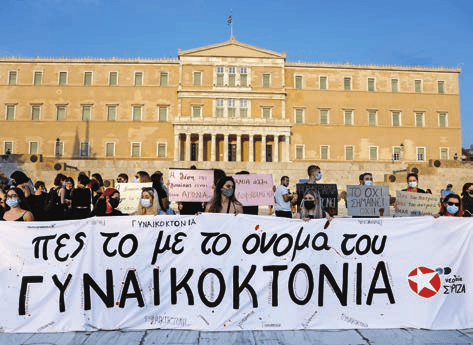
Athens, June 2021: Syriza youth banner reads “Call It by Its Name: Femicide.”
Whether femicide should be formally recognized as a separate crime under the Penal Code is a really loaded question in Greece. At present, the killing of women is legally treated as homicide or aggravated homicide. On one side of the debate are the left, the feminists and the center and left bourgeois parties, and on the other side the New Democracy (ND) government and the right-wing parties, which oppose any legislation recognizing femicide. This resistance stems from a mix of legal, political and cultural factors. In Greek society, where traditional gender roles remain dominant and conservatism is strong, there is opposition to explicitly stating that some killings are murders linked to gender/power dynamics. As they say, “What happens at home stays at home,” it’s “personal business.”
To be clear, we are not opposed to the recognition of femicide. But the reality is that even if it were to be formally recognized, this alone would neither stop nor likely reduce the number of brutal murders of women by their spouses or family members.
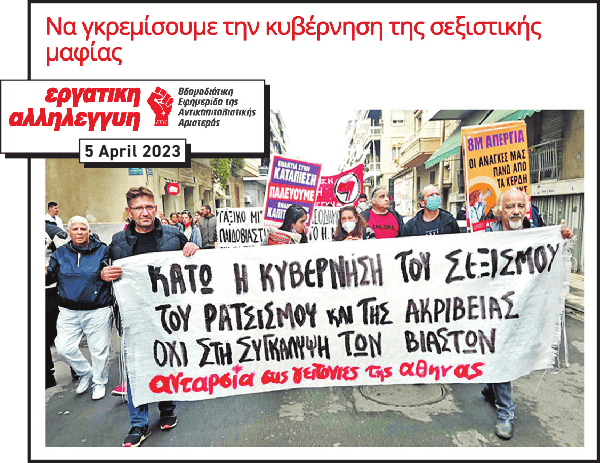
Athens, April 2023: Socialist Workers Party and Antarsya banner reads “Down with the Government of Sexism.”
The way the debate is framed narrows the problem and shifts responsibility almost exclusively onto the right-wing ND government for refusing legal recognition. Some left parties treat the issue as an ideological difference. For example, the SEK (Socialist Workers Party, part of the Antarsya anti-capitalist alliance) calls to overturn the “government of sexism,” which it holds responsible for femicides. By presenting one section of the bourgeoisie as chauvinist, this logic risks conciliating its so-called progressive wing. Thus, bourgeois parties that support legal recognition of femicide (such as PASOK, Syriza, and Plefsi Eleftherias) are portrayed as part of the solution rather than part of the problem. This accommodation of bourgeois elements can only end in defeat.
Ultimately, this approach confines the struggle to a narrow legalistic framework, treating femicide primarily as a problem of inadequate legislation rather than a product of concrete social and economic relations. By separating femicide from the broader conditions of exploitation, precarity and women’s material dependence, it obscures the roots of gender-based violence.
At the same time, this framework serves to rehabilitate the state and its institutions, presenting them as neutral guarantors of justice despite their systematic failure to protect women and their active role in reproducing the existing social order. Legal recognition becomes a substitute for real accountability, while the police, courts and social services remain incapable of—or unwilling to—prevent violence.
Most critically, this strategy displaces class struggle as the central axis of liberation. It replaces collective working-class organization with legal solutions and institutional mediation, weakening both the fight against femicide and the broader struggle for women’s emancipation. Without a proletarian strategy that confronts exploitation, insecurity and the privatization of social care, the roots of gender-based violence remain untouched.
The Conditions of Life
To understand the forces that continually reproduce reaction and keep women oppressed, we must return to a fundamental Marxist truth: emancipation cannot be achieved through formal rights alone but only through changing the material conditions of life. Reforms may temporarily ease pressures, but because they leave the social relations that generate oppression intact, they inevitably will not last or be enough. Every democratic gain and every improvement in women’s position will remain fragile and reversible.
The surge in violence didn’t come out of nowhere. In some countries this is a new crisis, but in Greece it is the continuation of a long emergency—from the economic crisis that started in 2008 to the collapse of the banks, the Covid pandemic a few years later and on to today. Families substitute for the already weak welfare state, women substitute for public care, and insecurity becomes the cost of “adjustment” and “resilience.” Under the dictates of the IMF, the entire country came to its knees—men and women alike.
It is the EU and U.S. finance capitalists who control and dictate every aspect of Greece’s economic and political life—the imposition of debt bondage, the subjugation of the country’s finances through the imposition of the euro, the theft of national assets and natural resources, the decimation of the country’s already meager industrial capacity and the intensified exploitation of workers as cheap labor. In a country subjugated by imperialism, increasing global instability and the rightward political shift only intensify these pressures.
The economic impact of Covid restrictions was particularly severe for women: 60% of Greek women reported a drop in income and 59% experienced a deterioration in work–life balance. Nearly one in three felt they had become more financially dependent on their partner as a result of the crisis, indicating a decline in economic autonomy. Some 93% believe that violence against women increased during the pandemic—the highest percentage in the EU—while nearly six in ten report that the restrictions seriously affected their mental health. Feelings of being confined at home (54%) and heightened levels of stress and anxiety shaped their daily lives more than in other European countries.
There is a direct connection between the rise in violence and in murders of women and the deterioration of social conditions caused by intensified imperialist exploitation. The same national oppression and backwardness that weighs down on women crushes the entire working class, which has a direct material interest in linking the fight for women’s liberation to its own emancipation. Without making this link, proposed solutions remain partial and cannot address the root causes of this brutal reality or effectively defend women in the present. Those are the conditions that we need to fight to change. Unless the conditions of everyday life are fundamentally transformed, women will never stop being oppressed.
Proposals for Immediate Action
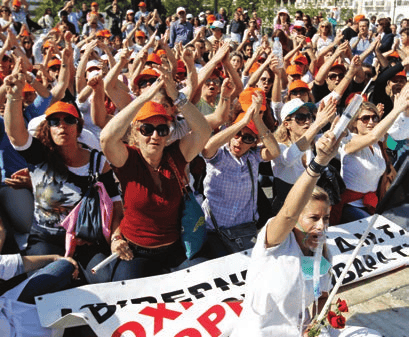
Athens, October 2011: Women workers played central role fighting austerity imposed by EU and U.S. imperialism.
The current context is extremely difficult. Economic pressure, political instability, rising social inequality and the deterioration of public services create conditions in which insecurity and fear grow. In such circumstances, women and workers are often the first to feel the impact: through high inflation, low wages, precarious employment, unemployment, 13-hour workdays, etc. Periods of crisis also tend to coincide with increases in gender-based violence and greater vulnerability for migrants and the most marginalized. This situation makes an immediate defensive struggle necessary—not as a retreat, but as organized resistance to further decline.
In opposition to the strategy of placing liberal demands on the state, we affirm that women’s defense can be achieved only through the independent organization and struggle of the masses themselves. This requires women to look to the working class as the only force with both the capacity and the interest to change material conditions. In this difficult context, we must build a united front around basic demands drawing in men and women, native Greeks and migrants alike.
Only by building working-class unity around such a program can we both defend against current attacks and begin to dismantle the material foundations of the entire system on which women’s oppression rests. The defense of women is therefore inseparable from the defense of the living standards of the entire working class.
We demand:
A living wage for working women. A wage high enough to cover the real cost of living and allow women to live with dignity and independence—not merely to survive. Economic independence is a precondition for freedom from abusive or oppressive relationships.
Union protection for women workers. We cannot effectively confront workplace harassment unless unions take active responsibility for defending their female members and co-workers. Organize women into the unions!
Women’s right to defend themselves. While self-defense alone will not eliminate femicide, it will definitely make abusers think twice about their decisions if they face an equal threat to their own safety.
Stop the collapse of the National Health System. The public health system, once presented as a model of universal and equitable care, is now on the verge of collapse. This particularly affects women, especially those on low incomes, by restricting access to essential services.
End the economic domination of the country by the EU and the IMF. No social progress is possible as long as the country is financially strangled by the imperialists. To stop the collapse of infrastructure and rebuild the social services we need, we must raise the slogan: cancel the debt!