
https://iclfi.org/pubs/wr/47/children
It is no surprise that children and youth make up one of the most vulnerable groups of people on earth. They have genuine biological disadvantages that are transformed into near-total social disadvantages and are brutally oppressed under capitalism. This is all so obvious that we rarely stop to think about it. Yet it sets up some questions at the heart of the matter that often go unasked: what are childhood and youth exactly, and what is the nature of their oppression? Up until now, Marxism has produced very little theory or analysis of these questions. This article aims to begin to provide some answers to both of them using the Marxist method. It is imperative that we fight this oppression because children and youth are vital to our collective future as the working class, and as a Marxist movement. Our class, as part of taking control over all of society, must in particular take control over the social process by which children grow up.
What Is Childhood and What Is Youth?
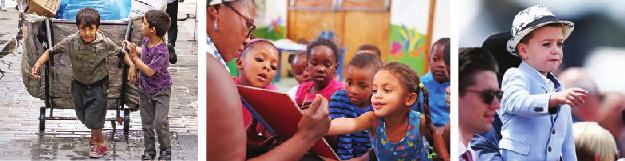
One’s childhood is conditioned by the class, race, country, etc. one’s parents happen to belong to.
Let us begin at the beginning. Childhood begins with infancy, a stage of life that is somewhat unique to mammals. Like other mammals, human infants require the care of primary adult figures, to whom they are emotionally attached, for both their biological and social development. What is virtually unique to human infancy and childhood is just how long it takes. This is because of the size and complexity of the human brain, which continues to develop for all of childhood, and indeed across the entire lifespan.
Along with our large brains, humans also require a lot of time to learn the highly complex norms of our societies. These norms have hugely varied throughout history and around the world and influence how long it takes for a child to be considered a full adult in their community. For example, it takes much longer for a child to learn how to be a functioning adult in capitalist industrial societies today as opposed to, say, a small hunter-gatherer tribe over 10,000 years ago.
Youth is the period, varying by society, that begins toward the end of childhood and extends somewhat into early adulthood. This is when young people are becoming increasingly independent, taking on more and more adult responsibilities and becoming more integrated into adult social life. This period of life is distinct in that physical development is nearly or almost complete but social development continues.
Both childhood and youth are periods of transition to becoming a fully mature member of society. While youth does come with gradually increasing independence, there is no strict division between childhood and youth. It is more of a long, continuous curve than separate stages.
What Is Children’s and Youth Oppression?
None of the above is especially oppressive in and of itself. Rather, it is natural to human biology and essential to culture and civilization. This is shown by the fact that every form of human society, both pre-class and class societies, has recognized some form of childhood and period of youth, often marked by rituals and obligations (e.g., the classic “rites of passage” described in anthropology and popular culture). So where, then, does the oppression come into things?
Due to the fact that child-rearing is largely treated as a private family function in modern capitalist societies, the kind of childhood most children have is entirely random and based on what social class, race, etc., one’s parents happen to belong to. This is the central injustice of childhood under capitalism: you don’t get to choose your family or the social station you start out life with, and the discipline you face is meant to force you into joining that class as you reach adulthood.
The vulnerability of children and youth is exacerbated by oppressive conditions under capitalism. In addition to the oppression that workers, women, black people and other minorities face, which affects children and youth as well, they are burdened with capitalist indoctrination during their education (itself regimented and even militaristic at times). Some children and youth also suffer physical, mental and sexual abuse both at home and in institutions. Many also feel a profound helplessness and dependence in the face of poverty, war and other hardships.
Capitalism has two tendencies when it comes to children and youth: to artificially strengthen and prolong dependence and to dump adult responsibilities onto children without providing adult privileges. The first tendency disciplines children and youth into the values and social expectations of capitalist society. In the United States, this often means a fierce religiosity as well as obedience to authority. For working-class children, the message is to accept the crumbs one is given and to always work harder to achieve the American Dream.
The tendency to place adult responsibilities onto children without any of the privileges usually affects older children in families of poorer immigrants, workers and the unemployed. This could mean helping with a family business, getting an outside job and/or taking care of younger siblings. Such work is often unpaid or very poorly paid, interferes with school and leisure and does precious little to prepare youth for decent work by adulthood. In today’s gig economy world, when parents need to take on multiple jobs and incomes to get by, it is even more expected that working-class children do these things without much benefit to themselves. This is all on top of the regular discipline children face.
The requirement that adults socialize children and youth under the oppressive conditions of capitalist society is the basis for divisions within the family. Today’s worsening conditions exacerbate these tensions, as the pressures to ensure children’s safety and survival often run up against their desire for more independence.
Against Libertarian and Liberal Conceptions of Childhood
Now let’s talk about what isn’t the origin of children’s and youth oppression: childhood itself, or some “institution of childhood.” There are two groups of people we will address. One are the libertarians who want to abolish childhood as inherently oppressive. The other are radical liberal human rights activists who want to reform the institutions they hold responsible for the oppressive aspects of childhood.
The libertarian answer in particular comes from a specific moment in history. In response to the liberal civil rights and mainstream women’s movements of the 1960s, a brief movement for child and youth liberation was born in the United States. This began in the 1970s with small groups at high schools founding groups for youth liberation. They were later joined by liberal activists concerned that children and young people seemed to be making hardly any social or cultural progress compared to other oppressed groups at the time. Former schoolteacher John Holt was a prominent early figure in this movement. He defined his concept of an “institution of childhood” in this way:
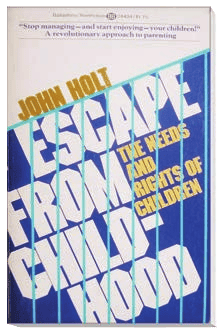
Holt advocates for children to have all adult rights and responsibilities.
“In short, by the institution of childhood I mean all those attitudes and feelings, and also customs and laws, that put a great gulf or barrier between the young and their elders, and the world of their elders; that make it difficult or impossible for young people to make contact with the larger society around them and, even more, to play any kind of active, responsible, useful part in it; that lock the young into eighteen years or more of subservience and dependency and make of them, as I said before, a mixture of expensive nuisance, fragile treasure, slave and super-pet.”
—Escape from Childhood (E. P. Dutton, 1974)
Holt concluded that changing those aspects of culture and practice would liberate children. He argued that children should have all the same rights as adults and that the distinction between childhood and adulthood is socially arbitrary. He argued this even though he recognized that there is some natural biological difference. He imagined that a sweeping, libertarian solution of blowing up all social structures that distinguish adults from children would serve all children. For example, he advocated for getting rid of laws (e.g., voting age), customs and institutions like schools. What Holt failed to recognize is that children’s dependence and the often oppressive institutions that service them are products of material conditions and social organization (e.g., the family), not laws or personal relationships.
Furthermore, Holt portrayed all adults and children as enemies of each other, since children are “a mixture of expensive nuisance, fragile treasure, slave and super-pet.” There do, of course, exist antagonisms between children and adults in capitalist society. But the fundamental objective interests of adults and children in the working class are not opposed to each other. In fact, older children and youth can join together with working-class adults to fight in the class struggle against the capitalist class, which upholds the social systems that really make childhood and youth oppressive.
The youth liberation movement of the 1970s is pretty much dead today, with only tiny remnants left. What we have instead are liberal NGOs and other charitable organizations advocating for children’s and youth rights. Decades of such activism followed the 1989 United Nations Convention on the Rights of the Child. This history has shaped liberal understandings of what it means to free children from oppression, such as “highlighting children’s voices” and respecting their “agency.” These are empty moral platitudes that change nothing. Meanwhile, the UN attempts to reconcile children having those things with a bloodthirsty U.S. imperialism (and its various junior partners) that ravages even its “own” children with outrageous levels of poverty, often prison-like segregated schools of lower and lower quality and much more. This is a reality in which many people’s children can scarcely hope to eat or stay housed, let alone have the ability to speak their political mind or do what they want with their time when even their parents often cannot do that.
Why We Fight
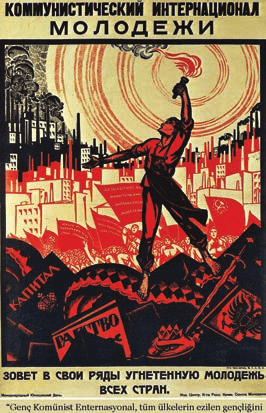
1920 Soviet poster reads “International Communist youth organizations call all oppressed young people of all countries to join their ranks!”
Why must we fight for children’s and youth liberation? Because childhood is central to the process by which this hated, oppressive capitalist system reproduces itself and perpetuates all of our collective oppression. Capitalism could not continue to produce the docile workers it needs to function without the deprivation many young children face, the division between adults and children that rends families apart, and the brutal discipline of children and youth in an unnaturally prolonged period of dependence. Child and youth oppression helps to create divisions between adults and children/youth in the working class even though their objective interests are the same. We must fight to overcome these divisions by taking up the cause of children’s and youth liberation in the class-struggle battles to come, defending children and youth against the rapacious capitalist state and against burdensome capitalist discipline.
What’s more, why stop at disrupting the capitalist process of oppressive reproduction? We must also take charge of fulfilling children’s needs and of social reproduction, directing these processes so they serve our interests as a class. While it is a long-held truism that children are the future, there is a deeper truth that underlies this trite saying. That truth is that the fate of our children and youth is our collective future, which we can either roll over and let the ruling class keep charge of or fight to take charge of ourselves. Older children and youth have an interest in joining this fight, since their integration into the struggle will liberate them from ignorance and artificially prolonged dependence on adults. The construction of a new society for workers can begin with the process of growing up, if we would only seize control of it.