
https://iclfi.org/pubs/wr/47/ai
There is endless hype insisting that the emergence of artificial intelligence (AI) is the most innovative moment in history—that this will create new opportunities, new industries and a bright future. While “tech bros” Elon Musk, Sam Altman and Jensen Huang promise limitless possibilities, working-class youth in America are living something entirely different: rising rents, low wages and precarious work. There are few jobs, and those are degrading: no benefits, no security, no future. As one young worker put it, “You will be obsolete before you even had a chance to work.”
The social crisis unfolding around AI is the product of a capitalist system that cannot offer stability or rising living standards. The two dominant responses to AI—doom and hype—both disarm young workers. Doom says nothing can be done, the future is already decided, survival means keeping your head down. Hype says adapt individually, hustle harder, treat social breakdown as a personal opportunity. These stories sound counterposed, but they push in the same direction: isolation, fear and submission to the existing order.
Young workers are entering a world in which none of the old guarantees remain and illusions of automatic progress have collapsed. Under the control of the bourgeoisie, all new technology (including AI) is used to speed up work, discipline labor and produce profit. Under the control of the working class, the same tools could shorten the workday, raise living standards and expand human freedom. The difference is not the machinery. It is which class rules.
Automation Is Not New
AI is not a qualitative rupture in the relationship between machines and humans. It does not, and cannot, replace human labor as the source of value, nor does it constitute a new mode of production. And despite the fantasies of tech moguls and the press, it is not on the brink of automating society into either a workerless paradise or a workerless dystopia.
What we are seeing today is the broad mechanization of intellectual labor—but not for the first time. Capital has been breaking down mental labor, formalizing it and automating pieces of it for over a century. Typewriters wiped out clerical positions. Electronic calculators replaced human “computers.” Mainframes eliminated payroll departments. Desktop computers decimated printing trades, secretarial pools and travel agencies. Early software automated vast layers of mid-level office work. Algorithmic platforms replaced dispatchers and warehouse schedulers.
AI belongs to this same historical process. What is new is not the basic logic but the scale and speed with which it can now be applied. AI systems touch coding, customer service, design, logistics, research, advertising and clerical work simultaneously. They allow capital to centralize planning, monitor workers in real time and fragment jobs that once required human experience and judgment.
AI Under Capitalism Means Speedup and Degradation
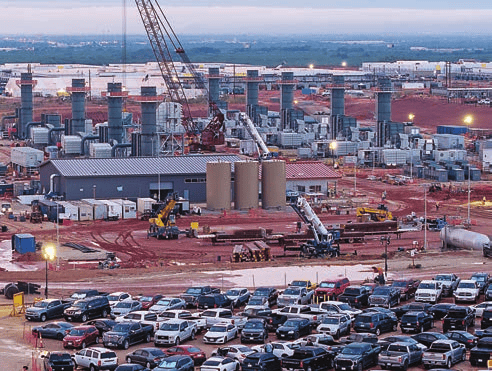
Abilene, Texas: Construction at Stargate AI data center.
AI rests on the same foundation as every other industry under capitalism: the labor of millions of workers. The data centers powering these systems do not appear out of thin air. They are built by construction workers, electricians and engineers. They rely on miners extracting copper and rare-earth metals, truck drivers hauling equipment, utility workers generating enormous quantities of electricity and technicians maintaining hardware around the clock. Since AI marks not a rupture but an acceleration, it intensifies the same class relations already shaping the economy.
Look at translation. A generation studying languages enters a labor market where machine translation performs in seconds what once required hours. Work does not disappear entirely—it is degraded, sped up and cheapened. Fewer workers are retained. Those who remain are expected to produce more for less. The skill remains, but its value is driven down because capital can now restructure the labor process around automation.
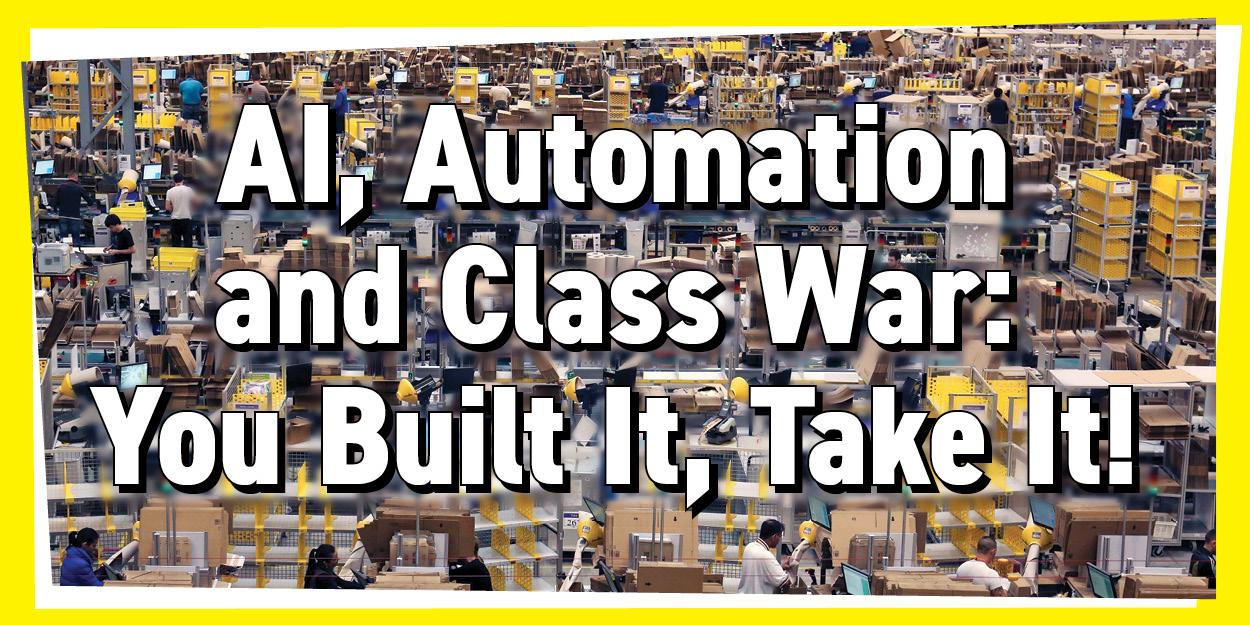
Look at Amazon: a logistics empire run by algorithmic management where workers are tracked to the second, disciplined by software, pushed to inhuman productivity rates and burned out as part of the business model. Warehouses filled with robotics and machine-learning systems are designed to squeeze more labor out of fewer bodies. Surveillance expands. Speed increases. Injury rates rise. Attempts to unionize are met with retaliation and legal attack.
This is not because Amazon chairman Jeff Bezos is uniquely evil (although he may be). It is because capitalism is driven by cutthroat competition. Every firm that can reduce labor costs, speed up production and streamline planning to gain an advantage must do so or be crushed by rivals. If a machine can discipline labor, it will be used to do so. If software can fragment skilled work into lower-paid, tedious tasks, then jobs will be reorganized accordingly. This compulsion is essential to capitalist enterprise.
Society already has the technology and productive capacity to shorten working hours, raise living standards and ensure that no one goes hungry. The problem is that under capitalism, the productive power of humanity has outgrown the cramped, irrational cage of capitalism—and the imperialist order that protects it. So instead of stability and abundance, the working class gets layoffs, hunger and war.
The Question of Power
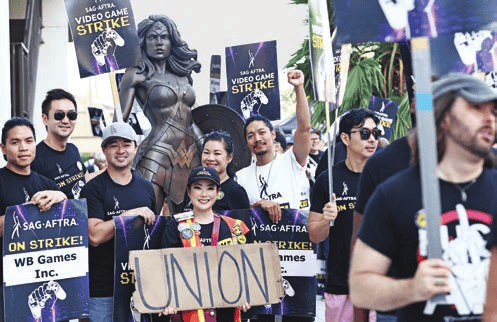
California, August 2024: SAG-AFTRA video game performers on strike over threat of massive job losses with AI.
From Santiago to Lagos to Jakarta and Manila, Gen-Z uprisings have erupted as youth are told to accept misery and despair. Layers of youth who expected advancement through education, credentials or creative careers are being pushed into the working class, where they confront exploitation, precarity and slavish discipline. The fate of educated youth becomes more tightly bound to that of the working class as a whole.
As production becomes more integrated, the leverage of workers does not disappear; it becomes more concentrated. But what prevents it from being exercised is the absence of the organization and consciousness sufficient to wield it. The ruling class is by its very nature class conscious; it understands its interests and defends them relentlessly. The working class does not automatically arrive at a unified consciousness. It is saturated with false narratives designed to keep it weak and divided by race, sex, nationality, immigration status and profession.
AI systems expand society’s productive power, but that power is turned against workers. The struggle over AI cannot be resolved at the level of individual adaptation, by learning to prompt better or hustle harder. As long as the means of production remain privately owned, every technological advance will be bent toward profit. The question becomes one of ownership and power—which class controls the productive forces, which class directs the state that protects those forces.
Even the most basic defensive demands—no layoffs, shorter hours, transparency, control over implementation—require collective, militant enforcement. They will not be conceded; they must be fought for. And in fighting for them, the contradiction sharpens: You cannot control what you do not own. You cannot democratize machinery that answers to capital. You cannot permanently advance workers’ interests while production remains organized for private profit. But you can build the collective power capable of ending capitalist control over production and reorganizing society around human need. To do this requires organization. It requires coordination across sectors and borders. It requires a conscious movement of the working class acting in its own historic interests.