
https://iclfi.org/pubs/wr/47/no-future
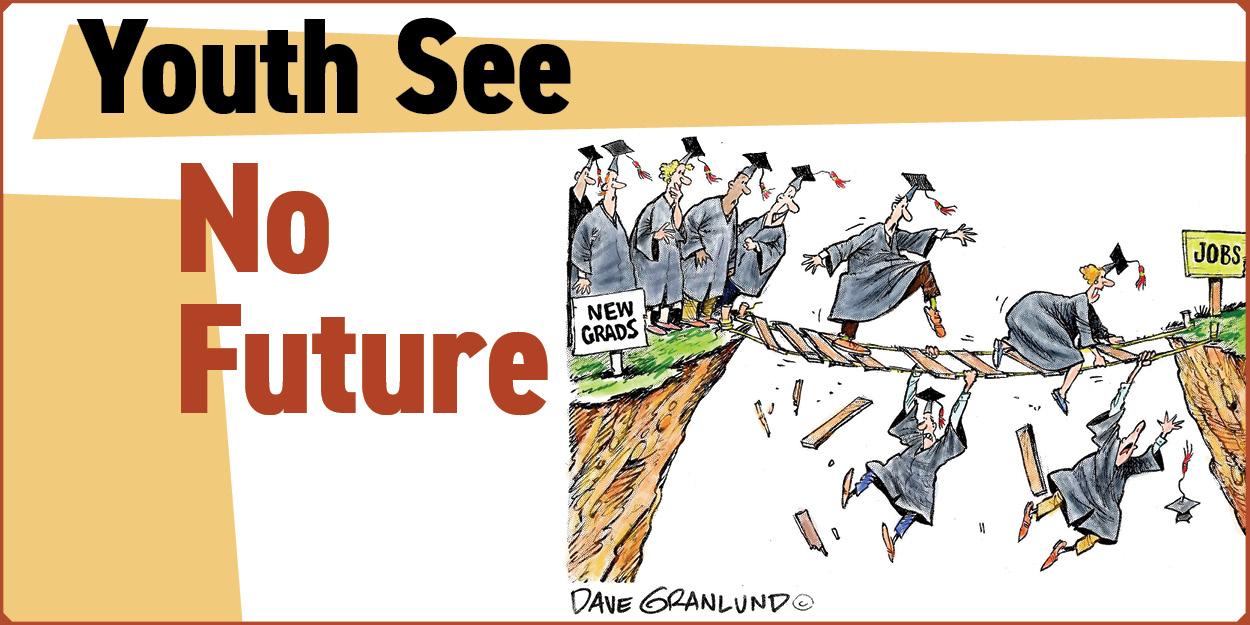
One of the most obvious defining features of youth consciousness today is deep anxiety about the future. Middle-class youth—long insulated from insecurity, used to living a relatively comfortable life and promised the world through a clearly laid-out series of steps—are now confronting this reality. The world that promised gradual improvement, stability, education and upward mobility is changing. The ruling class is tightening the screws on young people, workers and the oppressed and its rotting economy can no longer afford niceties such as higher education and a degree of social mobility for broad layers of the population.
These youth have little confidence in the future, but they remain stuck on the path that has been imposed on them: study hard, get good grades, go to university, get a degree, find a good, comfortable job, have 2.5 children, buy a house, get a dog, and live happily ever after. They do this not out of conviction but out of inertia. Although no decisive shock has yet forced a break, that shock will come. Many go to university only to come out debt-ridden and with no job in sight. Meanwhile, industrial jobs have largely disappeared, as most economies in the Western world have been hollowed out.
Working-class and ghetto youth, by contrast, have long experienced exclusion and degradation in the education system. This is especially true of young boys and even more so for black, Latino and Muslim kids, who are often seen and treated by teachers as nothing more than loud, annoying and unintelligent troublemakers. What is new for this layer is that they are being absorbed into a society that is literally rotting from the inside out. They have to make their way in an economy dominated by low-wage, unstable jobs with long hours and grueling conditions. Unlike their forebears, they cannot rely on industrial jobs to compensate for educational marginalization. And for many who lack the means to leave their parents’ home, it’s like being told, just as you’re about to be free, that your prison sentence has been extended indefinitely.
It is important to understand that we are living in a period of transition, halfway between an old order that is dying and a more reactionary one that is emerging. Expectations formed in one historical epoch continue to largely influence behavior, but they are colliding with the material reality of a new, harsher one. It is this conflict that generates anxiety and uncertainty.
Realignments Among Youth
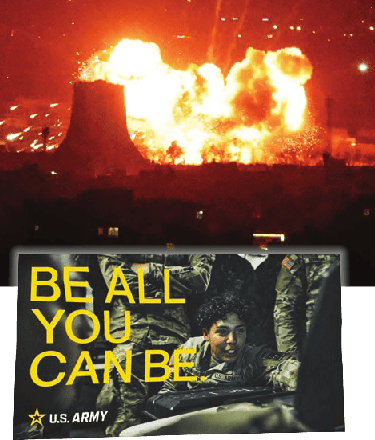
U.S./Israeli war on Iran. U.S. Army recruitment campaign.
How young people react to these changes reflects the different positions they occupy in society and the specific pressures they’re under. But some overall trends are clear.
Military recruitment is on the rise across the West, driven by youth unemployment, economic hardship and the ideological backlash against liberal values. These factors have essentially turned young men into cannon fodder for reactionary forces. Many are naturally drawn toward the military, whose appeal lies primarily in the fact that, in exchange for one’s body, one receives food and shelter, an education, a community, a sense of belonging and masculinity (which has been stigmatized for many young men).
Relatedly, religion is experiencing a resurgence. It is not uncommon that young people become more religious than their parents. Religion is, above all, an outlet for fear and despair. It is interesting (and unsurprising) to note that religions which adapted least to the hegemonic liberal values of the previous era are now benefiting from this trend: Islam and Catholicism in many parts of Europe and Canada; or Protestant evangelicalism in the U.S. and Latin America.
Today’s young people are overwhelmed by a sense of impending doom and powerlessness in the face of invisible forces changing the world. Those who sense the rightward trajectory of society and fear the growth of reaction cannot explain it and see no force capable of resisting it. The result is that despair dominates, especially in a period when workers and the oppressed are on the back foot and the initiative is firmly in the hands of the imperialists, who seem to be on the offensive everywhere, acting with the strength of 12 titans. “Doomerism,” withdrawal into private life and various forms of escapism—from music to social media to AI girlfriends—are very common. Many try to avoid politics, seeing it as stress-inducing rather than empowering, and others try to avoid the news entirely. While this is an understandable impulse, in today’s world it necessarily means disarming oneself at a time when one is in most need of being well-armed.
Reversal of the Roles of Left and Right
Everyone is talking about the shifts and realignments occurring among youth, especially regarding the manosphere and the rise of the right. But why is it that while previous generations of youth wanting to fight the status quo turned to the left, today they tend to look to the right?
Many do continue to adhere to the traditional view of the right as the force that represents the status quo, defends traditional values and opposes change. In simple terms, right = status quo, left = change. But this trend has been fundamentally reversed. Liberal ideology is so deeply entrenched in many institutions, in the very fabric of capitalist society, that many young people who are hungry for change (and men in particular) are turning to the right out of sheer revulsion for the parties and ideology responsible for their immiseration.
Being conservative is now a countercultural and rebellious movement, and there is increasing resentment toward privileged, moralizing liberals who think that society’s only problem is the lack of bike lanes and cultural diversity. The populist right is now seen as the only force not bound to the establishment and which is most prepared to challenge it aggressively. It bases its appeal on the dire situation for young people and an unflinching torching of liberal ideals, while the left and liberals bemoan the state of democracy, constitutionality and international law. For many on the left, simply stating this fact is sacrilegious. They simply do not see it and stubbornly refuse to accept it.
The Right-Wing Shift and the Gender Divide
This shift reflects a backlash against liberalism as the established orthodoxy of the past 30 years. Nowhere is this clearer than with young men. A popular sentiment among these youth is that white, cisgender, heterosexual men have been blamed for all of society’s ills; that it has become taboo to talk about the problems of young men; that while one should be proud to be a woman, one should not be proud to be a man, that one should be ashamed to be a man; and that to be one of the “good guys,” one must repent, be an “ally,” unconditionally support everything that is done for a minority, be “aware of one’s privileges,” etc. Growing up in this context, being told you’re the problem and still being faced with the brutal difficulty of making it in a society where material prospects and conditions are declining, cannot but lead to a backlash! To be clear: this does not mean justifying the backlash, but it does mean it must be explained in material terms.
The right, and the manosphere in particular, leans on these grievances and channels this anger into various reactionary outlets (see article page 17), while liberals simply brand such men as hopeless, unenlightened bigots and dismiss their concerns out of hand with abstract platitudes like “the world is already made for men.” Many youth are becoming politicized in a climate dominated by this poisonous polarization between liberalism and right-wing populism. The left’s failure to insert itself into this dynamic as an independent pole opposed to both the moralizing liberals and the right-wing populists has proven disastrous.
What to Do?
So what should we do? The only way to effectively counter these different reactions is to offer a solution to the root problem and to show how these other outlets prevent young people from getting what they need. Young people need to study politics seriously, understand the laws governing this epoch and debate the way forward. Individual escape routes may well allow a few individuals to succeed, become wealthy or cross the crumbling bridge into academia or the liberal professions. But for the vast majority of youth, this path is closing. It is vital that youth integrate themselves into collective struggle rooted in the working class, including by their choice of jobs and by joining and organizing unions.
Above all, youth need to break with liberalism. Those who are serious about fighting the right must first free themselves from and take a clear stand against the ideology that fuels the right. Concretely, this also means breaking with the liberal mentality instilled in young people by the educational system, which stands in the way of this necessary struggle.
To alleviate the growing burden on young people, solve the housing crisis, secure decent jobs for all and pave the way for a real future, significant resources will have to be wrested from the hands of the ruling class. The fight for a future is therefore inseparable from the broader struggle against the system that produces these conditions, which today means above all a struggle against the U.S. empire. It is neither a fight to defend the decaying liberal world order nor a fight for a return to traditional values. In other words: the fight for the youth to have a future must be fused with—and can only advance under the banner of—the fight for workers’ power and the defeat of imperialism.