
https://iclfi.org/pubs/wr/47/adolescence
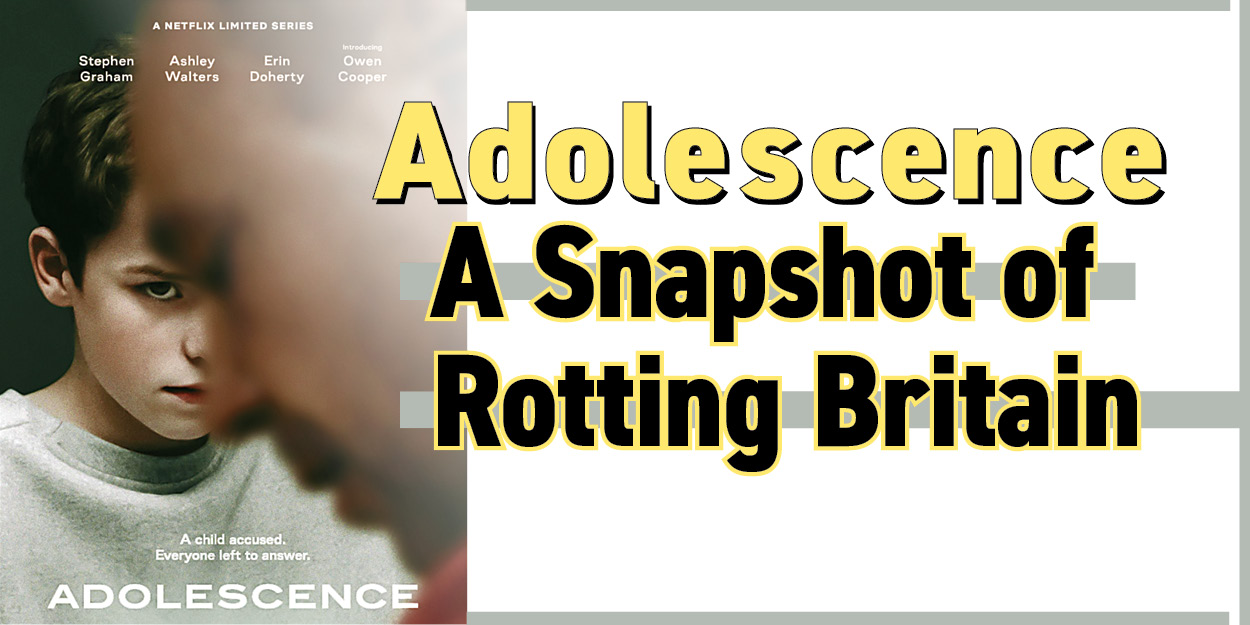
Adolescence is an excellent watch, and a must-watch. Brilliant acting to go with a powerful story depicting the deep rot eating away at the heart of Britain, and which does so in a heart-wrenching, relatable and, dare I say it, nuanced way. Set in a Northern town, the story follows the case of Jamie Miller, a 13-year-old arrested in a police raid in the wee hours of the morning for killing Katie, a classmate, the night before. In four uncut and unedited episodes, the audience is taken through the events which unfold from multiple vantage points: Jamie himself, his family, the school, the child psychologist, the social reactions, and the lives of youth which are indecipherable to most adults and parents. The backdrop against which it all plays out is, of course, Broken Britain.
Stephen Graham, the lead actor and one of the writers, conceived of it after reflecting on recent instances of violence against young girls by young boys. In 2021, Ava White, a 12-year-old, was stabbed to death by a 14-year-old boy in Liverpool, the city Graham calls home. In 2023, 15-year-old Elianne Andam was stabbed by 17-year-old Hassan Sentamu outside London. These are just two cases from a growing number. A Guardian article points out that the drama was released just as news was emerging that “crossbow killer Kyle Clifford had searched online for misogynistic podcasts and watched Andrew Tate videos hours before murdering three female members of the Hunt family [his ex-girlfriend]” (17 March 2025).
Adolescence is currently the second-most-viewed English-language show on Netflix. It strikes a chord with huge layers, certainly in Britain but more generally in the West: youth see their experience reflected in it, and parents see in it the challenges of raising children and ensuring their safety and well-being in an increasingly difficult social climate. Hell, it even “hit home” for Sir Keir Starmer, who was so moved by it that he forgot about the thousands of young girls being genocided in Palestine or their mothers being raped by Israeli soldiers.
The popularity of Adolescence has allowed liberals (and the right) to use it to justify crackdowns on social media to “protect the young” from “online radicalization.” Adolescence does not advocate bans, it merely depicts social media as young people use it. But it also depicts other things that the liberals are completely silent about. For example, the state of the school where Jamie and Katie went was marked by chaos, overwhelmed and exhausted teachers and horrible behavior. Yet no liberal has gone on a crusade to fix schools—a measure which could actually help youth.
What is happening is that the liberals are applying their own prejudice to the show, selecting and ignoring elements to suit their political aims. For instance, governments in Europe—Britain, France and the Netherlands—are integrating it into national school curricula as a means of combating misogyny and the influence of the manosphere. In Britain, it is part of the government’s strategy for combating violence against girls and women. As our article on misogyny in schools argues, these are entirely empty gestures that fail to address the decaying social conditions amid which young people are growing up. The only good thing about this strategy is that kids can miss some lessons to watch a good show.
There is a lot to be said about the show. Yes, it could have done this or that thing better. But our point in writing about Adolescence is not to dig into its creative and storytelling merits, but to insist on what to do about the social reality it depicts. A sentiment frequently expressed upon watching the show is one of being overwhelmed and feeling that nothing can be done. One is left wondering that if someone like Jamie—a smart kid with loving parents and a decent home—can end up stabbing a girl to death, then what are we to do? What chance do we have of dealing with this generalized crisis facing youth?
This is a valid question. From the outside, Jamie was a “normal” kid. His plumber dad tried his hardest to do right by his kids, as plenty of working-class parents do. Yet it wasn’t enough. It is this reality that generates anxiety and exasperation, and it is precisely why solutions such as bans and restrictions appeal to people, especially parents who want to protect their kids. But youth do not live in a bubble. No matter how much their parents try to shelter them, kids go out into a society that is in decay.
This is our point. This is the struggle to be had with concerned teachers and working-class parents. As the show becomes a reference point for the crisis confronting youth in Britain, communists must seek to advance the conversation along the lines of how to improve the social conditions in which youth are being socialized. This is the only way to prevent further tragedies like those of Ava White and Elianne Andam.