
https://iclfi.org/pubs/wr/47/editorial
Big events are shaking the world. Every day we wake up to new chaos sown by U.S. imperialism as it strives to defend Pax Americana. Amidst the endless analysis of world events, what gets overlooked is how these dynamics are remolding the social fabric of entire societies. But one doesn’t have to look hard or think long to notice that the sense of certainty and normalcy characteristic of the last decades is rapidly dissolving into deep anxiety about the future. This is especially true for young people.
As anxiety permeates social life, we are witnessing growing divisions across the board: native-born vs. immigrant, feminists vs. the manosphere, women’s rights vs. trans rights, “woke” liberals vs. MAGA—the list goes on. What’s clear is that minorities are under the gun everywhere. These polarizations pit the oppressed against one another and hamper the struggle against U.S. imperialism and the chaos it is sowing.
Marxists must build this struggle. The question is how. Merely preaching unity in the face of deep divisions won’t work, nor will limiting oneself to proclaiming the need for socialism and revolution for the future. This is not Marxism, but tomfoolery. We must provide answers stemming from the common class interests of all the oppressed, fighting to bring these to the fore, all the while combating bigotry by showing how the divisions it breeds only serve to advance the interests of the ruling classes. This issue of Women & Revolution seeks to do precisely this, with a particular focus on the question of youth. Only by preparing youth for the coming storms can the Marxist movement revitalize itself and emerge as a real factor capable of fighting for our future.
Imperialist Decline, Rising Reaction

In fighting its decline, U.S. imperialism is smashing everything that stands in its way. This explains why it is breaking up the liberal world order which it built on the ashes of the Soviet Union. Under this old order, it proclaimed democracy, freedom, multiculturalism, human rights, open borders, etc., as universal values. Together, these were the pillars of liberalism, the dominant ideology used by U.S. imperialism to mask its plunder of the world and uphold its hegemony over it. As Trotsky explains, “The appeal to abstract norms is not a disinterested philosophical mistake but a necessary element in the mechanics of class deception” (Their Morals and Ours, 1938).
These values are no longer an option. The belligerence necessary for the U.S. to regain its hegemony cannot be executed while touting liberal ideology. And both wings of the U.S. ruling class—Democrats and Republicans—know this. They differ only about how this break from liberalism should be carried out. This explains why the U.S. is tearing up liberalism, seeking to replace it with an ideological superstructure which can rally support behind the naked aggression at home and abroad. From open season on immigrants, nativism and anti-trans hysteria to genocide, war and pursuing diplomacy under the barrel of a gun—all of these are justified in the name of “Make America Great Again.” The rise of right-wing reaction is thus the ideological expression of U.S. imperialism fighting to stay on top.
This in and of itself does not explain why the right—especially the populists and far right—is able to appeal to large layers of the working classes throughout the West. For liberals, the answer is that they are simply backward—too uneducated to be able to cut through the gutter press and everything else the algorithm throws at them. But it is liberalism itself and the methods of the liberals which drove workers to the right. Let us illustrate.
The period of globalization resulted in material changes in the social fabric of the West. Immigration increased, LGBTQ+ discourse became mainstream, affirmative action put a handful of minorities in charge on the job. But alongside social liberalization, the fortunes of the working class as a whole plummeted. From offshoring and outsourcing to the 2008 financial crisis and then the pandemic, the working people were battered to no end.
But each time a new series of attacks was unleashed, the liberals used identity politics and professed concern for minorities as a means of discrediting and silencing dissent. The working people were told to swallow attacks in the name of anti-racism, diversity, women’s rights, environmentalism and the like. Such enlightened scorn made huge swaths of the working class sick to death of the liberals, resentful of minorities, and looking for ways to stick it to the status quo.
In this current conjuncture defined by the breakdown of U.S. hegemony, there is a convergence between the interests of the U.S. imperialist ruling class and the deep anger, resentment and insecurity felt by large segments of entire populations: both are looking to break with the status quo. This creates a fertile ground for right-wing and reactionary forces to seize on the anxieties among the population and use them to inflame and exacerbate existing prejudices. This deepens social polarizations along the lines of values and morals. These are indispensable tools with which the insurgent right batters down liberalism and the liberals. In this way, these polarizations act as the midwife of the reactionary realignment emerging from a dying liberal order.

Rising reaction from Japan (Takaichi Sanae with Trump), France (Marine Le Pen with youth), Britain (Nigel Farage) to Germany. AfD poster says: “It’s time to make policies that benefit young people.”
This is an international phenomenon which is reflected and refracted internally to varying degrees in the West. Where Trump has MAGA, the Alternative for Germany (AfD) raises the slogan “Germany. But normal” through remigration, the mass expulsion of entire immigrant-derived populations; Marine Le Pen in France promises to speak “au nom du peuple” (in the name of the people) through her party’s policy of “préférence nationale”; Nigel Farage wants to Reform Broken Britain by upholding Judeo-Christian values and making sure children learn about Britain’s “great and proud history”; and Japan’s first woman prime minister, Takaichi Sanae, is repopularizing the slogan “futsu no kuni” (“normal country”) to break the population from Japan’s post-WWII pacifism and march on the road to rearmament.
As the U.S. spreads misery, those who will bear the brunt in the most brutal way will be those at the bottom of the international chain: countries under the boot of imperialism. In these societies, the already murderous divisions will be redoubled, leading to an increase in violence against minorities, the rise of right-wing nationalism and religious fundamentalism. Consider the rise in anti-Muslim violence under Modi, Trump’s “very good friend”; or José Antonio Kast, the new president of Chile and a fan of Pinochet, who ran on the slogan “Hacer grande a Chile otra vez” (Make Chile Great Again); or the fate of the poorest in multiple countries where the U.S./Israeli war against Iran has left them without fuel even to cook with.
How to Combat Reaction

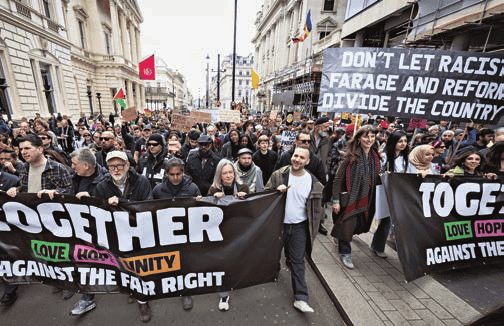
Above: Right-wing “Unite the Kingdom” demonstration, London, September 2025. Below: Jeremy Corbyn, Green Party leader Zack Polanski and Zarah Sultana lead Together Alliance march, London, March 28.
Imperialist decline and the social decay it generates is the material basis upon which right-wing reaction is growing. The fight against right-wing reaction is therefore inseparable from fighting U.S. imperialism, the force dragging the whole social fabric of the world in a spiral toward barbarism. But this fight can only advance if it is based on complete independence from the ideological and moral influence of the very force responsible for the chaos surrounding us.
To understand what this means, it is important to return to the basic Marxist approach to the realm of ideology and morality. Marxism takes as its starting point that there is no such thing as “universal morality.” That is, there are no eternal truths and values floating above the heads of people, divorced from the social conditions and class relations prevailing at a given time and place. Trotsky’s Their Morals and Ours is indispensable here. He writes:
“Whoever does not care to return to Moses, Christ, or Mohammed; whoever is not satisfied with eclectic hodge-podges must acknowledge that morality is a product of social development; that there is nothing immutable about it; that it serves social interests; that these interests are contradictory; that morality more than any other form of ideology has a class character.”
If we understand that liberalism, as the moral philosophy of U.S. imperialism at a particular historical juncture, is what paved the way for the right-wing backlash against it, then it follows that revolutionaries must clearly distinguish themselves from liberals and make a political break from liberalism. Associating ourselves with liberal influences can only strengthen the right.
At the same time, we must combat the growing conservative social attitudes, religiosity and traditional values in the working class and among young people. To do both is akin to balancing on a political tightrope, especially in the current polarized social climate. There are and will be pressures in both directions, but the way not to succumb to either side is to base oneself on the historic interests of the working class. This is less complicated than it sounds: just as you cannot win a strike in cahoots with the boss, you cannot fight imperialist reaction with liberalism. To return to Trotsky: “A revolutionary Marxist cannot begin to approach his historical mission without having broken morally from bourgeois public opinion and its agencies in the proletariat.”
But from this does it follow that wherever we go, we must raise slogans declaring our moral independence from the bourgeoisie on all fronts? Should we go to a picket line and insist that for it to be successful, the strikers must also break from religion and proclaim atheism, or reject patriarchy, since both are also instruments of the ruling class? Of course not.
While this sounds ridiculous when presented this way, it raises important questions for how Marxists should combat the influence of bourgeois ideology among the masses. Revolutionaries must fight for working-class independence, but they must do so in a way that does not inflame existing prejudices, but brings shared class interests to the fore, in opposition to both the liberal and the right wings of the ruling class as a whole. The way to do this is to not make the realm of ideas the primary terrain of political struggle.
The Marxist approach to religion provides the necessary framework. Marxism holds that religion serves to mask class exploitation and “befuddle the working class.” In this sense, liberalism or MAGA or any other ideology of the ruling class is like religion. All such ideologies must be combated; we must expose their true function in the eyes of the masses. But they must be combated in a materialist way: the struggle against them must be subordinated to the struggle for socialism. Lenin, in “The Attitude of the Workers’ Party to Religion” (1909) explains this succinctly:
“A Marxist must be a materialist, i.e., an enemy of religion, but a dialectical materialist, i.e., one who treats the struggle against religion not in an abstract way, not on the basis of remote, purely theoretical, never varying preaching, but in a concrete way, on the basis of the class struggle which is going on in practice and is educating the masses more and better than anything else could.”
If we consider the huge segments of the working class that have right-wing, nativist, anti-immigrant as well as religious ideas, every single word of Lenin reads like a guide for what to do today. We will not win such workers away from these influences if we preach abstractly about the virtues of open borders or some other enlightened idea, hoping that with enough explanation, they will finally get the point. Sermonizing good values abstracted from the social conditions that prevent their realization can only push such workers further away.
Let us be concrete. A common trend in many Western countries is governments dumping refugees in cities/towns which are run-down, decrepit, and starved by years of austerity without providing enough additional resources. This is a recipe for breeding resentment and hatred for refugees among the local population—which incidentally is precisely what these governments want. The way to combat this state of affairs would be to motivate that both the local workers and refugees wage a united struggle against the government to improve conditions, since this is in the interest of both.
This won’t happen magically, and it definitely won’t happen if we begin to just denounce the locals for their reactions. The latter will push the locals away and further isolate the refugees. The only way to avoid the pitfalls which inflame divisions would be to take a clear stand in defense of the refugees, while at the same time providing a concrete way to draw in the widest layers in practical struggle based on their shared material interest. This would demonstrate concretely to the “backward” workers that it is not the refugees but the powers that be who are responsible for their conditions.
Now step back. This same dynamic is present throughout the Global South: Afghan refugees in Pakistan, or Syrians in Türkiye, or Sudanese in Egypt. The list goes on. The same method of combating divisions applies to these situations as much as it does to a decrepit city in Germany or France.
However, this is not the approach that is generally deployed by the left. There are two wrong answers when it comes to dealing with social polarizations: one is ultraleftism, the other is economism. The former shuns all backwardness, shouting “fascist!” at any supporter of Reform UK or Trump, or for that matter, Modi or Milei. Their answer is to proclaim socialism and revolution without providing any answers which can undercut the growth of the right and combat divisions in the here and now. This approach can only fuel the backlash.
In contrast, economism tries to address today’s struggles, but does so by ignoring, minimizing or conciliating backwardness in favor of bread-and-butter issues, preaching socialism for the future. Its logic is to build unity on the lowest common denominator, such as wages. But in reality, this approach amounts to ditching the particular concerns of oppressed groups—whether that’s women, trans people, immigrants or religious minorities—because these would “alienate” others. Thus, it ends up conciliating existing prejudices and thereby perpetuating the divisions among the working class, ultimately undermining both the struggle for today and for socialism.
To both of these false answers, Lenin responded in the above cited article:
“A Marxist must be able to view the concrete situation as a whole, he must always be able to find the boundary between anarchism [or ultraleftism] and opportunism (this boundary is relative, shifting and changeable, but it exists). And he must not succumb either to the abstract, verbal, but in reality empty ‘revolutionism’ of the anarchist, or to the philistinism and opportunism of the petty bourgeois or liberal intellectual, who boggles at the struggle against religion, forgets that this is his duty, reconciles himself to belief in God, and is guided not by the interests of the class struggle but by the petty and mean consideration of offending nobody, repelling nobody and scaring nobody—by the sage rule: ‘live and let live,’ etc., etc.”
In this age of imperialist decline, revolutionaries must navigate a political climate littered with socially charged dynamite which threatens to explode at the slightest misstep. We must traverse this landscape carefully; we have sought to return to the ABC of Marxism to provide a guide for what to do and what not to do.
In this issue, we use this method of analysis and intervention across multiple themes which illustrate the concrete dynamics of division and the means of combating it in a Marxist way. The bulk of the articles deal with youth, who are being used as a key wedge with which the right pushes its moral crusade of traditional family values, and who are rapidly facing a worsening future. Alongside youth, we also present key articles on sex, gender, violence against women and misogyny, right-wing workers and women in the working class. We hope these will engage and inspire our readers. As always, in the spirit of political clarity, we welcome discussion, debate and correspondence.