
https://iclfi.org/pubs/wr/47/cpgb-trans
We print below a presentation at a debate with Communist Party of Great Britain (CPGB) leader Mike Macnair on 12 October 2025.
I would like to start by thanking the CPGB for organizing this discussion. The trans question is of central importance to the left today, first because it is being used by the right as a spearhead for reaction; second, because it is a source of great controversy and disunity on the left; third and most importantly, because trans people represent one of the most oppressed groups in society whose cause must be championed by communists.
In my report today, I will try to outline the Spartacist League’s basic approach to the question of trans liberation. The discussion should be quite interesting because there are many points on which we and the CPGB converge. I hope this can allow us to really get to the heart of the matter.
For us, the way we view our tasks regarding the trans question is consistent with how we view the tasks of communists in general. Marxism is a guide to action; we must use its method and materialist grounding to guide the struggle of the oppressed.
As for the CPGB, we think the strengths and weaknesses of its approach to the trans question reflect those of its approach in general. We think the CPGB is in rare company in the British left in that it upholds orthodox Marxist conceptions on many questions and will argue for them polemically within the left. However, we believe it does so from an overly abstract standpoint which doesn’t help guide the struggles at hand. I will show this concretely with regard to the trans question at the end of my presentation. First, I want to explain our basic approach to the question.
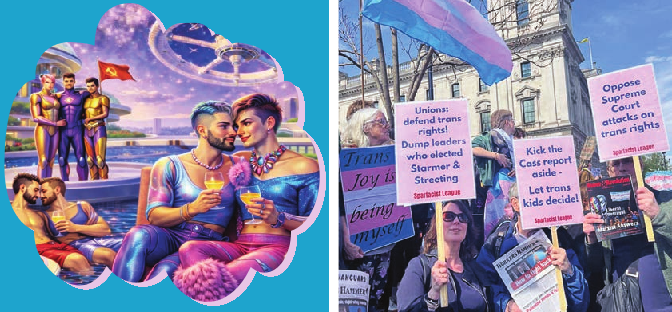
The task of communists is not only to dream about the future, but to guide today’s struggles to get there.
Source of the Backlash
The first step in making a constructive intervention into the trans movement is to understand the political situation it currently faces. It is not difficult to observe that the trans movement finds itself on the back foot and isolated. Where Marxists have a unique contribution to make is in providing a historical materialist explanation for the current backlash. This is not just a theoretical exercise; it is essential if we want to root our intervention in concrete material reality.
To understand the debates over the trans question, it is necessary to take a broader view and place them within the general trends of historical development. Somewhat counterintuitively, we need to start with the position of the U.S. in the world to understand the challenges facing the trans movement.
Since the collapse of the Soviet Union, the U.S., starting from a position of uncontested hegemonic power, has seen its relative position and that of its imperialist allies gradually decline. As with all empires, its ideological and political superstructure evolved in tandem with these economic and geopolitical changes. The ideology embodying the interests of the U.S. order started with liberal triumphalism in the ’90s—basically that the American model was universally applicable and preordained to triumph. Then in the 2010s, as liberalism started to be challenged, it became increasingly brittle and hysterical, aggressively confronting any opposition (think of the crazy Russia-gate campaign). And now we have the openly anti-liberal Trump regime. The key point to understand is that these ideological shifts reflect changes in the material position of U.S. imperialism.
Looking at it in this context, we can see that an important reason the trans question is so explosive and holds so much weight in public debate is that it stands right at the frontier of two broad historical trends. It started to become a question in the political mainstream right as the liberals were increasingly running out of road. Neoliberal leaders started pushing for trans rights as a way to appear socially progressive at little cost. Comrade Macnair has shown quite well how the Theresa May government tried and failed to do this.
It is certainly a good thing that being trans became, for a time, more socially acceptable. But the fact that this happened right as the liberal world order was plunging into an existential crisis has meant that support for trans rights has been very brittle. It didn’t take much for supposed champions of the trans cause to turn around and embrace totally reactionary anti-trans positions. Just look at the Labour Party.
The other consequence of the trans question breaking out on the political scene when it did is that much of the pro-trans discourse has been tainted by the worst traits of liberalism in crisis: extreme moralizing, brittleness and refusal to engage in debate. For a group that represents a tiny minority of the population, such methods are disastrous and can only further its social isolation.
For Marxists, a central task is to forge a link between the trans movement and the workers movement. Here, too, it is essential to understand the broader context. Throughout the Western world, the working class has moved sharply against the liberal status quo, sick and tired of being told to accept worsening living conditions in the name of grand, abstract ideals. The problem, however, is that this backlash against the status quo is taking on a conservative, anti-liberal expression that directly targets minority rights, including those of trans people.
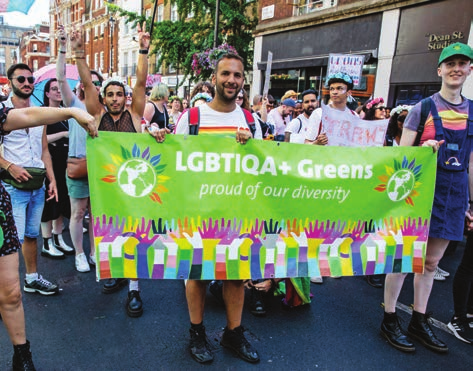
London, July 2022: Zack Polanski (center) takes part in Trans+ Pride march.
From all of this, we draw a rather simple conclusion. The trans movement’s association with liberalism has been an albatross around its neck. The only way it can form an alliance with the working class is by breaking with liberalism. This doesn’t mean compromising on the fight for trans rights but simply placing it within a class perspective. I will elaborate more on this a little later.
Marxist Analysis of Gender
First, I want to briefly lay out how we as Marxists understand the trans question. As you know, debates on gender and sex tend to be very heated. For us, it is important to place the theoretical debates in the context of what each side seeks to achieve.
At bottom, the anti-trans side seeks to make it more difficult to be socially accepted as trans. To justify this, they present reality as fixed and unchanging. This is why they harp on biological essentialism so much. The pro-trans side of the debate, for its part, wants to make being trans more socially acceptable. Unfortunately, they usually do this by using relativism and idealism, whereby categories are entirely arbitrary and depend solely on individual will. We see the most absurd version of this when a cis (non-trans) person claims they could change their gender by simply proclaiming themselves another gender.
As Marxists, we are of course on the pro-trans side of the debate. But as in all other struggles, we root it in a dialectical materialist analysis, in which reality is not fixed but contradictory and in constant change. If we aim to change not just individuals but society itself, this approach is essential.
How does this translate concretely into understanding gender and answering the notorious question: what is a woman? We start by recognizing that there is indeed a qualitative biological difference between male and female humans. Without this dichotomy, human reproduction would be impossible. This is not to deny that there is a spectrum, where a small number of individuals are not easy to place in these distinct categories. But these are variations within a clear bipolar spectrum.
While a lot of the heat comes from debates over biology, this is not really the heart of the matter. Chromosomes and the ability to reproduce are not actually decisive in determining social relations between the sexes. The real contention is about gender, in other words, the social significance of being a man or a woman.
The reason why reactionaries always refer to biology is that they think it easily proves their argument that there are fixed, impermeable categories separating the genders. Against this, the trans movement is correct to argue that gender is first and foremost social. But just because something is social doesn’t mean it is not real or can be changed on a whim. In fact, trans people know better than anyone how difficult it is to transition from one gender to another. It is not a purely individual process but a social one in which, for most, it is a constant struggle to be accepted.
The most important mistake made by the mainstream trans movement is to downplay the material roots of gender divisions. The fact is that the sexual division of society runs extremely deep and is rooted in the institution of the monogamous patriarchal family. This institution predates even capitalism itself and cannot simply be wished away. Denying this is, in fact, the central thesis of idealist academics like Judith Butler, a key figure in the modern trans movement.
The truth is, defense of the gendered status quo is not just a product of backward ideas floating around in people’s heads. These are rooted in the way society is organized. Even in a country like Britain where there is a National Health Service, the provision of social care largely relies on the family. The same is true for the raising of children. No theoretical argument can make this material dependence disappear. This is the source of conservative ideas on gender.

In many ways, views regarding the family can be compared to those on religion. As Marxists, we know that religious ideas are false. But unlike crusading atheists who seek to purge this backwardness by mocking religious ideas, we understand that they are rooted in a social need; that religion is the opium of the people. As such, while arguing against religious illusions, we fundamentally seek to remove the social need for such ideas. Our approach to gender must be the same. We cannot abolish gender relations; they must wither away.
This does not mean that trans people need to wait until after the revolution. Rather, it means that the fight for trans rights in the here and now must consider the material constraints in which it takes place. This means understanding that in the same way that the majority of the working class will not be won to atheism before the revolution, it will not be won over to the idea of ending all gender divisions. But through its struggles, the working class can and must be won to the understanding that the organized church is its enemy and that fighting for trans rights is a necessity. In both cases, the masses do not need to start with the correct abstract conceptions; ideas change as a result of struggle and transformations in material conditions.
The Task of Communists
Now that I have given a basic overview of how we approach the trans question, I want to deal with some concrete political questions facing the movement. As I already said, for us, guiding struggle is the whole point of Marxism, and it is here that we see our most important differences with the CPGB.
Your Party
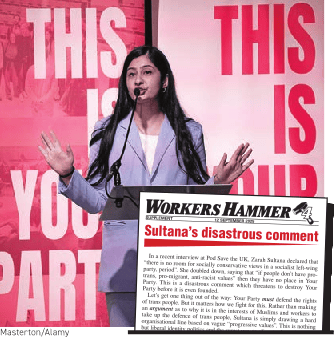
Dundee, Scotland, February: Zarah Sultana, co-founder of Your Party, addresses the conference.
Let me start with our respective interventions in Your Party. You know as much as we do that the trans question is already one of the most polarizing questions in this party. In fact, this question already threatens to rip it apart. For us, it is essential to weigh in on these disputes and put forward a position that can unite the working class and the trans movement.
As you know, the controversy was kicked off when Adnan Hussain, one of the independent Muslim MPs, said he defended women-only spaces. This sparked a strong reaction among pro-trans activists. While it was certainly necessary to argue against Hussain’s views, it was necessary to do so in a way that wouldn’t push away left-leaning Muslim activists…which of course is exactly what Zarah Sultana did in stating there was no place for people with socially conservative views in Your Party.
The problem here is once again focusing on what people have as ideas in their heads rather than on how to unite them in a common struggle. In our intervention on the question, we argued that an alliance between Muslim and trans people can be built if we insist on the need to fight for each other’s rights (which includes, of course, the right of trans people to access public spaces corresponding to their chosen gender). Such an alliance does not need to be premised on accepting gender theory, or Islam for that matter.
To build such an alliance, it is necessary to push back against both sides: the conservative prejudices of certain Muslims and the moralism of certain trans activists. In both cases, the key argument to make is that neither group can afford to be isolated. They need to forge alliances, and this can only be done by uniting in a common struggle, where it is accepted that there are different views on social questions but where each side will respect and defend the other’s democratic rights.
I bring this question up because it very concretely brings to life all our theoretical views on the trans question. The point of our theory has to be to overcome such immediate political problems. I’m curious to hear what comrades of the CPGB thought of our intervention on this question. I found some of the points in Jack Conrad’s article “Neither king nor empress” similar to our views but somewhat general about the basis for unity in action.
So, what is our difference here? I think it is really how we view our respective roles regarding Your Party. For us, the main problem in Your Party is that it can’t answer any of the important political questions of the day, centrally, the divide between the left and the working class. At bottom, we think that Marxists are the only ones who can provide real answers to this problem.
In this sense, we think it is of the utmost importance that communists help overcome the tensions on the trans question in a progressive way. It is exactly the kind of question that divides the left and is used as a wedge to drive workers to the right. This is why we have made the trans question one of the spearheads of our intervention in Your Party.
For its part, the CPGB does not seem to recognize that there is a great divide between the working class and the left. And to the extent it recognizes the tensions on the trans question, it does not view overcoming them as central to its intervention in Your Party. While it has written pages and pages on the democratic functioning and intrigues at the top of Your Party, it has only made passing comments on the trans question.
But here is the question: what is the point of theoretical Marxist discussions on the trans question if we do not seek to use Marxism to advance the movement when this is concretely posed and urgently needed? This is the whole point, really.
The Cass Review
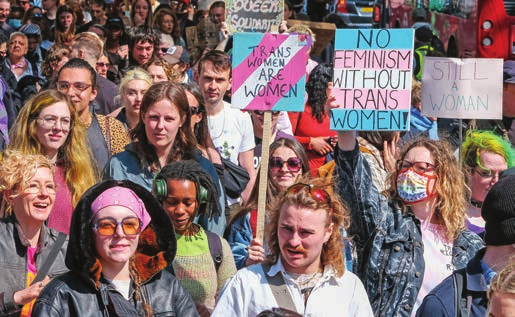
London, April 2025: Pro-trans demonstration after the Supreme Court’s trans-exclusionary ruling over legal definition of a woman.
The next example I want to go to is the Cass review. Its publication in 2024 marked a major shift in public opinion in Britain. It was used to ban the provision of hormone blockers to teenagers and as a justification for the Labour Party to ditch any association with the trans cause. We think it was essential to oppose this ban as well as the hysteria around it.
The problem with most of the left’s response to the review was that it did not oppose its moralistic premise that youth should not be given the choice to decide their gender. In this regard, I think comrade Macnair makes an important mistake in his exchange with comrade Brunhilda (see “Solidarity, not sectionalism,” Weekly Worker No. 1504, 29 August 2024), where he compares access to hormones and puberty blockers to the overprescription of antibiotics. While the latter concerns a medical condition, the former is a question of how an individual wishes to be recognized socially—being trans is not a medical condition.
Moreover, hormone blockers are generally safe and simply delay the onset of puberty. As communists, we don’t think it is for parents or the state to decide if a kid can be trans or not. As such, we are against restrictions on puberty blockers, and we hope the CPGB reviews its approach to this question.
Minimum Maximum
I will finish by addressing what I think is the biggest issue with the CPGB’s approach: its minimum-maximum program. The problem is not having a minimum and a maximum program per se. The problem arises when this program is viewed as a timeless set of positions that does not address how questions are posed concretely.
Let me give just one example. In the past four years, there have been undeniable qualitative changes in the world situation. Yet the CPGB’s draft program has not significantly changed as a result. If we look at the trans question, the movement is in a very different place today than it was five years ago. A program on the trans question—in other words, “what we need to fight for”—must change to account for the new challenges.
We can debate which five or ten points a workers government could enact to improve the condition of trans people, but that doesn’t help in any way to guide people in their struggles today.
For us, the main problem facing the trans movement right now is its social isolation and its separation from the working class. In fact, this is basically the same problem the left has in general. We view our main task as trying to overcome this state of affairs. If we work on the theoretical side of the question, it is to accomplish this objective.
As for the maximum program—what a communist or socialist society will do—it can be interesting and thought-provoking to think and write about, but again, this does not help us get any closer to socialism, or even to a workers government. As Lenin famously said, paraphrasing Engels, “Our theory is not a dogma, but a guide to action” (“Letters on Tactics,” April 1917).
To conclude, I look forward to comrades’ comments and criticisms. And I hope that, as two socialist organizations actually willing to engage with other groups, our discussion today can be clarifying and lead to constructive debates in the future.