
https://iclfi.org/spartacist/en/71/unite
“In the period of crisis the hegemony of the United States will operate more completely, more openly, and more ruthlessly than in the period of boom….
“A major crisis in the United States will strike the tocsin for new wars and revolutions. We repeat: there will be no lack of revolutionary situations. The entire question hinges upon the international party of the proletariat, the maturity and fighting ability of the Comintern, and the correctness of its strategical position and tactical methods.”
—Leon Trotsky, The Third International After Lenin (1928)
We print below the conference document, drafted by comrade Mansa Kaur and adopted by the ICL’s Ninth International Conference.
Introduction
The international situation is characterized by an untenable contradiction. On the one hand, U.S. imperialism is on a brutal offensive to reassert its hegemony on the world stage. To do this, it is ready to plunge all of humanity into a spiral of crises and wars. On the other hand, the working class—the only force which can offer a progressive alternative to the U.S. empire—has not yet entered the stage decisively under its own banner.
The working class has never lacked the will to fight; it lacks a leadership which can lead the struggles for its historical interests. For decades, organizations claiming the banner of Marxism have failed to provide such a leadership. This vacuum has allowed the forces of reaction to grow. Today, the communist movement is hopelessly fractured and stands isolated from those it claims to represent. The objective situation will not resolve this crisis, nor will conjunctural successes. To start the work of reconstruction and to regroup revolutionaries around the world, a program is needed—one which corresponds to the tasks of the epoch.
It is with this understanding that the Ninth International Conference of the ICL puts forward the following analysis and program. It is built on a critical analysis of the Marxist left during the post-Soviet period, as well as on our own modest but determined experience in the class struggle over the past three years of global turmoil.
Part I: The International Situation
“…what is most important, that which constitutes the very gist, the living soul, of Marxism—a concrete analysis of a concrete situation.”
—Lenin, Kommunismus (12 June 1920)
U.S. and China
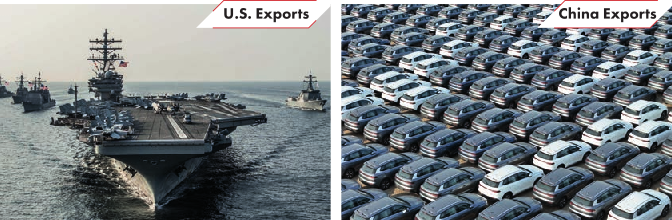
The defining feature of our epoch is the antagonism between U.S. imperialism and China. Since 1945, the U.S. has been the dominant imperialist power and the guarantor of the world capitalist system. But for decades its economic base has been in relative decline. This was accelerated by post-Soviet globalization, the main beneficiary of which was China. This basic picture is widely agreed upon. However, the concrete dynamics and contradictions of this conflict are widely misunderstood in favor of impressionism and empiricism. It is necessary to understand the historical development of this relationship in order to understand the dynamics of the international situation today.
On the level of production, globalization led to the hollowing out of the industrial base of the imperialist bloc in favor of China and other countries of the Global South. The global manufacturing share of G7 countries declined by nearly half, falling from around 60% in 1995 to around 30% by 2020. The U.S. share of this figure dropped from 21% in 1995 to 17% in 2022. During the same period, China’s share of global industrial output increased from 6% to 32%. This represents a truly seismic change in the balance of forces in this decisive arena, critical for large-scale war.
However, China’s industrial and commercial weight far outweighs its financial and institutional role in the world economy, which remains firmly dominated by the U.S. and its allies. The institutions governing the international economy and relations remain those established by the U.S., namely the IMF, World Bank, WTO and the United Nations. While the dominance of the U.S. dollar has diminished, it remains the world’s reserve currency, affording the U.S. “exorbitant privileges.” Wall Street remains the center of international finance. The U.S. share of global market capitalization has remained at 45–50% in recent decades, whereas China’s share has risen from virtually zero in 1980 to around 10–12% in 2025. And while China accounts for roughly 15% of global trade, the renminbi is used to invoice only around 2% of global trade.
Many argue that the exceptional growth in China’s economic, commercial and military power means it is actively striving to supplant the U.S. on the world stage. This could not be further from the truth. Fundamentally China plays a conservative role and is not doing anything to decisively bridge the massive gap between its economic strength and its institutional and financial weakness—an anomaly for an emerging power.
This picture is reflected in the military dynamics between the two great powers. The U.S. continues to have military preponderance, with 750 bases globally. And while China now has the second-largest military by expenditure, it is geared toward protecting its own borders, not replacing the global domination of the U.S. Its sole military base abroad is in Djibouti. While the U.S. has no qualms about using its military force, imposing its will on one country after another, China has not waged war since 1979. Faced with tariff assaults, it did not utilize its choke hold on rare earth minerals to cripple the U.S. military-industrial complex. It has done almost nothing to defend its partners when they have come under attack by the U.S.—Venezuela, Iran and Cuba being the main examples. In the realm of foreign policy, China prefers appealing to international law and “win-win” cooperation rather than wielding the considerable hard power at its disposal.
Fundamentally, China is not acting to establish its own hegemony, but seeks to reform the current order to improve its own standing and gain a degree of autonomy. It is of decisive importance to understand why this is the case. Where imperialism is by its very logic impelled toward expansion and conquest, China is not driven by the same laws. The state structure and social development of the People’s Republic of China (PRC) remain rooted in the 1949 Revolution. This does not mean China’s foreign policy is benevolent or guided by internationalism; far from it. But the social foundations of its state mean that its growth does not necessarily lead to the drive to subjugate other nations. It is because of this that there is simply no exclusive Chinese zone of influence imposing itself at the expense of the U.S. empire.
The primary contradiction at the heart of the world system is reduced to the following dynamic: U.S. hegemony is being undermined by the rise of China, but the Communist Party of China (CPC) is not trying to upend the U.S.-led order. Given the decay of industry and the parasitic role played by finance capital, the U.S. economy simply cannot outcompete China through conventional means. To stay on top, it must resort to ever more aggression and force to bring down the rest of the world. We are thus confronting a historically unprecedented situation where the emerging power is struggling to preserve the status quo while the declining power is tearing it up, trying to forge a new, reactionary realignment in world relations, squeezing ally and foe alike to achieve this aim.
The Impotent Allies
Within this emerging dynamic, Europe finds itself caught in a growing contradiction. The weakening of U.S. hegemony raises the need for the European powers to have greater strategic autonomy. Yet despite growing tensions, the European Union (EU) has not broken from the U.S. but is falling in line with its diktats, committing ever-greater resources to propping up the U.S. empire. First, this is explained by the fact that the entire foundation of modern Europe was built under the umbrella of U.S. military power, from its construction after World War II to its expansion following the collapse of the USSR. This is embodied in NATO. Without the U.S. as a unifying force, the EU would disintegrate into its component parts.
Second, due to their own relative decline, the imperialist countries of the EU have become ever more dependent on the U.S. to defend their privileged position on the world stage. Despite their best wishes, and multiple empty declarations to the contrary, they do not currently have the ability to project their power independently. Thus, rather than emerging as an independent pole, Europe is increasingly following the reactionary course being laid down by Washington, destroying its own economic and political stability in the process. The same dynamic explains the trajectory of Japan and junior imperialist powers such as Canada and Australia.
Russia, the Immovable Object
Russia stands out as an important force resisting the U.S. Although it has sufficient military power to obstruct U.S. ambitions, it lacks the economic and social weight necessary to establish a rival global order. The war in Ukraine, which Russia is likely to win, demonstrates its ability to resist and push back against NATO expansion on its western border. However, these efforts have come at a considerable cost. Further, its attempts at international adventures, whether in Syria or Africa, have not been successful and have not significantly increased its international influence. Russia’s overall role is less as an alternative pole to U.S. domination and more as a brake on it: accelerating the crisis of the existing order without being able to replace it.
The Spiral of Reaction in West Asia
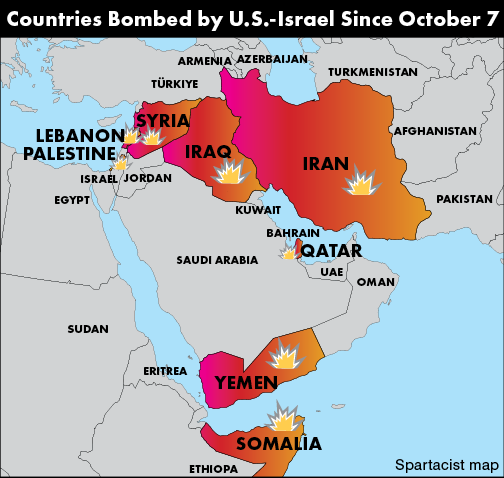
Since October 7, Israel has engaged in an escalating cycle of carnage, assisted at every step by the U.S. This dynamic is not primarily due to October 7 itself, but to the relative weakening of the Israel-U.S. position in the region, mainly in favor of Iran. As a nationalist project rooted in the oppression and genocide of the Palestinians, Zionism cannot tolerate any regional counterweight to its domination which could challenge its ability to oppress the Arab masses. As a result, the Zionist state has used increasingly aggressive methods to re-establish its supremacy in West Asia, destroying the entire social fabric of the region.
While the U.S. and Israel have succeeded in inflicting tactical and strategic defeats (e.g., Syria) on many of their adversaries, these have not resolved the underlying crisis of their regional position. Military superiority has not enabled them to establish a stable political order, and they have failed in their attempts to destroy the Islamic Republic. However, it remains to be seen what the longer-term consequences of the increased pressure will be for Iran. What is certain is that the U.S. and Israel will continue to wreak untold devastation on the region until they are decisively defeated.
Latin America in the Crosshairs

Venezuelan president Maduro kidnapped by U.S.
The rise of China provided many Latin American countries with greater economic and diplomatic room for maneuver, weakening the near-monopoly once exercised by U.S. imperialism. Yet the region remains deeply integrated into the political, military and financial structures of U.S. domination. As U.S. hegemony comes under increasing pressure globally, Washington is attempting to reassert its authority within what it continues to regard as its exclusive sphere of influence. It is doing so by leveraging both its decisive military advantage and its influence over key sections of the region’s ruling elites. Because of these advantages, the U.S. has identified Latin America as the most favorable terrain on which to push back against China and secure reindustrialization.
This has already been reflected in a renewed alignment of several governments with Washington and in a more aggressive assertion of U.S. power, as seen in the kidnapping of Venezuelan president Maduro and the escalation of the blockade against Cuba. Thus, the relative autonomy won by sections of the continent, as well as China’s economic interests, increasingly collide with the renewed determination of U.S. imperialism to restore its authority in the Western Hemisphere.
Africa Fragmenting
The African continent may not be the focal point of great-power competition, but it is disproportionately affected by its consequences. At a time when economic development and continental integration are more necessary than ever, Africa is increasingly pulled toward fragmentation and conflict. The absence of strong national states means geopolitical shocks take a much greater toll on an already vulnerable social fabric. This opens a space for regional and global actors to exploit existing divisions. As the old imperialist powers compete with a rising China, as well as regional actors including Russia, Türkiye and the Gulf monarchies, local conflicts are becoming increasingly entangled with wider geopolitical rivalries. States such as Rwanda have also sought to advance their own strategic interests, intervening beyond their borders and deepening existing tensions. The various conflicts shaking the continent—in particular in Sudan, the Sahel and the Democratic Republic of the Congo—and the sharpening social antagonisms within individual countries point toward state fragmentation, heightened national and ethnic antagonisms, and the collapse of public authority and services.
Yet Africa’s fragmenting is not new. Even the liberal period, which brought some economic growth to the continent, was plagued by bloody wars and genocides, from Rwanda to Congo to Darfur. While the liberal period saw a massive increase in imperialist aid through NGOs and international institutions, these have now been massively rolled back. In place of aid, the U.S. is dealing with the continent’s crises with either disinterest, naked plundering or open hard power. Thus, the current fragmentation is characterized by an increase in scope and depth.
While the fractured state of the continent presents extreme dangers, its young, growing and hyper-exploited working class also holds immense revolutionary potential. The very contradictions which divide and weaken Africa make the need for a revolutionary overthrow of the neocolonial order and the unification of the continent on a new social basis all the more palpable and urgently posed.
Southeast Asia Between the Anvil and the Hammer
Globalization integrated Southeast Asia into international supply chains as an intermediate link, dominated by foreign manufacturing giants, reliant on Chinese inputs and oriented to U.S. consumer markets. “With China on trade, with the U.S. on security” was the ASEAN catchphrase. Now, this means being caught between the anvil and the hammer. The U.S. is kicking the legs out from under the region’s economies, hacking away at its supply chains with the aim of strangling China. In a warning of what’s to come, Trump’s tariff assaults and the war against Iran have already delivered devastating economic blows to a region where much of the population lives on the brink. By militarizing Southeast Asia and encouraging the aggressive expansion of Japanese forces across the region for the first time since WWII, the U.S. is raising the specter of war as it heightens its threat against China. Across Southeast Asia, the ground is being prepared for social explosions.
Global Economy on the Brink

Despite mounting geopolitical tensions, the basic structure of the world economy has remained remarkably resilient. But the very forces that have sustained this resilience—centrally the extraordinary performance of the U.S. stock market—are generating new contradictions that threaten to destabilize the entire system. Wall Street’s gravity-defying rise has been driven by unprecedented levels of fiscal and monetary stimulus, massive capital expenditure by the major technology companies and the speculative frenzy both have engendered. While it is impossible to know exactly when this dynamic will come to an end, what is certain is that the eventual unwinding of the speculative boom centered on the technology sector will have profound consequences for the world situation. Already, China’s deflationary pressures and excess industrial capacity are being exported to the rest of the world—likely early signs of a global crisis of capitalist overproduction.
The bursting of the financial bubble will sweep away the mountains of fictitious capital which mask the true balance of international forces and expose the rot at the heart of the U.S. empire. Yet so long as the basic architecture of the world economy remains intact, the U.S. will retain enormous advantages in shaping both the response to the crisis and its outcome, enabling it to shift a significant share of the burden onto other countries.
In the first instance, we can expect the coming crisis to exacerbate all the existing dynamics and the intensification of capitalist attacks. But whether this results in a further descent into reaction or opens the road to revolutionary developments will depend above all on the response of the international proletariat. Here, the outcomes depend on the leadership and organization of the working class in each country. It is to this political question that we now turn.
Part II: The Dynamics of World Politics
“A failure of correspondence between subjective and objective is, generally speaking, the fountain-source of the comic, as also the tragic, in both life and art. The sphere of politics less than any other is exempted from the action of this law. People and parties are heroic or comic not in themselves but in their relation to circumstances.”
—Leon Trotsky, History of the Russian Revolution (1930)
The Death of Liberalism and the Rise of Reaction
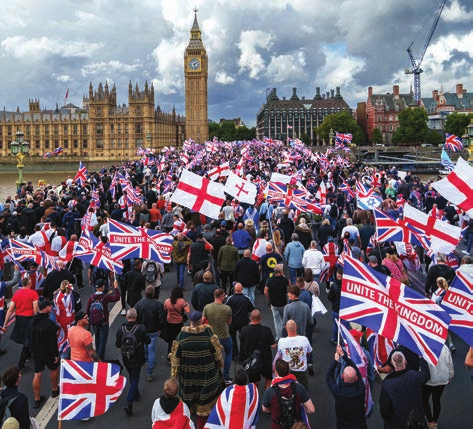
Reactionaries flood Central London in “Unite the Kingdom” rally, September 2025.
The political status quo of the post-Soviet period is shattered. The ideological tools appropriate for the post-Soviet era of U.S. hegemony no longer correspond to the needs of the imperialist powers today. When U.S. hegemony was uncontested, the U.S. could afford the luxury of liberal democracy at home and abroad, fund NGOs and proclaim itself the champion of human rights, free trade, multiculturalism, etc. This road is now exhausted. As its hegemony slips away, the U.S. must go on the offensive. It cannot do this through liberal values and institutions, which are now obstacles to its aims.
The death of liberalism does not mean that a new realignment in world politics has been sealed. The general trend unleashed by the offensive of U.S. imperialism is toward increasing instability, reaction and conflict. But we are not on a straight road to hell. There is a difference between the needs and aims of U.S. imperialism and its ability to meet and implement them. Already its offensive has provoked all manner of resistance. However, the various contenders and would-be challengers are laying bare their bankruptcy, allowing the U.S. to retain the initiative in shaping world politics even in its decline. As a result, the liberal world order is being brought down by an insurgent imperialist right wing, not through a proletarian upsurge or an anti-imperialist offensive.
The leaders of the Global South are coming under ever-greater pressure to resist the depredations of U.S. imperialism but, bound by their own class interests and fear of mobilizing the masses, they seek to accommodate and maneuver rather than confrontation. The Communist Party of China, presiding over the gains of the 1949 Revolution, is squandering the revolutionary energy and potential of the gigantic Chinese proletariat by clutching onto the remnants of globalization and the liberal world order. Most other leaders are focused on balancing between the various pressures, as opposed to unifying against the U.S. This is best exemplified by BRICS+, an alliance with no unifying strategic objectives and which amounts to less than the sum of its parts.
As for the workers movement, in most cases its leaders are desperately trying to shore up the liberal status quo even as it is collapsing before their eyes. Those on the left who claim to want a radical rupture, or even a revolution, generally stand far from the genuine sentiments of the masses, satisfying themselves with abstractions disconnected from the concrete tasks of the epoch. The absence of an independent proletarian opposition to U.S. imperialism is the single most important factor shaping world developments, whether in the imperialist centers, the semicolonial world or the various movements of resistance. Until this changes, the erosion of U.S. hegemony will continue to proceed on reactionary terms, increasing the oppression of the masses rather than advancing their emancipation.
This is not to say that non-revolutionary forces cannot inflict setbacks on the U.S. But these will always remain partial. Forging a true proletarian leadership is the central problem of revolutionary strategy in the present epoch. It can only begin to be resolved through a realistic appraisal of political dynamics and by drawing clear lessons from the experience of contemporary struggles.
Populist Right Ascendant in the West
The populist right is emerging throughout the West as the main anti-status-quo force, from Trump and MAGA in the U.S. to Reform in Britain to the AfD in Germany and Pauline Hanson’s One Nation in Australia. It is gaining ground on the basis of a convergence between the needs of U.S. imperial strategy and a broad rejection of the liberal status quo among significant layers of the population. As a result, it is increasingly able to channel working-class anger and resentment into a reactionary political agenda. The clearest sign of this rightward shift is that the political center of yesterday is itself adopting elements of the right: in Britain, the Labour Party has turned on immigration and, in the U.S., the Democrats have abandoned their earlier pretense of defending black and trans rights.
Pink Tide Crashes in Latin America
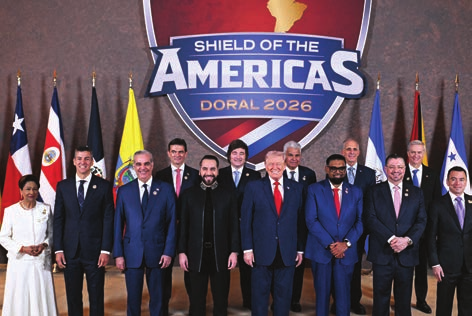
Trump’s alliance of Latin American villains assembles, 7 March.
The growing wave of right-wing governments in Latin America is driven by a similar rejection of the status quo of the last decades on the continent. Left populist governments which rode to power on the back of a wave of anti-imperialist sentiment in the 2000s are today falling like flies. While these governments enacted many progressive reforms, they also restrained the revolutionary energy of the masses, ultimately leading to retreats and betrayals. Now, it is the right populist and pro-imperialist forces who are riding on their failure to deliver lasting improvement, not Marxist challengers armed with the lessons of the Pink Tide.
The Bolivarian regime in Venezuela cracked at the first direct military blow by U.S. imperialism. How thoroughly rotten the regime had become has been shown by the absence of any significant mass upsurge against the kidnapping of President Maduro and by the fact that former Chavista Delcy Rodríguez is now collaborating with the U.S.
A similar trend is observable in Cuba, a beacon for the oppressed and anti-imperialists since 1959. The Cuban Revolution today hangs in the balance as Trump escalates the vicious U.S. blockade. Yet instead of an internationalist, revolutionary strategy to break the blockade, the Communist Party of Cuba is wagering everything on negotiations and has opened the doors to a capitalist takeover of the economy. This can only embolden the U.S. and the gusanos, who are determined to finally crush the Cuban Revolution.
There are contradictions in this picture. Mexico and Brazil still have left-wing governments. But while they have stood up to the U.S. in words, both Lula in Brazil and Sheinbaum in Mexico have also made numerous concessions. In the case of Bolivia, the mass uprising against Paz’s neoliberal government opened up a real possibility for a counterattack. However, the leadership of the Bolivian Workers’ Confederation made a pact with the government and called for a lifting of the blockades, thus betraying the indigenous peasant masses. This has caused a rift between the workers and peasants movements, weakening their ability to fight against the Bolivian bourgeoisie and its masters in Washington. Paz now has fertile ground to intensify his attacks against the masses. He has already imprisoned peasant leaders, attacked the unions and worsened living conditions. This outcome strengthens the grip of U.S. imperialism in the region.
Right-Wing Entrenchment in South Asia
The dynamics in South Asian countries present us with an advanced state of what is in store for the Global South. Squeezed between mounting external pressures and the gigantic needs at home, governments in countries like India and Pakistan are resorting to ever more religious nationalism, repression and bonapartism to manage the contradictions of their societies and secure their rule.
In India, the BJP has consolidated its national power through victories in recent state elections, in part made possible through mass cleansing of voters’ lists. The left is increasingly irrelevant. The communists, having alienated their base over decades, have lost their last toehold in power, and the Maoist insurgency is being crushed by the state. In Pakistan, there is even more military-dictatorial entrenchment, crushing any dissent, whether it comes from the left, Kashmir or from former prime minister Imran Khan. But there is a limit to how much the masses will tolerate. As we enter a more unstable period, the social tinder accumulating at the base of these societies will only find more dynamite, threatening to explode and destabilize the rule of these Bonapartes, like the uprisings in neighboring Nepal, Bangladesh and Sri Lanka. The recent struggles in Pakistan-occupied Kashmir and the student movement in India embody a similar potential.
Missed Opportunities
There have been important openings in recent years which could have turned the tide and put the working class on the political scene as a factor in shaping national and international events. This did not happen, whether it was the uptick in strikes in the West following the Covid pandemic or the Gen Z uprisings in the Global South. In all cases, there was no leadership ready to decisively capitalize on the upsurges, allowing the ruling class to regain the initiative. In each case the obstacle was not the absence of militancy but the absence of leadership.
The strike wave in Britain (2022-23) and the struggle against pension reform in France (2023) were defeated by trade-union leaders unwilling to escalate the struggle far enough to decisively defeat the governments. In the U.S., the wave of strikes and contract battles in 2023 (UPS, ILWU, UAW and Hollywood), as well as the 2024 Boeing and ILA strikes, were settled by increasing wages but leaving the other decisive questions driving the strikes unresolved. This had the effect of containing the class struggle. Had these struggles been successful, the working class would have emerged as a stronger, revitalized and more united force, with confidence in its own ability to struggle and win.
In Greece, the Tempi struggle could have radically changed the course of the country with the potential to change the relationship of forces in favor of the proletariat after the big defeat of 2015. However, the workers movement failed to capitalize on the discontent of the masses. The KKE, the leadership of the workers movement and the left capitulated to the petty-bourgeois leadership of the movement that promoted a strategy of “no parties or colors,” rejecting a working-class perspective. Their policy refused to transform the mass anger into a decisive struggle against imperialist subjugation, which caused the crime. This defeat has further weakened and demoralized the working class and the oppressed.
The recent Gen Z uprisings were important explosions of discontent fueled by rapidly deteriorating conditions for youth in the semicolonial world and seething hatred for their venal rulers. Yet the raw energy driving them was not on its own enough to improve the overall position of the masses. Some uprisings were crushed by repression (Indonesia, Morocco, Peru) while others led to right-wing governments (Bangladesh, Nepal) and a military regime (Madagascar). These outcomes stem from the absence of a coherent political leadership capable of charting a progressive course against the ruling classes and imperialist subjugation. That the working classes played a marginal role in these movements enhanced their heterogeneity, leaving them vulnerable to repression and co-optation.
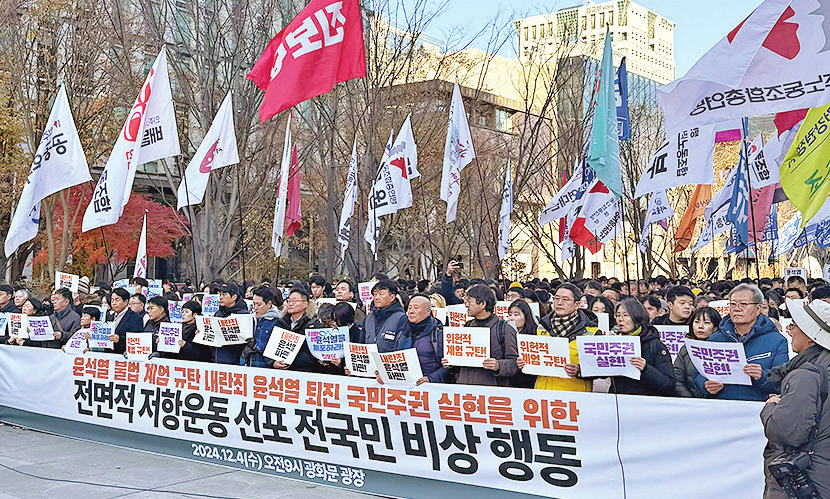
KCTU-led mass protest in Seoul following then-president Yoon Suk-yeol’s attempt to impose martial law, 4 December 2024. Banner reads: “Declaration of All-Out Resistance Movement, Nationwide Emergency Action.”
The December 2024 coup by former South Korean president Yoon Suk-yeol was quickly beaten back by militant union-led mass mobilizations. This stunning defeat put the working class in a position of strength. This backlash against the rabidly pro-U.S. agenda of Yoon Suk-yeol could have opened a major rift in the U.S.-South Korean alliance—the cornerstone of reaction in the country. However, the trade-union leaders sold out, siphoning off the anger into a vote for the equally pro-imperialist but less rabid Democratic Party, stabilizing the political situation for the ruling class.
The Liberal Left Breathing Its Last Gasp
Although the right is on the rise internationally, the growing instability and turmoil in the world nonetheless continue to push forward forms of left-wing resistance built up and shaped by the preceding period. In the realm of political parties, these include outfits such as the Greens and the already-moribund Your Party in Britain, Die Linke in Germany and La France Insoumise. Many observe these and gain a renewed sense of hope. This is as dangerous as it is deluded.
What is fueling this “left-wing resurgence” is unfortunately not a new wave of working-class militancy or deep working-class support. Rather, the driving force of these parties is the palpable sense of panic and desperation among large layers of middle-class liberals and progressive students, as well as minorities rightly terrified at the prospect of right-wing governments. These parties and their leaders represent a knee-jerk reaction to world events, grasping at a more radical version of liberalism in the face of uncertainty and chaos. Recycling the tired tropes of liberalism when the world order that sustained them is disappearing is not a recipe for success, but for spectacular disaster.
It is precisely this character which makes these parties impotent and which repels more conservative workers further away from them, strengthening the right wing in their respective countries: the Greens lag behind Reform in Britain, Die Linke well behind the AfD and Mélenchon behind the far right in France. What we are witnessing is not a resurgence of the left, but a tragicomedy being penned by the growing gap between the worsening objective situation and the completely useless subjective elements being pushed forward in response.
The proponents of this left-wing resurgence also point to the recent strike of the Italian workers for Palestine and the “block everything” movement in France. Yet these have failed to emerge as sustained movements. They ended as soon as they began, and have not shifted the overall trajectories of their countries. In France, the Rassemblement National is inching closer to the Presidential Palace and, in Italy, Meloni faces no significant challenge to power. In both cases, what we are witnessing is the incapacity of radical syndicalism—a strong tradition in both countries—to deal with the changing world situation.
U.S. Left Dumps Identity Politics, Not the Democrats
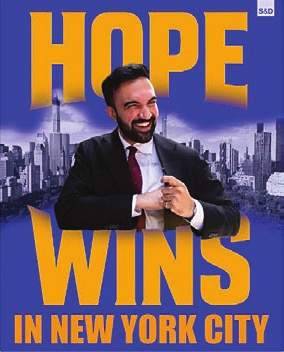
So 2008.
The second term of Donald Trump has provoked important developments on the left in the U.S. On the electoral field, Democratic Socialist Zohran Mamdani was elected mayor of New York on a bread-and-butter platform explicitly modelled on 20th-century “sewer socialism.” Concretely, this platform is based on avoiding the most explosive social questions such as racial oppression and police brutality. This is an important move away from the era of identity politics. Like other DSA electeds, Mamdani has lost no time in attacking the working class and black and Latino masses. However, this has not stopped most of the left hailing his victory as a great triumph, excusing his betrayals and refusing to wage a real fight in the DSA and the workers movement to break with the Democratic Party.
In response to ICE terror in the streets, there have been important and often heroic popular struggles. The high point of these mobilizations was achieved in Minneapolis following the murder of two anti-ICE protesters. While these struggles have shown that there is deep popular opposition to Trump’s totalitarian deportation program, they have also shown the incapacity of the movement so far to break through the conservative leadership of the trade unions and the Democratic Party. Trump has been forced into temporary retreats, but his overall anti-immigrant offensive has not been broken.
Axis of Resistance at a Dead End
The Islamic Republic’s resistance against the U.S. and Israel’s military onslaught has fostered illusions that this theocratic-capitalist regime can lead the fight against imperialism in West Asia. But while the Islamic Republic has shown it can stand up to the U.S., it has simultaneously shown that it is utterly unwilling and incapable of being a rallying point for genuine anti-imperialist resistance which can expel the U.S. from the region.
The Iranian ruling strata certainly has an interest in this, but it comes second to its interest in maintaining its own parasitic existence. As a result, it keeps resistance against foreign aggression within tight military-bureaucratic control, refusing to call on the masses of the region to enter the struggle. Moreover, the Islamic Republic’s despotic internal regime divides the oppressed along national, religious and gender lines, making a unified anti-imperialist struggle impossible. Worse, its bloody repression of dissent pushes large layers of the population into the arms of monarchist, pro-imperialist reaction. To defeat imperialism and expel it from the region requires the broadest unity of the masses, which simply cannot be built on the politics of the Islamic Republic.
The resistance of the Palestinian people against the genocidal Zionist onslaught has been heroic. Yet this fact must not be used to mask the political and strategic impasse of the liberation movement. The Palestinian people have experienced a social and human catastrophe on an unprecedented scale. Gaza is in a complete state of disaster and Israel wants to annex entire swaths of what remains of it. The West Bank is worse than ever. This has exposed the failures of Hamas’ strategy: reliance on liberal public opinion and the Arab regimes to defeat Israel, rather than on the masses of West Asia in a united struggle against Israel, the U.S. and the Arab regimes that conciliate them. In this impasse of the resistance, Hamas is basically negotiating the terms of its own disarmament and the movement has no strategic perspective for how to continue the struggle.
Palestine Movement Dissipating
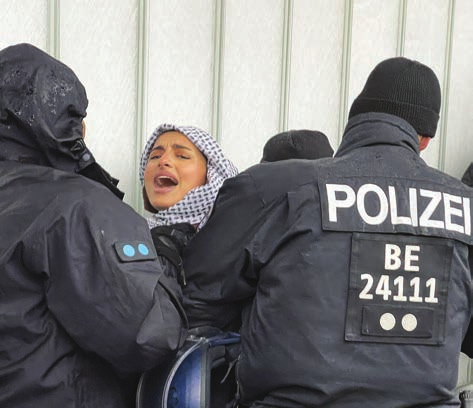
Police drag off a pro-Palestinian activist in Berlin, October 2025.
The Gaza genocide stirred millions into action, and hundreds of thousands marched in major cities throughout the world for over two years. Yet this was not enough to put a stop to Netanyahu. In the West, the movement was paralyzed by the liberal outrage which dominated its politics and its reliance on politicians such as Rashida Tlaib in the U.S., who spoke out against Israel while being a representative of the very party which was facilitating the genocide. In Muslim-majority countries such as Indonesia, Malaysia and Türkiye, the governments supported or even organized mass mobilizations while maintaining their alignment with the U.S.
The Palestine movement did not have as its strategic perspective to fuse the needs of the working class to the struggle for Palestinian liberation. This would have put real pressure on governments to break their support or conciliation of Israel. Instead, in most countries the mass Palestine marches were largely tolerated, regularly scheduled events which became the norm to let out anger. But anything that violated this norm and sought to challenge its direction remained relatively isolated and was brutally crushed by state forces. Today, the movement is in an enfeebled state. Revolutionaries must draw sober lessons from this outcome and work toward its political rearmament.
Brace for Attacks, Shocks and Upheavals
Overall, the balance of forces internationally is not one which favors the working class and oppressed for the foreseeable future. U.S. imperialism is on a rampage, the right is ascendant and there is an ever-growing gap between the left and the working class in most countries.
For the moment, demoralization, apathy and a tendency toward retreat and self-preservation is the dominant trend in the working class. But class struggle does not proceed in a straight line. The populist right is capitalizing on built-up discontent and successfully pushing it into anti-immigrant and other reactionary channels. This model may work for some time, but it is fundamentally unable to solve any of the underlying drivers of social crisis. Those who look to the right to deliver on its promises—of growth, jobs and a return to the “good old days”—will be disappointed. Inevitably the working classes will be pushed into action. The question for revolutionaries is whether these confrontations will ultimately result in victories, strengthening the workers movement, or defeats and a further drift toward imperialist reaction.
In the Global South, chronic underdevelopment and the U.S. imperialist offensive are intensifying social crisis and deepening instability. The combination of imperialist strangulation, domestic decay and growing discontent at home is piling pressure on the corrupt national bourgeoisies, pushing them toward repression, bonapartism and nationalist divisions to prevent a united struggle. For revolutionaries, the task ahead is serious preparation. They must break out of the trap of either tailing every movement which erupts or resorting to abstract methods of the “pure” class struggle. The task is to merge the needs of the masses with the struggle for national liberation from imperialist domination.
Part III: A Revolutionary Program
“No one has bothered to pave in advance the road of revolutionary upsurge for the proletariat. With inevitable halts and partial retreats it is necessary to move forward on a road crisscrossed by countless obstacles and covered with the debris of the past. Those who are frightened by this had better step aside.”
—Leon Trotsky, “To Build Communist Parties and an International Anew” (1933)
Fight the U.S. Empire!
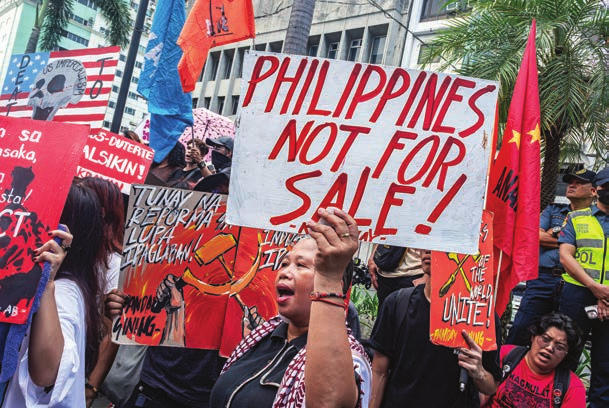
Protest against U.S. military presence, Manila, 4 July.
U.S. imperialism is the main force dragging the world toward barbarism. Fighting the U.S. empire is thus central for the international proletariat and oppressed everywhere. The working class in the U.S. is made to pay for the global ambitions of its ruling class through militarism, austerity and attacks on its living standards. Across the imperialist countries and in the U.S.-aligned semicolonies, the ruling classes remain deeply tied to the existing order. Whether it is allegiance to NATO and trans-Atlanticism in the West, Japan marching onto the road of rearmament, or the Quad in the Indian Ocean, opposing the alliance with the U.S. forms an integral part of the struggle against the ruling classes in these countries.
In Ukraine, soldiers are being sent to the slaughter for the interests of the Western imperialists and their Ukrainian puppets. In neocolonial countries and workers states facing sanctions, economic pressure or military threats, the struggle against national and social oppression will bring millions into motion, posing the overthrow of imperialist domination and the national bourgeoisies. Everywhere, the struggle against U.S. imperialism provides a basis for uniting workers across borders and forging an international revolutionary leadership capable of challenging the existing world order.
For a Proletarian Strategy Against U.S. Imperialism!
Revolutionaries must build the strongest opposition to the U.S. empire. But the decisive question is which political strategy and methods of struggle are capable of actually defeating it in a progressive manner. The emancipation of humanity from barbarism depends not on the victory of one rival ruling class or geopolitical bloc over another, but on the revolutionary triumph of the international proletariat. The means and methods of the anti-imperialist struggle are inseparable from its aims: permissible only are those means which build the political independence and unity of the working masses. Anything to the contrary ultimately deepens national divisions, strengthens the ruling classes and therefore weakens the struggle against imperialism.
This is the central flaw of “campism.” It rejects proletarian independence as the guiding thread of the anti-imperialist struggle and supports any force opposed to the U.S. and its allies, regardless of its class character or policies. Under this logic, states such as Russia and the Islamic Republic of Iran, or alliances like BRICS+ are treated as progressive poles of resistance simply because they present a challenge to U.S. dominance. This logic of lesser-evilism ends up excusing the crimes and oppression carried out by such forces on the grounds that they weaken a rival.
The implications of this approach are disastrous. Siding with Russia in the Ukraine war, for example, on the basis that it is fighting a NATO proxy accepts and legitimizes the national oppression of Ukrainians as a lesser evil in the struggle against U.S. imperialism. This further divides the working class in Eastern Europe, binding it to its respective rulers, thus obstructing its revolutionary unity against the dominant forces responsible for the current status quo in the region: the U.S., EU and NATO. The same logic applies in Iran, where political support to the Islamic Republic against the U.S. repels the Kurdish masses and other oppressed minorities, clearing the terrain for pro-imperialist forces to step in as their saviors against an oppressive regime, thereby deepening divisions and strengthening the hold of imperialism in the region. In both cases, what is necessary is to take a stand against U.S. imperialism while putting forward a proletarian strategy.
For National Liberation Under a Communist Banner!
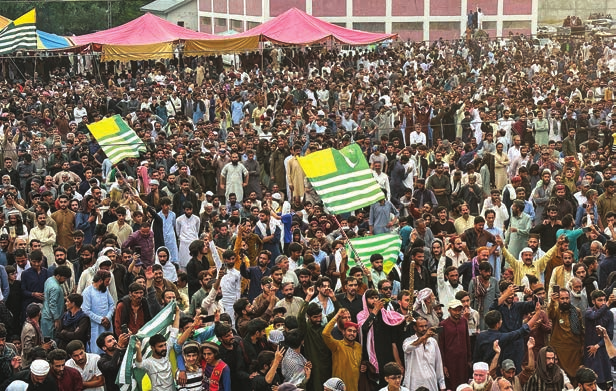
Mass anti-government protest in Rawalakot, Pakistan-occupied Kashmir, 24 June.
The offensive of U.S. imperialism is further subjugating and devastating the countries of the Global South, giving the struggle for national liberation an ever-greater urgency. Revolutionaries must oppose the economic and military predations of the U.S. and its allies, whose wars, sanctions and coercion are unleashing havoc on oppressed nations. This means taking a side with the forces directly under the gun, from Palestine to Iran and Cuba. Standing firmly against national oppression everywhere is a precondition for uniting the international proletariat against imperialism.
The decisive task is to fight for leadership of the national liberation struggle in opposition to the national bourgeoisie, which claims to represent the interests of the whole nation and uses nationalism to bolster its authority. As an exploiting class, it will ultimately seek to restrain, divert or crush the independent mobilization of the masses in order to preserve its own power, thereby betraying the struggle against imperialism. Revolutionaries must expose its vacillations by pushing forward the struggle against imperialism.
The Marxist and anti-imperialist movement is divided into two wrong trends. One rejects national liberation struggles as inherently bourgeois, proclaiming socialist revolution while abandoning the real aspirations of the masses. In so doing, it leaves the masses to the leadership of the nationalists. The other trend tails behind the national bourgeoisie, especially its radical or anti-imperialist wings, likewise tying the masses to nationalist forces and abandoning oppressed groups to manipulation by pro-imperialist forces. Both trends abandon the central task: building proletarian leadership of the struggle for national liberation.
For a Workers and Peasants Alliance!
Due to direct colonial and neocolonial domination, unresolved democratic questions remain a defining feature of the semicolonial world. Foremost among them is the agrarian question: the fate of millions of poor peasants, landless laborers and agricultural workers. The onslaught by U.S. imperialism against the semicolonies makes these layers some of its primary victims. Its relentless pursuit of control over natural resources, the expansion of agribusiness conglomerates, land speculation and rising prices caused by crises and wars are further ruining this segment of the population.
The working classes, often linked directly to the countryside through ties of kinship, are also under attack, and so have a material interest in defending the rural masses and the entire nation against further subjugation. The only effective way to resist is to forge an alliance of workers and poor peasants to jointly defend their living conditions. The task of revolutionaries is to build this alliance as a means to advance the anti-imperialist struggle and, in so doing, expose the impotence of the national bourgeoisies in confronting the U.S. offensive.
Defend China! Down With the CPC Bureaucrats!
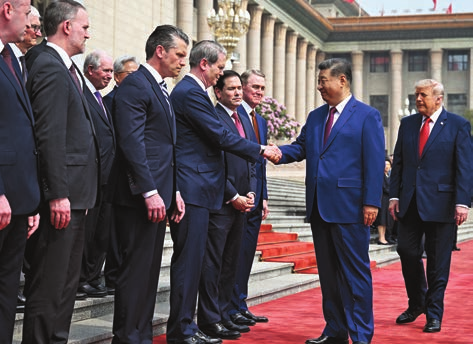
President Xi rolls out red carpet for mass-murdering Trump cabal, 14 May.
The defense of China will be a decisive test for revolutionaries in the coming period, just as the defense of the Soviet Union was throughout much of the 20th century. China cannot be understood apart from the 1949 Revolution: although many of its gains have been greatly eroded, the social foundations created by that revolution have not been overturned. The People’s Liberation Army, which destroyed the old ruling classes, remains the armed force of the state which emerged from this revolutionary process. For U.S. imperialism, whose global position is increasingly challenged by China’s rise, counterrevolution in China has become a strategic necessity. The defense of China is therefore inseparable from the struggle against U.S. imperialism.
The collapse of the Soviet Union demonstrated that the defeat of a proletarian social order does not merely transform one country; it reshapes the global balance of forces. U.S. imperialism’s victory over the USSR opened a period of unprecedented domination, allowing it to project its power with far fewer restraints. A similar defeat in China would represent an even greater historic reversal—the destruction and subordination of one of the largest concentrations of productive forces on the planet—worsening conditions for workers internationally. The question is therefore not only the fate of China, but the fate of the international proletariat. Failing to defend China or equating it to the U.S. can only strengthen imperialism’s offensive and accelerate the descent toward barbarism.
The defense of China, however, cannot be separated from the political independence of the proletariat. Defending China does not mean political support for the CPC bureaucracy, which has repeatedly demonstrated that it seeks accommodation with the imperialist order rather than relying on the international working class to challenge it. In fact, the CPC actively alienates the toilers in other countries through its nationalist military, political and trade policies. The defense of China must be combined with a struggle against the CPC bureaucracy, whose rule prevents the working class from acting as the decisive force in defending and extending the gains of the revolution.
Break the Popular Front!
In response to a rising right, a growing tendency on the left seeks alliances with “progressive” forces to block reaction, abandoning class independence in the process. This is the popular front—tying the workers movement to the liberal wing of the bourgeoisie. This prevents the working class from developing an independent struggle against the material basis of right-wing reaction.
The record of the popular front speaks for itself. It always fails to stop reaction. At best, it delays the process, only for it to return with greater strength. In France, repeated “Republican” alliances have not halted the country’s rightward trajectory; the far right is now closer to power than ever. In India, the coalition between the Congress, communist parties and other bourgeois parties has not broken the consolidation of the BJP. The lesson is clear: the right cannot be defeated by aligning with the forces that fueled it.
The task of revolutionaries is to break the popular front. It is not enough to condemn it; workers and oppressed masses must be shown concretely how alliances with the bourgeoisie are detrimental to their interests. This requires that revolutionaries actively intervene and advance tactics toward formations like the DSA in the U.S., Mélenchon’s party in France or the communist parties in India to sharpen the contradictions between the aspirations of the base on the one hand and the dead-end strategy of the leadership on the other. Failure to fight for such a perspective can only leave the working class and left in the hands of the class enemy.
For the United Front!
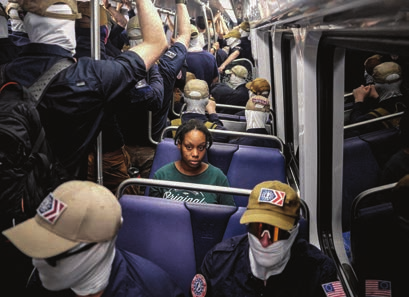
Black woman surrounded by Patriot Front fascists on 250th anniversary of American independence.
The rise of right-wing reaction has meant an increase in state repression against left-wing activists, as well as a growth of fascist attacks and provocations. More broadly, in the face of imperialist aggression and assaults on living standards and democratic rights, the socialist and workers movement is often fragmented and weak. To counter this, communists must champion the united front. The goal of the united front must be to unite the broadest forces possible in a struggle in the interests of the proletariat.
Yet this simple point is the source of great confusion on the left. On the one hand, many socialist organizations believe it is opportunist to form any bloc with non-revolutionary forces—leaving the oppressed divided in the face of attack. On the other hand, it is common for socialists to justify opportunist lash-ups in the name of the united front. Usually, this takes the form of placing the tactic of the united front—the need to rally the broadest forces—above the strategy it must serve. As Trotsky explained:
“March separately, but strike together! Agree only how to strike, whom to strike, and when to strike! Such an agreement can be concluded even with the devil himself, with his grandmother, and even with Noske and Grezesinsky. On one condition, not to bind one’s hands.”
—“For a Workers’ United Front Against Fascism” (8 December 1931)
Thus, the united front can be concluded with any forces—from union bureaucrats to bourgeois politicians—as long as it serves a specific cause in the interests of the workers movement: from repelling a fascist attack or campaigning to free imprisoned activists all the way to defending a strike and fighting attacks on living standards. Crucially, this includes uniting with nationalist and resistance forces against a specific imperialist aggression—the anti-imperialist united front.
The crucial purpose of the united front is for communists to demonstrate, in action, the superiority of a revolutionary strategy to advance even the most partial struggles of the working class against the liberal and legalistic strategies of bourgeois and non-revolutionary elements.
Unite the Oppressed, Ditch the Liberals!
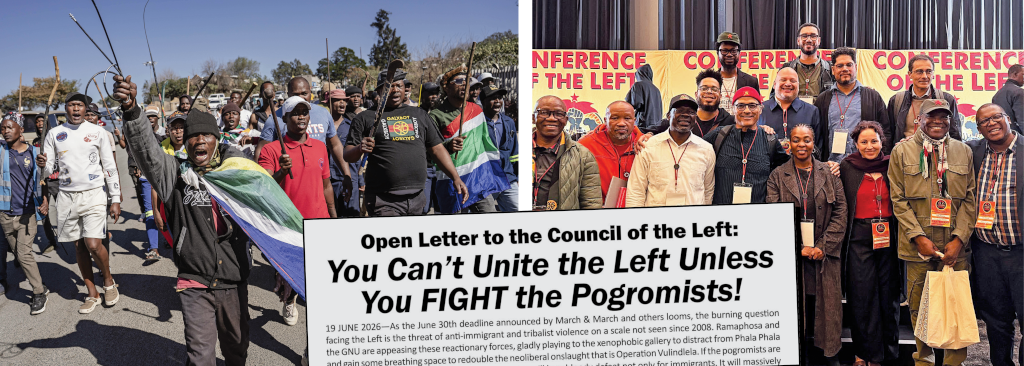
As anti-immigrant riots swept South Africa (left), SACP-led Conference of the Left conciliated MK Party, supporter of xenophobic rallies. Spartacist South Africa fought this capitulation.
The breakdown of the liberal order and the rise of the right are fueling social antagonisms within the working class. Divisions between immigrant and native-born workers, black and white workers, and men and women, and over questions such as trans rights, are increasingly weaponized against the oppressed. The right directs anger over social decline toward minorities, while liberals respond through moral appeals and identity politics, further entrenching these divisions. In semicolonial countries, these polarizations often lead to ethnic conflict and bloodshed. Revolutionaries must fight to overcome these divisions and build the unity necessary to strengthen the struggle of the masses.
This unity must be built by showing that the defense of the oppressed is in the material interest of the working class as a whole. Bigotry and chauvinism weaken the struggle against the ruling class by pitting segments of the working class against one another. For example, the polarizations around immigrants and refugees in countries from Britain to South Africa is rooted in social decline: scarce jobs, collapsing services and deteriorating living conditions. The blame lies not with immigrants, but with ruling classes that have allowed society to decay in order to protect their own interests. The solution is a united struggle of all workers against the ruling class.
However, much of the Marxist left either denounces reactionary ideas and their supporters without a strategy to win workers away from them or adopts economism, sidelining the specific struggles of oppressed groups in favor of economic demands. One leaves workers under the influence of reaction; the other leaves divisions intact and pushes minorities into the arms of liberals. Revolutionaries must reject both errors and show how the working class must champion the cause of all the oppressed to advance its own emancipation.
Turn the Trade Unions into Revolutionary Organs!
The working class is entering a period of mounting attacks on its living standards, rights and organizations. Yet the trade unions enter this period weakened by decades of defeats and by the class-collaborationist course of their bureaucracies. Against this, revolutionaries must fight within the unions for a class-struggle leadership.
This means intervening in every battle over wages, conditions and democratic rights, connecting these struggles to the broader fight against capitalism and imperialism. It also means breaking out of narrow craft limits and organizing the unorganized layers of workers. Only through such concrete struggles can the influence of the union tops be defeated and the unions transformed into true instruments of proletarian resistance. Unfortunately, much of the revolutionary left does not approach unions from this standpoint. Where it has influence in the unions, its work is marred by the twin plagues of opportunism and ultraleftism.
Opportunism consists in adapting to existing union leaderships, supporting “left” bureaucrats or simply advocating for the existing bureaucracy to be more militant. This substitutes pressure on the bureaucracy for a struggle to replace it on a revolutionary basis. The same is true when left forces take control of union apparatuses but preserve bureaucratic methods, or where union work is reduced to immediate economic demands while avoiding the political struggles needed to unite the class against divisions of race, nationality and gender. Ultraleftism is the opposite error: it either substitutes adventurist confrontation for the patient work of building an opposition to the bureaucracy or abstains from the unions altogether because they are controlled by the bureaucracy. Whether through adaptation or abandonment, these deviations leave the bureaucracy’s hold intact and strengthen the forces responsible for the defeats of the working class.
Part IV: The Task of Revolutionary Regroupment
“Mass actions tend as a rule to wash away secondary and episodic disagreements and to aid the fusion of friendly and close tendencies. Conversely, ideological groupings in a period of stagnation or ebb tide disclose a great tendency toward differentiation, splits, and internal struggles. We cannot leap out of the period in which we live. We must pass through it. A clear, precise ideological differentiation is unconditionally necessary. It prepares future successes.”
—Leon Trotsky, “Groupings in the Communist Opposition” (31 March 1929)
The Marxist movement is not prepared for the upheavals on the horizon. It is small, splintered into innumerable competing groupings and increasingly isolated from the working classes. This crisis is not simply a result of unfavorable conditions, but of political disorientation first and foremost: the failure to build a revolutionary opposition to the liberal world order in the preceding period, leaving the ground open for the right wing to capitalize on the backlash today.
As the U.S. tears up the old status quo and pursues a reactionary realignment, the left is mired in disorientation about the fundamental dynamics shaping world events. There are segments which proclaim that U.S. hegemony has already collapsed and place China and Russia on the same plane as the U.S. Others mirror the same mistake by hailing China and Russia as anti-imperialist heroes. On the political plane, the vast majority of the left denies or downplays the defeats suffered by the international proletariat in recent years, alibiing the misleaders and drastically miscalculating the balance of class forces for the coming battles. As a result, many project major breakthroughs for Marxists in the short term. Like the stock market, these illusions will soon burst as they collide with reality.
We do not claim to have solved the crisis of the left, nor do we have all the answers; that is the claim of fools. But we have advanced some key elements of Marxist analysis and program for the coming period. We have sought to outline the burning tasks of this epoch: building the fight against U.S. imperialism without abandoning proletarian independence, fighting right-wing reaction without subordinating workers to liberal forces, championing national liberation and uniting the struggles of the oppressed with a revolutionary class perspective. We have rooted this approach in a concrete analysis of world developments. It is around these lines that we seek to regroup the Marxist movement.
Such regroupment requires the patient work of programmatic and theoretical clarification. But this alone is not enough. Revolutionaries must seek to advance the concrete struggles of the masses in a direction corresponding to the independent interests of the working class as a whole, exposing the betrayals of misleaders and demonstrating the necessity of a revolutionary program in practice. Through this process, the basis for political clarification and unification can be forged. Only in this way can the movement overcome conservatism, bureaucratism and sectarianism. Only in this way can we forge the revolutionary leadership the epoch demands.
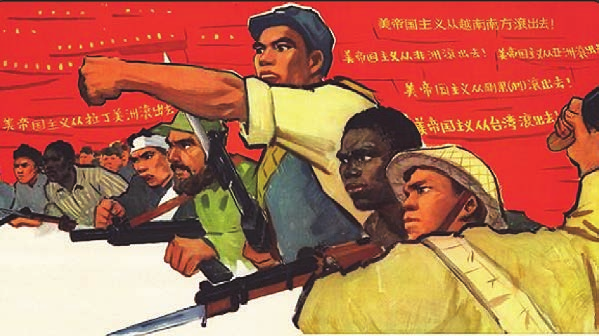
U.S. Imperialism Must Get Out
of All Places It Occupies!