
https://iclfi.org/spartacist/en/71/africa
The following presentation, edited for publication, was given by comrade Jesse at our Ninth International Conference.

To begin with the obvious point, the African continent is vast. There are many different dynamics in the different regions and countries, and even within different regions of single countries. To make things worse, we as a tendency have written almost nothing about most of them. Keeping these caveats in mind, the process of fragmentation which is described in the conference document hits on a fundamental dynamic shaping the continent. One statistic captures the basic issue at the economic level: less than 15% of all the trade conducted by African countries is with other African countries.
The current political dynamics within many African countries greatly exacerbate this problem. South Africa stands out in this regard: when you have daily pictures of foreign-owned shops being burned in Johannesburg and Durban, it threatens to block and reverse what little progress has been made toward economic integration of the continent. The anti-immigrant pogroms in turn feed into a bigger reactionary spiral: from Kenya and the Democratic Republic of Congo (DRC) to Nigeria, other regimes point to what’s happening in South Africa to justify cutting deals with U.S. imperialism.
Pan-Africanism is increasingly discredited among growing sections of the masses, having become identified with the rhetoric of the African Union and former liberation movements that are in power. For decades, they have hypocritically used phrases about African solidarity and unity as a cover for maintaining colonial borders and deepening their countries’ subjugation to imperialism. South Africa today shows very starkly how this fuels a chauvinist backlash which threatens to further weaken the masses and strengthen imperialism.
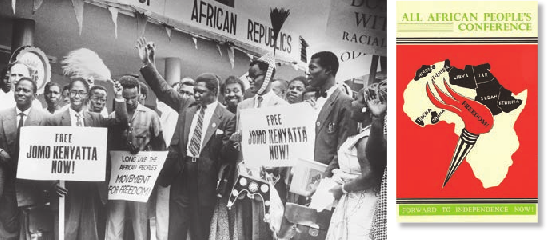
Accra, Ghana: 1958 All African People’s Conference. Nationalists could not achieve progressive goal of African unity.
Barriers to Progress
To begin to cut against this, what we have to do is start from the barriers to regional and economic transformation and ties, which means confronting imperialism at every step. First, almost all regional trade is conducted in U.S. dollars. The comrades from the Movement for a Socialist Alternative (FRL-Nigeria) pointed out to us that even the bandits, when they kidnap people, demand their ransoms in U.S. dollars.
Second, African countries are strangled by debt and corruption, making the maintenance of effective state powers—not to mention public services—increasingly untenable. The result of this is the proliferation of private military contractors such as Erik Prince’s mercenaries or the private police forces funded by the United Arab Emirates (UAE) that are being set up to guard mines in eastern DRC. In a way, Paul Kagame has also turned the Rwandan military into a contractor for the imperialists and foreign companies. This state fragmentation is an absolute barrier to national development and to continental trade.
Third, the infrastructure on the continent still reflects that established by European colonizers during the scramble for Africa in the 19th and early 20th centuries. For example, the Addis Ababa-Djibouti railway connecting landlocked Ethiopia to the sea was under French control for most of the 20th century. Falling into disrepair, it had become basically useless for trade by the early 2000s, before being replaced by a modern railway that Chinese companies began constructing in 2018.
So, how do we begin to turn this around? Obviously, the hyper-exploited, youthful working class of the continent is the only force that can lead this. But to get anywhere in forging the leadership of the working class needed for that monumental task, we have to start by being honest about the current state of our movement. What I want to emphasize, since I’m speaking to a room filled mainly with Trotskyists, is that our movement is not seen as having anything to offer to the masses of Africa—to put it bluntly.
One of the main reasons for this is that the dominant trend among Trotskyists on the continent is to reject the national liberation and anti-imperialist struggle as a diversion from class struggle. This completely cedes the ground to the nationalists and Stalinists, leaving their treacherous leadership of the most advanced sections of the workers and oppressed unchallenged. I want to address in particular the way Trotskyists have approached the U.S.-China rivalry, because it’s very important for understanding the current dynamics of the relationship of forces on the continent.
U.S.-China Rivalry in Africa
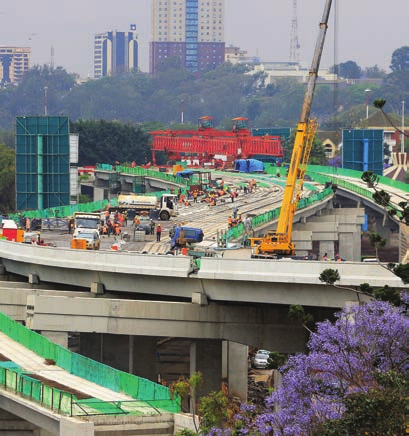
Construction of Nairobi Expressway led by Chinese state company, October 2021.
The dominant tendency among Trotskyists and many others is to view current developments through the lens of a “new scramble for Africa” in which China, like the U.S. and Europe before, is engaged in imperialist plunder. They view imperialism as an economic abstraction defined simply by foreign investment. And since China has by far the biggest economic footprint on the continent, and since Chinese companies are prominently visible in almost every country, the conclusion is to denounce China as one of the equally bad imperialists holding back African development. The appeal of this line of reasoning is bolstered by the fact that, in a superficial way, Chinese trade relations with African countries do in many ways resemble the colonial patterns. For example, the focus on the extraction of raw materials.
However, this whole way of viewing the U.S.-China rivalry in Africa obscures the true dynamics. It undercuts the ability of revolutionaries to compete with those who embrace the Communist Party of China’s (CPC) model as the way to liberate Africa. Among these are the Economic Freedom Fighters in South Africa or the Communist Party Marxist-Kenya. They both champion the line that the CPC regime is gradually weakening the power of U.S. imperialism, building a multipolar world, and that this shows the way to resolve the huge problems facing Africa. You can try to answer that by saying that China is imperialist, that it’s “bad” just like the U.S. But this will only further the isolation and impotence of Trotskyists, and it won’t convince anyone because it simply doesn’t reflect reality.
If you seriously study American and Chinese policies in Africa and their historical development, you cannot ignore the fundamental differences. On the one hand, the overriding concerns of the U.S. in Africa, besides countering Chinese influence, are extracting minerals and interest payments on debt. Nothing else really matters.
On the other hand, China also has an interest in extraction. But that is not the only concern driving Chinese intervention in Africa. Besides extraction, CPC policy is aimed at trying to build up stable powers on the continent to trade and interact with. It does this primarily through cooperation with African elites, trying to woo them away from Washington. But at the same time, it appeals to the felt needs of the masses for development and an alternative to the Washington consensus, arguing that China’s growth model offers a way to industrialize and break free from imperialist subjugation. No serious attempt to make sense of China’s role in Africa can ignore this.
To recognize this does not mean hailing CPC policy in Africa as progressive. No, it is reactionary in many ways. Rather, it is to acknowledge that there is a profound contradiction between the progressive, anti-imperialist aspirations for African development that China’s policy appeals to, and the fact that the CPC’s bureaucratic, gradualist strategy stands in the way of actually realizing those progressive aspirations. In fact, this strategy plays into the hands of U.S. imperialism, as we can see with some African governments that were previously aligned with Beijing now turning toward Washington (the DRC, for example). Revolutionaries must leverage this contradiction to build a proletarian pole against U.S. imperialism, in competition with the CPC and the nationalists.
Ethiopia
Ethiopia shows concretely how this dynamic plays out. Ethiopia has seen major economic growth since the early 2000s, mainly driven by Chinese investment in manufacturing and industry, as Ethiopia does not have a lot of resources to extract. One of the central projects of the CPC in the region has been to build a free-trade zone centered on Ethiopia and projected to be the largest in Africa. The Addis-Djibouti railway mentioned above is part of this project. So, economic development and regional integration—good things, right?
The problem, however, is that if you look at the methods with which this has been carried out, they do not in any way touch the fundamental obstacles to lasting development. This requires addressing national unification, overcoming ethnic rivalries, and the radical overturn of feudal land relations. The Chinese model for economic development in Ethiopia left all these issues completely unresolved. And that is no accident because as China’s own history powerfully attests, to fundamentally address these problems requires a ruthless struggle against imperialism and a break with the bourgeois-nationalist forces that conciliate it.
Because none of these underlying issues were addressed, the economic growth stimulated by Chinese investment exacerbated all the social contradictions. In particular, it benefited mainly urban areas, and above all the elites of the Tigray People’s Liberation Front (TPLF)—which, despite being based on an ethnic group representing only 6% of the country’s population, has dominated the governing alliance that ruled since the 1990s.
This fueled a backlash among the peasantry, particularly among the Oromo and Amhara peoples, the two largest ethnic groups. Lacking leadership to direct this anger against the imperialists and their lackeys, their legitimate anger over lack of rural development has been channeled against the Tigray minority by the elites around current prime minister Abiy Ahmed, using this to sideline the TPLF and consolidate their own hold on power.
This became a driving force for the 2020-22 war in the Tigray region. The truce that halted this bloody conflict is in constant threat of breaking down because of increasing tension within the Oromo-Amhara elite coalition, as well as shifting regional and global alignments. At the regional level, it has led to an increase in Ethiopia’s destabilizing influence in neighboring countries and to strengthening Ethiopia’s alignment with the UAE.
A Shift in Imperial Proxies
The alliance with the UAE points to an important shift in the Red Sea/Horn of Africa region, and more broadly on the continent: the increasingly prominent role of the Gulf monarchies (along with other actors like Türkiye). U.S. imperialism has historically never really sought to play a major interventionist role on the African continent, relying on the former colonial powers to take the lead on the ground. An important turning point in this regard came with the Arab Spring and the NATO intervention in Libya, which, by destroying the Libyan state, had a number of farther-reaching consequences throughout the continent, including fueling armed conflicts in the Sahel and other regions.
The consequence it underlined was the increasing ineffectiveness of European military power, prompting the U.S. to turn instead to the Gulf monarchies as a cheaper means of pursuing American interests in the region. This has had far-reaching reactionary consequences, many unintended. For example, the military elites in Sudan became closely tied to Saudi Arabia and the UAE and were drawn into the Saudi-UAE war against the Houthis in Yemen. This was a factor in the U.S. and its vassals pushing the military to oust Omar al-Bashir in 2019 in order to contain the forces demanding civilian rule. But after suppressing the threat to military rule, Gulf monarchies also fed into the split within the military that erupted in civil war since 2023. The UAE and Saudi Arabia back opposing sides in this extremely bloody and reactionary conflict, a rift which has contributed to prolonging the war.
In the midst of all this bloody instability, what has China’s policy been? It has basically been completely impotent. At most, the CPC seems to be trying to back the Saudis in this rift, because the Saudi rulers prefer a posture of less overt hostility to China in order to hedge, while remaining completely dependent on the U.S. and falling in line with Israel. This highlights another basic reason why the so-called “Beijing consensus” being offered is bankrupt when it comes to providing a path for African development: the world has fundamentally changed from what existed in the 1990s and 2000s when much of China’s industrial rise took place amid a liberal globalist order guaranteed by unrivaled U.S. hegemony.
Tasks of Revolutionaries
To conclude, I want to briefly return to the tasks of charting a revolutionary perspective for Africa. My main takeaway point is that we absolutely must try to leverage the contradiction inherent in China’s role in Africa. That is the only way for revolutionaries to actually compete with left-wing nationalists and Stalinists, and win the toilers to a strategy of actually fighting imperialism.
One key to leveraging this contradiction is the fight for anti-imperialist unity of the African and Chinese proletariats. If you look at the fragmentation of Africa today, there are many ways in which it resembles the century of humiliation that China went through when the country was divided into fiefdoms ruled by competing warlords acting as gendarmes of the colonial powers. This similarity speaks to the shared interest of the Chinese proletariat in opposing the CPC’s reactionary policy of conciliating imperialism and siding with the national elites against the African working people. Given that the African continent contains one of the largest concentrations of Chinese workers outside mainland China, revolutionaries in Africa must look for ways to motivate this anti-imperialist unity and connect it with the daily struggles of the masses. This by no means takes the place of a fleshed-out program for the continent, but it’s a necessary starting point.