
https://iclfi.org/pubs/wh/258/prepare
This article was published online on 3 September 2026.
The following document was adopted at the SL/B National Conference on 11 July 2026.
From racist riots, Tommy Robinson’s mass rallies and the rise of Reform UK, Britain is in the midst of a growing wave of right-wing reaction. The once-dominant liberal veneer of “multiculturalism”, “tolerance” and “diversity” as cornerstones of British values is now being shattered under the blows of anti-immigrant chauvinism. As the social and economic crisis deepens, the Labour government and the political centre are utterly incapable of offering any way forward. Their paralysis and attacks on immigrants and workers are only fuelling the appeal of the right. As for the mainstream left—the Green Party or the soft left in the Labour Party—neither has any plan to fix “Broken Britain”, and both are seeking to save the liberal centre by dressing it up with economic populism.
What conditions the political situation is the absence of the working class as an independent force, able to impose its interests and direction on society. Countless betrayals by trade union leaders, the total subservience of the Labour Party to the City of London and the squandering of attempts at building a working-class alternative at the hands of left Labourites have hollowed out the labour movement and resulted in a deep-seated sense of despair and atomisation among the working class, whose growing anger at falling living standards finds its main political expression in right-wing reaction. Society is thus ever more polarised not on class lines but on bourgeois lines, with a dominant, anti-establishment right and a liberal camp clinging to the status quo.
Huge attacks are on the horizon, from austerity and anti-union assaults to military rearmament and racist violence on the streets. Socialists must prepare to fight! But the socialist movement is weak and divided. The central problem is that most socialists are mired in middle-class and moralist politics, having substituted liberal progressivism for working-class socialism. As a result, the socialist movement is largely divorced from the working class, removed from its preoccupations and with no influence within its ranks. This is the central obstacle to organising the struggle against reaction and building an alternative. The task of socialists must be to cohere a revolutionary trend on the left that decisively breaks with liberal politics and firmly anchors itself among the working class. This document is a contribution to this goal.
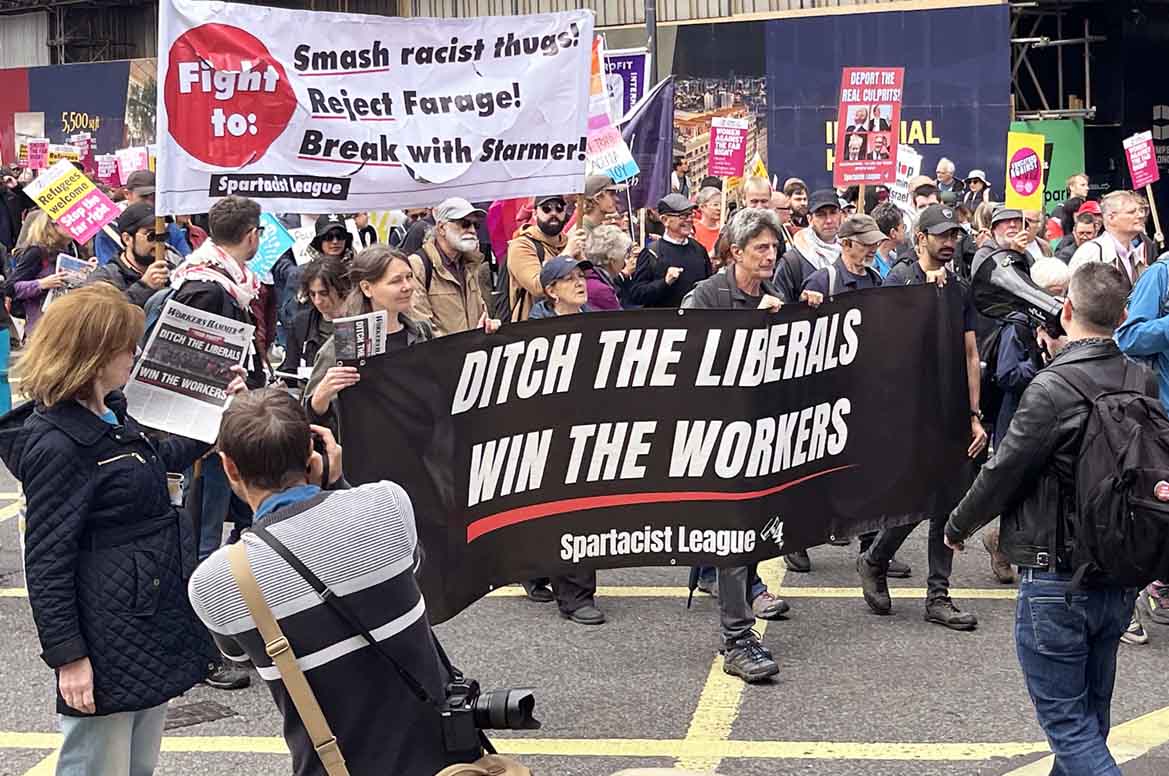
London, 13 September 2025: Spartacist contingent at SUTR demonstration against Tommy Robinson.
I - The crisis in the British ruling class
British capitalism is in a crisis of leadership. In the last ten years, the country has seen seven prime ministers, including the recently deposed Starmer and his successor, Andy Burnham. The fundamental reason for this political instability isn’t the incompetence of leaders, although there is no shortage of that. The reason is that the UK’s economic structure is rotting to its core and is unable to fulfil basic needs. Furthermore, the decline of the US Empire, in which Britain is a key pillar, and the growing demands of the American hegemon are increasing the pressure to the breaking point.
Britain has been a declining power since the late 19th century. Two world wars and the rise of new powers, mainly the US after World War II, rendered British industry outdated and unproductive. From the 1970s onward, the ruling class liquidated almost its entire industrial base in favour of a rentier economy centred on finance and concentrated in the City of London. Thatcher’s smashing of the trade union movement removed the main obstacle to this path. From then on, Britain became mainly a financial hub for the US Empire, with an economy based largely on speculation, property bubbles, private equity looting and financial services.
During the 1990s and 2000s, the devastating consequences of this shift were somewhat masked as globalisation and cheap credit provided some economic growth and helped maintain a large middle class. However, the 2008 financial crash hit Britain violently, putting a stop to this artificial growth and revealing an economy completely hollowed out, like timber infested by woodworm.
Because British financiers prefer to park their money in luxury properties or in the stock market for quick profits, there is a chronic lack of investment in productive industries, infrastructure, research etc. As a result, since 2008 real wages and productivity have stagnated. Society is growing in numbers, but output is shrinking, dragging down competitiveness and living standards.
Financial speculation has also inflated a huge housing bubble, with house prices rising by 426% on average over 30 years. Rent and mortgage payments now eat up a large proportion of the national revenue, keeping the working class and young people out of the property market and squeezing the middle class.
The destruction of industry also laid waste to entire regions outside the South East of England, leaving a landscape of generational unemployment and poverty. The bulk of the working class has been pushed into low-wage, precarious sectors or into a huge underclass that can’t find stable work. Thus, the welfare budget is ever growing (standing at around £330 billion a year, five times that of the defence budget), acting as a subsidy for landlords and the low-wage economy, concealing unemployment and providing a tiny income for those who can’t work due to old age, illness, disability etc. Indeed, the NHS, cut to the bone by years of austerity, has seven million cases on its waiting list.
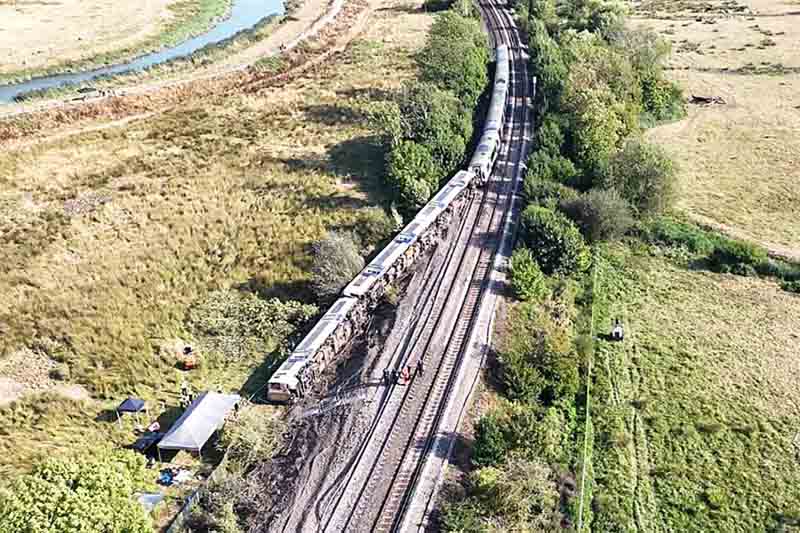
13 August train derailment near Lewes, result of poor maintenance and privatisation.
The privatisation of almost all public services (rail, water, energy, social care etc) has created chaos, inefficiency and high prices. Strategic arteries of the economy are managed by hedge funds and subcontractors, stripping public services of anything of value. Sewage released into rivers by water companies stands as a symbol of this criminal parasitism. Market anarchy has also made Britain dependent on high-cost energy imports—something the Ukraine war has exacerbated. The UK has the highest industrial electricity prices and the second-highest domestic energy prices in the G7.
This entire economic structure has been sustained by rising immigration. Particularly since the EU expansion in the Tony Blair era, the ruling class has relied on immigration to lower wages, substitute for investment and artificially grow the economy. Entire sectors—like the NHS and social care—simply cannot function without a constant flow of hyper-exploited foreign labour. The more the economy slowed down, the more the ruling class increased immigration numbers, reaching nearly one million in 2023. This put significant strain on the crumbling infrastructure—which the ruling class left to rot—and provided fertile ground for a huge anti-immigration backlash.
The liquidation of industry has also set in motion centrifugal forces threatening to tear the United Kingdom apart. For centuries, the UK was held together by the British Empire’s plunder and a large, integrated working class. But the end of the Empire, the liquidation of industry and the sucking of economic life into the City of London are collapsing the material incentive for the Union. This is true for Wales, the North of Ireland and especially for Scotland, with London increasingly forced to maintain the Union through coercion. In turn, for Scottish working people, support for independence has become an expression of class anger against Westminster rule, as shown in the 2014 referendum.
Blind to the ravages of finance capital, many blame Brexit for the current crisis. Brexit was first and foremost a plebeian revolt against the liberal order, exploited by careerist politicians who believed that scrapping EU regulations would boost finance and bring Britain closer to the US. What it did, however, was to cut trade with Britain’s main trading bloc, while the US had no incentive to deepen its commercial relations with the UK; thus exposing Britain’s isolation on the world stage. Brexit is not the root cause of the crisis, and working people were right to reject the EU. But without structural changes in the economy, Brexit could only accelerate existing economic problems and act as a trigger for the impending political crisis. Like 2008, the pandemic or the Ukraine war, Brexit is but one of the consecutive shocks that brought the Thatcherite/Blairite model of finance capital closer to the breaking point.

Starmer performing his supreme duty for the Realm.
As Washington mounts a global offensive to defend its declining empire, it is demanding total compliance and rearmament from its European allies, notably to contain Russia (an obsession for the British ruling class). For the City of London, the US alliance is an existential necessity. But the British state has neither the money nor the industrial base to meet American demands. Deindustrialisation and austerity have left the British armed forces in such a dire state that they simply cannot assist the Americans in any serious way, let alone defend British interests abroad. At the start of the Iran war, Britain could not maintain a single warship in the region. It scrambled one vessel, HMS Dragon, which broke down a few days after leaving port.
Discussions about reindustrialisation are increasingly common in ruling circles, as this is vital for military rearmament. This faces titanic obstacles such as the rising cost of land, construction materials and labour, as well as endless red tape. But the main issue is the parasitic nature of finance capital, which drags most investment into the stock market. Britain has also gone so far down the road of deindustrialisation that it faces a shortage of basic engineering and technical skills. Any substantial rebuilding of industry on a capitalist basis will require massive state intervention to compensate for this parasitism, as well as to crush living standards to bring down labour costs. Ultimately, this poses the threat of increased bonapartism.
The rot in the economic structure—defined by the dominance of finance capital over a hollowed-out economy—is the material source of the endless, chaotic rotations in the political superstructure. To maintain its standing, rearm and boost growth for the City, the British ruling class needs a major economic overhaul. But with debt-to-GDP at historic levels and the bond market poised to bring down any government threatening fiscal instability, the state cannot borrow its way out of the crisis. The only path available to the ruling class is to launch a new frontal assault on working people—that is, slashing the welfare bill, gutting education and finishing off the NHS.
Keir Starmer’s downfall is a product of paralysis in managing this crisis. Stuck between the relentless demands of the City and the US on the one hand and the growing needs of a population confronting inflation and collapsing public services on the other, Starmer was paralysed; he dithered, U-turned and angered everyone as a result. Andy Burnham will find himself trapped in the same vice.
For working people, there are no reformist solutions to “Broken Britain” and no more space for social-democratic halfway houses. The City of London is the cancer eating away at the economic and social fabric of the country. The only progressive way forward is to build an alliance of the working class and oppressed layers against the City in order to reindustrialise the country under socialist planning.
II - The collapse of the centre & the rise of the “far right”
The last few years have seen an acceleration of the collapse of the political centre. This is reflected in the breakdown of the traditional two-party system and the rise of Reform UK and the Green Party.
Following their devastating defeat in 2024, the Tories have become increasingly irrelevant and utterly discredited after 14 years of disastrous rule. On the one hand, the “One Nation” wing of the party is finished, given its long association with the dying liberal order. On the other, the right wing, personified by Kemi Badenoch, is seeking to survive by combining Thatcherite economics with anti-immigrant populism. But the Tories cannot compete with Reform’s populist appeal and are condemned to mimic Farage’s rhetoric, with the disadvantage of being the recognised party of the ruling establishment.
Despite securing a historic parliamentary majority, the Labour Party is bleeding on both flanks. Its traditional working-class base is turning towards Reform, forcing the Labour leadership to compete with Farage’s anti-immigrant chauvinism. Yet this reactionary shift, combined with austerity and systematic purges of the party's left wing, is driving away layers of historic voters, particularly towards the Greens. Crucially, Labour's support for Israel's genocide in Gaza has proved a total disaster among Muslim and immigrant communities, fracturing what used to be a bedrock of electoral support for the party.
Now that Andy Burnham has come to power, there is hope that Labour’s fortunes could turn. The Greens’ poll numbers have fallen. The media and establishment have launched a campaign to undermine Farage by dredging up his sleaze, with many celebrating the end of Reform. However, this optimism is deluded. Reform is facing the same legal trickery used against Trump and Le Pen, which only backfired on the establishment. Whatever Nigel Farage’s personal fate, the growth of the far right will not be stemmed by parliamentary investigations any more than by rotating the prime minister. As Burnham confronts the reality of governing, the same dynamics that led to the growth of right-wing forces in the first place will only be exacerbated.
The growth of right-wing reaction
It is impossible to effectively combat the growing right wing without a materialist understanding of its rise. For liberals and many socialists, the rise of what is called the “far right” is explained away as the product of racism and right-wing media. They are in denial about its growth among the working class, the reasons behind this and what underpins this realignment—which we are seeing across the Western world.
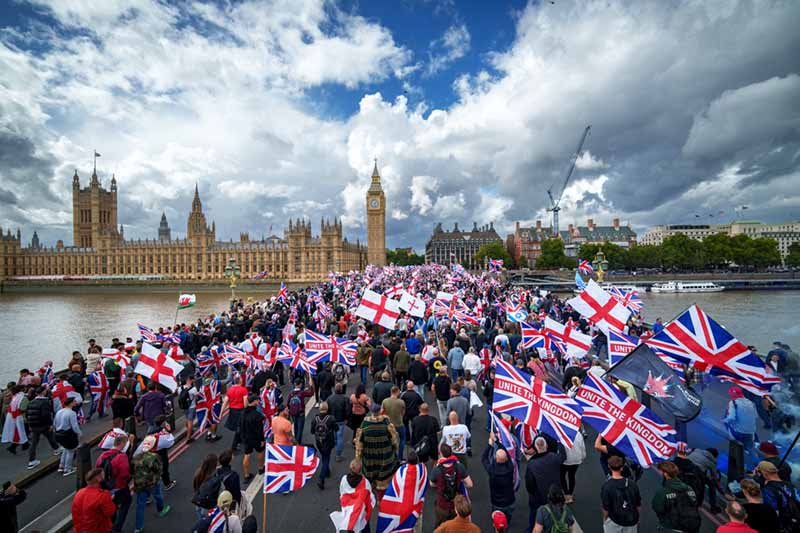
Reactionary mass “Unite the Kingdom” march, 13 September 2025.
The “far right” originates within a faction of the ruling class that increasingly recognises that the Blairite consensus—itself a product of US-led globalisation that dominated politics for decades—is failing to serve its interests. In particular, the US is breaking with liberal values and institutions, and, given the British ruling class’s vital alignment with the American Empire, the ruling class has no choice but to follow suit. This requires military rearmament, rebuilding some industries and attacking living standards. But the hypocritical façade of “multiculturalism”, “human rights” and “ecology” (eg net zero) stands as an obstacle that must be shattered in favour of a nationalist, authoritarian and more reactionary political consensus.
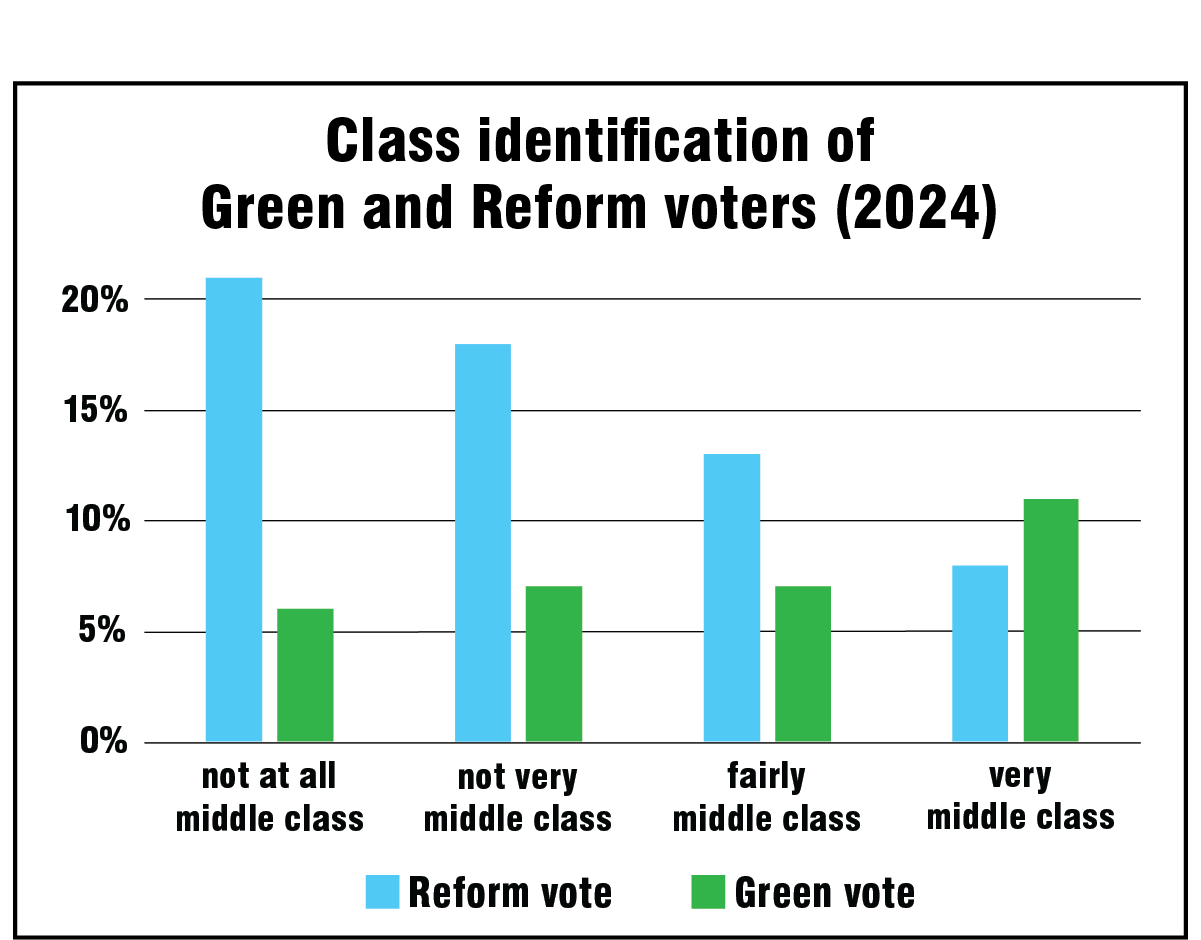
To achieve this realignment, the capitalist faction behind it must weaponise and even lean on existing working-class discontent as a battering ram against the liberal consensus. This is why the growth of the right has been largely among poor, working-class communities and ex-Labour strongholds, attracting not only lumpen layers but also large sections of the working class, including trade union members. This is something most of the left actively denies, clinging instead to a comforting and outdated view that the populist right is exclusively the domain of affluent, middle-class racists.
The primary factor behind the growth of the right isn’t ideological racism but capitalist decay, the destruction of living standards and scarcity. Anti-immigrant chauvinism gains a hearing among poor, working-class communities as they are forced to compete for a shrinking pool of housing, benefits, public services and jobs. The scapegoating of immigrants offers an outlet for this anger, and the promise of “mass deportation” appears as a measure to secure immediate relief. This appeal also extends to the upper layers of the working class and the lower middle class. Squeezed economically and seeing their small privileges threatened, they view anti-immigrant measures as a way to remove “foreign” competition for what little they have left.
The second factor is the widespread revulsion against the liberal order and its establishment, which, for decades, has overseen the destruction of living standards in the name of “progressive” liberal values. This was the essence of Blairism. The destruction of heavy industry was done in the name of cosmopolitan progress and ecology. The expansion of cheap, hyper-exploited migrant labour was managed under the guise of “anti-racism”. EU integration, which brought widespread privatisation and the casualisation of labour, was sold as “internationalism”. Throughout the 2010s, the more the economic situation worsened and austerity intensified, the more the ruling class sought to save face by doubling down on liberal progressivism. This included the Tories, with Cameron’s government boasting of being “the greenest government ever” and legalising same-sex marriage while carrying out brutal austerity. This fuelled a huge anti-liberal backlash, encapsulated in the Brexit vote, with the establishment labelling any rejection of the liberal order as “backward” and “racist”.
During this period, the far left did not offer an alternative but rather positioned itself as the more radical and consistent liberals. Whether on the EU, immigration, anti-racism or ecology, most socialists found themselves in a bloc with the ruling class and its establishment. This is best captured by Jeremy Corbyn, who, desperate to maintain unity with the Blairites, campaigned for a second referendum on Brexit in 2019, thereby driving layers of Labour voters into the arms of Boris Johnson. For many working people, the socialist left appeared simply as a more extreme wing of the bankrupt liberal order.
The third factor is that the left and trade union leaders betrayed the anger and aspirations of working people, leaving a huge space for the right to present itself as the main opposition to the status quo. This was glaring during the pandemic, a disaster for working people. Boris Johnson’s lockdowns not only did very little to prevent deaths from Covid, but they also created a massive social catastrophe with job losses and school closures, while the NHS was on its knees. The only political force that stood in opposition to the government was the right, which channelled the pent-up social anger into anti-vaccine sentiment. On the other side, trade union leaders suspended every struggle in order to collaborate with the ruling class. As for “progressives” and the far left, they became the most ferocious defenders of lockdowns, labelling any discontent as anti-science and even “fascist”.
The strike wave in 2022-23 opened up an opportunity for the workers movement to go on the offensive, reshape the balance of class forces in its favour and undercut the growing right wing. The trade unions were in a favourable position, with members determined to fight and facing a weak and discredited Tory government. A resolute push could have brought the Tories down and imposed the weight of the working class on society. But the trade union leaders squandered this opportunity, kept the strikes isolated and inefficient and pushed through below-inflation pay deals. As many people initially looked to the unions to improve their lives, the result was a wave of demoralisation which weakened the labour movement as a whole.
2022-23 strike wave: Major opportunity betrayed by union leaders.
All union leaders then campaigned to elect the Starmer government. For two years now, trade union leaders have not only prevented any serious struggle against Labour but have also bankrolled the most unpopular government in modern history. Meanwhile, Corbyn and those around him totally wasted the opportunity to build a socialist alternative. In the working class, the space was wide open for Reform, Tommy Robinson & Co to present themselves as the only real opposition to the Labour government. Thus, there is a direct connection between the defeat of the strike wave, the coming to power of a right-wing Labour government, the rapid growth of Reform and the eruption of racist riots in the summer of 2024.
The result is that we now face an insurgent right wing, which is consolidating support in deindustrialised communities and among workers by promising to tear down the remnants of the liberal status quo. This appeal is strengthened by the worsening economic situation and the utter impotence and paralysis of the centrist Labour government, whose main response has been to mimic Reform’s anti-immigrant rhetoric—dragging the entire political field further to the right.
III- The crisis of the left
(or how on earth did Zack Polanski become the left’s leader?)
The breakdown of the liberal order and the crisis of the centre have had a significant impact on the left. As the insurgent right wing seeks to shatter the liberal status quo, the response from various left-wing movements in recent years has been to hold onto the ideas and promises of the dying liberal order. The left’s clinging to liberal ideology and making common cause with its defenders is the greatest source of its impotence and failure—from the Palestine and anti-racist movements to Your Party. Understanding this process explains why the Green Party has become the dominant force to the left of Labour.
The Palestine movement
The Palestine movement in Britain saw some of the largest demonstrations in the entire Western world. It had huge potential, attracting workers and youth, particularly minorities, and wreaking havoc in Labour’s voting base. Yet, despite years of demonstrations, the movement has been unable to exert any serious pressure on successive governments to stop aid to Israel, has had very little impact on the genocide itself and has not registered any significant victories.
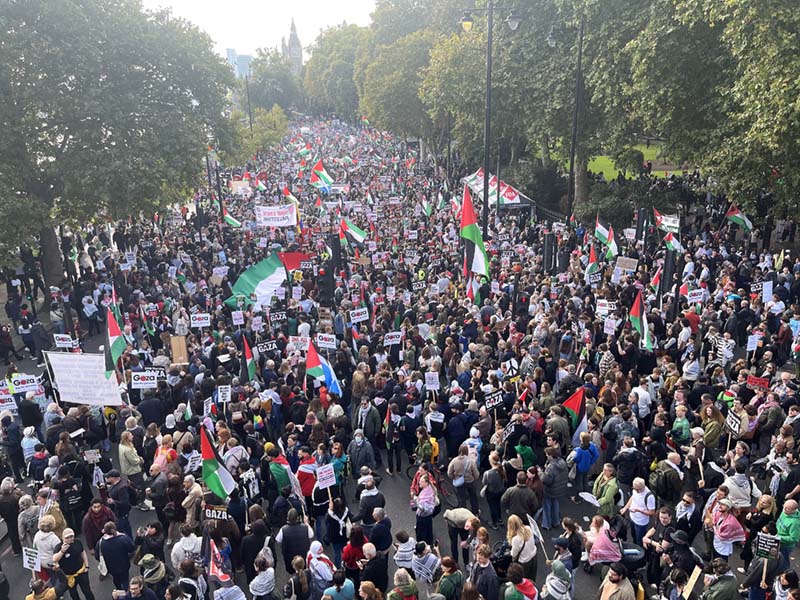
Palestine demonstration, London, 11 October 2025.
The movement's leadership, represented by the Palestine Solidarity Campaign (PSC), did everything to confine it within the bounds of liberal outrage, pacifism and the illusion that the government should abide by “international law” and UN resolutions. This hampered any militant anti-imperialist response and was intended to keep the movement “respectable” for its main backers: Labour Party figures and trade union bureaucrats. Indeed, the mass demonstrations were usually endorsed and addressed by Labour MPs and union leaders—all of whom supported the Labour government, which supported Israel’s genocide. This syphilitic chain guaranteed the movement's impotence, with demonstrations acting as a pressure valve for anger and tolerated by the government so long as they did not fundamentally disrupt its foreign policy. Even though much of the movement was to the left of its leadership, it remained amorphous, with no organised left-wing, anti-imperialist pole emerging from within.
Crucially, the movement did not make connecting with the working class its strategic priority. On the one hand, the union leaders did nothing to organise union actions in support of Palestine, particularly among sectors directly involved in military support for Israel, thereby shielding Labour. On the other hand, the movement’s politics confined Palestine to a humanitarian, moral issue, disconnected from workers’ immediate preoccupations. The trade unions played no organised role, and the right wing was able to present the movement as caring more about Gaza than about issues at home.
The bankruptcy of the “human rights” liberal (and pro-imperialist) politics of the official leaders became evident when the genocidal war extended to Iran. While support for Palestine is tolerated, even fashionable, among Labourites, defending the Islamic Republic of Iran against the US is an entirely different affair, and a bright red line for the ruling class. Although the base of the Palestine movement was, in the main, in favour of an American defeat, the leaders refused to take a clear side in defence of Iran against the US, preferring pacifist slogans or silence. The PSC did nothing to build support for the closure of US bases in Britain, which were crucial to the bombing of Iran.
The movement's impotence pushed a layer towards direct action, as seen in Palestine Action. The courage and determination of these activists—who went on hunger strikes and faced bogus “terrorism” charges—are undeniable. Yet, short of a powerful mass movement, their actions remained isolated, enabling the state to unleash brutal repression.
Liberal anti-racism
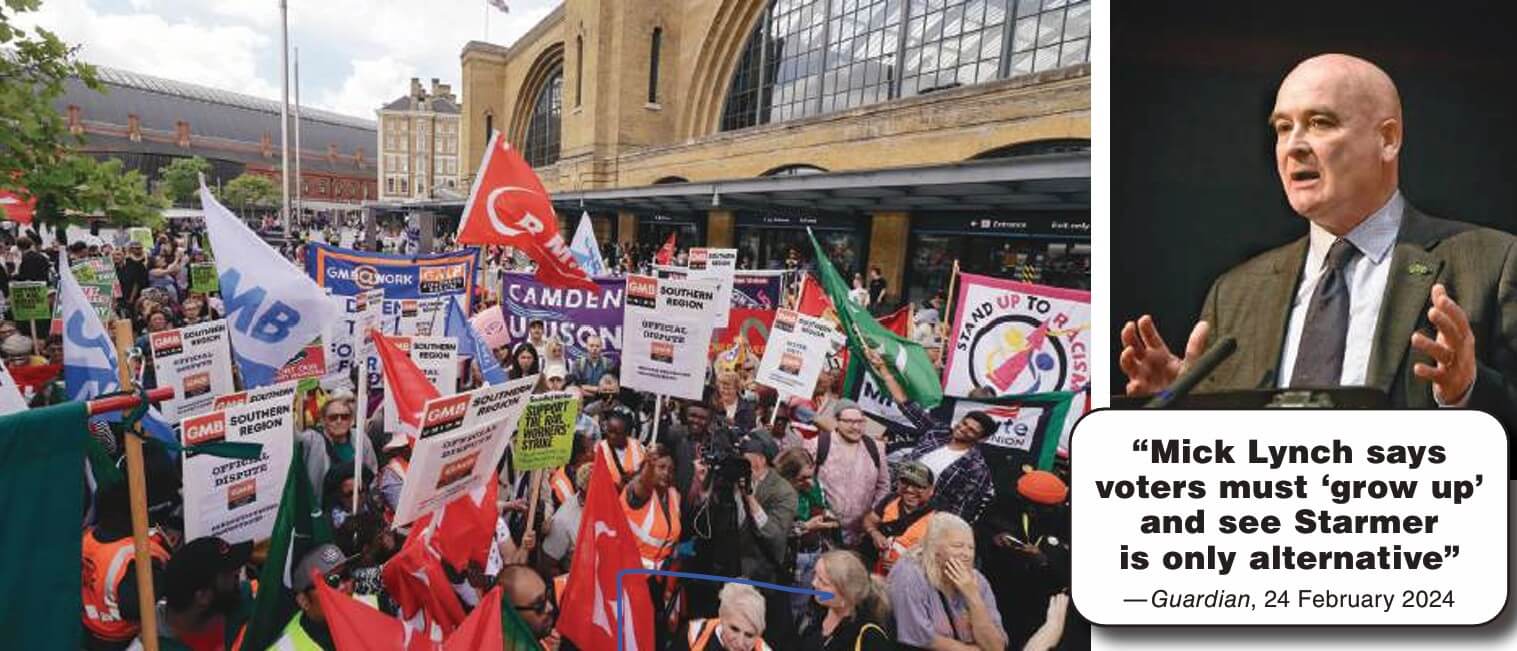
In parallel with the Palestine movement, the rise of Reform and the racist riots and demonstrations against migrant hotels have pushed many activists into action, motivated by the urgent need to build a movement in defence of immigrants. However, the organisation leading almost all initiatives, Stand Up to Racism (SUTR), initiated and led by the Socialist Workers Party, suffers from the same problem as the Palestine movement: it follows a thoroughly liberal strategy based on moralism and alliances with representatives of the status quo.
SUTR’s strategy is based on defending the high-immigration policy of previous governments and berating as “racist” anyone who criticises it. Its mobilisations are based on liberal slogans, chosen to be acceptable to union leaders and Labour politicians, who speak at and sponsor most of its events. SUTR’s actions make no distinction between fascist thugs and the millions of people turning to Reform out of despair and confusion. Yet while SUTR proudly disrupts Reform’s public meetings, it is often notably absent when it comes to confronting actual fascists for fear of alienating its moderate backers. SUTR has also led electoral campaigns called “use your vote to stop Reform UK”, which amounts to implicitly endorsing Labour, as they did in Andy Burnham’s election in Makerfield. While the Palestine movement was at least opposed to the government, SUTR’s outlook has led many workers to see the anti-racist movement as purely defending the status quo.
This is most obvious over the issue of migrant hotels. For years, the government has had a policy of sending refugees to hotels at public expense, most often in poor and dilapidated areas. This has generated legitimate anger among locals, which racists have exploited. SUTR’s response, however, has been to organise counter-demonstrations under the slogan “refugees are welcome here”. These mobilisations are widely perceived as directed against locals and as defending the government’s actions.
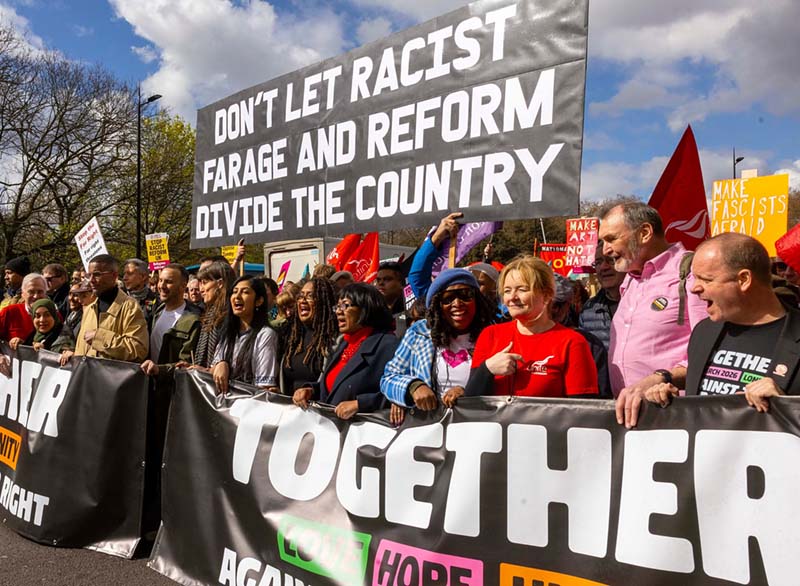
28 March, London: Together Alliance march, led by Labour MPs, Greens and union leaders (top). Spartacists denounced this alliance with the hated government (bottom).
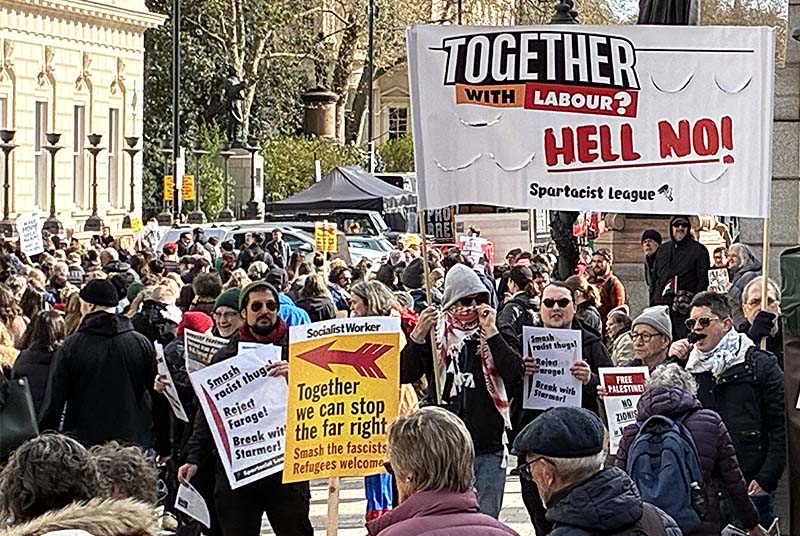
Following its disastrous counter-demonstration against Tommy Robinson on 13 September 2025—where the left was massively outnumbered—SUTR rebranded itself as an even more liberal and moderate organisation: the Together Alliance. Its first demonstration was last March, under the slogan of “love, hope, unity”. Although it was huge, the initiative was backed by Labour MPs, the Greens, almost all trade unions, NGOs and the far left. This popular front on the street—which might prefigure one at the ballot box—is a gift to Reform and the right. For any worker angry at the status quo, this is the ultimate proof that the radical left and trade union leaders are in an unholy alliance with the government and the establishment.
Nowhere has the left’s clinging to liberal ideology been more damaging than in the anti-racist struggle. Rather than fighting to unite the plight of migrants and local communities—all starved of jobs, services and funding—against the ruling class, SUTR’s liberal interventions have inflamed racial divisions and identified the anti-racist movement with the government.
The Your Party debacle
In the summer of 2025, the powerful energy unleashed by the Palestinian movement was yearning for political expression. Anger at Labour’s betrayal was mounting, a vacuum was opening to its left, and panic was rising among leftists in the face of the rise of Reform. It was these factors, not the foresight of leaders, that pushed the creation of Your Party.
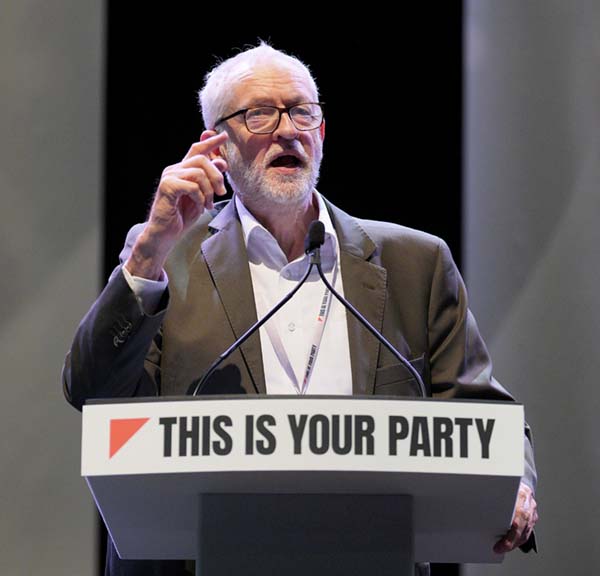
In the end, it was nobody’s party.
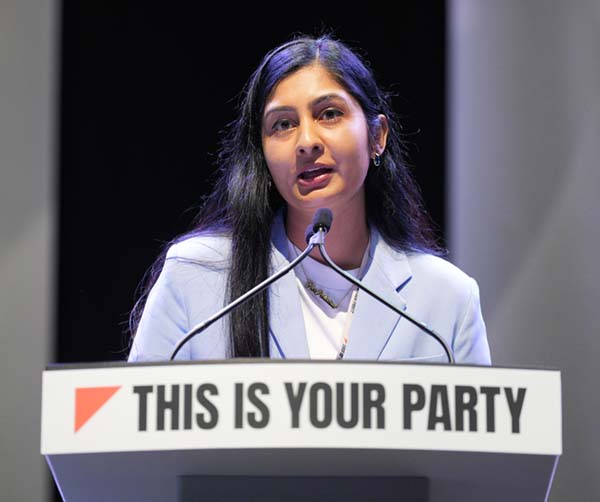
Jeremy Corbyn never wanted to leave the Labour Party, let alone build a left-wing opposition to it. A broken man, Corbyn wanted a loose, toothless alliance of community organisations and groupies—just enough to stem the pressure to launch a party, yet sufficiently inoffensive to preserve his bridges to Labour. As for Zarah Sultana, who had just resigned from Labour, her standing on the left was less secure. Under pressure from more radical elements who wanted a fighting socialist party, she twisted Corbyn’s arm into launching Your Party.
For months, a confusing and acrimonious struggle raged. On the one hand, Corbyn and his clique, anxious to preserve their alliances with liberal elements, imposed a highly bureaucratic regime to clamp down on dissent and purge the far left. On the other hand, Sultana, frozen out of any leadership position, leaned on the most radical and pro-socialist wing of the party to secure her base. Sultana never consciously broke from her liberal/Labourite background but was forced by objective conditions to adopt politics incompatible with the tepid liberalism of Corbyn’s camp—making speeches denouncing Zionism, NATO, the EU and the monarchy, calling to nationalise the entire economy, etc.
However, in typical Labourite fashion, Sultana was adamant that she never wanted to wage a struggle against Corbyn, but only to secure her place at his side. This is why Sultana and the Grassroots Left’s campaign for the Your Party leadership elections focused almost entirely on members’ democracy. An opportunity for an open fight between working-class socialism and liberal platitudes was wasted—generating confusion among many, who came to view the clash as a battle of egos. Corbyn, on the other hand, had a clear goal: to crush Sultana and the left. In the end, he decisively won the leadership, purged the far left and appointed his people to every post. Your Party was effectively dead.
Rarely in the history of the left have such massive expectations been shattered so pathetically. But it is wrong to blame the destruction of Your Party solely on the Corbynites. From the get-go, they wanted a liberal, tepid alliance. They fought for this and won. The left wing wanted a militant socialist party. But rather than fighting for this, they subordinated that goal to unity with the Corbyn clique. This is the key lesson, and what killed this opportunity more than anything else.
Zack Polanski as the last hope
The rise of the Green Party is a direct consequence of the Your Party debacle. While Corbyn and Sultana were bickering, newly elected Green Party leader Zack Polanski made a left turn, abandoning the image of Tories on bicycles, calling to tax the rich and nationalise utilities while denouncing the genocide in Gaza. As Your Party collapsed, thousands of young people flocked to Polanski’s banner. And for those whose goal was always a left-wing liberal party, Polanski’s Greens represented a much more credible option than Your Party.

God save the left…
The Green surge was driven not by Polanski offering any coherent response to the collapse of the political centre but by a sense of panic at the rise of the right and the feeling that the left needs something—anything—to confront Farage. While opposition to the Greens as petty bourgeois used to be a given on the British left, now swaths of socialists are closing their eyes and embracing this outfit.
Fundamentally, the Greens are a middle-class party whose outlook is a radical version of liberal ideology, with an idealist twist. They stand for rejoining the EU, military support to Ukraine, open borders, net zero, taxing fuel and cars, identity politics, etc. Polanski himself is the very embodiment of the woke, middle-class left: an ex-Lib Dem, he is a vegan, has never touched drugs or alcohol and refuses to fly on principle. Polanski’s left turn has consisted of plastering economic populism and vague appeals for “hope” over this liberal core, giving the Greens an incoherent and half-baked character. At bottom, the Greens defend the very “progressive” politics against which growing sections of working people are rebelling, and their role consists in pressuring the political centre while giving it a radical veneer.
With such a perspective, the Greens will never win over decisive sections of the working class and thus can never seriously undercut the growth of the right. They are condemned to pockets of urban progressives and middle-class voters, while attracting minorities only out of fear of Reform. Now, as the leadership and the “old guard” of the Greens aspire to become respectable, they will move to quash the most left-wing sections among their thousands of new members.
The left ended up in the camp of the Greens because of a succession of stumbles and failures, primarily due to its political outlook: seeking to save the liberal values and politics of the last era, which are now on life support. Rather than looking forward, the left is clinging to the past in a panicky, defensive reaction to the growth of the right. Several movements have offered opportunities to reject liberal politics in favour of a socialist, anti-imperialist, working-class road. But the pressure to unite with liberals was prioritised, leading to defeats and failures.
IV- The state of the workers movement
The trade union movement is facing a profound crisis. With frontal attacks on the horizon, the unions are hollowed out and unprepared — a situation that could threaten their very existence. To understand the depth of this crisis, it is necessary to grasp how the unions have evolved in recent decades.
By the time Tony Blair’s Labour came to power in 1997, the unions had already suffered historic defeats under Thatcher. Once-powerful institutions deeply rooted in the industrial proletariat, they had been profoundly weakened by deindustrialisation and a series of anti-union laws by the 1990s. In particular, Thatcher’s defeat of the 1984-85 miners strike (and later the closure of the coal pits) had obliterated the vanguard of the proletariat, as was her aim. From this, union leaders drew the lesson that class struggle must be avoided. Blair promised “New Labour”, free from trade union favouritism, rejecting socialism and working-class politics as relics and fully embracing the liberal triumphalism of the post-Soviet period. Objective blows, combined with Blair’s ideological offensive, profoundly altered trade unions and their leadership.
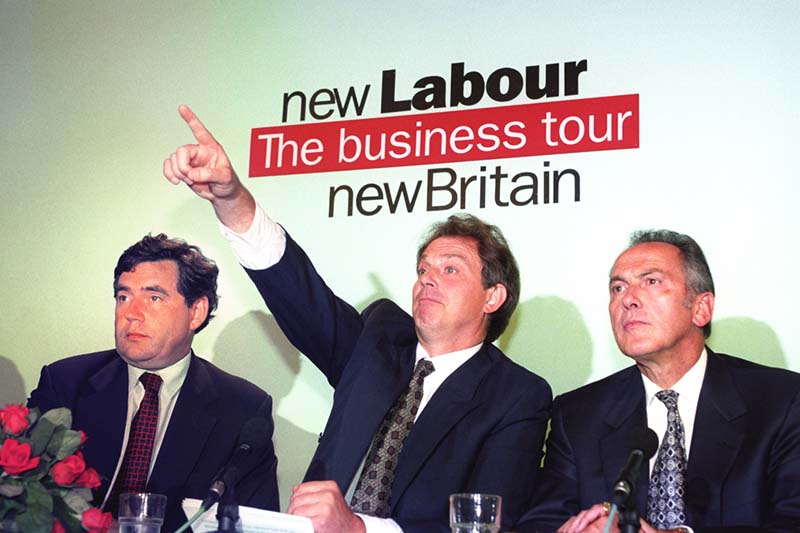
New Labour’s Tony Blair (centre) brought “new unionism”, the one-sided rejection of class struggle.
Blair did not crush the unions but rather co-opted their leaders and remodelled them in his image, a mission they embraced, or at least accepted, to survive. John Monks, then leader of the TUC, put forward the “new unionism” to align the unions with Blair’s vision. The modern trade unions would seek “social partnership”, not confrontation, with employers. Rather than being combat organisations, they would become service providers for legal representation, workplace training and insurance. What was historically fought for on picket lines would now be obtained through legal channels—particularly the EU’s social model, upheld as the means to defend workers’ rights. While Blair refused to repeal the anti-union laws, he offered statutory protections such as the National Minimum Wage and set up employment tribunals, which became the main arena for resolving most workplace disputes.
This transformed the union leadership and apparatus. Gone were the days of the “labour barons”, who, despite being highly bureaucratic and pro-imperialist, commanded powerful industrial organisations that could, and frequently did, paralyse the economy. The union apparatus would now be managed like an HR department, with bureaucrats acting as lobbyists and union reps trained in the spirit of partnership with the bosses. Trade unions still advocated the repeal of the anti-union laws, but this was reduced to routine lobbying, while on the ground union leaders policed their members against any encroachment on them. Strikes were seen not as a tool to strengthen the union but as a legal liability to be tightly controlled if they couldn’t be avoided.
As Blair enshrined a liberal legal framework that castrated the unions, the working class was being sliced up. Already well underway under Thatcher, Blair oversaw further deindustrialisation, privatisations and the introduction of a “flexible labour market”. This atomised millions of workers within a web of subcontracting, zero-hours contracts, low-paid and precarious employment—all designed to prevent union organising. Trade union membership dwindled and became concentrated in the public sector, representing office workers and middle-class layers, while losing many strongholds among manual and industrial workers. Union membership also aged, with the largest concentration now among the over-50s. Because the leaders bowed to the Blairite straitjacket in the name of “modernisation”, the unions did nothing to organise the growing layer of unorganised workers, confining their efforts to tepid lobbying for legislative crumbs. Thus, the trade unions would come to represent a small layer of relatively cushioned workers surrounded by a sea of unorganised, hyper-exploited labour.
This process was a catastrophe that completely hollowed out the trade unions. While today they still boast six million members—roughly 22% of the workforce—the unions are often empty shells. They struggle to recruit members and reps or to maintain their recognition. The closed shop has long disappeared, and unionised workplaces represent a fraction of the workforce, divided among multiple unions competing against each other. Union apparatuses are bloated with overpaid pen-pushers for whom this is like any other job. They confine their activities to legal representation, where they often do not even put up a fight. On the rare occasion when they do strike, inefficiency reigns: strike funds are often non-existent, and picket lines are meaningless, with unions openly calling for scabbing on each other. Then union leaders hide behind the law and the membership’s apathy as an excuse for why struggle is impossible.

What your union membership gets you: Lottery, “bed & bubbles” deals… but no plan to actually fight.
The other consequence of this process is a deep erosion of class consciousness among members, who are trained in social partnership and legalism. Union membership is presented by the tops—and viewed by most members—not as an expression of class power but as an individual transaction for workplace representation. Members are atomised as grievances are mostly dealt with individually. The class line against the employers has been blurred as multiple unions have opened their doors to managers. The consequence is not only that barriers to recruitment have been built, but also that union members themselves often see no point in a union.
Rapidly falling living standards are increasing pressure on trade unions to fight. But their hollow structures and leaders’ subservience deliver only defeats and managed decline. The betrayal of the 2022-23 strike wave weakened unions and convinced many workers—often striking for the first time—that industrial action isn’t worth the loss of wages. In the last two years, the Port Talbot Steelworks, the Luton Vauxhall car plant and the Grangemouth Oil Refinery were all closed without a single day of strike action, with union leaders negotiating redundancy packages. When workers force union leaders to fight, they act as a constant brake. In Birmingham, the bin workers have heroically been striking against a Labour council for over a year. Yet the Unite leadership has refused to mobilise the wider labour movement, instead watching as the council ground the strikers down.
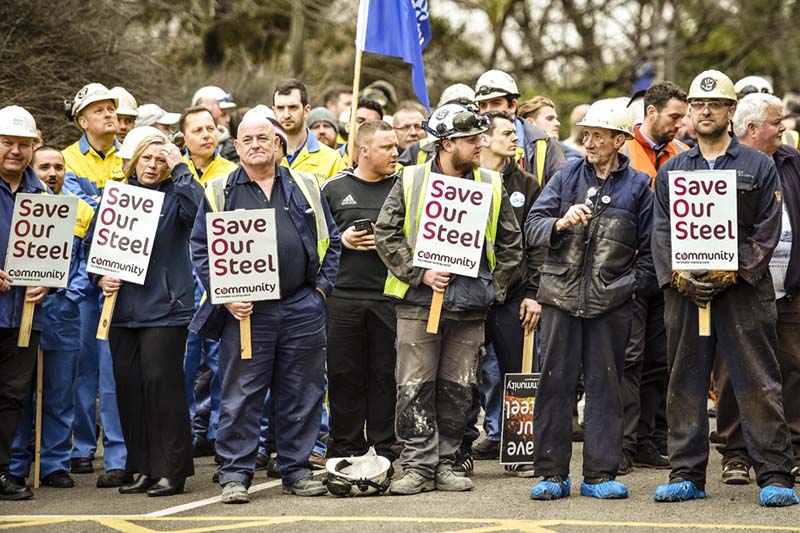
Steelworkers protest at Port Talbot, Wales. 2,800 jobs were cut in 2024 without a single day of strike.
The impotence of union leaders is opening a dangerous gap between the union’s apparatus and the base. For ordinary workers, the union bureaucracy does nothing to improve their condition while using their dues to fund the Labour Party, which openly attacks the working class. This is fuelling resentment in the rank and file, which the right is exploiting. Indeed, recent polling revealed that among trade union members, Reform is neck and neck with Labour as the preferred party. Nigel Farage recently called on trade unions to affiliate to Reform, knowing there is a huge gap between the leaders and the base. On the Birmingham bin workers’ picket lines, Reform is the most popular party.
The unions’ weakness and the widening gap between members and leaders are not tempered but reinforced by so-called left leaders, elevated to power by a small layer of activists, who do nothing fundamental to change the unions’ structure. For example, Andrea Egan was recently elected head of Unison on a left-wing platform. But she won with a 7% turnout—meaning only activists took part in the ballot, while the broad membership was indifferent. Unison members are facing layoffs and cutbacks across multiple sectors—yet the union is doing nothing to mount a real fight back. Meanwhile, Egan boasts of being for Palestine, trans rights, ecology etc, while continuing to fund the Labour Party.
A similar situation exists in the NEU, where leader Daniel Kebede has done nothing to address the huge overwork crisis among teachers, while also being the main backer of SUTR and Palestine demonstrations. The story is similar in UCU. In Unite, most socialists back Sharon Graham as a supposed militant, even as she accumulates defeats on the industrial front, maintains a tight bureaucratic grip on the union and continues to fund Labour. This situation is a ticking time bomb that risks a right-wing backlash while disarming the unions in the face of attacks.
The refusal of union leaders to seriously organise the unorganised is also creating a dangerous dynamic, allowing the bosses to use a mass of poor, unorganised workers as a battering ram against the trade unions. This was illustrated during the recent RMT strikes on the London Underground. RMT drivers have gone on strike for a 32-hour week with no loss of pay—a legitimate demand every socialist must support. However, this battle is waged in a context where tens of thousands of rail workers in infrastructure, cleaning and track maintenance—working on the same network—are sub-contracted to private agencies on low wages, with no job security and often working six or seven days a week. Since the union has made no serious effort to bring those workers into the struggle, the RMT strike is breeding resentment among those layers, which the bosses can and will weaponise to weaken all trade unions. Worse, ASLEF, the other union in the underground, has already reached a deal and is scabbing on the RMT.
A Reform government is sure to unleash attacks on the unions, with Nigel Farage already promising to “go to war” with the teachers’ unions. Labour might even fire the opening salvos. Yet union leaders are presiding over institutions hollowed out by decades of acceptance of the Blairite consensus. Of course, there are still layers of courageous and dedicated union reps and members. But they have to fight daily against a bureaucratic apparatus sabotaging their work, and are being bled dry under the pressure. This situation means a resolute offensive by the ruling class could deliver a mortal blow to many unions. Without a class-struggle leadership ready to lead real battles, and without an active, politically conscious membership to defend them, the trade unions could face catastrophic defeat at the first serious confrontation.
V - Prospects
Andy Burnham will have no choice but to cut benefits and social services to fund the defence budget and shore up the City of London. At the same time, he will likely be forced to introduce measures to ease the cost of living and soften the blow, which will likely anger the City and the bond market. As for his proposal to decentralise power, it will simply mean transferring the task of implementing austerity and managing scarcity to local authorities, while increasing regional tensions and chaos. In current conditions, and within the bounds of the fiscal rules, his premiership is likely to quickly become discredited, which could mean Labour’s annihilation for an entire period and the collapse of the centre.

Ukraine, 24 August. New British PM Andy Burnham, same as the last one, except he plays guitar.
Economically, there is zero prospect of renewed growth. The next period will bring either an economic slowdown or a sharp crash of the international financial bubble, with devastating consequences for Britain. House prices are already falling, and a crash could risk bursting the housing bubble, which has long been one of the pillars of economic stability. With high public debt and inflation, it will be much harder for the central bank to pump money into the market this time. Thus, the next period could see the further impoverishment of the middle class, who have poured their life savings into assets whose value could soon be slashed. Also, to stem the right, Labour has hugely tightened immigration rules. Net migration to Britain is falling and could reach near zero. But this will not stem anti-immigrant chauvinism; rather it will mean economic slowdown and layoffs in many sectors. In the short term, the worsening economic situation will accelerate current political dynamics.
Scotland and Wales both saw sweeping victories for nationalist parties, with the SNP returned to office for the fifth time and Plaid Cymru becoming the largest party in the Senedd for the first time. But the road ahead promises to be stormy. Both the SNP and Plaid have grown in the liberal era by promoting the nationalist cause as part of a liberal, progressive agenda. Now that era is closing, and they will seek to shed their “progressive” image. The SNP has backtracked on its support for trans rights and softened its opposition to North Sea oil and gas production. With Westminster firmly blocking referendums, neither party can make concrete progress towards independence. Both will be stuck managing crumbling public services and infrastructure while anger at the status quo grows. Furthermore, in both countries Reform made significant gains, becoming the second party in Wales and joint second in Scotland. We can expect further growth of reaction in the face of the SNP’s and Plaid’s bankruptcy.
That said, we can also expect an increase in centrifugal forces threatening to tear the UK apart. Devolution, a product of the Blair period, will likely come under attack as right-wing reaction rises, and so will the need to maintain the union by force as the ruling class attacks living standards. Indeed, Farage is famously hostile to devolution. As for Burnham’s pledge to bring devolution to the Red Wall areas of England, with no new money in the pot, any resources used for this will come at the expense of Scotland, Wales and the North of Ireland. Either this or a reactionary assault on devolution will likely provoke a nationalist reaction.
As pressure from the right grows, so will the urgency for the left to rally around the centre. We have seen this in by-elections, in the Together Alliance march and in the left’s recent trajectory. The pressure will only intensify as the next general election nears. From Labour and the Greens to the far left, all will be urged to unite and swallow the worst betrayals in the name of stopping Farage. While this might temporarily set Reform back, the left’s alliance with the status quo will boost Reform’s anti-establishment appeal while blocking the emergence of a socialist, working-class alternative.
With a crisis-ridden Labour government, we can expect trade union leaders to continue doing everything they can to avoid a real struggle against it. They will be squeezed between their allegiance to Labour on one side and the anger of their base on the other. But this will not necessarily translate into militancy. In fact, with class struggle barred at every step by union leaders and given the lack of a working-class alternative, the most likely scenario is that the appeal of the right wing will continue to grow among the broader working class.
For now, Reform is walking a tightrope. To prepare for power and reassure the ruling class, Farage has co-opted a layer of ex-Tories and abandoned some populist positions. This has created a split-off—Restore Britain—now rising to Reform’s right, with Elon Musk’s support. Restore is in no position to overtake Reform, with Farage remaining the dominant figure on the right. Rather, its role is to act as a right-wing pressure on Reform, pulling the entire political field further right (akin to Reconquête’s role in France).
Overall, current political dynamics favour the continued growth of the right wing. We are likely in the early days of a protracted period of political reaction. A paralysed Labour government, together with an economic crisis which could impoverish large layers of the middle class, will only make the right wing’s chauvinist and anti-immigrant appeal more potent. Meanwhile, a large, working-class uprising is highly unlikely in the next period, for all the reasons laid out above. However, despite an overall difficult period, some factors can create openings and help strengthen the defensive position of the working class.
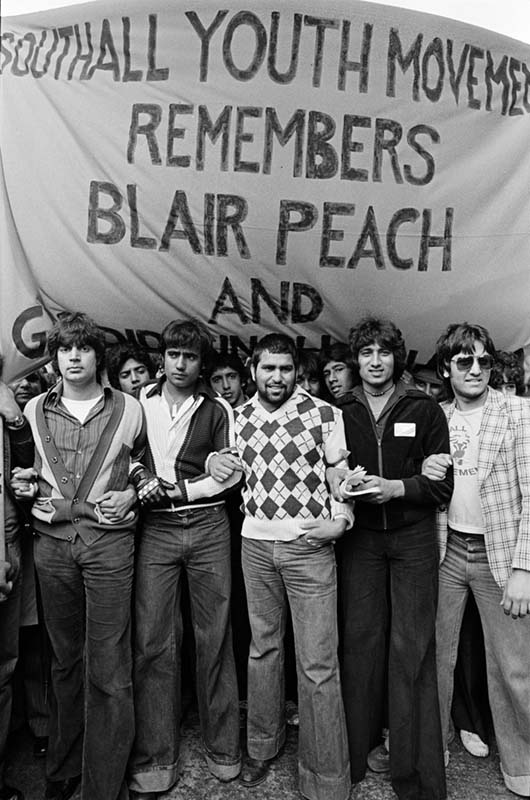
Southall, 1979: To fight racist thugs, minority youth rebelled against conservative community leaders and launched self defence movement.
The rise of right-wing reaction, particularly the frequent outbreak of racist riots, is bound to provoke a response among immigrant, Muslim and other non-white workers and youth. The working class is multiracial, which objectively limits the appeal of racist reaction within it. Overt racist provocations could well lead to militant responses from sections of workers, including white workers. Furthermore, as racist scapegoating and riots escalate, sections of workers and youth will rebel against the conservative and submissive responses of religious and community leaders. It was precisely in such a revolt by black and brown youth against conservative community elites that the self-defence movement of the 1970s was born. The rise of such a militant movement today—despite inevitable problems and challenges—could change the dynamic on the left and accelerate a break with the dead end of liberal politics.
Localised strikes and struggles, in workplaces or communities, will take place and can play an important role. As the economic crisis pushes some workers towards demoralisation, others will be forced to fight. Local and limited struggles are often a lightning rod for widespread anger and can be turned into a rallying point for the oppressed. They can undermine the right, win much-needed victories and train new layers in struggle. But the precondition is a leadership willing and able to fight the union bureaucracy, Labourite community leaders and liberals, whose narrow, routinist and legalistic outlook asphyxiates movements.
VI – Tasks of socialists
The socialist movement in Britain is weak and divided. In the main, it has totally capitulated to the liberal ideology of recent decades and is mired in identity politics, radical environmentalism and moralism. Or else, some groups retreat into a sectarian niche. In both cases, they refuse to mount a serious struggle against the liberal and Labourite leadership of successive movements. Crucially, the socialist left is largely rooted in and oriented to the middle class—students, academics, etc—and is divorced from the working class. The left is in complete denial about this problem, with the excuse that “the working class has changed”. Among the actual, expanding layers of unorganised and precarious workers, the socialist movement has near-zero influence.
The coming period is bound to deliver severe shocks to a feeble and unprepared far left. The focus on student recruitment by most groups is already running into a crisis. State repression, as well as fascist violence against the left, is on the rise and is bound to intensify. With liberal ideology on its deathbed, most organisations are clinging to it, leaving them utterly disoriented and incapable of offering answers to the growing polarisation on social questions. The existing far-left organisations, built over decades in a bygone era, will face serious internal crises, splits and collapses.
Revolutionary socialists must lead a struggle on the left against the demoralisation and confusion, incubated by decades of adaptation to the liberal world order, which is paralysing the movement in the face of reaction. The overarching task must be to build a current that wages an uncompromising struggle to break with liberal ideology on a Marxist basis and firmly anchor itself in the working class. This fight must be waged across all arenas of the socialist and working-class movement.
For serious work in the working class!
The socialist left either ignores the working class and trade unions (RCP, CPGB, RCG etc), or is integrated into the union bureaucracy (SWP, SP, CP etc), discrediting the entire socialist movement by propping up hated union leaders. Both of these approaches must be rejected.
Socialists must turn to the working class and the base of the trade unions. They must build socialist caucuses capable of leading struggles—even minimal ones—against the bosses and the treacherous union bureaucracy. They must seek influence among the ranks of workers, not in the echelons of the apparatus. The precondition for this is to resolutely oppose all wings of the bureaucracy—left and right—as well as the Labour government. The immediate task, to be carried out under difficult conditions of apathy, is to put the trade unions in the best possible defensive position in the face of coming attacks. But the overarching goal must be to rebuild the trade union movement from the ground up and to forge a new, socialist leadership of the labour movement.
Fight racist thugs—and fight liberal anti-racism
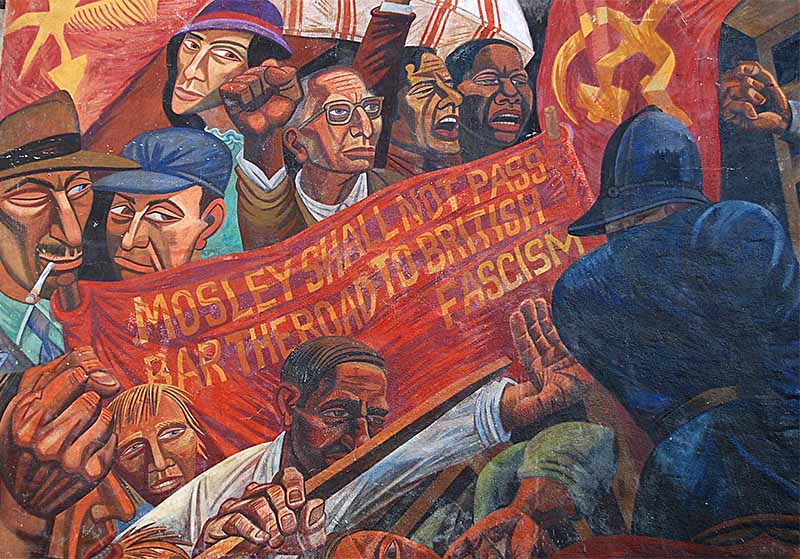
Battle of Cable Street mural. In 1936, communist-led workers of east London defeated fascists in street battle.
Socialists must be in the vanguard of the struggle to defend immigrants and black and brown communities. But doing so requires rejecting the liberal, moralising framework of the middle-class left and their alliance with the government in favour of a Marxist strategy.
Socialists must distinguish between racist mobs and the millions of working-class people turning to right-wing parties. Racist terror must be confronted and crushed through the broadest united front possible. This includes encouraging the creation of self-defence organisations among minorities, bearing in mind the need to link those to the labour movement and to combat the danger of sectarianism.
On the other hand, socialists must actively engage the millions of workers turning to Reform, and even Restore, out of anger, economic despair and confusion. The case must be made that it is the City of London that is destroying this country and profiting from the hyper-exploitation of immigrant workers. Only a working-class alliance against the City can turn the tide in Broken Britain—something that requires actively defending immigrants and Muslims. Obviously, the precondition for waging this fight is to oppose and denounce any reliance on Labour MPs, liberal politicians and other agents of the status quo.
Fight militarism as socialists, not pacifists!
The ongoing military rearmament will bring attacks on living standards and pose the need for a struggle against militarism, NATO and imperialism. But this cannot be done with tepid pacifist appeals and invocations of “international law”, nor by supporting union bureaucrats who themselves support the rearmament drive (eg, Sharon Graham).
Socialists must fight to build a movement against militarism that is firmly anti-imperialist and anti-Zionist—including opposition to British support for Israel, NATO and Ukraine. Crucially, these points must be raised in a way that connects with the widespread discontent among the working class, including workers in the defence industry. Calls for “peace” and “human rights” or for shutting down arms factories will go nowhere. Rather, the argument to be made is that workers are being used as pawns to shore up the American Empire (and the British establishment’s position in it), which will only mean more forever wars, death, refugee crises and the crushing of living standards and public services. Socialists should fight not only for the victory of oppressed nations in their struggle against the US but also for the shutdown of US bases in Britain and British bases abroad—a demand vehemently opposed by all wings of the British ruling class.
Fight UK chauvinism!
“Unite the Kingdom” national chauvinism is on the rise, promoted by Farage and Tommy Robinson, and the crisis of British capitalism is sure to intensify the national oppression of Scotland, Wales and the North of Ireland. The left in England is largely indifferent to this issue. In Scotland and Wales, it tails the nationalists, who are mired in liberal gradualism and paralysed in the face of Westminster’s bullying. In the North of Ireland, the left is either doing the same or adapting to Labourite Unionism.
Socialists must aggressively fight UK chauvinism. They must defend the right to self-determination for Wales/Cymru. They must also agitate for a second Scottish independence referendum and an Irish border poll, as part of the struggle for a Scottish workers republic and a united Irish workers republic.
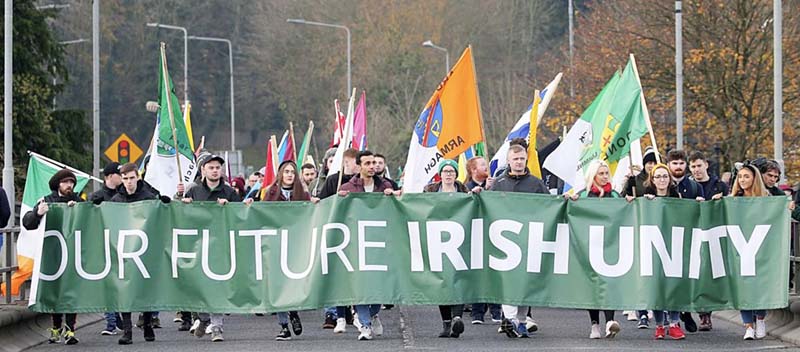
British communists must fight for Britain out of the Six Counties.
For united-front defence against repression!
State repression, including the imprisonment of left-wing activists, is increasing. Yet most groups defend themselves alone and receive at best symbolic solidarity, or at worst indifference, from other organisations. The ingrained sectarianism on the left is a major obstacle to building what should be a basic task: united fronts against state repression.
This situation is intolerable. Socialists must be the vanguard of the fight against repression and must make “an injury to one is an injury to all” a real principle again. This requires fighting sectarian poison, raising cases within the labour movement, organising joint actions and supporting comrades in prison. Ultimately, this calls for creating an organisation of the entire socialist left to combat repression of militants in a united manner. This is what we are attempting to do—in an embryonic form—with the Partisan Defence Committee.
Fight the liberals, regroup the left!
The left is deeply confused about the nature of the epoch and the reasons for the rise of reaction. Socialists must fight for debates to elevate the level of political discussion. As existing far-left organisations face intense internal turmoil, revolutionaries must intervene to prevent groups from collapsing along confused lines and to fight for political clarity. Any initiatives that seek to bring existing left-wing organisations together for common work in the interests of the working class must be supported.
In all cases, the task of revolutionaries must be to wage a relentless struggle against liberal politics plaguing the far left; against conciliation of the Green Party, of Burnham’s Labour and of trade union bureaucrats. Every opportunity must be used to show how divorced the left is from the working class, and how urgent it is to connect with its struggles and preoccupations.
Right-wing forces have the wind in their sails, the centre is utterly discredited and the left keeps clinging to it. Meanwhile, massive class anger is building up. That the right is perceived as the only anti-status quo option is a massive indictment of the socialist left. Socialists must get ready for a fight as brutal attacks are underway. But the only way to carry this out, and ultimately to chart a progressive way out of the current abyss, depends entirely on the capacity and determination of a critical mass of authentic socialists to decisively break with petty-bourgeois liberals and gain authority among a section of the working class. There is no other way.