
https://iclfi.org/spartacist/en/71/left
The following presentation was given at the ICL’s Ninth International Conference.
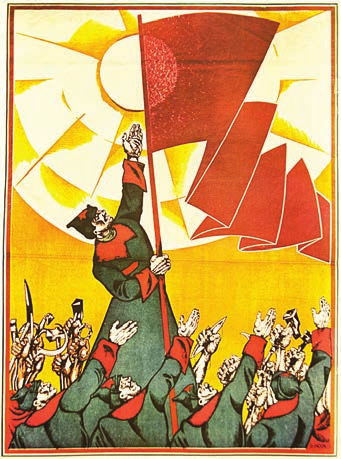
We all know great shocks are coming. We also know that the workers movement, starting with its communist vanguard, is thoroughly unprepared for them. For decades the left has accommodated itself to liberal bourgeois democracy, forgetting the basic principles of the class struggle and positioning itself for a rude awakening.
There is, however, another side to the question. Trotsky once wrote:
“Every profound crisis—whether economic, political, or military—has its positive side, in that it puts to a test all the various traditional values and formulas, laying bare the rottenness of those that served to mask ‘peacetime’ contradictions, and thereby spurring forward the general development.”
—“A Fresh Lesson” (October 1938)
We are already seeing this process unfold before our eyes. The increasing violence of world events is exposing the rot in the workers movement and anti-imperialist forces. From the collapse of the Bolivarian regime to the teetering Cuban Revolution, the hollowed-out trade-union movement, all the way to the impotent and fractured communist left.
The ICL is a tiny organization within the spectrum of Trotskyism—itself quite weak. What role can the tiny forces of the ICL seek to play in this context? This is one of the key questions we face at this conference. How can we, in the midst of global turmoil and a left in crisis, play our part in “spurring forward the general development” of our movement?
The objective course of events will bring great revolutionary upheavals. There can be no doubt about this. Our job is to make sure that when these great waves come crashing down, the communist movement isn’t stuck in a tangled mess of its own making. Instead, it must be in a position to vie for leadership.
This task will be achieved by offering the working class a real political alternative, one which can break the false binary of capitalist politics. Drawing lessons from past failures, we must forge a revolutionary trend, extend it internationally and root it deeply in the proletariat and oppressed masses.
This is the task of the ICL. It is not the most glamorous, and there will be no quick success, but it is the only perspective that gives real meaning to our existence as an independent political force, that can arm us with the confidence to withstand the coming shocks and prepare us to seize the opportunities they will create.
The Crisis of the Revolutionary Left
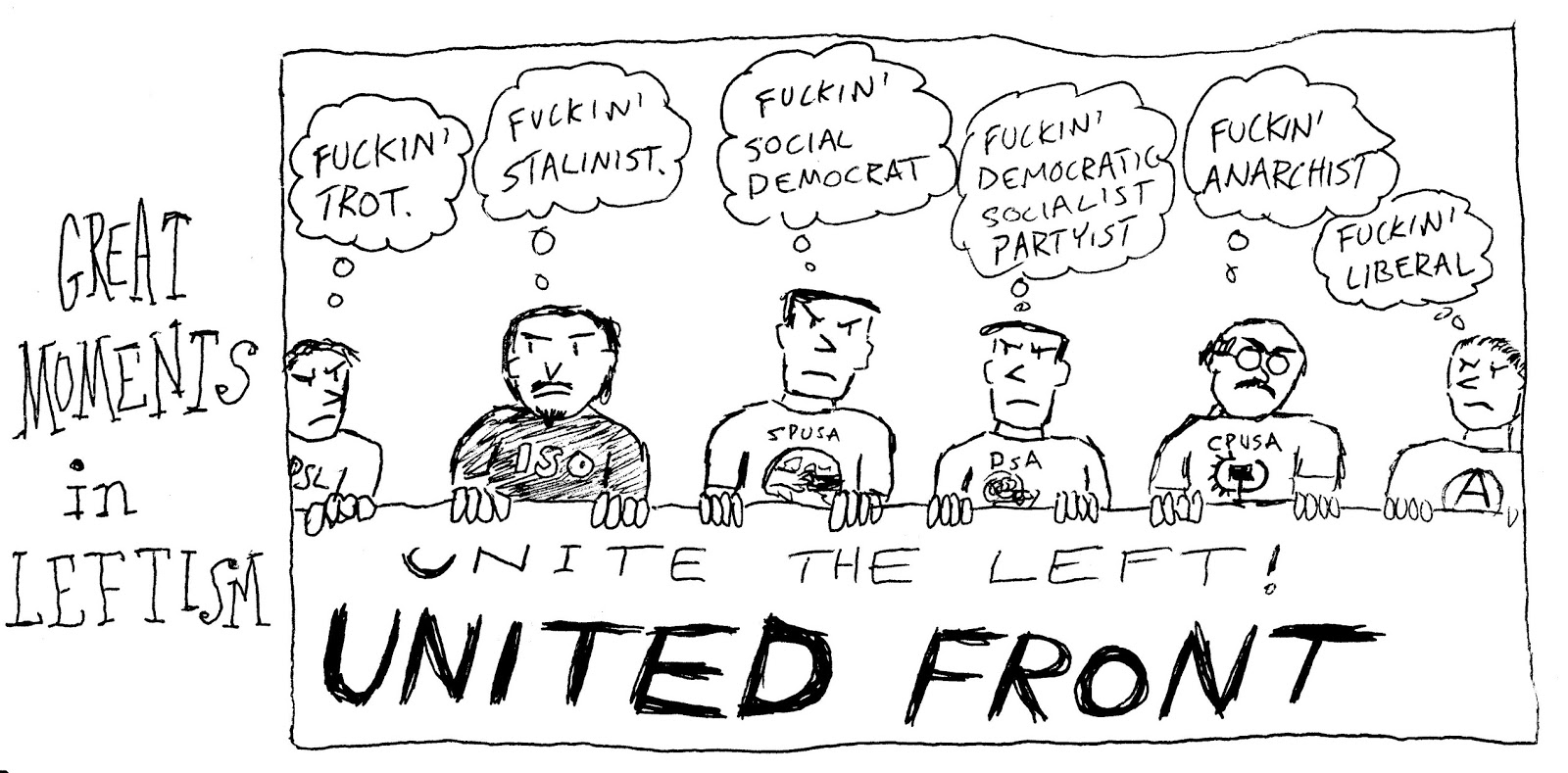
Trotsky explained how “thoughts are scientific if they correspond to an objective process and make it possible to influence that process and guide it” (History of the Russian Revolution [1930]). To influence the course of the Marxist left, we must understand the source of its crisis. What are the objective factors which explain the current weakness of our movement? At first sight, the answer seems obvious: the left is divided because people disagree. But that only pushes the question back. Why do these disagreements arise, and why do they persist generation after generation?
The first thing to understand is that the myriad ideological differences which divide the left are not just ideas floating in the air. They reflect real class polarizations—often in a very deformed way. It is important to understand this point: disputes in the left reflect in embryonic form the great class and social conflicts of a given epoch.
And if internationalist Marxist principles lay the basis for uniting the working class behind its historic interests, the conciliation of bourgeois interests drives it apart. Fundamentally, the conciliation of non-proletarian interests explains why the Marxist left is hopelessly splintered.
A party that conciliates nationalism will drive away workers from other nationalities. A party that refuses to fight against the discrimination faced by certain minorities will be shunned by the most oppressed. A party that conciliates liberal feminism will splinter along moralistic lines. And on and on it goes, with capitulations in one direction generally followed by mistakes in the opposite direction, leading to an endless cycle of splits and fractures.
What makes this reality more difficult to understand is that the mistakes of the past have been compounded often for generations in the various Marxist trends. The divisions between Trotskyists, Stalinists, Maoists, even Hoxhaists, all reflect past clashes of interests and programs. But the more distant we are from the events which prompted these divisions, the more they lose their meaning.
The clearest evidence of this is that all the different Marxist currents are polarized along similar lines: the Ukraine war, imperialism, the national question, identity politics. None of the different distinct Marxist traditions can present a unified answer to the main questions of the epoch. The point is not that the disputes of the past do not matter—we will certainly continue to defend the Trotskyist tradition—but that the existing chapels of Marxism are anachronisms which mask rather than clarify the key class questions that our movement faces today.
How Other Tendencies Get Revolutionary Leadership Wrong
“The philosophers have only interpreted the world in various ways; the point, however, is to change it.”
Before moving on to how we can start laying the foundations to solve this mess, I want to say a few words about some of the other explanations which exist for the crisis of revolutionary leadership. There are generally two mirror-mistakes made. The first reduces revolutionary leadership to objective events; the second reduces it to correct ideas abstracted from practice.
Expressions of this first trend can be found in parties such as Lutte Ouvrière, or our own party in the past. Obviously, the balance of class forces, the level of class struggle and the consciousness in the working class are crucial in determining the influence that revolutionaries can acquire. But to insist on the objective at the expense of all else reduces revolutionaries to waiting for a different period. The result is passivity and fatalism.
In the second idealist trend, the Partyists have their own distinctive argument. They think that if Marxist groups could agree on a common minimum program and maintain a democratic culture, then all the various groups could start uniting. As I already explained, conflicting political trends reflect conflicting class or sectoral interests. Unification can only happen by overcoming these conflicts, not by sweeping them under the rug behind abstract principles and formulas.
Most other parties are just as idealist, but unlike the Partyists, they tend to deny the crisis among communists. Groups like the Revolutionary Communist International, but really almost every tendency, consider themselves to be the only example of the unbroken thread of Marxism. For these parties the crisis of revolutionary leadership can be reduced to the weakness of their own forces. Naturally they become overwhelmingly obsessed with the number of people they recruit. Instead of treating Marxism as a tool to advance the class struggle, they reduce the class struggle to an arena for winning people over to the “correct” set of Marxist ideas.
Marxism, from the analysis of objective reality, elaborates ideas which can themselves be applied to change this reality. So, it is obviously antithetical to Marxism to explain the crisis of the revolutionary movement either by ideas abstracted from reality or by blaming objective reality without a program to change it.
Untying Political Knots
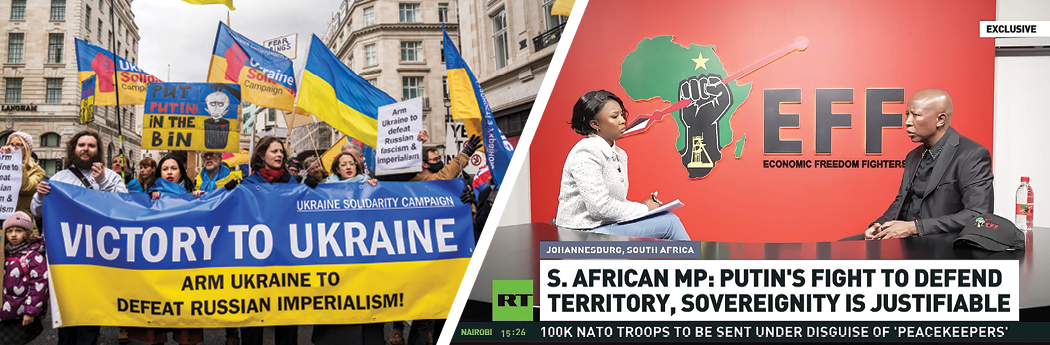
From pro-imperialist cheerleaders for Ukraine to “anti-imperialist” cheerleaders for Russia, divisions on the left reflect real social conflicts.
Now that we are clear that divisions in the workers movement are a refraction of existing social divisions and that we have dispelled certain wrong notions about revolutionary leadership we can finally start working toward solutions.
First, we must look at how we can overcome the infernal cycle of bad splits and polarizations within the left. The answer to this question is again basic: to break with all forms of bourgeois ideology. Now, don’t dismiss me just yet. I know it is a caricature for small groups to proclaim that they uniquely in the world have once and for all broken with reformism. This is not where I’m going.
Abstractly proclaiming one’s rupture with bourgeois ideology is meaningless. The ICL makes no such claim. Instead, we try to put forward a method which can overcome reactionary bourgeois polarizations.
As a rule, every political conflict presents the working class with two bourgeois alternatives. Whether the issue is a war, a strike or a thorny social question, revolutionaries must develop an independent proletarian solution capable of going beyond this false choice. Our starting point must always be to fight for the triumph of a working-class alternative against all those on offer. The moment this is lost sight of, and our goal becomes merely to influence existing forces, we can no longer speak of being an independent proletarian factor.
This being said, it would be a vulgar mistake to paint all disputes involving bourgeois programs as equally reactionary. The working class must often take a side in such conflicts. In the war against Iran, as in all wars of imperialist aggression, the only way to unite the working class is based on defending the oppressed nation, in this case Iran. The position we take in any conflict must always be guided by what advances the interests of the proletariat as a whole, and not one sector of the class at the expense of another.
Many Marxists stop here; they take a side while proclaiming their political independence and raise revolutionary demands. But revolutionary leadership requires more than taking the correct side. It is essential to also seek to overcome the limitations imposed by bourgeois leaderships on progressive causes. Take the struggle for trans liberation, for example. It is certainly necessary to take a side against TERFs. But to offer the movement any prospect of advancing amidst the huge wave of reaction it faces, we must wage a determined struggle against the liberal ideology which dominates the movement. The point is not to recite platitudes about eliminating gender division under communism—although we are for this—but to concretely show how Marxism is an essential tool to advance the struggle of trans people.
Elaborating a strategy which can effectively challenge existing leaderships is where the difficulty truly lies. To impose a class solution, one must look at the contradictions in each side of a conflict and untangle the reactionary interests of the bourgeoisie from the legitimate social aspirations of the masses. This may sound straightforward in the abstract. In reality, it is often the hardest part of revolutionary politics.
In the Russia-Ukraine war, both sides fight for reactionary aims. Yet both also draw on legitimate grievances. The Russians have faced decades of Western aggression, and Russian minorities in Ukraine were oppressed by the post-Maidan regime. Ukraine, for its part, is justified in fighting for its national existence against Russian aggression. To overcome the reactionary polarization between Russian and Ukrainian workers, it is necessary to lean into the progressive side of their respective aspirations and show how achieving these aims cannot be done through the bourgeoisie’s strategy. For Ukraine, Western alignment together with attempts to reconquer Russian-majority territories undermines the national survival of the country. In the case of Russia, oppressing Ukrainians will set back the struggle against Western imperialism by permanently inflaming national antagonisms.
This basic method is essential for the working class to advance its own class interests and no longer be forced to choose among bad alternatives. But it is no guarantee. Life is always more complicated than theory. Nevertheless, what is certain is that without consciously trying to offer working-class solutions to social polarizations, there can be no talk of revolutionary leadership, and no talk of overcoming the divisions in the Marxist left.
The Dynamic of World Events
I have made a case for the ICL’s basic methodology and how it can help overcome many of the conflicts on the left. However, as we all know it is not enough to have the right ideas; these ideas need to be adopted. Given our size, it is fair to ask how we can ever expect to have a decisive influence on the rest of the Marxist left, much less the class struggle. To answer, it is necessary to view our tasks beyond the bounds of our own little organization and place the political trend we represent against the backdrop of great world events.
At bottom, our confidence does not rest on the abilities of our members, our size or our resources. It rests on the dynamics of the class struggle itself. Our political perspective points the way toward resolving the central political contradiction of the present epoch. On the one hand, the U.S. empire is bringing the world down in a cycle of barbarism to defend its hegemony, and on the other, there is the absence of a force which is willing and able to bring it to a progressive end.
Events themselves will show both the burning need to defeat the U.S. empire and the inadequacy of the non-revolutionary solutions on offer. The objective situation itself will demand an independent working-class alternative to this growing contradiction. This is why, although our trend barely exists in terms of the forces it represents, we can be confident in its political potential.
We are not arguing that history will mechanically vindicate our program, as every Marxist tendency claims. Our confidence rests on something more concrete: our program addresses a contradiction that the objective course of events will continuously bring to the fore.
None of this should encourage complacency. If the experience of the Cold War teaches us anything, it is that objective pressures alone are not enough. Despite the need for a revolutionary solution to the polarization between the Stalinist world and imperialism, the Trotskyist movement fundamentally failed in its historic task. History presents opportunities. It does not seize them for us. This is where building a political instrument that can be the living vehicle of the revolutionary program takes its full importance.
From Perspective to Practice: Building the ICL
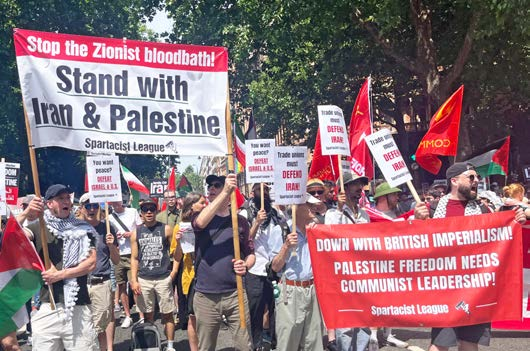
Spartacist contingent at Palestine demonstration in London during Twelve-Day War, June 2025.
So far, I have been highlighting the broad political perspective which must animate our work. I have tried to show how the ICL can contribute toward overcoming the historical challenge facing our movement. This understanding is essential in giving meaning to our efforts and sacrifices in the difficult times we face. But from the broad we must come back down to the particular, and to how, with the forces currently at our disposal, we can advance our cause.
Before discussing what we should do, we need to be honest about where we are. In his 1936 article “Marxist Politics or Unprincipled Combinationism?” Max Shachtman speaks of the three stages of the evolution of a revolutionary organization:
“A propaganda group which concentrates on hardening the initial cadres on the basis of clearly defined principles; then a more active group in the process of transition to a mass movement…; finally, the larger movement, which not only calls itself a party but which can discharge the responsibilities incumbent upon an organization claiming to defend the daily as well as the historical interests of the proletariat.”
The ICL finds itself in a rather contradictory position. We are an old organization. But one which has seen dramatic renewal. In many ways we are still in the initial stages of our development. The bulk of our membership is composed of older comrades, who have dedicated their lives to building the party, and we are only starting to build a younger layer of leading cadre. At the same time, we have been making important interventions into a growing range of struggles, from defense campaigns, to strikes, to small united-front initiatives.
Overall, we are in a very delicate position. This conference illustrates very well how we are politically mature as an organization, but still organizationally embryonic. The tenuous nature of our forces makes the efforts of each one of our comrades all the more important. The loss of even a few comrades in certain critical areas could set us back in an important way. Meanwhile the current political turmoil in the left does present certain openings that could lead to a rapid transformation of our party. Our recent work has attracted a following which we previously did not have. But this has not yet materialized in important organizational gains.
To the comrades who agree with us on our fundamental perspectives, we need your help as members of the ICL. A revolutionary trend will not build itself; it needs an organized force which will make it a material force in the class struggle and an influence on the course of events.
Conclusion: What Does Revolutionary Regroupment Look Like?
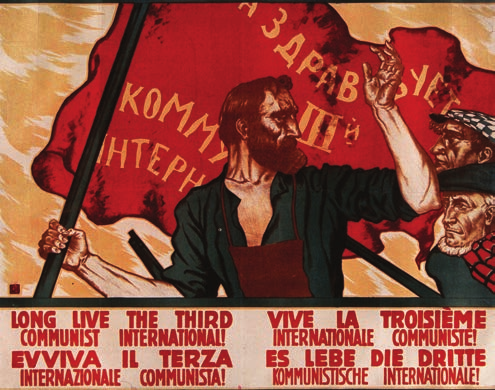
Founding of Comintern: the greatest revolutionary regroupment in history.
I want to conclude this report with the question of revolutionary regroupment. The fractured nature of the Marxist left and the upcoming upheavals in the world are more and more bringing this question to the fore. Recognizing the need for revolutionary regroupment is one thing; understanding how it can actually happen is another.
Currently, the crisis in the Marxist left is not favorable to a broad regroupment of forces. If anything, we see a reinforced tendency toward fracture and sectarianism. But we can also see beginnings of a countertrend—individuals, groups and parties who are drawing lessons and looking for a way forward. There is potential for regroupment within this layer, but we need to be very clear about the scale here. For the time being, we are talking of a small minority.
These initial small regroupments must be seen as steps to build a lever that can later produce much bigger realignments within our movement. If all of this sounds rather ambitious, then the obvious question becomes: where do we actually begin?
We’ve seen how the crisis of leadership is rooted in the absence of a firm proletarian foundation. It follows that there can be no solution to this problem without rooting a revolutionary trend within the working class itself. This is fundamentally what will give social power and political coherence to the Marxist left. Without this we are doomed to remain small intellectual circles playing with ideas. In this sense, our industrial work is important not only because of the immediate struggles we wage, or because it deepens our party’s understanding of reality. It is essential because it is the only path to building a revolutionary trend rooted in the working-class vanguard. Breakthroughs in this area of work will not come easily, but they have the potential to fundamentally transform the character of our movement.
We’ve also seen how the crisis of imperialism will be the central factor driving forward a revolutionary trend. A true perspective of revolutionary regroupment is one which seeks to totally shift the center of gravity of the international left away from Western countries, turning to the millions bearing the brunt of the imperialist boot. The small but disproportionate resources available to the Marxists in the West must be leveraged to push the movement forward in the Global South.
Finally, when we think of revolutionary regroupment, we must look to the greatest example in history: the founding of the Third International. World War I and the Russian Revolution were of course the catalyst for the historic feat of regrouping revolutionaries on an unprecedented international scale, but it was prepared by long and patient struggle by the Russian Bolshevik Party.
Fortunately, we are not the first revolutionaries to confront a period like this. In “Left-Wing” Communism: An Infantile Disorder, Lenin describes the first stage of this struggle in the years 1903-05, which he names the years of preparation for revolution. He explained how during this period:
“Representatives of the three main classes, of the three principal political trends—the liberal-bourgeois, the petty-bourgeois-democratic..., and the proletarian-revolutionary—anticipated and prepared the impending open class struggle by waging a most bitter struggle on issues of programme and tactics…. Those political and ideological trends which were genuinely of a class nature crystallised in the struggle of press organs, parties, factions and groups; the classes were forging the requisite political and ideological weapons for the impending battles.”
This is the stage we find ourselves in today. Our task, like then, is to forge the political and ideological weapons for the battles coming our way.
If we are to have any hope of standing up to our historical task, we need to forge a political trend capable of meeting the great political challenges of our epoch—and we need a party to give it flesh and blood in the class struggle.
We cannot afford another generation of sterile and fragmented Marxists. There is no time to lose.