
https://iclfi.org/spartacist/en/71/china
This presentation, edited for publication, was given by comrade Qimin at our Ninth International Conference.

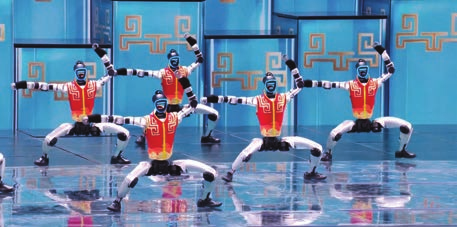
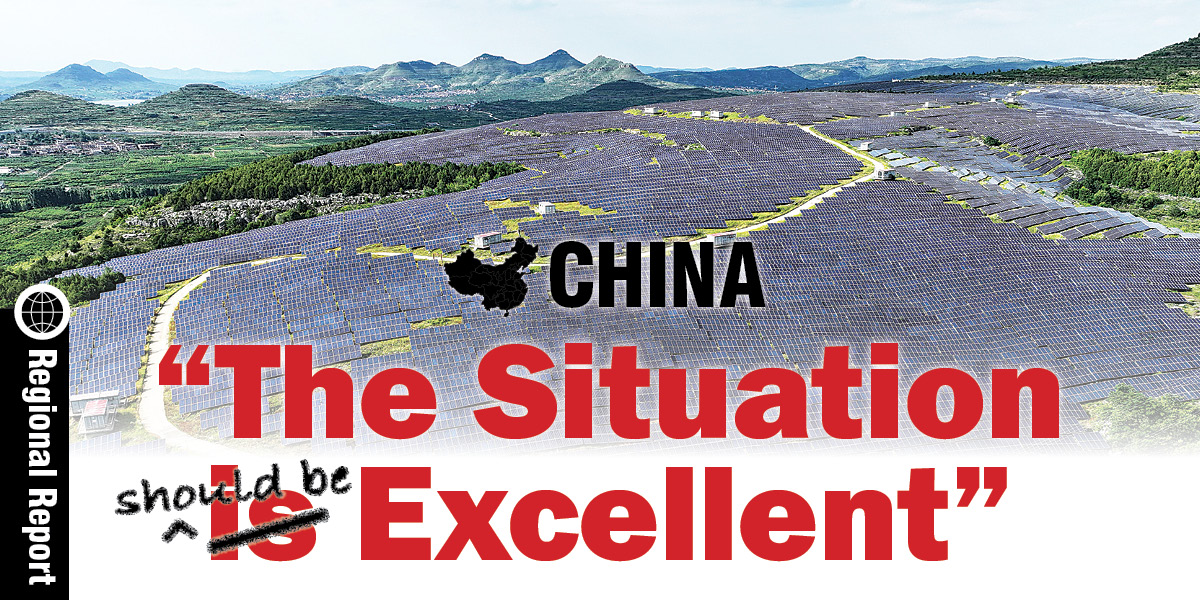
Top photo: Solar panels cover hills in Shandong Province. Above: Robots perform martial arts at Beijing Spring Festival in February.
Everything under heaven is in chaos. The situation should be excellent. Yet it is not. This report aims to address precisely this question: How is it that the People’s Republic of China, the world’s biggest industrial power, technologically on a par with and even surpassing the U.S. empire, appears entirely passive on the world scene? What does this contradiction tell us about the Communist Party of China (CPC), its program and the road to China’s continued development? How does the turning point in the world situation relate to what is happening within China itself?
A Two-Faced Strategy
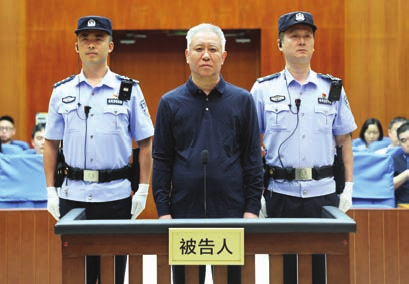
Xu Jiayin, former Evergrande real estate tycoon, sentenced to life in prison, August 20. Justice done, but what about his enablers?
As Trotsky said, the historical crisis of mankind is reduced to the crisis of the revolutionary leadership. Where this is most evident is within the largest organized working class on Planet Earth, in China. The main contradiction that the entire world situation hinges upon is precisely the class balance of forces in China. This is also what creates the two-faced strategy of the CPC.
On one hand, there is the immense pressure to keep the U.S. system stable. This explains China’s call to open the Strait of Hormuz. This explains its criminal abandonment of Cuba and Venezuela, and the massive reduction in oil purchasing that kept stock markets stable while Trump bombed Tehran. China’s non-presence on the world stage is tied to the capitalist and market sectors of the economy and the massive integration of the CPC bureaucracy at the highest levels with the U.S. dollar order, including through personal corruption, but also its interest in keeping social stability.
On the other hand, the CPC bureaucrats’ power rests upon the social foundations of the 1949 Revolution. Their legitimacy rests upon the promise that China will never again suffer a century of humiliation. They know that the aim of imperialism is to keep China subjugated. This is what forces them to drive the development of the country. That the CPC itself has 100 million members, including proletarian cadres, requires it to respond to this class pressure.
The bureaucracy very much self-consciously expresses this contradiction. This is why it abandons its allies, and defends free trade but uses its massive state power to defend the free-trade order. Its current strategy on the world stage has been to stabilize the global economy, while the current Five-Year Plan doubles down on technological and national autarky. The Politburo is not stupid in that they know that a crash is coming and that China could face a blockade. Huge stockpiles of grain and fuel and gigantic bailout funds are being prepared. The problem is that their very material basis and program prevent them from actively fighting to break out of this encirclement through proletarian internationalism. They are stuck with purely responding while the U.S. has the initiative. That’s because the U.S. rulers are defending their own system: imperialism.
China’s Rise and U.S. Hegemony
The contradiction between these two pressures could be smoothed over as long as the global economy continued to expand. Globalization brought new buyers for Chinese goods, foreign investment and relative political calm outside of a few U.S. interventions. The Chinese capitalists would submit to CPC diktats, and the Chinese working class was kept pacified, as long as the economy grew at double digits, real wages increased and eye-watering speculative profits were made in the housing bubble.
It is China’s own rise that is now tipping the U.S. world order to its limits and thus putting this basic social contract at home in jeopardy. Let me be fully clear: China climbing the value chain, denying the imperialists their profits in key sectors like auto and AI, and gaining technologies to defend itself and develop the economy is progressive. The problem is the CPC’s strategy, caught between a rock and a hard place, in response to their own newfound power.
Look at the trajectory in China over the last few years. The bureaucracy has already begun to turn “left,” in its own nationalist, repressive way that runs roughshod over the masses. The property bubble represented a gigantic cancer, creating a massive class of speculators—not even capitalists but speculators—who are parking hundreds of billions of U.S. dollars abroad. Massive capital flight. They popped this bubble because it represented a capitalist threat. The state banks then started lending like crazy toward technological upgrading and advanced industry.
This much-needed move, however, was done in a way that also trampled the masses. 60% of Chinese household wealth is in property. Almost everyone owns a home. Wiping out $18 trillion worth of valuation meant that consumption crashed. Local governments, which depend on land sales but also provide basic education and public transport, have had to impose severe austerity. The center wants to stop the wanton corruption of local governments. But the mountains are tall and the emperor is far away. So, the only method they have is the blunt tool of financial starvation.
Just to illustrate what else they’re doing. Unused housing converted into social housing. But what else? A planned, targeted raising of the Chinese stock market so that household wealth is gradually rolled over into stocks. What kind of stock market has targets? One of the few wonders of the socialist market economy.
The deeper problem, however, is that China’s economy is completely unbalanced in its development. Its population, too, is completely stratified between several hundred million migrant workers and the skilled urban workforce. This is how you can have an economy that is both racing ahead, with productivity in automated auto factories double that of the U.S., and hundreds of millions of people still working in low-end export sectors, agriculture, mining and steel. The rapid pace of industrial automation is quickly ballooning the gig sector—to 84 million workers—which is so socially volatile that the CPC is now actively ordering the unionization of the sector.
A Forced March
The CPC’s strategy is a forced march to socialist modernization, i.e., technologically outcompeting the imperialists. They pour billions into semiconductors; every province is supposed to have its own EV, AI and solar sectors. This is at the expense of modernizing the backward sectors of the economy, or of improving the consumption and welfare of the masses. The state is able to spend so much precisely because China has one of the highest savings rates on the planet, the consequence of a system which actively denies rural workers education and healthcare.
This has been the basic model since Reform and Opening Up: the peasantry are now allowed freedom of movement (unlike the Mao period), but they are not allowed residential rights in the cities, their children cannot be educated in urban schools, and a plot of land guaranteed to them by the state is used to cover the costs of child-rearing and pensions. Economic development has granted limited reforms, but the fundamental model remains. Thus, you have a several hundred million member strata of migrant workers, who could work for extremely cheap, attracting Western and Japanese capital.
Unlike the West and Japan, China’s rapid leap into industrialization did not involve acquiring colonies or imperial expansion. What this meant was that the country necessarily had to exploit itself in order to obtain the capital needed.
Now this fundamental stratification maintains itself even as the CPC adopts a new strategy—that of technological autarky. The Five-Year Plan speaks of “whole industrial chains”—that is, their solution to the encirclement of China is to literally reproduce the entire global economy within one country. Thus, the estimated 67 million left-behind children of migrant workers become generationally trapped as the lowest tier in the CPC’s strategy to build socialism in one country.
The reactionary peasant family serves as the shock absorber for when crisis hits. This is why all these reports on hukou reform and consumption spending are only marginal. They do not change the fact that there remains gigantic inequality in distribution between rural and urban workers. Urban workers also hold desperately onto their privileges for fear that equalization means equalized poverty. The point is that you cannot just administratively abolish this hukou stratification. Like a tier question in a trade union, we have to fight for raising all workers to the welfare received in Shanghai and Beijing. This can only be done by squeezing the capitalists and fighting to break the imperialist encirclement of China.
This is how we get to the funny conundrum of the IMF demanding that China establish a welfare state, while Xi Jinping says that welfare breeds “lazy people.” We should be very clear—the imperialists want China to “raise welfare” by adopting a market economy. The imperialists want this to cripple China’s industrial upgrading. They want Chinese workers buying Volkswagens, not BYDs.
The other reason the bureaucracy doesn’t want to do it is that the CPC is haunted by the Brezhnev period of stagnation in the USSR. They see the chief mistake as granting welfare to workers that then could not be taken back without sparking a proletarian uprising threatening their bureaucratic rule.
For Socialist Globalization!
Our response to this is simple. They forget that the working class would be willing to sacrifice its own amenities if it had a clear and conscious understanding of its task, and if that decision was made not by fat-cat bureaucrats but by themselves. Socialism cannot be defended by “wise” men with supercomputers. It is defended through the conscious participation of billions.
So, what is the proletarian internationalist program to resolve this contradiction in China’s development? It is to say: the world revolution and China’s domestic development are fused. They are the same strategic task. Neither the snail’s pace of a “consumer” economy nor the forced march to socialist modernization!
This was Trotsky’s basic point in The Third International After Lenin—you have to use the global division of labor. Wages and consumption in China can be raised without reducing the rate of industrial accumulation—by importing cheap goods from the global market. Let go of basic manufacturing, transfer this to the Global South and use the export of Chinese industrialization to advance socialist globalization!
The CPC is not the cash-strapped Soviet Union or the DDR [East Germany] that had to sell its own citizens’ blood for dollars. We are talking about the country with one of the biggest piles of U.S. dollars on Planet Earth. The bureaucracy keeps this hoard because they need it to defend their rule during a crisis. We would instead use the money to offer massive technical and industrial aid to the world’s workers and oppressed in order to, ultimately, establish a belt and road of workers states that will prevent China from being blockaded by the imperialists. Instead, the CPC’s strategy is to curry favor with the current bourgeois regimes in the Global South, exporting surveillance equipment and aiding in the repression of workers and peasants.
The current global economic order is untenable. China’s productive forces are a mortal threat to the imperialists. This is why they have begun a death spiral of deglobalization. So where will the bureaucracy go? Because it lacks a global revolutionary perspective, it will instead double down on a nationalist, technological autarky. This will be a strike against both capital and the masses. It will mean more in-state measures—particularly if the imperialists really attempt to close the world economy to China. Such a move will look very much like the fortress built during the Covid lockdowns. Smashing capital, repression against the social freedom of the masses. But also technological wonders that allowed China to emerge with new productive forces. This will also be extremely brittle! Look at how the uprising of Foxconn workers during the lockdown, alongside the street protests, led the bureaucracy to completely reverse course.
The reality is that such a move would be socially explosive. It would mean closing in the capitalists at home. An economy shuttered from the imperialists would also create massive social instability in the West. You have a generation in China that has had unprecedented economic growth for 30 years, that has had certain individual and social freedoms. To clamp down on this in a society far richer than the Soviet Union in 1927 will present an almost civil-war-like scenario.
To fight for the People’s Republic to use its strength in the service of the world revolution, to cohere a left anti-imperialist opposition both inside and outside the CPC, we must confront the immediate illusions.
The first is pacifism, and it runs deep. Grueling work in the factories—whether for Western capital or Chinese—still looks better than sending an only son or daughter to die on a battlefield. The masses do not want World War III, and the hardliners who demand military confrontation offer it on a nationalist basis that would alienate the very proletariat of the area China needs on its side. But this is a false choice.
The CPC’s power to cripple U.S. military production and to pour investment into oppressed countries can freeze the imperialist assault without a single ICBM leaving its silo. But the sabotage is political, too: Beijing still counsels the Cuban Communists to adopt market reforms that now amount to surrender, and still presses the Palestinian resistance into unity with the Zionist quislings of Fatah—the very method, dictated by Stalin, that the CPC itself had to break from to make its own revolution.
The second illusion is economic objectivism: faith that the baggage train of cheap Chinese goods will cripple the imperialists all on its own. It is a seductive idea—one look at high-speed rail projects in Britain or California tells you what the imperialists’ “industrial prowess” is worth. But goods alone will not do it. Socialism can only be consciously constructed. The most important point is that the CPC itself is internally contradictory. So is its Belt and Road Initiative, when it builds solar panels that fuel American military bases in Mindanao.
These illusions must be smashed because they are what justifies China’s inaction in the defense of oppressed nations. To prepare for a future blockade while granting the imperialists a free hand will ultimately atomize the masses. They are the only ones we can count on in the defense of the 1949 Revolution. Xi Jinping said that the USSR fell because no one was “man enough” to defend it in its dire hour. But his strategy is precisely going to destroy the only force—the conscious socialist proletariat—capable of preventing counterrevolution.