
https://iclfi.org/spartacist/en/71/venezuela
The following presentation was given at the ICL’s Ninth International Conference.
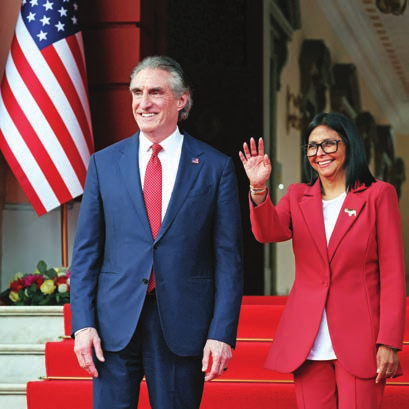
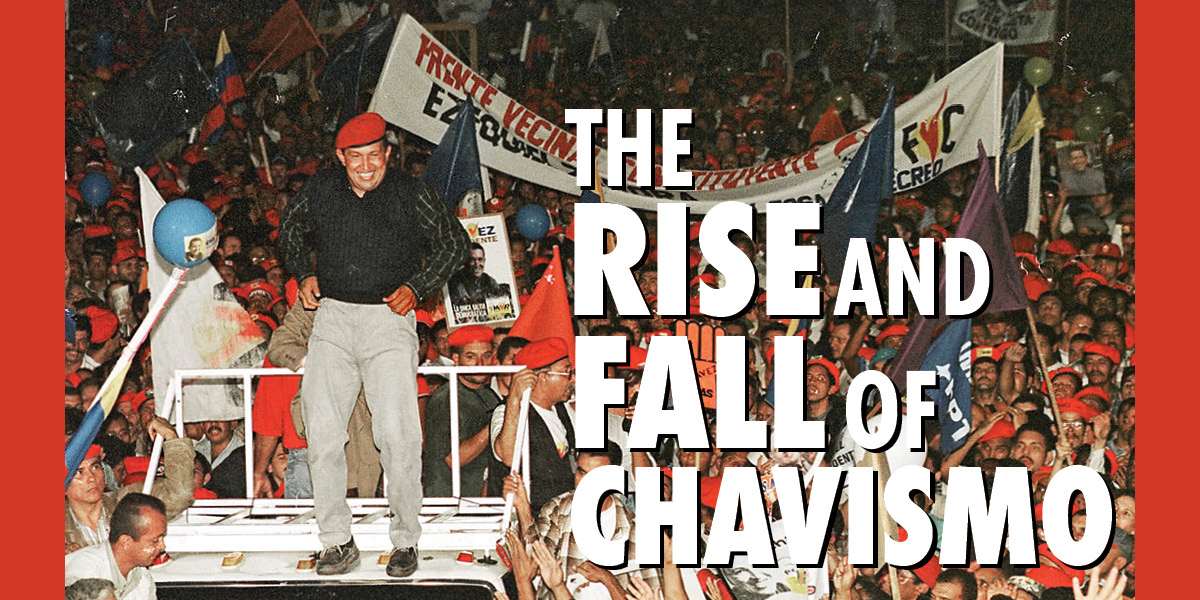
December 1998: Hugo Chávez on the brink of power cheered by thousands of supporters (top). March 2026: Interim president Rodríguez selling out Venezuela to the U.S.
Now that U.S. imperialism has increased its attacks on Latin America, starting the new year by abducting Nicolás Maduro and his wife, we have to take a look at how Venezuela got to its current position. But we can’t answer this without changing our approach toward Chavismo and the “Bolivarian Revolution.” This is necessary not only because of the dire situation in Venezuela right now, but also because the U.S. invasion of the country has created a devastating wave that reaches Cuba, Colombia, Puerto Rico and the rest of Latin America. The invasion of Venezuela has also paved the way for the attacks on Iran and other parts of the world.
The masses in Venezuela and Latin America are looking for a way out, but many still see Chávez as the model for countering imperialism. Most of us here know that Chavismo is not the way forward, but how do we convince the masses of that? We also need to reach those who once supported Chavismo but became demoralized by this dead-end strategy. How do we show them that there is a path to a genuine anti-imperialist movement that can crush both the imperialist rulers and the oligarchs? To come up with the answer, we need to look at the unfinished democratic tasks of Venezuela’s war of independence, how Chávez became the champion of the masses, how he restricted their revolutionary energy, what the task of revolutionaries should have been during the Chávez years, and what the different trends on the left said and did.
1. Bolívar
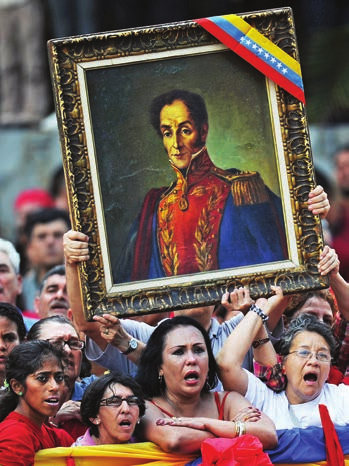
Commemoration of Simón Bolívar, hero of the independence struggle, July 2010.
I wanted to start the presentation off with Simón Bolívar and the war for independence because it was this figure and this struggle that shaped Chávez as a political leader and shaped his program as well. Just like you’ll see a portrait of Toussaint L’Ouverture in many Haitian households, the same goes for Bolívar portraits posted up in the homes of Venezuelans, sometimes with portraits of Chávez right next to them.
When looking at Latin American history, many paint the wars of independence in the 1800s as total victories, where nations broke free from Spain and became completely sovereign. But when we look critically, these independence struggles were deeply flawed, deformed and incomplete. Bolívar’s was no different. This fight for national liberation was progressive, but it was organized by a reactionary class who, although they led the rebellion against Spain, were never actually capable of carrying out the progressive democratic tasks needed to build a truly free and equal society. Bolívar’s grand dream of a unified, democratic Latin America didn’t fail because he didn’t fight hard enough or because he lacked military genius. The revolution failed and Gran Colombia shattered because both were tied to wealthy landowners whose economic interests ran completely against the needs of the oppressed masses and the struggle for genuine national liberation.
As mentioned before, the leaders of the revolution weren’t slaves or the toiling poor—people who actually made up a good portion of the army. They were the Criollo elite: Spanish-descended, white, wealthy landowners who made their fortunes by exploiting enslaved Africans, the Indigenous and mixed-race peasants. These elites hated Spain and wanted freedom, but they only wanted emancipation so they could trade globally on their own terms and have complete control over their land. The Criollo class was absolutely terrified of the people they oppressed. With the bloody Haitian Revolution fresh in their minds, the wealthy leaders refused to give the poor majority real power.
One of Bolívar’s reforms was to give land to his poor rank-and-file soldiers, but this was fought against ruthlessly by the Criollo class. Instead of breaking up the massive colonial estates (latifundia) and giving them to the peasants, the war’s generals (many of whom came from the Criollo class) kept the best land for themselves and left the large landlord estates completely intact. The poor remained landless, forced to stay on land owned by the wealthy elite while working under brutal conditions just to survive. When it comes to the land question, you cannot have true liberation when a handful of people own all the land while everyone else starves.
The new laws and constitution Bolívar fought for technically abolished the old colonial caste system, but daily life told a different story. The constitution barred anyone who didn’t own property from voting. This automatically excluded the vast majority of the black, Indigenous and mixed-race population from having any say in their own country.
The Criollos also did everything they could to prevent or at least slow down the abolition of slavery. Bolívar, who condemned slavery, said it is “madness that a revolution for liberty should try to maintain slavery.” But he would conciliate the Criollo slaveowners at the Congress of Angostura, decreeing a gradual abolition of slavery. As a result, this barbaric institution remained intact until 1854.
Bolívar knew that for Latin America to survive against powerful foreign empires, it needed to be one massive, unified country: Gran Colombia. But the local elites only cared about protecting their own small regional markets and businesses. Infighting among the Criollo elites broke Gran Colombia apart into small, weak nations. This set up a cycle of poverty, instability and imperialist intervention across Latin America.
Although the Spanish were defeated, nothing really changed for the oppressed masses in the region. The Criollo aristocracy simply sat on the old Spanish thrones, keeping the money, the land and the power for themselves. The fragmentation of Gran Colombia left the most important democratic tasks of the revolution unfinished: the land question, the unification of the continent and the destruction of the racist class system. This fracturing and weakness left the region vulnerable first to British and then to American colonizers, who moved in to take control of the economy. Nearly two centuries later, Hugo Chávez stepped right into this historical trap. Using Bolívar’s name to win over the masses, Chávez tied them and his “revolution” to a left-wing military caste while trying to fix a broken capitalist system, instead of putting the working class and the oppressed at the head of the anti-imperialist and anti-capitalist movement.
2. Military Man/Champion
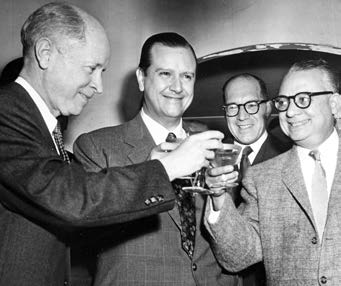
Leading signatories of the Punto Fijo Pact. The pact gave a democratic facade to U.S. neocolonial domination of Venezuela.
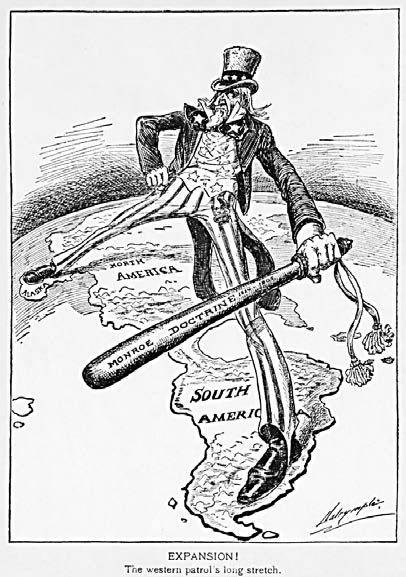
The U.S. built itself into an imperialist force in Latin America and the Caribbean through the Spanish-American War, the Monroe Doctrine and the Roosevelt Corollary. The U.S. had a particular interest in Venezuela because the country was rich in resources like oil. To keep the country under their domination, the imperialists installed one dictator after another until dictatorships were no longer politically advantageous to them.
With Cuban nationalists and the masses trying to oust Batista in Cuba in the 1950s, the imperialists could not afford a similar situation in Venezuela. They needed to set up some sort of “democratic institutions” to counter any sentiment for a liberation struggle. So, the country’s ruling parties worked with the U.S. to get rid of dictator Marcos Pérez Jiménez, bringing in democracy under the Punto Fijo Pact. But what was presented as democracy for the masses was really just a corrupt power-sharing scheme between Venezuela’s three main parties. Whether under a dictatorship or Puntofijismo, the Venezuelan working class and oppressed were excluded from the political life of the country, and the left was driven underground. At the same time, the imperialists sank their teeth deeper into Venezuela, and the oligarchs grew richer off the backs of the masses.
This long history of oppression and exclusion finally bubbled up in the 1989 Caracazo. By this point, Puntofijismo had reached its limits as President Carlos Andrés Pérez, who had ruled at the height of the pact in the 1970s, was re-elected by masses hoping for some relief from crushing impoverishment. After decades of using the working class’ pockets to compensate big oil and the imperialists, when Pérez imposed austerity measures in exchange for IMF loans, the oppressed had had enough. Venezuela exploded in the Caracazo as a massive, spontaneous uprising of the working class and urban poor swept across the country.
The thing is that Puntofijismo had choked off any independent working-class movement, as many union leaders attached the working class to the ruling parties. Then you had the left that had crumbled because it had no real strategy for fighting the traditional parties and the oligarchs. The Venezuelan working class and oppressed masses had no one to turn to. There was no mass, independent revolutionary party to guide the explosive energy of the Caracazo and direct it against the ruling class and toward the seizure of state power. And with no leadership to guide it, the traditional capitalist parties brutally crushed the revolt, killing thousands.
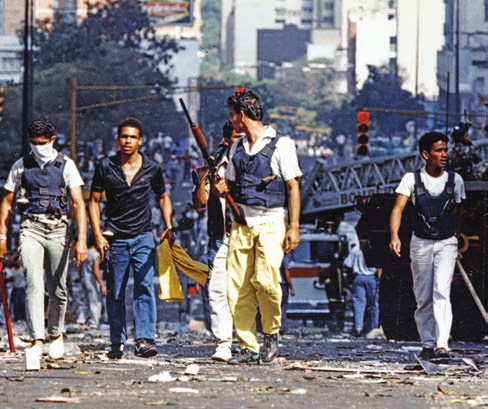
Caracazo: Brutally repressed popular uprising against neoliberal president Andrés Pérez, February 1989.
At the time of the Caracazo, Hugo Chávez and his collaborators knew they needed to fight the ruling class and were planning to stage a takeover. But they were taken by surprise by the mass uprising and remained helpless in changing the course of events. This experience and the severe repression of the masses radicalized Chávez and his group, convincing them to go ahead with their coup plans.
Through his Movimiento Bolivariano Revolucionario-200, Chávez led a bloody but unsuccessful coup against the unpopular government of President Pérez in 1992. Though the military uprising was brutally put down, Chávez was allowed to make a brief televised surrender speech. By taking sole responsibility for the failed coup and asking his collaborators to stand down “por ahora” (for now), Chávez became a hero to the working class and oppressed masses, who felt abandoned by the political establishment.
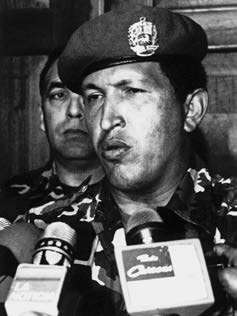
Chávez defiant after his failed coup, 4 February 1992.
But Chávez was not done. During his time in prison, he recognized the potential for a more “democratic” path to power, and once he was out, he founded the Fifth Republic Movement. His movement made demands that spoke to the hearts and minds of the masses. Along with pledging to rewrite the constitution, establish a participatory government and redistribute the country’s immense oil wealth, Chávez swore to fight corruption, spoke out fiercely against U.S. imperialism and invoked Bolívar’s dream of a united Latin America.
It’s not unusual in Latin America for military strongmen to come to power. When the capitalist class is too weak or discredited to rule effectively and the working class is not yet organized enough to take power, the state apparatus (specifically the military) can elevate a leader who appears to stand above classes. In this case, it was a left-wing military officer who was pushed forward. Speaking to the widespread anger at political corruption and a collapsing neoliberal economy, Chávez transitioned from a military officer into a champion of Venezuela’s working class and urban poor. He campaigned as an outsider and won the 1998 presidential election in a landslide, taking office in 1999 and officially filling the political vacuum left by a decaying establishment.
So, the failed coup and the 1998 election propelled Chávez’s rise to power, but what solidified him as a defender of the oppressed was Plan Bolívar 2000 and the “Misiones.” Once in office, Chávez used the military to directly assist marginalized communities. Through programs like Plan Bolívar 2000, he deployed soldiers to build low-income housing, repair schools and deliver affordable food to the barrios. This bridged the gap between the armed forces and the people, firmly cementing his status as a defender of the poor. He promised that his “Bolivarian Revolution” would finally finish what Bolívar had started. Using billions of dollars from nationalized oil revenues, Chávez funded massive social programs for health, education and food, giving the poor their first real taste of political and social dignity.
Chávez continued to nationalize key industries and enact reforms that benefited the working class and oppressed masses. Chávez’s reforms, like his Bolivarian program, were moderate—but they still made the oligarchs hysterical. This was because the masses mobilized to push Chávez and his reforms forward, and also to defend them when they came under attack from the oligarchs and the imperialists. Instead of harnessing the revolutionary energy of the working class and oppressed to finally smash the oligarchs and imperialists, Chávez chose to conciliate them. Each act of conciliation signaled weakness on Chávez’s part, which emboldened the right wing and Washington to continue their attacks.
3. Holding Back
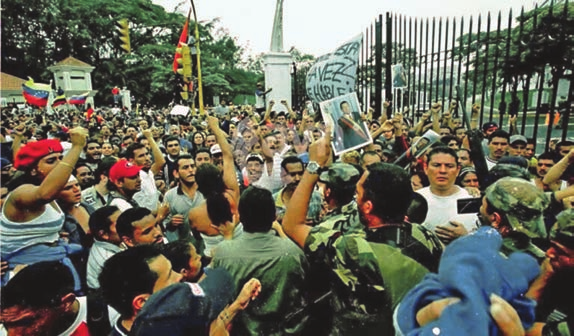
Masses rally to defense of Chávez, defeating U.S.-backed coup, April 2002.
There have been many instances of Chávez conciliating the opposition. The most notable came in the aftermath of the April 2002 coup. The 2002 right-wing coup attempt in Venezuela is considered to be the moment the country’s oppressed masses woke up to their own historical agency. A coalition of business elites, corrupt labor bureaucrats and military generals, backed by U.S. imperialism, kidnapped Chávez and installed Pedro Carmona as dictator. In response, hundreds of thousands of workers, peasants and the urban poor poured out from the barrios, surrounded Miraflores Palace and forced the coup plotters to flee. The masses moved with such force that the oligarchs and the imperialists had no choice but to put Chávez back in office. This spontaneous and heroic uprising could have been the beginning of a true transformation of Venezuelan society. The masses were ready, standing up as an independent political force willing to fight the capitalist system and the imperialists alike.
But rather than seizing this revolutionary opening to defeat the bourgeoisie and beat back Washington, Chávez actively held back the insurrectionary momentum of the masses. Once he was back in the presidential palace, Chávez did not call for the arming of the workers or the expropriation of the property owned by the coup plotters. Instead, he held up a crucifix and preached national reconciliation. He is famously quoted as saying, “The revolution does not see the opposition as the enemy; we see them as compatriots.” With this, Chávez demobilized the masses, sending them peacefully back to their homes.
Many will disagree with what I just said, but look at what happened next. In the wake of the failed coup, the Venezuelan working class expected revolutionary justice against the oligarchs who had just kidnapped their leader and thrown the country into chaos. Instead, Chávez relied on the bourgeois court system to administer justice. But the courts ruled that there was no coup and cleared all the plotters of any charges. Chávez criminally channeled the raw, combative energy away from being unleashed against the oppressors and back within the bounds of what was safe for capitalism. This would have deep consequences.
His conciliation only emboldened the ruling class. The oligarchs and the imperialists continued their offensive through the December 2002 bosses’ lockout and oil industry sabotage. Workers responded aggressively by staging spontaneous factory occupations. The masses wanted to arm themselves to defend the Bolivarian Revolution, but Chávez prevented the formation of independent workers militias. Instead, he mobilized the military, maintaining it as the only force capable of keeping order and fighting the opposition. This ensured that the working class remained disarmed and completely dependent on the state.
The response of the working class and urban poor to the 2002 coup provided an opportunity to build workers tribunals and soviets, and even to transform the Bolivarian Circles into these councils. Chávez, though, made the conscious decision to maintain capitalism. He consistently went out of his way to reform the system from above instead of allowing the masses to dismantle it from below. That’s because guiding the working class to power would have threatened his position as the military strongman in Miraflores Palace.
Even Chávez’s reforms, which did alleviate the pressure of impoverishment on the working masses, still respected private property relations. Under his constitution, the banks, the land and the major manufacturing infrastructure were left in private hands, and the state itself remained a bourgeois state. Chávez never intended to change this system. Just look at what he did when workers took control of key sections of the oil industry. Instead of dismantling the capitalist state and giving real democratic control to the workers through factory committees, he centralized power within the military and his own political inner circle. This created a new class of wealthy bureaucrats, often called the boli-bourgeoisie. Private property remained protected, and the entire country stayed dangerously dependent on selling oil to global capitalist markets.
4. Tasks
So, you have a lot of craziness going on in Venezuela during the Chávez years, with all sections of society taking part in political life. Or at least having something to say about the situation in the country. The left around the world had some sort of analysis of Chávez, but no group laid out what the real tasks were. So, what were the tasks of revolutionaries during this time? The primary task during the “Bolivarian Revolution” was to participate actively in the mass movement in order to expose the contradictions and limitations of Chávez’s bourgeois-nationalist program—not to follow it blindly or sit on the sidelines. Only by actually taking part in the struggle and getting your hands dirty could revolutionaries win the trust of the working class and oppressed masses. Part of the fight would have been to use their concrete, day-to-day struggles to expose Chávez’s reformist program. Chavismo could never bring true national liberation to Venezuela because it sought to alleviate the daily hardships of the masses within a capitalist framework rather than smashing the root cause of their oppression.
Within the movement, revolutionaries should have constantly pushed beyond Chávez’s rhetoric, demanding the total expropriation of capitalist private property and the arming of the working class. Raising these demands would have backed the Chavista regime into a corner, exposing how it was consolidating power in the hands of the military instead of the working class and urban poor. This would have been tied to calling for the creation of independent workers and peasants councils, showing the masses that genuine socialism could not be delivered from above by a leader looking to conciliate the oppressors. It had to be built from below through independent organs of working-class power. This would not have been hard to argue, either, as the masses were constantly set in motion to defend the “Bolivarian Revolution” and Chávez from the ongoing attacks of the ruling class and the imperialists.
The point was to use these demands to expose the increasing corruption and bureaucratism that started to hollow out the Bolivarian government. But how did the hollowing out happen? The problem is Chávez never built the Bolivarian movement on an anti-imperialist or anti-capitalist program, and his party and government were filled with people who wanted to maintain the status quo. Chávez himself was only pushed in that direction by the masses, who wanted to free themselves from centuries of colonial domination. Because he had no real strategy for defeating the opposition, he constantly performed a balancing act: leaning on the masses and coming out strongly against the imperialists in words, but conciliating the opposition in deeds by never touching private property. This gradually disorganized and demoralized the Chavista base.
To break the masses away from bourgeois-nationalist reformism and build an independent vanguard party, it was necessary to have an orientation toward Chávez’s Partido Socialista Unido de Venezuela (PSUV). The PSUV was marketed as an organization meant to bring the fragmented left and other revolutionary elements together and advance the Bolivarian movement. I know we’ve been talking about revolutionary regroupment—this was not it. The PSUV was a top-down, multi-class coalition designed to bureaucratically control the revolutionary energy of the working class. Fighting to break it from within was necessary as many had joined because they saw it and Chávez as the main force fighting imperialist oppression. Being in the movement, participating critically, and fighting relentlessly for a genuine anti-imperialist path would have broken the masses from Chávez’s grip. But none of the left groups that joined the PSUV did this. Many claimed they were entering to break the masses from Chavismo, but all liquidated into the party and remained there until they were bureaucratically expelled by Maduro.
5. Two Trends
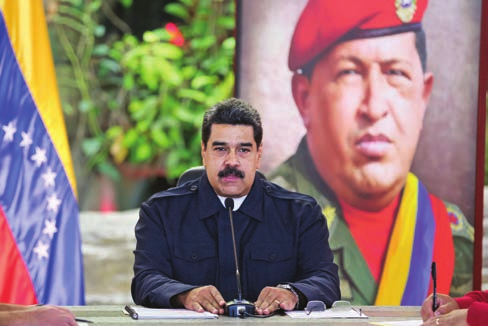
President Maduro, successor to the Chavista Bolivarian Revolution, January 2017.
The strategy of entering the movement to expose the limits of bourgeois nationalism went directly up against the two main political trends in the Marxist movement around Chavismo. These two trends were (and still are) sectarianism and opportunism. Both were wrong because they failed to connect revolutionary strategy with the actual political and social reality of the working class and oppressed masses. Here is how these strategies clashed and why they failed.
Sectarian groups looked at Hugo Chávez, saw that he was not a pure Marxist and refused to have anything to do with his movement. They stood on the sidelines, shouted slogans and denounced Chávez and his followers from afar. We fell into this trend. We simply called Chávez a bourgeois politician and said his movement and neoliberalism were two sides of the same coin. This is a damaging line to have. Bringing this line to the Venezuelan masses, who saw Chávez pushing back against imperialism and making their lives more bearable, could only repel them from us. That’s if they didn’t physically hand our ass to us.
It’s true that Chávez was a bourgeois nationalist and not a Marxist. But we denounced him, kept our hands clean and offered nothing to the masses, who were being led down the wrong road. This wrong road contributed to the degraded position they find themselves in today, further under the boot of imperialism. Our sectarianism did nothing but isolate us from the very people we needed to lead and organize in an anti-imperialist movement. But we had no desire to be in the movement or find out what the masses were thinking. During the Chávez years, we never seriously attempted to find out for ourselves what life was like for the masses—what they thought and what they felt. Millions of working-class people passionately supported Chávez. To them, he was the extension of Bolívar. Chávez was their defender, fighter and leader. Communists standing on the outside of the movement throwing insults would only make the masses see Chávez as the true socialist. This should make it clear why you cannot win the trust of workers or convince them of better ideas if you refuse to fight alongside them in their day-to-day struggles.
The opportunist trend, represented by the likes of Alan Woods of the International Marxist Tendency (IMT)—now called the Revolutionary Communist International—completely liquidated itself into Chávez’s movement. To maintain favor with the leadership and remain popular with the masses, they uncritically joined the PSUV. Woods tried to be slick by saying, “The Bolivarian Revolution cannot succeed if it remains within the limits of capitalism” (The Venezuelan Revolution: A Marxist Perspective [2024]). Unlike the sectarians, who wanted nothing to do with the Chavistas because they were bourgeois, Woods correctly understood that Marxists needed to actively intervene in that movement and that it needed to be taken outside the confines of capitalism. But the basis of the IMT’s intervention was to push Chávez far enough to the left that he would be the one to complete the Bolivarian Revolution and expropriate the bourgeoisie. The IMT did not see the working class and oppressed as the force that would carry the Bolivarian Revolution forward by breaking from the leadership of Chávez. So, their whole perspective was to push Chávez to the left instead of challenging him for leadership.
Opportunism is, and always will be, a betrayal of the working class and oppressed. By hiding the truth to avoid making waves, groups like the IMT helped spread the illusion that Chávez could achieve socialism. When Chávez’s bureaucratic state eventually restricted workers’ strikes or protected private property, the opportunists were trapped. They were unable to defend the working class and oppressed masses because they had tied themselves to the Chavista regime. Alan Woods has long since abandoned his support for the Bolivarian regime, but many opportunists haven’t. They need to understand that if they truly want to change the course of events, they can no longer abandon revolutionary Marxism in order to remain in the good graces of a “Chavista” regime that is now working as closely as possible with the imperialists.
It’s very important for communists to recognize and understand these two trends so that we don’t fall into either of these fatal traps. It’s also necessary to expose both trends to the masses while providing a path that will bring true national liberation. I’m hoping this presentation can do just that: provide the Venezuelan masses with an explanation of how they got here and how the Chavista years did them no favors in the struggle against the domestic ruling class and the imperialists. That isn’t to say we will undo all the damage we helped contribute to over the last 27 years, but it should at least be a start. It is with this new line, firmly grounded in permanent revolution, that we can stand in sharp contrast to both extremes of sectarianism and opportunism. We can no longer remain isolated from the Venezuelan masses and their living struggle. We have to understand that if we want not only a hearing but also the trust of the masses, we need to be there in the dirt and the mud of their day-to-day struggles. We need to stand side by side with them as all hell breaks loose, showing that another way is possible.
We can see that Hugo Chávez didn’t actually finish Simón Bolívar’s revolution; he simply managed the ongoing and recurring crises of Venezuelan society within the limits of capitalism. Bolívar’s tragedy was that he led the Criollo class that was fundamentally incapable of bringing true equality and unity to the continent. Chávez’s tragedy was that he used anti-imperialist and anti-capitalist rhetoric and leaned on the revolutionary energy of the masses only to reform the capitalist system. If there’s one lesson to learn from the last 225 years of Venezuela’s history, it’s that the unfinished democratic tasks cannot be solved by left-wing military populism or bourgeois nationalism. These tasks can only be accomplished by a leadership that seeks to unite the working class and oppressed masses around an anti-imperialist program in order to create a genuine democratic, socialist federation of Latin America. The wealthy elite and privileged military caste can never resolve these historic injustices. Only the working class can do that by taking power and building a socialist society.
6. Now
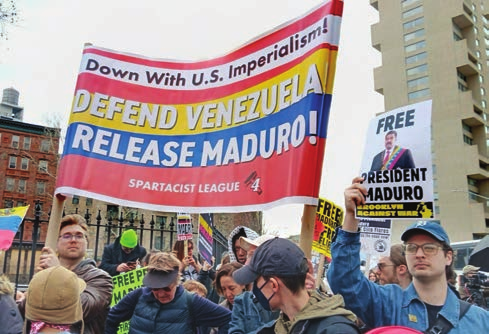
Spartacists join protesters demanding freedom for kidnapped president outside court hearing, New York, March 26.
So what do we do now? After years of holding back the revolutionary aspirations of the masses while the imperialists destabilized the country, the Chavista regime has completely rotted out. Both Chávez and Maduro have responsibility for this. And after Maduro continued to undermine the aspirations of the masses, the masses did not come out to defend him like they did for Chávez in 2002. The left has barely been able to mobilize in defense of Venezuela and many haven’t even called for Maduro’s release. From the moment of Maduro’s abduction, we in the ICL have called on the left and working class to come out and reject the imperialists’ attacks. We have written articles, produced podcasts and initiated united fronts to defend Maduro and Venezuela. Let’s take it a step forward.
Delcy Rodríguez came to power after Maduro’s kidnapping and she has just begun selling the country off to Washington. At first, she played a good game. During her inauguration, she took her oath and then proclaimed that Maduro was the rightful president of Venezuela. Rodríguez initially seemed hard against imperialism only to roll over quick, making deals to open oil fields to the U.S. while stopping all oil shipments to Cuba.
Nothing is going well for the working and oppressed masses of Venezuela. Rodríguez opening up the country to U.S. intervention will only make things worse and turn the country into a neocolony. Now, with Caracas in shambles after two devastating earthquakes, the lives of the masses will be more unstable. The capital itself doesn’t have enough response teams to save the thousands trapped underneath the rubble. This is the result of continued imperialist sanctions that have eaten away at Venezuelan infrastructure. Many are dying as buildings continue to collapse. What’s Rodríguez doing? She continues to make deals with the U.S. in exchange for aid. (See “Venezuela and Colombia: Same Disaster, Same Enemy,” Spartacist, 24 August.)
This aid will only come at the cost of ensnaring the country and its masses tighter in the choking grip of American imperialism. The Venezuelan working class and oppressed need to fight, but the struggle cannot be under the same Chavista program of the last 27 years that has completely undermined their revolutionary strength. The masses must organize together and fight back against Rodríguez and the colonial vultures in Washington, placing the working class at the head of the movement. This movement needs to be based on an anti-imperialist strategy that also crushes the oligarchs and the conciliators in the Chavista regime. An anti-imperialist fight that harnesses the revolutionary energy of the masses is not only about saving Venezuela but also the rest of Latin America, where a wave of right-wing reaction is sweeping the continent.
So let’s correct our approach to Chavismo. Go to Venezuela. Find out what the masses want and think in order to win their hearts and minds. Let them know what we have to say and work with the masses and those on the left who truly want to build a revolutionary anti-imperialist united front.
- Down with Delcy Rodríguez!
- Down with U.S. imperialism!
- Free Maduro!
- For a Free and Red Venezuela and Latin America!