
https://iclfi.org/spartacist/en/71/workers
The following is an excerpted presentation given by comrade Tom C. at an international gathering of the ICL’s working-class friends and supporters.
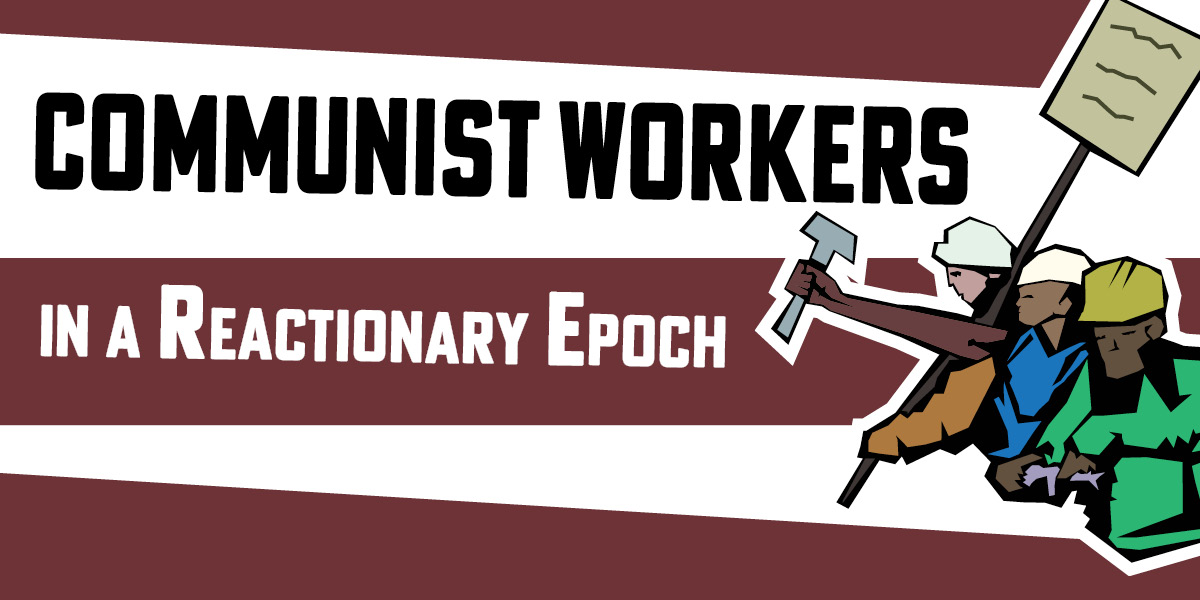
Welcome, comrades. It’s unusual and important to have a gathering of communist workers from different continents and nations. It gives us the opportunity to discuss our tasks within the working class and the unions, not just in the lofty terms of our final revolutionary goal, but in concrete ways of getting us closer to that goal. Today, we want to take a serious look at the current conditions of the working class, our own aims and tactics, what challenges we face and how to take meaningful steps forward.
We know from direct experience that there’s been a dramatic rightward shift in the world, not just in bourgeois politics but in the mood and mindset of many workers. In the midst of this, we need to understand what’s going on and why. Equally important, we as communist workers need to know where we stand and what we can realistically do right now, individually and collectively, on the job and in the unions. We must not only survive in industry, but also gain political authority and build support for our revolutionary program. We want to bring the most advanced workers into our orbit, to build a fighting workers movement and a revolutionary party. Our goals are huge, but our forces are tiny. Our coworkers are often unresponsive, wary or even hostile to our ideas. Obviously, this can be a source of demoralization and despair, and we need to consciously address that.
That’s what James P. Cannon was doing in 1932. He was worried about the vanguard getting exhausted and demoralized and then perhaps being unable to handle the real movement when it breaks out. In a similarly grim period, he offered this advice:
“The Communist workers are not the working class. They are only its conscious section, and at present in America they are a small and numerically insignificant section. The Communist workers alone cannot fight real class battles. Their function is to fight with the workers and in their front ranks. The task of the Communists at the moment is to prepare the workers for the coming struggles. The center of this task is the ‘patient work of explanation’; of agitation and propaganda to win the workers over to a course of struggle. There is no substitute for this prosaic task and there is no way to leap over it.”
—James P. Cannon, “The Threat of Illegality,” Militant (19 March 1932)
The patient work, that’s what Trotskyist workers did. They did it where they found themselves working, often not by choice but by necessity, in a funny little industry (coal delivery yards) and in a city very hostile to unions (Minneapolis). When talking to their coworkers after the Great Depression began, they must have used one simple but essential phrase countless times: “Hey, let’s keep in touch.” Then, they did keep in touch, offering Marxist political analysis, a program and practical advice.
They became the real leadership for something rare but coveted: an actual fighting union. And when conditions were ripe, they seized their opportunity. The 1934 strikes they led were part of the great wave of class struggle that led to the formation of industrial unions in the U.S. We’re nowhere near that point right now, but the historical tide will turn again, and we want to be ready just like the Minneapolis Trotskyists were. Things may be terrible right now, but things change. When they do, the workers you cultivated by once saying “hey, let’s keep in touch” just might be your most militant coworkers or hopefully comrades.
Despite the bad period, what we do is important and it is remembered by our coworkers. One of the things that keeps me going is remembering times when I saw the enormous pent-up militancy and creative energy of my transit brothers and sisters unleashed, some of whom I thought beforehand were hopelessly self-centered and backward. I’ve seen black, white, Latino and Asian coworkers furious at the bosses and union tops alike, ready to walk off the job if only the union gave them a hint that it would back them up. And when that hint came, I’ve seen them walk out and man picket lines in the freezing cold in the thousands.
Let me end with an observation from the recent SL/U.S. conference motion: “Everything we do now matters, irrespective of the immediate response. By establishing a track record in today’s struggles, we will attract vanguard elements as we become more widely known. It’s on the basis of this work that we can aspire to build a revolutionary current within the working class itself when the objective situation changes.”