
https://iclfi.org/spartacist/en/71/latin-america
This presentation, edited for publication, was given by comrade Julia Emery at our Ninth International Conference.

Our basic starting point in the ICL, as comrades know, is that the struggles of the oppressed in Latin America must be directed centrally against U.S. imperialism. So, what I want to deal with is the political direction in Latin America and how the overall rightward shift in world politics is being reflected. The basic position I want to defend is that we are seeing a significant shift to the right throughout Latin America, with one country after the next going over to neoliberal, pro-Trump governments. At this point, there are only a few countries like Mexico and Brazil where left-wing governments are holding out that are attempting to balance measures to placate the masses with an ultimately futile perspective of negotiating with the rapacious U.S. imperialists.
This position differs significantly from the worldview of other left groups who argue that the right and left are neck and neck, and who either deny or minimize the fact that the right wing is on a real offensive across the continent.
Factors Driving the Rightward Shift

Electoral billboard for new Colombian president De La Espriella. Left grasps at straws to downplay right-wing turn in Latin America.
What are the factors behind this rightward shift in Latin America? The first is obviously the world situation defined by Trump’s tearing up of the liberal order. The conflict between the U.S. and China is increasingly dominating world politics, and Latin America is a key terrain where this is playing out. China-Latin America trade grew more than 30-fold in the last 20 years from roughly US$12 billion around 2000 to over $480 billion by 2022. The U.S. remains Latin America’s largest overall trading partner, mainly because of its trade with Mexico and Central America, but China has become the largest trading partner for much of South America. While I won’t defend everything China does in South America, it is important to be clear on which power oppresses Latin America, and that is the U.S. Although it is increasingly challenged on the world scene, the U.S. has long considered Latin America its backyard and is prioritizing squeezing the region and pressuring its governments to cut their ties with China.
2026 has seen a rapid intensification of U.S. aggression, beginning with the kidnapping of sitting Venezuelan president Maduro in early January and the capitulation of a wing of the Chavista regime. The most sinister development so far is the imminent threat of counterrevolution in Cuba. Under extreme threat of U.S. strangulation, the Cuban government put all its faith in negotiations, leading to the adoption of a package of economic reforms dictated by U.S. imperialism which, if implemented, would overturn collectivized property and re-establish private property, allowing unfettered access to foreign and gusano capital. The Communist Party of Cuba (PCC) is under deadly illusions that this will enable them to survive.
The response to our articles from pro-PCC types has been extremely hostile and hysterical, but I haven’t seen an intelligent answer to our arguments that the measures proposed will both overturn all the gains they fight to defend and lead to the destruction of the PCC regime itself. This is what the ICL is fighting against with all the means we have as a small organization.
A second factor driving the rightward shift is the failure of the pink tide governments, which were elected in the 2000s following the neoliberal governments of the 1980s and ’90s. As Trotsky explained, in the oppressed countries, the national bourgeoisie can rule either by relying on the imperialists against the masses or by leaning on the masses against the imperialists. For a period of time, these pink tide governments were able to lean on the masses and give them what many considered, quite rightly, as real gains, allowing them some breathing room from imperialism.
However, because of changes in the world markets and the world situation, an increase in corruption and in particular very high inflation in countries like Argentina and Venezuela, these governments lost the popular support they once enjoyed. While illusions in Chavismo and Evismo, for example, remain, the fact that Maduro’s kidnapping and Delcy Rodríguez’s betrayal were basically unopposed in Venezuela was definitive proof that the regime had lost the support of the masses.
Another factor driving support for the right is the very real fear of crime and powerful narco gangs throughout Latin America. These hold whole villages and populations hostage, forcing youth into drug gangs and driving mass immigration to the U.S. by families desperate to escape this violence. Even among many who hate U.S. imperialism and neoliberalism, existing Latin American governments are widely seen to be totally ineffective against the narcos, and there are real illusions that the CIA and DEA are more effective in fighting the drug lords. Aside from our elementary opposition to U.S. imperialism, we have yet to tackle this question seriously. However, I did find the framework laid out in the main article of the new Nigerian newspaper of the ISA-R quite useful to approach this question (see “No to U.S. Imperialist War on Nigeria!”, The Anti-Imperialist, Issue 1, Summer 2026).
Denial of Reality
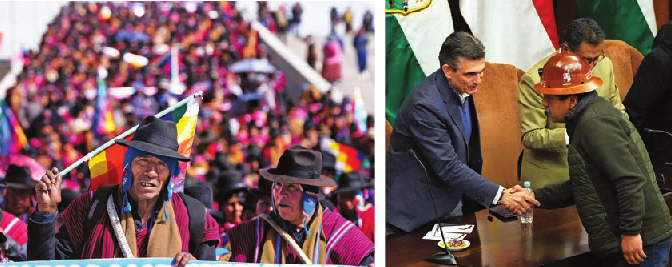
Mass uprising against Bolivian government (left) was betrayed by COB workers federation leadership. Right: COB’s Mario Argollo shaking hands with U.S. lackey president Paz, June 17.
The picture I’m presenting here goes significantly against the view presented by many other left groups, according to whom the left and right are basically neck and neck in Latin America, and it’s a toss-up which way things are going. I’m going to deal with some of the arguments they raise to defend this view.
One is that although right-wing governments are coming to power across Latin America, in many of these elections, like Peru and Colombia, the results were close. In Argentina, many argue that Milei has met with resistance in implementing some of his measures and his absolute number of votes went down in the midterm elections last year. An example is the Partido de los Trabajadores Socialistas (PTS) in Argentina, which many of you know as Left Voice in the U.S. or Révolution Permanente in France. They argue:
“The point is that the Right is failing to reconfigure the balance of power to the extent it needs to. What we see, instead, is a very rapid erosion of right-wing governments, like José Antonio Kast’s in Chile, Javier Milei’s in Argentina, and Rodrigo Paz in Bolivia.”
—“Beyond ‘Trumpification’: Latin America’s Deepening Organic Crises,” Left Voice (5 July)
While some of this is true, the outcome of recent elections must be judged from the standpoint of whether the interests of the oppressed are advanced or set back. The victory of right-wing governments with the backing of the Trump administration, even when they do not have overwhelming support, empowers them and their U.S. imperialist masters to carry out catastrophic attacks on the oppressed masses. For example, despite repeated large mobilizations in Argentina, Milei managed to get his basic law through, cutting back many social services like health and education, and most recently passed a labor reform law that fundamentally guts trade-union rights.
Obviously, it’s not out of the question that one of these governments could be replaced with a more left-wing alternative. But it’s important to look at the overall historical trend. The last 30 years have seen an exceptional period of liberal democracy in much of Latin America, unlike the succession of coups that was more characteristic of earlier periods. But this is not the norm, and it is quite likely that the Latin American bourgeoisies will be compelled to impose their will and, more importantly, that of the U.S. by force in the coming years.
Another approach on the left is to really minimize the defeats that the working class has seen. Some groups, including the PTS/Left Voice, and to some extent, I think, the latest article that the Partido Obrero Revolucionario (POR) wrote on Bolivia, argue that Bolivia was not a defeat because the uprising was not drowned in blood—despite the Paz government’s threat to do so. But the way in which the uprising was defeated is even more dangerous: the COB, the historic organization of the Bolivian working class, knifed the peasants and indigenous peoples in the back, creating a poisonous division that could last a generation. The Paz government remains in power, its emergency powers remain on the books, and it has gained time to regroup, train fascist bands and receive more reinforcements from U.S. imperialism.
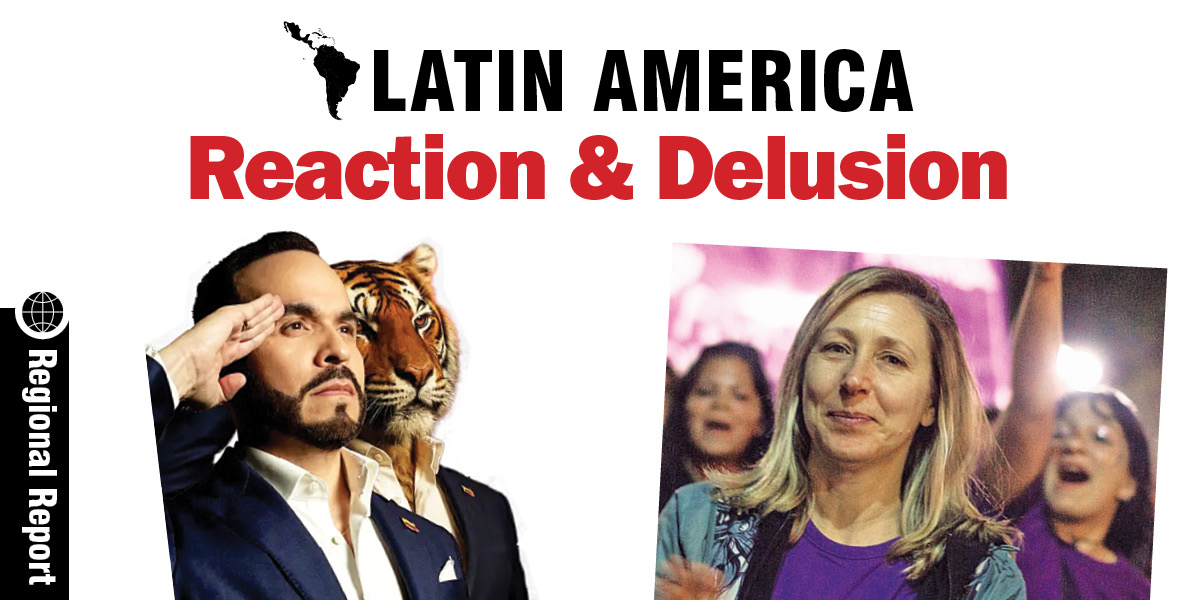
One argument raised more recently by the PTS and others is that the popularity of their leader and elected congresswoman in Argentina, Myriam Bregman, shows that the Argentinian population is turning toward Trotskyism and the FIT-U, the electoral coalition of Trotskyists. Now what is the significance of this increase in popularity? I do not think that the working class is turning en masse to the dictatorship of the proletariat.
I think what is happening is that Milei has been in power for two and a half years. Those who voted for him hoping for change are seeing these hopes dashed because their living standards are getting worse. Meanwhile, the Peronistas are totally divided, discredited by their previous stint in government, which ended with inflation at over 200%. They have put up no serious opposition to the Milei government, opting instead for social dialogue and maintaining stability. So, by default, support is growing in the polls for an alternative option. But that doesn’t mean the Argentinian proletariat’s illusions in Peronism have been broken. The real question for the PTS is what they are going to do with that support.
The Need for a Revolutionary Pole
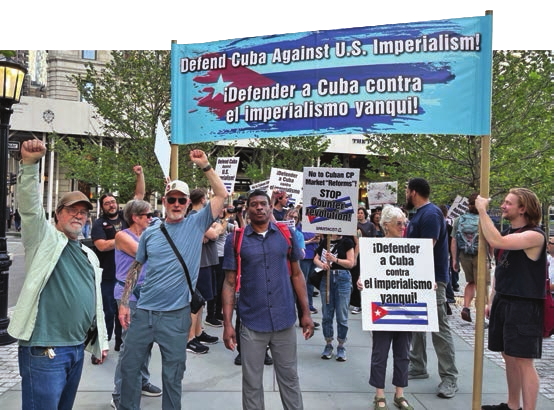
United-front demonstration in New York, July 17.
Does this bleak picture mean that the masses in Latin America are universally turning to the right? Absolutely not. There are important countertrends and fightbacks, not least the frequent mass mobilizations in Argentina and the recent uprising in Bolivia. However, what is fundamentally hampering these mobilizations is that even when there is a lot of discontent, there is no alternative leadership perceived as viable at this point, as the various non-revolutionary leaderships have shown themselves to be totally bankrupt.
Why is it important to have a correct understanding of the balance of forces? Because the key task of Trotskyists in Latin America, as elsewhere, is to build a revolutionary force that can unite the masses in the struggle against U.S. imperialism.
If you think that leadership is already there, that it is represented not in a Trotskyist program but in the size of the mobilizations against neoliberalism or in the spontaneous capacity for self-organization of the masses, the task becomes simply to amplify the mobilizations, which is indeed what much of the Argentinian left argues for. But the task of Trotskyists in Latin America is to build a Trotskyist pole capable of leading the masses.
In doing so, we need to struggle against a couple of trends. One is best represented by our own previous attitude to the governments of the pink tide: to treat governments like Chávez’s or Morales’, or for that matter Claudia Sheinbaum in Mexico, as no different from right-wing neoliberal governments. The problem with this is that you can’t address the illusions people have in them, which are a result of real gains the oppressed have achieved.
The other trend is to capitulate to those forces. This is best represented by organizations and forces who argue that what’s necessary is to return the likes of Maduro and Morales to power. One argument we heard in Bolivia is that the problem was that Evo Morales’ collaborators betrayed him, and what is needed is a return to “real” Evismo. The same argument is heard in Venezuela.
Here I will mention that our total reorientation on the question of permanent revolution and the need to fuse national liberation and anti-imperialist struggle with the fight for socialism is absolutely fundamental and forms the basis on which we’ve been trying to intervene in Latin America, and also the basis for our ongoing discussions with the POR.