
https://iclfi.org/spartacist/en/2026-cuba-catastrophe
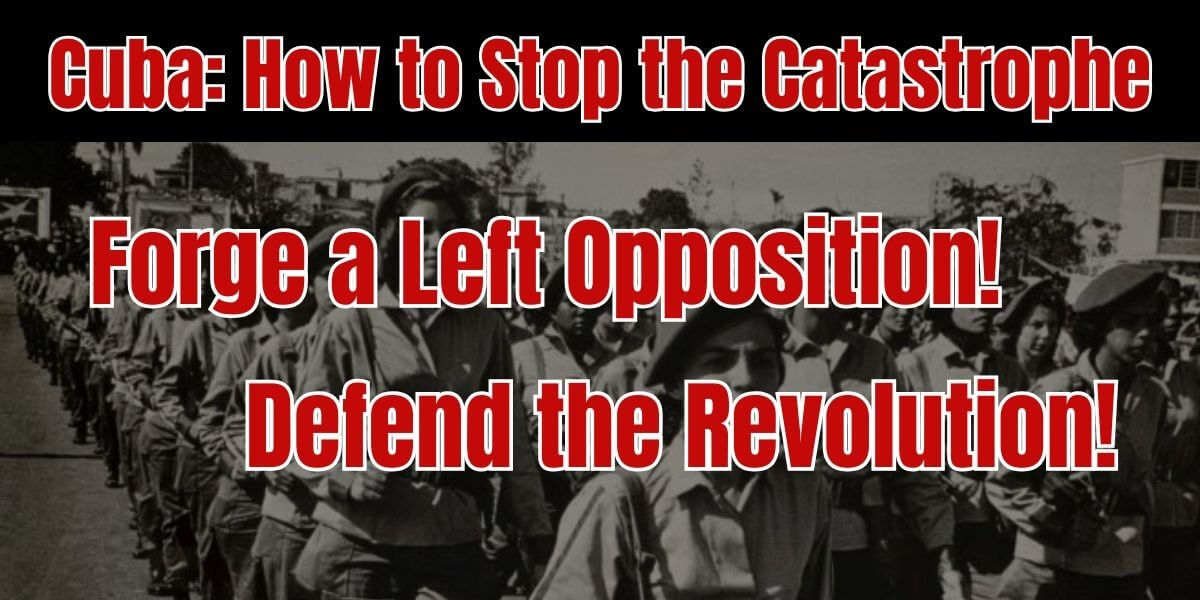
Cuba is under a total siege by U.S. imperialism. There is no fuel, no medicine, and most food is unaffordable. Blackouts now last 30 hours or more. The situation is beyond desperate, and everyone on the island knows it cannot last. But the latest blow to the revolution has come from the leadership of the Cuban Communist Party (PCC). Bowing before the threats from Trump and Rubio, it is abandoning the gains of the revolution and selling out the workers state.
The reforms approved by the PCC would dismantle what remains of the planned economy and state monopoly of foreign trade. They would allow almost unfettered private ownership and imperialist economic penetration and end programs that have provided basic necessities for the population. Rubio says this is still not enough, and the U.S. is escalating its attacks still further. How can we stop this catastrophe?
The rhetoric about “defending socialism” by Díaz-Canel and other party leaders is empty and insulting. They are betraying the foundations of the revolution. Huge swaths of the population are angry and despairing, but they do not know where to turn. A left opposition must urgently be forged to fight the party’s disastrous course. It must unite dissident members of the PCC and Young Communist League (UJC) with independent socialists and others around a clear program. The watchwords must be revolutionary internationalism, radical egalitarianism and mass mobilization based on the fullest workers democracy. That is the only way to defend the revolution.
The China/Vietnam Model?
The PCC leaders and their apologists claim that Cuba is implementing the model used in China and Vietnam, which saw the introduction of market reforms and large-scale foreign investment under ultimate control by the state. But that is not what is happening in Cuba. The measures introduced by Díaz-Canel would all but eliminate state control, unlike the earlier joint ventures with companies in the tourism and nickel industries. In fact, the reforms are directly in line with the dictates of the U.S. imperialists.
Cuba has nowhere near the population levels or natural resources of China or even Vietnam, and it is not thousands of kilometers away but right next to the U.S. colossus. Washington would never, and will never, allow Cuba to take the “China road.” Its program has always been: communists out, capitalists in. This has massively intensified under Trump, as the U.S. has jettisoned all talk of globalization, free trade and open markets and is unleashing brute violence around the world in a drive to restore its declining global hegemony.
The “investors” preparing to descend on Cuba are the U.S. imperialists and Miami gusanos who were kicked out in 1959. They will seize industry and resources to line their pockets. And the PCC is ready to accommodate them. Raulito Castro—Raúl’s grandson, who is playing an increasingly prominent role in the party—has already declared that compensation agreements can be reached with exiled Cuban capitalists whose property was expropriated in the early years of the revolution. This is a complete betrayal of the gains won by Cuba’s working people.
Some on the left claim the PCC’s measures are a way to develop Cuba’s economy along socialist lines. To be clear, far from being benign, the market reforms in China and Vietnam have also produced vast increases in inequality. China now has a large and powerful capitalist class which, while it does not currently exercise state power, is a major threat to the workers state. Hundreds of millions of workers there and in Vietnam suffer grueling exploitation in factories owned by foreign or local capitalists. In Vietnam, the ruling elite has gone so far as to ally with the U.S. against China, even agreeing to join Trump’s Board of Peace.
The real parallel to what is happening in Cuba today is the Soviet Union of the late 1980s/early ’90s. Massive concessions to imperialism in the name of perestroika (restructuring) paved the way for the destruction of the world’s first workers state. The Soviet bureaucracy fractured, and a wing led by Boris Yeltsin allied with U.S. imperialism to lead a counterrevolution. Decades of lies, corruption and mismanagement by the Soviet rulers drove huge layers of the population to the right, greatly aiding the counterrevolutionary drive. That is the threat hanging over Cuba today.
Moreover, while the Soviet Union was a vast country with significant resources and industrial development, Cuba is a small island whose economy has already been largely destroyed. The counterrevolutionary developments in the USSR took several years to play out, but events will almost certainly move faster in Cuba, particularly as much of the population is already desperate and demoralized. All this underscores the urgency of the present situation.
Lessons from the Russian Revolution
The most common argument raised by supporters of the PCC leaders is that the situation is so bad that they have no other choice. That is false and utterly defeatist. It is true that the situation is terrible. Cuba has little social or economic weight in the world, and the full force of U.S. imperialism is bearing down on it. So what to do? The answer mainly hinges on the question: what force do you look toward to safeguard the revolution? That force is the working people of Cuba and their potential class allies around the world.
The problem is that much of the population is, at best, totally cynical toward the PCC leaders. And understandably so. They have no fuel, food or medicine, and the leaders give them empty slogans and growing inequality while suppressing protests. How do we win them away from despair, anger and in some cases illusions in U.S. imperialism? What policies can salvage the revolution and propel it forward? The answer starts with radical egalitarianism and the mobilization of the masses based on the fullest workers democracy.
Historical analogies are never exact, but the clearest lessons come from the early Russian workers state under Lenin. After the 1917 revolution, the country was besieged by imperialist armies, sanctions and blockades. The economy, which had been shattered by World War I, was driven into even worse crisis. To survive, in mid-1918 the Soviet leaders adopted policies that came to be known as “war communism,” including nationalization of all industry, state control of foreign trade, food rationing and more. The aim was for the workers state to survive while Lenin’s Bolsheviks fought to build parties in other countries that could spread the revolution.
Crucially, these measures were combined with the widest possible workers democracy and mass mobilization. Key policies were debated out openly in councils of workers, peasants and soldiers. Earlier in 1918, for example, there was a major debate over whether to accept onerous peace terms demanded by German imperialism to end the war. The differences were made clear to the masses, not hidden behind closed doors and masked by empty sloganeering as happens with today’s PCC.
War communism lasted until 1921. It allowed the workers state to survive, albeit at a great cost. Then, to revive the still-shattered economy, the Bolsheviks introduced a program known as the New Economic Policy (NEP), which allowed for marketization and imperialist investment under strict control by the workers state. Once more, it was thoroughly debated out within the workers councils before being adopted.
Some apologists for the Cuban government’s current course have cited Lenin’s NEP as a historical justification. For example, the Communist Party USA’s People’s World (22 June) calls the NEP a “more apt historical parallel” than the developments in China and Vietnam. But a crucial difference, as even the CPUSA admits, is that the workers state had already beaten back foreign military invasions and counterrevolution before launching the economic reforms. In contrast, the PCC is introducing changes that go much further than the NEP even as Cuba is in the midst of a brutal imperialist assault. This, combined with large-scale discontent among the population, puts the country in a very weak position.
Cuba is under such extreme pressure today that opening up the economy and welcoming foreign investors (including the gusanos) will likely lead to a complete political collapse in the short term. As events move toward a total crisis, the obvious question posed for the masses would be: if we’re going to have capitalism anyway, why do we need the PCC? A different historical analogy is the crisis that unfolded in East Germany (the DDR) after the opening of the Berlin Wall in late 1989. With the Stalinist rulers deeply discredited, large-scale social protests erupted that posed point blank the question: anti-bureaucratic political revolution or social counterrevolution? In the absence of an authoritative, authentically communist alternative, the DDR was soon destroyed by capitalist reaction.
In China, the Communist Party’s decision to adopt broad market reforms came in the wake of its crushing of the 1989 Tiananmen uprising. The CPC unleashed massive repression against workers who were, in the main, protesting corruption and demanding socialist equality—repression that all authentic Marxists strongly opposed. In the aftermath, however, the CPC rulers consolidated their grip and felt they were in a strong enough position to proceed with the market reforms following Deng Xiaoping’s 1992 southern tour. The political aims behind the Bolsheviks’ NEP in 1921 and the Chinese Stalinists’ moves in the early 1990s were diametrically opposed, but in both cases the rulers were in a relatively strong political position. To embrace liberal marketization from a position of weakness, however, is a direct path to collapse.
In sum, the chances for survival of the Cuban workers state through marketization in such a fragile position are almost nil. What is needed to defend and extend the revolutionary gains is the direct opposite of what the PCC leaders are pushing.
For a Radically New Course!
Activists abroad who have fought for solidarity with Cuba while giving political support to the party leadership must urgently change course. Defense of the revolution today means opposing the government’s overt betrayal to imperialism. While much of the left continues on the disastrous path of backing the PCC leaders, others have shamefully abandoned defense of Cuba altogether.
A few Marxist groups have taken a clear stand against the drive to capitalist restoration and the PCC’s political course. In addition to ourselves, they include the Current for Permanent Revolution, whose leading party is the Argentine PTS, and the Revolutionary Communist International (RCI). The declarations issued by these groups have weaknesses. Most crucially, they do not outline a concrete course of struggle for the Cuban masses today. This is especially true of the RCI, which substitutes abstract calls for world revolution and to build their own tendency.
A declaration by a group originating on the island, Comunistas Cuba, is far better on this score, seeking to lay out a perspective for struggle while calling to “create a united anti-imperialist front” in solidarity with the Cuban working class (“Our Program Facing Cuba’s Transition to Capitalism,” comunistascuba.org, 21 June). It is vital that such groups, in Cuba and internationally, put aside secondary differences and sectarian practices, and work together to help forge a left opposition on the island.
The widespread unease and discontent within Cuba certainly extend into the ranks of the PCC. Party leaders rely on vacuous slogans and vague declarations, but sometimes discontent emerges from between the lines, so to speak. For example, an editorial in the UJC’s Juventud Rebelde (21 June), whose purpose was to justify the PCC’s reforms, acknowledged “an avalanche of opinions, of all kinds, navigating through the networks, on every corner, in every home, or in the neighborhoods’ corners.”
Some Cuban intellectuals have also issued statements seeking another road. For example, an article by the economist Liu Mok titled “Is There Another Alternative for Cuba?” (Juventud Tecnica, 20 June) raises the idea of workers control of the factories and production as opposed to handing them to the private sector. Even the unanimous vote to approve the party leaders’ measures in the national assembly came only after the release of a statement by the 95-year-old Raúl Castro endorsing them. As one of the few surviving veterans of the 1959 revolution, Raúl has vastly more moral authority than the current generation of party leaders. This was likely a calculated move to ensure that any dissidents, or even those with doubts, would fall into line.
One way or another, the PCC is likely to fracture in the next period. There will likely be an open right wing that is ready to embrace U.S. imperialism. There will be recalcitrant elements, who may simply become paralyzed. And there will be elements open to a new, radical solution.
A left opposition must be cohered, urgently. We put forward the following as key elements of a fighting program:
-
Break the blockade! Trump’s ban on fuel shipments is only effective because it is enforced by “progressive” governments in Mexico and Brazil. The PCC merely praises Sheinbaum and Lula for their humanitarian assistance. In contrast, we must demand they resume and greatly increase fuel shipments to Cuba. Call on workers there to mobilize independently of and against their own rulers! This would both aid the Cuban people and push forward the anti-imperialist struggle in Latin America. Demand that China stand up to U.S. imperialism by providing massive aid and personnel to rebuild Cuban infrastructure!
-
For radical egalitarianism! No bureaucratic privileges! To win the trust of the population, for whom daily survival is the preoccupation, communists must make clear that we are all in this together. No privileges, no corruption, no speculation—total equality as we fight to survive. End the special privileges enjoyed by PCC leaders. Mobilize all possible social resources to survive the siege. Stop the privatizations, which only line the pockets of the new profiteers and their imperialist patrons. Renationalize industries and services under workers control!
-
For workers democracy! End the private negotiations with the U.S. and release full records of what has been discussed. Key decisions must be taken by the working masses organized in the factories, workshops and neighborhoods, not by a self-sustaining bureaucracy. Stop the attacks on protests demanding equality and an end to poverty. Workers: appeal to security personnel to end such suppression. The PCC leaders’ current practices serve to assist, not defeat, the counterrevolutionary drive by the U.S. and its agents.
There is no time to waste. Socialists must come together in a left opposition to stop the drive to capitalism and defend the Cuban revolution.