
https://iclfi.org/spartacist/en/2026-ven-col

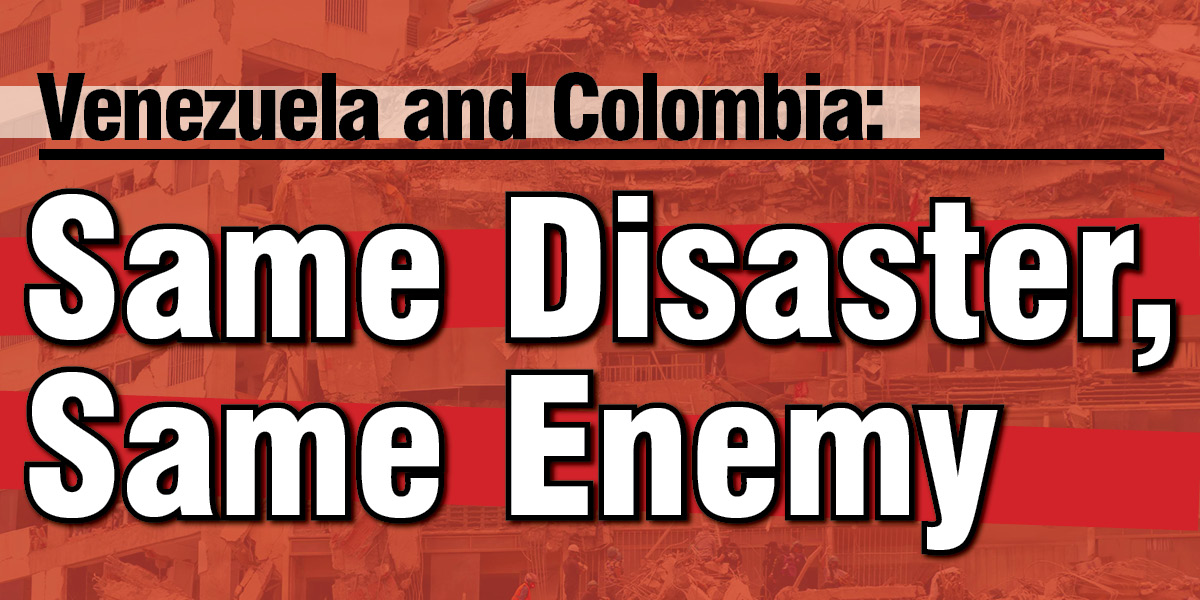
In June, two earthquakes shook Venezuela, killing thousands and leaving Caracas and La Guaira in shambles. Now, Colombia is suffering from its own seismic catastrophe with rescuers pulling bodies from the rubble, as if decades of armed conflict and imperialist interventions haven’t destabilized the country enough. The earthquakes were natural disasters but collapsing schools, hospitals and poor rescue infrastructure are both capitalist- and imperialist-made. It is these forces that created the already shaky foundation Colombian and Venezuelan society sits on, and it is these forces that will dictate how and who will rebuild.
Many in the left and the bourgeois press highlight the solidarity and perseverance of these two nations. But this is only brought up when they have no real solutions to the problems plaguing these masses. The masses of Venezuela and Colombia are tired of being resilient. They need real answers to the questions they are dealing with right now, like: What does this destruction mean for Venezuela and Colombia? What will the societal aftershocks look like? What are the obstacles to rebuilding? And why should reconstruction be based on fighting both the imperialists and the native bourgeoisies?
Earthquakes or Imperialism:
What’s at the Root of the Catastrophe?
In Colombia, there is news coverage of the carnage in cities like Pereira and Cali. The damage there is devastating, but what the world sees little of is the destruction that hit Buenaventura and Chocó, the epicenter of the earthquake and the poorest department in the nation. It’s not by some accident either. The majority black, indigenous and peasant populations of these areas have been starved of their basic needs by the racist Colombian ruling class and are the targets of the armed conflict instigated by U.S. imperialism.
It’s not only the lack of media attention the black, indigenous and peasant peoples are worried about but the fact that the Colombian government will do close to nothing to help them in the middle of destruction. President Abelardo De la Espriella visited Buenaventura, throwing soccer balls marked with “Defensores de la Patria” (“Homeland Defenders”) at citizens who are without food or water. It’s obvious in Colombian society that getting just the basics is tied to your position in the country; but who gets to rebuild is a matter of class, too. And in the racist neocolonial system of Colombia, which is deeply tied to U.S. imperialism, it’s always the black, indigenous, peasant and working-class populations who are deprived, beaten down and massacred.
Whether fleeing civil war, imperialist-imposed sanctions or crippling impoverishment, both the Colombian and Venezuelan masses have sought refuge in each other's land. Sanctions by the U.S. to crush the Chavista regime sent millions into Colombia. Many more Venezuelans are looking to enter Colombia again as life back home becomes increasingly unbearable. But Colombia is getting squeezed too. As six airports have been closed and cities are leveled, many Colombians are left without work and children without school. In the case of Buenaventura and Chocó, armed conflict is expected to rise as paramilitary organizations will take this moment as the perfect opportunity to violently seize land. This recipe for disaster will cause Colombians to run to the northern region looking for safety and work. But cities like Cartagena and Barranquilla are already facing pressure from lack of jobs, impoverishment and cartel violence. Having a wave of people come and compete for crumbs will only add to the chaos that exists on the coast and will push Colombians into Venezuela, adding to its instability.
Workers Must Lead Rescue and Reconstruction
Economic instability, poverty-driven violence and the existing antagonisms between black, indigenous, peasant and working-class people in both Colombia and Venezuela is a combination American imperialists dream of. Right now, Washington has sunk its teeth deeper into both sister nations. With Nicolás Maduro out and Delcy Rodríguez in, the U.S. has taken control of the country. The sanctions ate away at much of Venezuela's infrastructure, stripping emergency agencies of the ability to adequately rescue Venezuelans. Now, Trump is making deals with Rodríguez for aid that will bring the Venezuelan masses further under American domination.
The same aid is being promised to Colombia, and with De la Espriella’s election the country’s shackles of colonial domination will weigh even heavier. In the news, officials are saying that response time and efforts are better than that of Venezuela. While there is some truth to this claim, it's no thanks to the government but rather the masses who organized quickly. How did De la Espriella's government respond? It mobilized the military into Cali as an intimidation method to remind Colombians that the state will crack down on them even in their most vulnerable moments. On top of that, De la Espriella turned down rescue teams offered by Mexican president Claudia Sheinbaum, only to accept assistance from the U.S., Israel, El Salvador and Ecuador. Workers and the oppressed of both nations must fight to throw the U.S. and Israeli troops out!
Both Rodríguez and De la Espriella couldn't give a damn about the working class and oppressed. They're concerned with selling off both nations to secure their own privileged class positions in a neocolonial system as the U.S. is capitalizing off of the disasters in both countries. So what should the Venezuelan and Colombian workers do? Right now, they should join forces to organize the masses and lead rescue, relief efforts and reconstruction plans. We already see the beginnings of this as the working masses have stepped forward looking for their brothers and sisters in the rubble since both governments have shown themselves to be incompetent.
The point of the working class leading these efforts is to push the heroic response of the masses out of the bounds of moral obligation and into a struggle against the native ruling elites and the imperialist masters they serve. It is these forces of reaction that are responsible for the instability and violence before the earthquakes. They will only push the masses, who are trying to crawl out of the rubble, back down into subjugation.
In Colombia, the mobilizations of workers to rebuild wouldn't just be for Cali, Pereira and Manizales but also for Buenaventura and Chocó. A working-class-led relief effort to restore homes, plumbing, electricity and roads could help overcome the divisions that exist between the black, indigenous and peasant population in that region and in the country. In Venezuela, these divisions also exist. But the working class taking the lead in the struggle for national liberation would not only bridge these divides but also revive the revolutionary energy that has long been smothered by the Chavista regime.
Bi-national relief and reconstruction efforts led by the working class would be the first step in an anti-imperialist alliance of the sister nations of the Bolivarian revolution. This is the last thing the ruling elites and imperialists want, because the working masses and oppressed peoples united across nations would disrupt profits and threaten their interests in the region.
The Main Enemy Is U.S. Imperialism
The Marxist left in Colombia is correct in criticizing De la Espriella for his response to the disaster and for only accepting rescue teams from the U.S. and other reactionary governments. Groups like the Colombian Communist Party (PCC) counter De la Espriella by favorably quoting former president Gustavo Petro saying, “It is a mistake to put an ideological filter on international aid. International aid is for humanity and for life, period.”
Yes, Colombians need aid but the struggle for reconstruction and basic necessities is being tightly controlled by the Colombian ruling class and its U.S. masters. For anything to move in a positive direction for the working, black, indigenous and peasant masses in Colombia means waging an organized struggle against both the ruling elite and U.S. imperialism. Although Petro spoke left, heavily criticized the colonial masters and gave back to the oppressed (all good things) he never once organized the people to wage a struggle against the imperialist rulers. This is something he could've easily done as the masses went into the streets protesting every attack by the U.S. against him and the country.
The Colombian masses showed their potential, too, when thousands mobilized against the abduction of Venezuelan president Nicolás Maduro in January. But instead of taking that revolutionary energy and bringing in the rest of the Latin American workers with it, Petro's party corralled that strength into the election and contained it there.
In Venezuela, there have been protests against low wages and against Rodríguez establishing a new relationship with Trump and U.S. imperialism. Now, there is public outrage over the government’s disaster response. Groups like Marea Socialista, in coalition with other left organizations, have been trying to channel popular anger by organizing protests against both Washington and the government. This is important. But while parties like Marea Socialista correctly denounce U.S. imperialism, they also denounce China as another imperialist power and oppose its involvement in Venezuela. As they wrote in 2019, “Confronting North American imperialism does not mean we cease to oppose the imperialist policies of China and Russia, particularly their interference in Venezuela….”
To equate the U.S. with China is to blur the Marxist distinction between an imperialist oppressor and a bureaucratically deformed workers state. The United States is the central imperialist power of the capitalist world, and its sanctions, military threats and repeated interventions against Venezuela serve Wall Street and the American ruling class. This is not the case with China. That does not mean the Stalinist bureaucracy has no interests in Venezuela and Latin America, or that we should not criticize it. But whatever the crimes of its ruling caste, China is not a capitalist imperialist power and does not exert domination over Venezuela as the United States does.
This position has immediate practical consequences for how to relieve the devastation caused by the earthquakes. Rodríguez is crawling on her knees before the U.S., arguing that Venezuela has no alternative but to ask Washington for aid in reconstruction. But there is an alternative that could both provide relief and counter American domination: the Venezuelan left and popular masses should call on the People’s Republic of China to provide aid. While China’s bureaucracy is not benevolent, assistance from China would be on better terms than any deal with the U.S. Rodríguez’s deals with Washington will only tighten the colonial grip on Venezuela. Looking to China can push back against U.S. imperialist blackmail. The demand should be: China, send aid to earthquake-stricken Venezuela—without conditions! At the same time, we should demand full transparency over all foreign assistance and that its distribution be placed under the control of workers’ organizations and affected communities.
Saying that China is a threat equivalent to the U.S. also obscures the concrete reality facing Venezuela and confuses the priorities of revolutionary workers and peasants. The central task is to mobilize against American colonial domination. Therefore, Marea Socialista and the Venezuelan left should reject the false equation of the U.S. with China and instead focus on opposing U.S. imperialism while demanding aid from China on terms that do not compromise Venezuelan sovereignty.
From Reconstruction to Anti-imperialist Struggle
There is not one part of the social crisis and the natural disaster that doesn't confront U.S. imperialism. Leaving the struggle against imperialism out of this current disaster and only going after the right wing will just keep the colonial status quo in Venezuela and Colombia intact. This will also aid in the wave of right-wing presidents being installed in Latin America and keeping the oppressed masses down. Linking the fight against the ruling elite to the fight against imperialism in the context of reconstruction is not only about the sovereignty of Venezuela and Colombia but also applies in other countries where natural disasters have struck.
Fighting neocolonial domination on the continent also brings in the question of independence for Puerto Rico, the U.S.'s principal colony. Puerto Rico has been plagued with a water crisis that the ruling class there is blaming on a drought. While there is a drought, what's really driving the crisis is the austerity measures imposed by the imperialist-backed La Junta that has ruined infrastructure and bled Borikén dry. On top of the water crisis are the blackouts, attacks on education and smashing of unions. All the doing of the colonial overlords, with the help of the Puerto Rican government. The Boricua masses have fought imperial domination for over a century and feel completely abandoned in their struggle for liberation.
It seems like the Latin American left has put the struggle for Boricua independence on the side, but this is an important struggle to take up. The U.S. maintains Puerto Rico as a colony because of its strategic position in the Caribbean. It has been used as an outpost and military training ground for the U.S. to invade places like Venezuela, Haiti, the Dominican Republic and most of all, Cuba. Being able to extract millions from the Boricua masses, the colonial masters have been able to fund their adventures in the region, destabilizing countries and installing puppet presidents. This is why taking up the struggle for Puerto Rican independence is not a moral crusade but absolutely necessary if the entire Latin American region wants to be free. An anti-imperialist alliance of the Americas, set on taking up the struggle for Puerto Rican independence, is the only way to end the isolated struggles and bring the working class and oppressed masses up together.
The earthquakes in Venezuela and Colombia have exposed the increasingly naked brutality of U.S. imperialism in Latin America. Washington is no longer concerned with maintaining the liberal mask of humanitarian intervention and partnership. Instead, it is using the devastation as an opportunity to deepen its economic, political and military grip over the region. It should be clear that the answer cannot be to rebuild what existed before, because that would mean rebuilding under the same conditions that left millions vulnerable in the first place. The masses must fight to rebuild their lives but they also must fight to construct a whole new system. Venezuelan and Colombian workers and oppressed peoples have the power to organize relief and reconstruction on their own terms, but that power must be tied to a broader struggle against the ruling classes and the imperialists who profit from their misery.
From the rubble of these disasters, a united struggle across borders can emerge, one that connects the fight for reconstruction in Venezuela and Colombia to the anti-imperialist struggle that will liberate Latin America, including Puerto Rico. The task is not to ask the oppressed to be more resilient under the same imperialist system, but to organize them to defeat it.