
https://iclfi.org/spartacist/en/2026-bangladesh-garment-workers
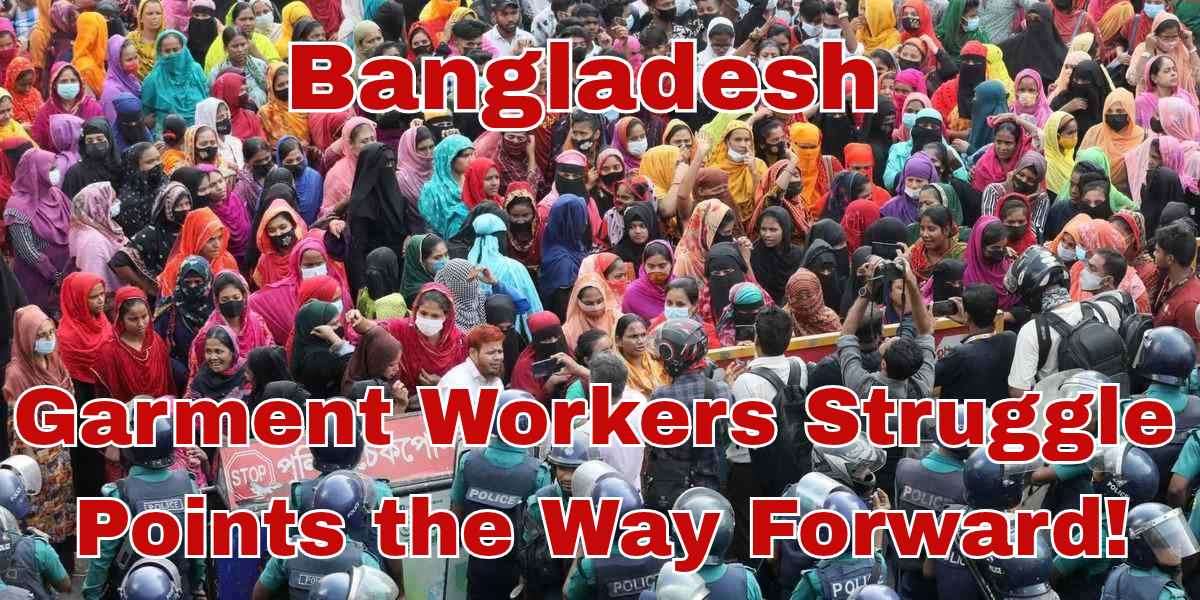
November 23—All month long, garment workers in Bangladesh have been fighting against starvation wages, facing down both brutal police repression and back-to-work pleas by trade union leaders. Strikes, protests and company lockouts have crippled the industry that accounts for roughly 80% of the country’s exports.
The workers’ key demand is to hike the monthly minimum wage from 12,500 taka ($100) to 30,000. The multinationals have long made fortunes by paying rock-bottom wages. That status quo has become simply unbearable for the masses. First came Trump’s tariffs, which set back the whole garment industry. Then the cost of living shot up due to the oil price hikes caused by U.S. imperialism’s war on Iran.
Yunus’ project of restoring “stability” to Bangladesh following the 2024 uprising lies in ruins. The Islamist Bangladesh Nationalist Party (BNP), which a segment of the student movement put its faith in during the last elections, is in total crisis. Banks are facing insolvency after years of plunder under the regime of Hasina and the Awami League. And sheltered by the Modi government, Hasina’s moves to return in December have led to mayhem and arson attacks throughout the country, including on Yunus’ ancestral home.
Ravaged by the changing international headwinds and a wretched ruling class dragging the country deeper into misery, Bangladesh is at an impasse. The only progressive force which can defend the masses and the country from complete ruin is the working class—it is the only social force which has no interest in the status quo and everything to gain from toppling it.
The struggle of the garment workers points the way forward. But as we write, all kinds of obstacles are leading to partial retreats. Without a fundamental transformation of their conditions, workers will be compelled to fight again and again. To go forward to victory, advanced workers and revolutionaries must understand what is at stake, draw the correct lessons from the 2024 uprising and apply them to the struggle today.
Class Independence is Key
The task for revolutionaries in 2024 was to fight for revolutionary leadership and lead the uprising to victory against the bourgeoisie as a whole. This meant tapping into the masses’ hatred of Hasina in order to put the working class at the head of the students and all the poor and oppressed. But the workers’ power to bring down their hated rulers can only be wielded when they are organized independently of all bourgeois political parties—Islamist, liberal and nationalist. And that is not what happened.
Instead, the movement put its faith in the kindly liberal Muhammad Yunus, who replaced Hasina but proved to be no less an agent of the imperialists and their IMF. His reward was to be voted out earlier this year in favor of the conservative BNP. The country is spiralling once more and none of the basic problems raised by 2024 have been resolved. Instead, the Awami League is trying to stage a comeback. Only the independent strength of the working class can break through this vicious cycle of bourgeois reaction! Unless revolutionaries learn this lesson and apply it in struggle, there can be no advances for the masses in Bangladesh, let alone a successful revolution. No faith in the liberals! For class independence!
Fight for a Revolutionary Leadership of the Trade Unions
Several union officials have been arrested since the strikes began, and it is the duty of the left and trade unionists everywhere to demand they be freed immediately. But the truth is that that the union leadership is rotten. Huge swathes of workers are not organized in the unions and are left at the mercy of the sweatshop bosses. Workers report that they do not know who is negotiating on their behalf. To the extent that the unions organize, they rarely make their presence felt in the factories. Many workers are “represented” by company unions—bodies organized by the employer to tick the box of “good practice” by foreign multinationals. Then there are those labor leaders collaborating with the bosses on the government-appointed wage board, negotiating sellout deals.
As a result, workers have widespread distrust towards their “leaders”. They have fought with courage and determination, repeatedly spurning the demands of these traitors to accept the empty promises of the wage board. But their struggle will disintegrate without a strategy to win. Indeed, recent reports indicate that while in most areas workers are staying out, 80% of those in the Gazipur industrial belt have returned to their jobs in fear that they will lose whatever pay rise is due on December 1. This dynamic shows the immense anger and potential for revolutionary struggle, but also the sheer desperation which can choke such struggle.
There is an urgent need for revolutionaries to fight for leadership of the trade unions, including by waging mass campaigns to organize the hundreds of thousands of unorganized workers into a single union representing all garment workers. Rally the workers to demand that their trade union leaders get off the class collaborationist wage board—if they refuse, throw them out! No faith in the BNP government or any of its bourgeois competitors! Only class struggle methods, based on the independence of the working class, can advance the struggle! In memory of Rana Plaza—turn Savar, Gazipur, Ashulia and others into red Petrograds!
Prepare for Upheavals
The recent experience of Bangladesh indicates what is in store for the nations of the Global South. The masses of the countries at the bottom of the international order are the first to suffer as the world situation turns. This will compel them again and again into defensive battles, binding their fate ever closer with that of the nation in a struggle against imperialist subjugation. In order to prepare for the coming upheavals, revolutionaries everywhere must learn the lessons which Bangladesh so painfully and clearly offers: split with the liberals, only the working class points the way forward! For communist leadership of the trade unions and the national liberation struggle!