
https://iclfi.org/pubs/wh/258/scotland
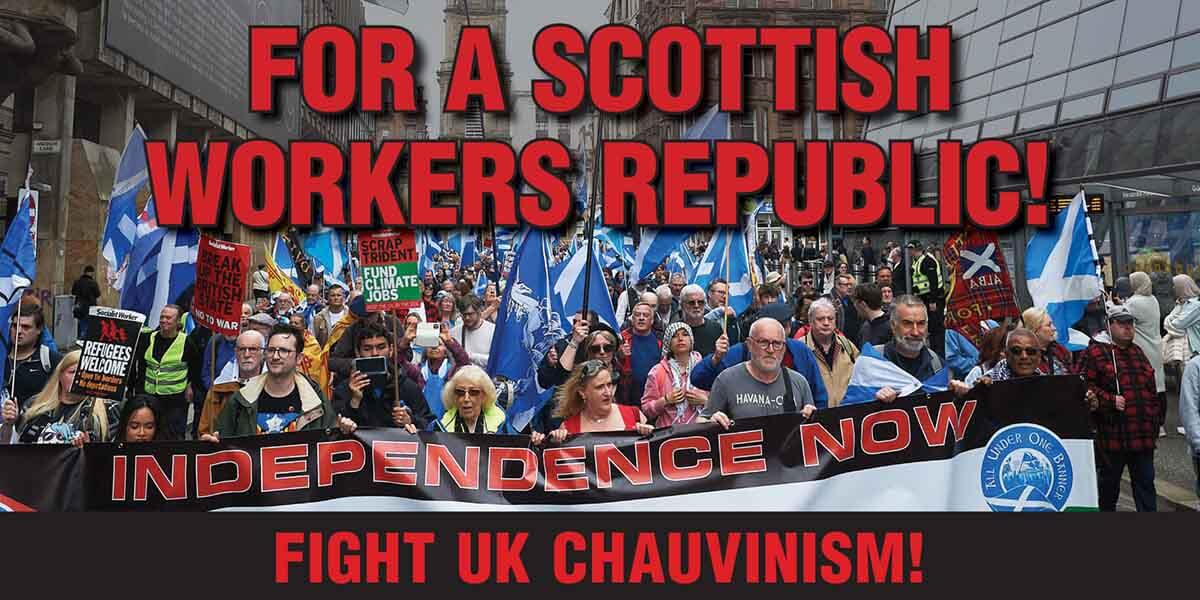
The Spartacist League/Britain’s 11 July National Conference adopted the position for Scottish independence and a Scottish workers republic. We reprint below a document by Eibhlin McColgan, edited for publication, which motivated this line change.
In “The Right of Nations to Self-Determination” (1914), Lenin wrote:
“The categorical requirement of Marxist theory in investigating any social question is that it be examined within definite historical limits, and, if it refers to a particular country… that account be taken of the specific features distinguishing that country from others in the same historical epoch.”
I will examine the Scottish national question across three historical periods—the era of the British Empire, its decline in the post-World War II period, and the recently concluded liberal post-Soviet era. My aim is to motivate why we should adopt the call for Scottish independence as part of our programme for a Scottish workers republic. This differs from the historic position of the SL/B, which called for Scotland’s self-determination and opposed UK chauvinism, but didn’t advocate independence.
Why change our line?
For some time, many of us in the SL/B have thought we should support independence. But we were unclear about the criteria for shifting our line. This became clearer recently when a Scottish sympathiser pointed out that, to gain a hearing among the working class in Scotland, you must call for independence. Calling for self-determination doesn’t cut it; it makes our opposition to the Westminster establishment seem hollow and unconvincing.
In the 2014 independence referendum, the British establishment and global finance capital were firmly against independence, while working-class communities, particularly in Glasgow, overwhelmingly supported it. This strength of feeling among the working class for independence is the decisive factor behind our change of line. We may lament the passing of the era when the working class of England, Scotland and Wales waged their struggles as one class, united across national lines. But imperialist decline has ravaged Scotland, destroying entire industries and communities. As a result, the need to break with London has become central to working-class resistance, and thus the Scottish working class overwhelmingly supports independence. It is reactionary for communists to oppose this sentiment. Rather, our task is to harness the desire for independence to advance the working class’s struggle to overthrow their capitalist exploiters. In opposition to the nationalists, we should put forward a pro-socialist, pro-independence perspective as the foundation for regrouping the left and the nationalist movement in Scotland.
To approach the Scottish question in a Marxist framework, we must situate it in its historical context. In 1978, a founding document of the SL/B stated that, in Scotland, “we are for the right of self-determination, but call on the Scottish people to exercise that right by choosing to stay in the same state as the other peoples of Britain” (Spartacist Britain no 1, April 1978). This position was not wrong at the time. There had been no movement for Scottish independence for nearly three centuries. Since the Union of 1707, many of Britain’s most momentous uprisings have been class struggles—and, unlike in Quebec, for example, where class struggle and the independence movement were intertwined—in Scotland the independence movement was marginal and divorced from the class struggle.
Furthermore, from the Chartist movement in the 19th century to the late 20th century, national differences were no barrier to revolutionary struggle. The class struggle reached potentially revolutionary heights, for instance in Red Clydeside, the mass strike wave throughout Britain in 1919-1920, in the 1926 general strike or in the 1984-85 miners strike. While the British working class—English, Welsh and Scottish—had shown the capacity, under a willing and able leadership, to overthrow the ruling class, the demand for independence was not an essential component of a revolutionary programme.
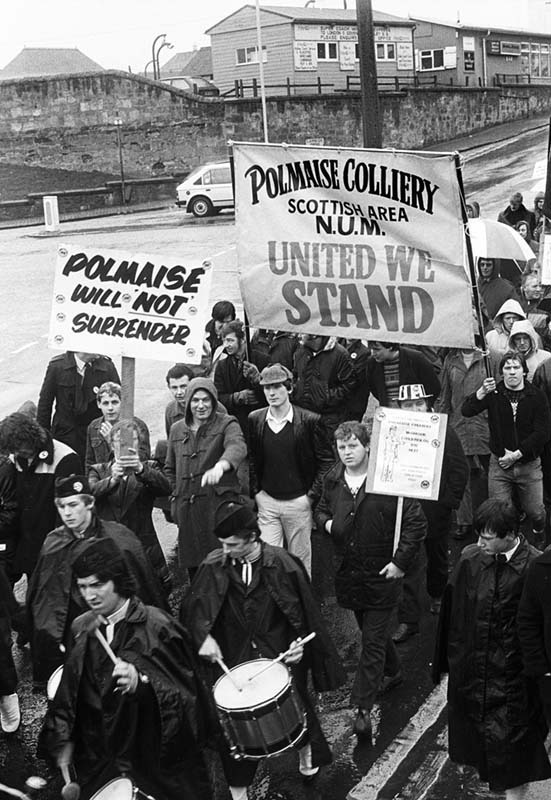
Striking miners, Dunfermline, 1984.
However, the relationship between the class and national struggles changed fundamentally over time. The sentiment for independence that lay dormant for centuries has now reached a point where the Scottish working class sees it as essential to improving their declining living standards and social conditions.
Scotland and Empire
The Scottish national question differs from classic anti-colonial struggles, which arose from resistance to imperialist oppression and subjugation. By contrast, the Scottish nationalist movement moved from the margins to the centre of political life towards the end of the 20th century. Nationalist versions of Scottish history like to trace the origins of today’s independence movement back to medieval wars against England led by Scottish heroes including William Wallace and Robert the Bruce. But this does not explain why there was no independence movement for centuries after the Union with England. The answer lies in Scotland’s role in the British Empire.
The Scottish elites willingly signed up to the Union of Parliaments in 1707, which made them junior partners with England in the Empire. The Union boosted Scotland’s economic development by giving Scottish merchants access to the Empire’s markets and overseas trade they had previously been denied. In contrast, in India, for example, the Empire’s brutal colonisation throttled the development of the productive forces. In Scotland, the Union was followed by a rapid development of the forces of production. The country underwent a rapid transition from feudalism to capitalism, although this was achieved through bloody and brutal methods. The Highland clans, fighting under the Jacobite banner, were crushed at the Battle of Culloden—a slaughter of Highland peasants. However, far from fighting feudalism, the Jacobites opposed the twin pillars of historical progress of their era—the Reformation and the English Revolution—and fought against England in the interests of the absolutist Catholic monarchies of Europe. The suppression of the clans and the Highland clearances paved the way for uniting the Scottish nation and establishing English as the common language.
Of course, the common people in Scotland often raged against the tyranny of their overlords, and the nobles who signed the Union are remembered in legend as a “parcel of rogues” who were “bought and sold for English gold”. However, such struggles do not constitute an early anti-imperialist or nationalist movement. The reason there was no nationalist movement until after the end of the Empire is well captured by Tom Nairn, who wrote in 1968:
“First of all, Scotland is not a colony, a semi-colony, a pseudo-colony, a near-colony, a neo-colony, or any kind of colony of the English. She is a junior but (as these things go) highly successful partner in the general business enterprise of Anglo-Scots Imperialism.”
—“The three dreams of Scottish nationalism”, New Left Review, May/June 1968
His article went on to note, “Now that this business [of Empire] is evidently on its last legs, it may be quite reasonable for the Scots to want out.”
Post-Empire decline
The Scots’ desire to leave the Union emerged as a reaction to the decline of British imperialism. Although this decline was clear by the end of World War II, the Labour government’s nationalisation of key industries mitigated its immediate effects by shoring up Britain’s ailing industrial sector. Alongside the creation of the welfare state, these measures helped strengthen British working-class unity—workers in the NHS or in the nationalised coal and steel industries worked for the same employers and belonged to the same unions, which boosted their sense of a common working-class identity. Yet despite these piecemeal efforts, Britain’s industry was outdated, and neither the nationalisations nor the hefty government subsidies of the 1960s would make it competitive in the world market.
What ultimately shaped the movement for Scottish independence as we know it was Margaret Thatcher’s transformation of British society. Thatcher pursued a scorched-earth policy towards Britain’s manufacturing sector and the strongholds of working-class power. Beginning in the late 1970s, deindustrialisation ravaged whole areas of northern England and Wales, exacerbating the North-South divide. Scotland was hit particularly hard because of its dependence on shipbuilding and heavy engineering, which relied on outdated infrastructure and could not compete in the world market. Under Thatcher, Scotland’s industrial base was demolished in just over a decade. In the two years from 1979 to 1981, Scottish industry lost a fifth of all jobs. Between 1979 and 1986, Scotland lost nearly 250,000 jobs, about one in ten across the country.
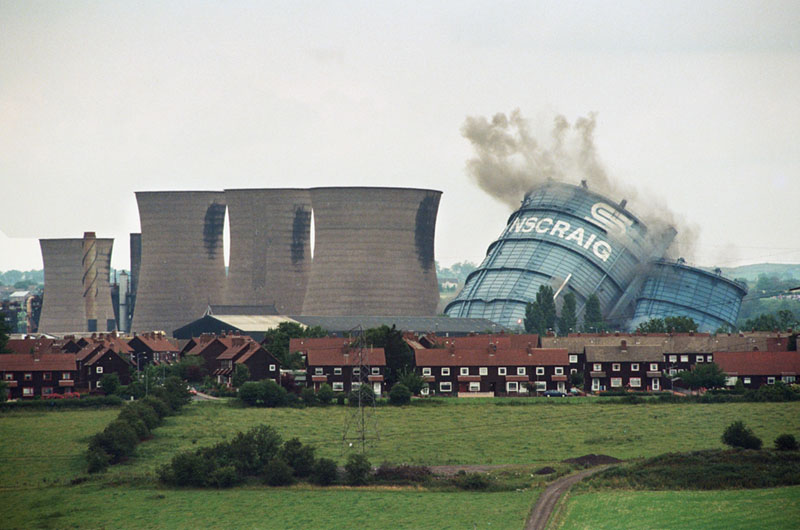
1996: Demolition of Ravenscraig steelworks. Deindustrialisation ravaged Scotland.
A crucial factor in the rise of Scottish nationalism was Thatcher’s crushing of the trade union movement. She defeated the Britain-wide steel strike in 1980, but the turning point was her defeat of the miners strike of 1984-85. This cleared the way for Thatcher to reshape the entire UK economy to serve the interests of banking and finance, which are overwhelmingly concentrated in London and the South East of England. The resulting structural change exacerbated the North-South divide, eventually leading to what we now know as Red Wall areas. When Thatcher imposed the regressive poll tax in Scotland a year before England and Wales, Scotland erupted in a mass anti-poll tax campaign, marking the beginning of a political sea change.
Liberal era of Blair
There are two key events in this period: the opening of the Scottish Parliament in 1999 and the 2014 independence referendum. During this time, it became clear that the working class supported Scottish independence as a way to escape the harsh austerity imposed on them. The Labour Party had dominated Scotland for decades; indeed, it was the glue that held Scotland within the United Kingdom. However, during the Thatcher years, Scotland continued to vote Labour, only to see Tory governments returned to Westminster. When Tony Blair’s government was elected in 1997, Labour was losing ground to the Scottish National Party (SNP). With this in mind, Blair agreed to set up a Scottish parliament with very limited powers, intending it to shore up Labour’s vote in Scotland while keeping it firmly within the United Kingdom. He famously proclaimed that “sovereignty rests with me as an English MP”.
But the devolved parliament had the opposite effect to what Blair intended. It gave voice to the growing sentiment for Scottish independence and fostered a positive sense of national identity. The Scottish Parliament, along with the quasi-state that accompanied it, was an achievement for the nationalist movement. The Scottish government assumed responsibility for managing public services, including health, education, local government and transport. This shift meant that the Scottish trade unions in these sectors now negotiated with a different employer from their counterparts in England and Wales. The impact of this change was evident during the 2022-23 strike wave, when trade unions in Scotland representing nurses, railway workers and teachers negotiated their own settlements with the Scottish authorities.
In the Blair era, the nationalist movement continued to grow, and by 2007 the SNP had become the leading party in Holyrood, a position they have maintained ever since. The nationalists won much of Labour’s traditional base, including the Catholic vote in the West of Scotland, and adopted a social-democratic programme of modest reforms—no university fees, free prescriptions and increased funding for childcare. David Cameron’s Tory government approved the independence referendum, arrogantly confident it would produce a resounding no vote that would kill the demand for Scottish independence for a generation. The vote for independence was 45%, far higher than expected. It shook Cameron and the establishment, who saw in it a threat to the United Kingdom. But among the Scottish people, the result strengthened their belief that independence was within reach.
The SL/B’s previous position
By the time of the 2014 referendum, we no longer argued against independence, but we didn’t support it either. A reader asked under what circumstances we would call for independence, and our answer was unclear because we didn’t know what criteria to apply. In 2012 I argued that we were wrong to oppose independence in 1978; Jim Robertson rejected my argument in no uncertain terms, and correctly so. We were not wrong to argue against independence at that time. As shown earlier, for many decades, English, Scottish and Welsh workers had fought as one class in struggles that reached revolutionary proportions. But by 2014, that had changed decisively. Working-class support for independence was driven by a desire to resist Westminster austerity, which was particularly harsh following the 2008 banking crash when the working class had to bail out the banks, not least the Royal Bank of Scotland, at that time one of the biggest in the world.
With our previous approach, we viewed Scottish nationalism as simply reactionary, rather than seeing Scots’ national aspirations as a potential tool to advance the class struggle. Instead, we equated the masses’ desire for independence—aimed against the British imperialists—with the SNP’s programme, which was pro-imperialist, pro-EU and pro-monarchy.
Our approach to the 1998 devolution referendum was also problematic. The two questions posed were: do you support the creation of a Scottish parliament, and should it possess tax-raising powers? We called for a yes-yes vote, recognising that even with limited powers, it represented a partial form of self-determination. This position was correct, but we later repudiated it, which was a mistake. In fact, devolution provided a concrete way to push back against the London-centred policies ravaging Scotland.
The Scottish independence movement reached its peak during the liberal era, and then-SNP leader Nicola Sturgeon became the symbol of liberal, progressive ideas and policies. On her watch, the SNP promoted massive illusions in the EU, dressed up as “anti-racism” and support for high immigration policies. The SNP-led Scottish government adopted several pro-trans policies, including gender recognition reforms, only to be blocked by Westminster. But as the political winds turned against liberalism, Reform UK found an opening as the SNP’s “woke” policies generated a backlash, discontent grew over crumbling public services, and the independence movement was paralysed by London’s rejection of a second referendum.
The SNP’s strategy for independence rests on the illusion that London will simply give up on the UK’s claim to Scotland if a referendum shows that to be the will of the majority. This misconception is bolstered by the belief that Westminster can no longer afford the Scottish budget subsidy. It is downright fatuous to think that the British imperialist establishment will let go of Scotland—where Britain’s entire nuclear arsenal is located—without serious struggle. Britain’s Trident missiles, which are submarine-based and cannot easily be relocated to England, are key to Britain’s alliance with the US and NATO. Britain will not jeopardise its dependence on the American empire unless it is forced to do so. In other words, it will take a revolutionary struggle by the working class, in opposition to the SNP as well as Labour and the trade union bureaucracy, to achieve Scottish independence. For us, the task is to advocate for independence as part of a programme that links the Scottish struggle against national oppression with the class struggle to overthrow the British establishment. Such a perspective would be the basis for revitalising the left and the workers movement in Scotland.