
https://iclfi.org/pubs/wh/258/scorching-heat
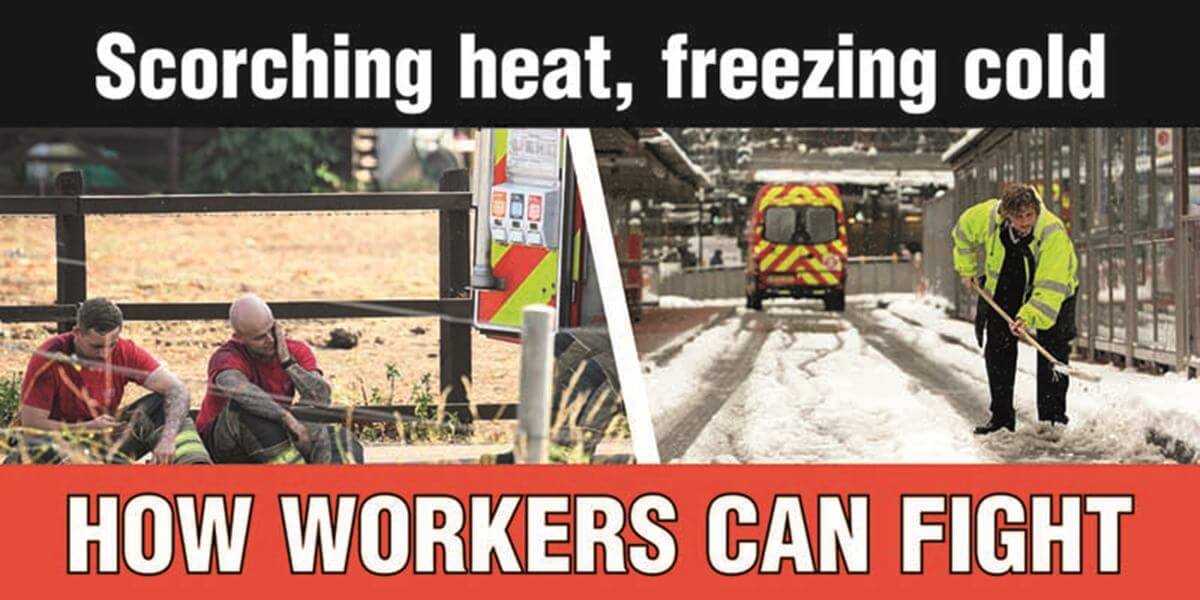
We just went through the hottest summer on record. Workers endured scorching heat in workplaces ill-equipped to cope, forced to risk their health and safety—and even their lives. Passengers, patients and students faced similar risks as trains derailed and schools and hospitals overheated. The bosses did nothing, putting their own interests and profits first. When workers demanded fans and air con, they were told: “We have no money”. The government hasn’t got a clue—the only thing it’s clear about is boosting defence spending even as basic infrastructure crumbles.
As for the trade unions, the picture is mixed: members were, and still are, angry, but there was little to no action. Why? The union leaders didn’t show the way. They failed to turn the felt needs and anger of their members into a struggle to shut down unsafe workplaces, to show that the unions can and should take charge of safety at work. Instead, they launched a paper campaign to lobby Westminster for a legal maximum temperature…to be implemented in the future…if the government agrees! They have been worse than useless.
We can’t let it go on like this. Workers face the brunt of the climate crisis and the increasingly dangerous working conditions it creates—so workers should decide what is safe for them and what isn’t, not the bosses, their management, or the government! For union control of health and safety! This basic principle is alien to today’s trade union movement. It must become its clarion call!
For this to happen, we need union leaders who are up to the task. If they won’t step up for us when it matters, we need to force them to step aside! With extreme weather becoming more common, we must fight for this principle in our workplaces, union meetings and across the movement, rebuilding the strength of our unions so that we can call the shots next time. To do this, we need to take on the various arguments and moral blackmail thrown at us to prevent our collective action.
Not a class issue?
The big lie we’re told is that the climate affects us all. If this just gave you a Covid flashback, it’s because this was the argument we were handed during the pandemic: “It’s a virus—it doesn’t discriminate! It affects us all equally. We’re all in it together.” The rehash today is: “It’s the climate, silly, we’re all in a heatwave.”
Let’s cut the crap. This argument is the purest blackmail designed to keep workers chained to the bosses. Workers were disproportionately impacted in the pandemic just as we are now. We risk heatstroke and collapse while they work from home and air-conditioned offices. We weren’t in it together then, and we aren’t now. Worsening climate is a class issue!
If the bosses and their managers do anything in the name of safety, it’s to tick the few legal boxes that exist—to save their skin, not our lives. We’ve worked through the worst summer on record, and we know those boxes barely scratch the surface. Improving our workplaces—many of which are Victorian not just in appearance but in their basic functionality—will require millions and billions in investment, money that will come out of their profits and budgets. They won’t spend it out of the goodness of their hearts. We’ll have to force them to, through collective struggle—through class struggle.
The bankruptcy of the TUC
Speaking of class struggle, let’s turn again to the trade unions. The main response to the heatwave by the trade unions is the TUC petition to the Health and Safety Executive (of His Majesty) for a legal maximum temperature. The TUC wants “to see ministers introduce a new absolute maximum indoor temperature, set at 30°C (or 27°C for those doing strenuous jobs), to indicate when work should stop” and for employers to take action to keep workers cool when it reaches above 24°C. The demand for a legal maximum should be supported as it would give workers something to use as a bargaining chip against the bosses. It’s a start.
But the question is how to achieve it: Westminster, or our own strength? Does the TUC expect that His Majesty’s ministers will sign off so easily? These temperatures are fast becoming the new normal in summers. Does the TUC really think the ruling class will agree that “work should stop” so many days of the year? We think not. This will become law only if there is real struggle. There are over six million trade union members in this country, and this petition has a little over 70,000 signatures. The unions are not mobilising their members for action. This is not a strategy to win, but a strategy for the union tops to look like they’re doing something while achieving nothing.
And even if by His Majesty’s environmentalist Grace this somehow becomes law, we should not rest content. Seasoned trade unionists know what legal codifications and guidance mean. Guidance says workplaces should be at least 16°C, but our workplaces still get freezing cold in the winter. Are they equipped with adequate heat? No. Do employers follow this? No, and they deploy all kinds of tricks to escape accountability. They send their own people to record temperatures, ignore what workers report, and somehow they always get the magical 16+°C reading. Or they say that they don’t own the premises so can’t install heaters. Or best of all, that portable heaters are themselves a safety hazard!
We return again to the same lesson: workers will get real safety through working-class struggle: struggle against the bosses, against Westminster and against the TUC tops who are leading us down a dead-end road.
Section 44 is not a strategy
The most common advice the unions gave was to invoke Section 44 of the Employment Rights Act, which allows workers “to remove themselves from situations where they reasonably believe there is a serious and imminent danger”. Section 44 is a limited right for those with a clear-cut case of risk from adverse temperatures; it is not a strategy to protect the working class as a whole.
And, as with all legalese, invoking this “right” is full of loopholes for the employer and traps for the worker. What exactly is reasonable, serious or imminent? The onus is on the worker to prove these, and the bosses retain the upper hand: they can raise counterarguments, dispute the workers’ assessments and ultimately take disciplinary action.
The biggest problem in pushing Section 44 as a protection, including for vulnerable workers, is that it isolates them in front of the boss. The best way to protect the most vulnerable workers is to act collectively through the union.
Rebuild union power
The climate crisis presents a crucial opportunity to rebuild the trade unions—an urgent need in Britain. By cutting through the blackmail thrown our way and exposing the dead-end of the TUC’s strategy, we can educate our co-workers in the basic principles of the class struggle and build their confidence in the unions.
It is also an opportunity to bring non-unionised workers into the unions and deepen joint union activity across workplaces. Workers are all in it together, regardless of which union they belong to. When competing unions put up barriers to such activity, we should fight harder for greater unity, exposing those at the top as obstacles to building our collective power. We must elect workplace reps and Health and Safety reps who are prepared to fight. No reliance on the bosses! For union control of health and safety! Make this TUC policy!
A social crisis requires social…ism? Yes!
The struggle to control our working conditions is the start of a broader struggle to control our fate. Genuine protection for working people against extreme weather means a complete overhaul of the status quo of British capitalism. The climate crisis is unravelling atop a social crisis: Britain is broken, and the cracks run deep.
To defend ourselves against what lies ahead, we need to rebuild Britain from the inside out. This will mean taking the wealth and power out of the hands of the ruling class and the monarchy and putting it under workers control. A social crisis demands a socialist strategy. There is no other way.