
https://iclfi.org/pubs/wh/258/frfi
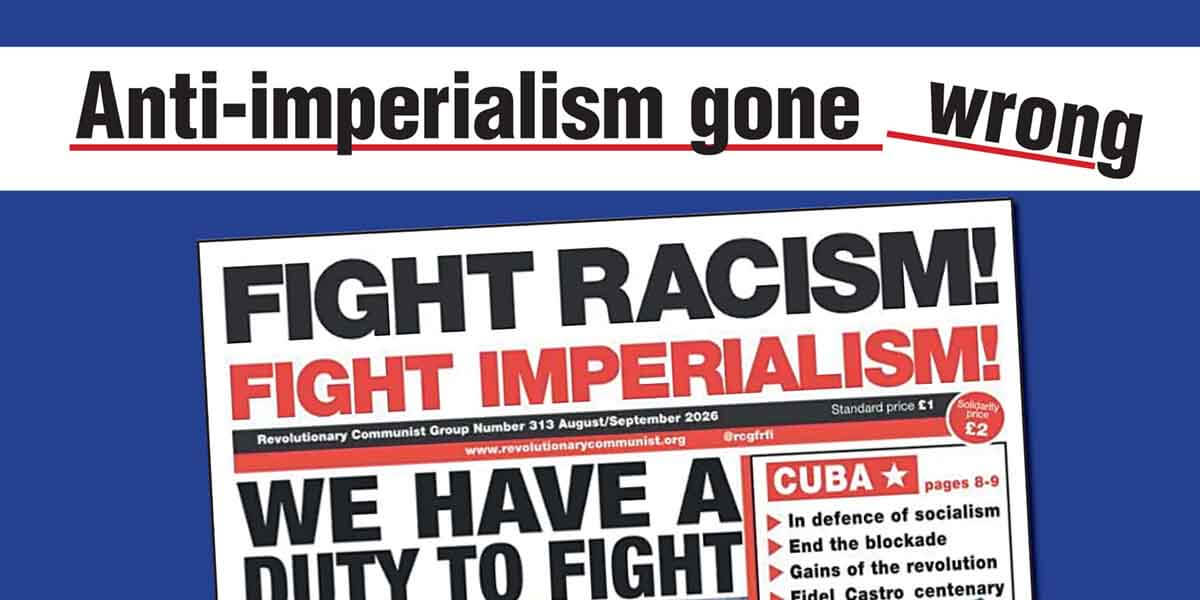
In a 26 July article, the Revolutionary Communist Group, better known as Fight Racism! Fight Imperialism! (FRFI) denounced our “Open Letter to the Left”, writing that “The Spartacist has gone as far as to join the imperialists in calling for the Cuban people to bring down their government.” (“With friends like these…British ‘left’ attacks Cuba”, 26 July). FRFI goes on to claim that our call to build a left working-class opposition to the market reforms of the Communist Party of Cuba (PCC) amounts to “crossing class lines in doing the imperialists’ dirty work for them”.
FRFI implies that we do not oppose the US blockade and indignantly asks: “Where is the call for anti-imperialist unity in defence of socialism?” In fact, as FRFI knows only too well, the ICL has joined and organised many demonstrations against the US blockade and the very article they denounce takes a clear stance on the matter. But, beyond the misrepresentation and demagogic attacks, FRFI’s article raises an important question: how are anti-imperialists to approach the market reforms in Cuba and the leaders of countries in the crosshairs of imperialism?
Here FRFI offers a chemically pure example of anti-imperialism gone wrong. From the genuine and often courageous sentiment of its members to oppose the crimes of imperialism, they end up apologising and covering for leaders who are actively betraying the very cause they claim to stand for.
How to defend the Cuban Revolution
We fully agree with FRFI on the need to unconditionally defend the gains of the Cuban Revolution. We also agree that these gains are embodied in the state power which was built after the Revolution. Where we disagree is on the role of the PCC, and more specifically on the recent measures to radically liberalise the economy.
There can be no doubt that these reforms were enacted under the pressure of the savage blockade imposed on Cuba by the US. This was a decision made under coercion. But that does not make it a correct decision. If it is true, as FRFI argues, that economic relations do not automatically determine the character of a state, they nonetheless remain decisive in the long run. The further growth of the private sector in conditions of mass privation is the perfect recipe for counterrevolution.
On the other hand, the reforms are hollowing out many of the social gains of the revolution and will further exacerbate the already rising inequalities. This can only undermine the support for the revolution among the masses. Why would they remain loyal to a state which allows a handful of speculators to get rich while they starve in the dark? If such a reality is presented as “socialism,” many will prefer to give capitalism a try.
What is needed to defend the Cuban Revolution today is a different course based on radical egalitarianism against all privileges, and internationalist appeals to the working masses of the region to break the US blockade—against their own governments enforcing it. But this is possible only if communists build a left opposition to the course of the PCC (see “Cuba: How to Stop the Catastrophe” Spartacist, 30 June).
The problem with FRFI’s approach is that its entire strategy to defend the revolution is based on remaining loyal to the policies of the PCC, no matter what. But what happens when those at the top of the PCC are cynical bureaucrats willing to betray the revolution—as has been shown only too often? FRFI is left with no choice but to excuse and justify policies that it itself recognises as dangerous. How is this being a “friend” to the revolution?
The Venezuelan debacle
No example shows the bankruptcy of FRFI’s policy better than its stance towards the current Venezuelan government. Delcy Rodriguez is giving away Venezuela’s oil to the US (while cutting it to Cuba), cosying up to Trump and welcoming the CIA director to Caracas, yet FRFI appears to think that her government still represents the “Bolivarian Revolution”.
In an article on the recent earthquake in Venezuela (21 September), FRFI praises the response of the state while denouncing the presence of an Israel Defense Forces delegation, which includes General Elad Edri. But this begs the question: who allowed this Zionist butcher to come to the country? Generally speaking, when it comes to Delcy, FRFI dodges the issue. Their article quotes her perfectly correct statement demanding the return of Venezuelan state gold but remains silent on her overall course, including her craven approach to the Trump administration, or the fact that growing sections of Chavista loyalists are realising that she is selling out the country. We can only wonder whether, according to FRFI, the policies of Rodriguez’s government are justifiable in the same way as those enacted in Cuba? Or are we again doing the “imperialists’ dirty work” for denouncing her?
Let’s get serious
The ICL has mounted an international campaign in defence of the Cuban revolution, raising thousands of pounds. We took a clear stance in defence of Venezuela and fight for the release of Maduro and his wife. We have also stood side by side with FRFI on countless occasions against state repression of activists from Nigeria to Britain. To present us as pro-imperialist stooges is ridiculous.
Nobody can doubt FRFI’s dedication to opposing imperialism. But its strategy is fundamentally wrong. To be an internationalist, one must take a clear side with all those fighting against imperialist oppression. But we cannot do so uncritically. The history of the anti-imperialist struggle is defined by heroic resistance and self-sacrifice, but also by treachery and cowardice. One has to be able to distinguish the one from the other.
If we still live in a world defined by barbarism and oppression, it is not because the masses are not revolutionary enough; it is because communists have failed to build the political force capable of ending capitalism. Building such a movement requires a serious effort of study and criticism. Denying failures or betrayals will only lead to more disasters.