
https://iclfi.org/spartacist/en/2026-khamenei
March 3—Many are celebrating the death of Ali Khamenei, Iran’s Supreme Leader. He was assassinated (along with members of his family) in his compound by American and Israeli strikes. The spectrum of those celebrating is quite broad, and it is quite the problem: from Netanyahu, Trump, Reza Pahlavi and the monarchist diaspora in the West, to respectable liberals, huge swaths of Iranian progressives bound together by the Woman, Life, Freedom movement and some leftists. What brings all these disparate forces together, at bottom, is joy at the death of the “dictator.”
Let’s get some basics out of the way: the murder of the Ayatollah at the hands of the U.S. and Israel is nothing to cheer about. Yes, he had blood on his hands, not just from the Dey uprising (late December – mid January in the Western calendar) but also the tens of thousands of communists and leftists that he and his predecessor butchered after 1979. From the point of view of a large segment of the Iranian masses, he was indeed a dictator. Communists do not support the regime of the mullahs. But when the country is under attack from imperialism, we take a side. And that side is with Iran, against the U.S. and Israel.
These are not mere words or slogans but have material and practical implications: it means being for the victory of Iran over the imperialists and Zionists and against its weakening at the hands of the aggressors. Any socialists on the ground, and for that matter all those who want to liberate the masses of Iran, are obliged to fight on the side of Iran to achieve these aims.
The murder of the Ayatollah must be seen within this framework, and from this standpoint it is nothing to be celebrated. This is not a moral question but one of political struggle. The Islamic Republic has been a problem for the U.S. and Israel’s designs for the region since 1979. Khamenei, as its central architect for 36 years, defined its overall orientation and was one of the main leaders of the Axis of Resistance. He was thus a principal manifestation of the problem for the imperialists. So, they killed him, as part of their broader plan to eliminate the Islamic Republic as an obstacle to their aims. He was eliminated not by an independent struggle of the masses but by the butchers of Gaza. His death, therefore, advances the aims of the imperialists and Zionists. To think otherwise is to be a willing idiot.
But many are being willing idiots. To understand this, we must examine the spectrum of all those celebrating Khamenei’s death. On one end is the imperialist/Zionist death machine, which justifies its aggression in part through talk of helping the “Iranian people” to rise up against the regime. The liberals in the West, in typical fashion, all of a sudden forget they hate Trump and nod sanctimoniously, parroting the propaganda of their own governments about the evil and authoritarian Ayatollah.
And while a lot of Iranian progressives and leftists are against the war and denounce the imperialists and Zionists for bombing schools, they skip over the fact that it was literally the same forces of death and the same bombs that also killed Khamenei. This does not seem to matter to them as they celebrate his death. Why? Again, because Khamenei was a dictator, so good riddance. They are so consumed by their hatred for the Islamic Republic and are so exasperated by their desire to be rid of the regime that they have no problem that it is the forces of genocide that are assassinating their leaders. They breathe a sigh of relief, lamenting only that the Ayatollah was not held accountable by the people.
And then there are those dilettantes on the left who are incapable of seeing the distinction between an imperialist power wreaking havoc around the world and an authoritarian and theocratic capitalist country oppressed by imperialism. Burying this fundamental Leninist distinction, they hop on this wretched bandwagon, denounce both sides as warmongers and cheer the death of the dictator while screeching “no war but class war.” Some organizations, like the Worker-communist Party of Iran, cross the line completely, blaming the Islamic Republic’s 47-year existence for provoking U.S.-Israeli aggression.
This current state of affairs is a problem. To those Iranian progressives, leftists and anti-monarchists who don’t want their country to be bombed but are happy seeing the blows against the regime, we must be frank: In the current context, to cheer the death of Khamenei puts you in the camp of Trump and Netanyahu. We understand the pain, anger, helplessness and exhaustion you feel. But it matters how you fight the regime.
To fight effectively, you must undermine the regime’s source of strength, that is, its appeal as a force standing up to imperialism and to Zionism. This appeal persists, despite being eroded domestically in the recent period. It persists because the country and the whole region are defined by subjugation to imperialism. From U.S.-backed regime change in 20th-century Iran itself to Palestine, Iraq, Libya, Syria, Afghanistan—imperialist devastation binds whole layers of the masses to anti-imperialist forces. By cheering the Ayatollah’s death, you drive these layers further into the arms of the regime, strengthening it instead of undermining it. Just look at the huge protests following Khamenei’s death, from Enghelab Square in Tehran to Kashmir, Pakistan, Iraq and Nigeria. To undermine this appeal, you must become the leaders of the anti-imperialist struggle, and merge it with the struggle to liberate women, the oppressed nationalities and the working masses of Iran from the clutches of imperialism.
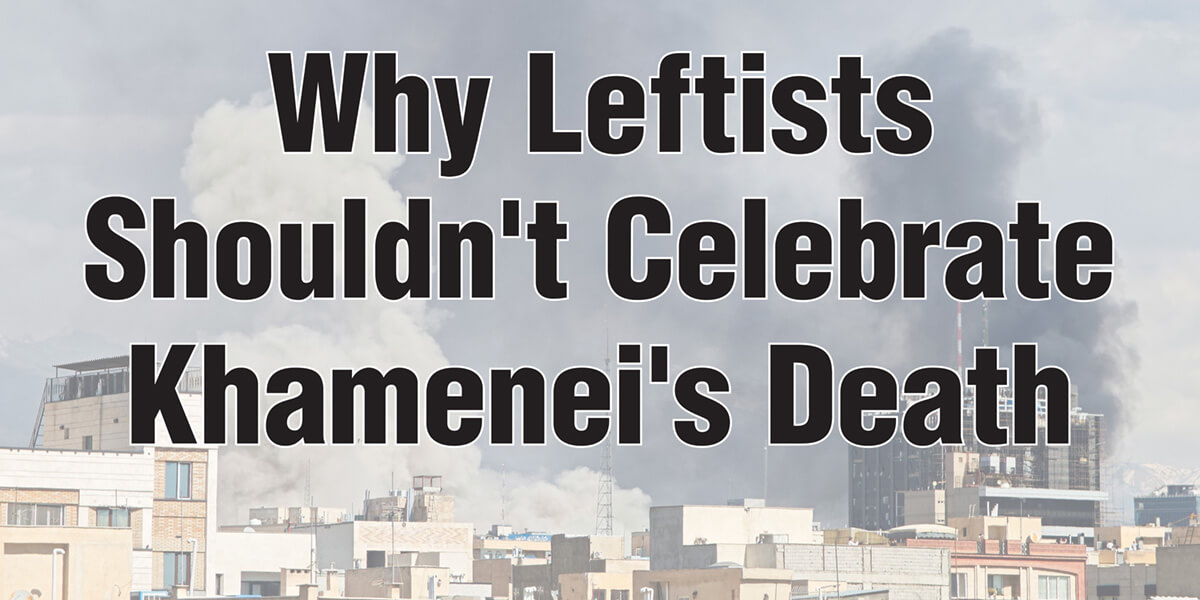
Why Leftists Shouldn’t Mourn Khamenei’s Death
Khamenei’s death crystalizes the problem of the international left when it comes to Iran. In opposition to the jubilant trend, the other side mourns the “martyr.” This includes many shades of the pro-Palestine movement in the Middle East, such as the Popular Front for the Liberation of Palestine (PFLP) and other “campists.” For instance, in its obituary for Khamenei, the PFLP writes: “We bid farewell to this revolutionary fighter” and “affirm that his passing represents a loss for the forces of global resistance seeking to break American hegemony and liquidate the Zionist project.”
This view is entirely misplaced. Yes, Iran is a thorn in the side of the U.S. and Israel. But its entire strategy is to neither “liquidate the Zionist project” nor “break American hegemony” in the region. Just look at Palestine. Iran did not act to decisively stop the genocide. Instead, its strategy sought to gradually shift the balance of forces by “boiling the Israeli frog slowly.” The result? Key leaders of the Axis of Resistance were killed with relative ease by Israel. Then Iran was pounded in the 12-day war, and now it is being bombed again. Unable to decisively challenge the imperialists but still posing enough of a problem, Iran has been slowly choked by imperialist sanctions. And unable to provide any solutions to this, it turned toward more repression and massacred thousands as they rose up to protest their declining conditions.
These are elements not of a winning anti-imperialist strategy but of a losing one. This is because the “anti-imperialism” of the mullahs is based on maintaining their own privileged and repressive rule. Meanwhile, they prevent a united struggle of the masses. Why? Because such a development would challenge their own rule. The strategy of the Ayatollahs in fact buys into the religious and national divisions that keep the masses weak and the imperialists happy. This is as true on the domestic front as it is for the region, and this ultimately renders the regime of the Ayatollahs an obstacle to liquidating Zionism and breaking American regional hegemony.
The death of Khamenei is objectively a blow against Iran in the war with the U.S. and Israel, the two bloodiest forces on the planet today. It is not to be celebrated, but nor is it to be mourned. From 1979 to today, the main problem of the left has been to effectively challenge the mullahs. It has flip-flopped between denouncing them completely and supporting them in the struggle against imperialism. This polarization is growing within Iranian society itself. To go forward, it is necessary to bridge this chasm and unite the masses. For this to happen, both trends must overcome their respective failures and merge the task to defend Iran with that of liberating the masses. Let us not repeat past failures but draw their lessons, no matter how emotionally difficult they are, and apply them to change reality now.
This article also appeared in: