

https://iclfi.org/pubs/wh/257/misogyny
In December 2025 the Labour government declared violence against women and girls a “national emergency”, committing to halving it in a decade by using “the full power of the state”. The numbers are truly disturbing. According to the Office of National Statistics, instances of domestic abuse, which disproportionately affects women, more than doubled in England and Wales, going from 410,572 in 2016 to 889,918 in 2023. The reported instances of rape have shot up from 13,272 in March 2004 to 71,540 in March 2025. If we abide by the famous aphorism that the status of women is a measure of the progress of society, then Britain is most certainly going backwards.
But if the Labour government thinks that some symbolic declarations and posturing as a champion of women and girls will make us forget that its own cops rape and murder women (we haven’t forgotten about Sarah Everard), that it supports the genocide of Palestinians, with women and children slaughtered in the tens of thousands, or that it cuts benefits for the most marginalised, or that it constantly gets on its knees for the misogynist-in-chief across the pond, then it has another thing coming. It is precisely because violence against women and girls is a burning problem that we need a real strategy to fight it! The conditions for women and girls will advance only if Broken Britain gets fixed.
Schools on the frontline
The growth of violence against women is happening in the context of the documented rise in misogyny among boys and young men, a reflection of the proliferation of the manosphere. Misogyny has become a mainstream topic since the release of Adolescence last year and Louis Theroux’s Inside the manosphere this year. Both, whatever their flaws, put the spotlight on a real and growing problem: a wholesale social crisis facing young people and unfolding along gender lines.
Schools are a natural frontline of this crisis since this is where young people spend most of their time. Teachers report a rise in misogynistic comments and attitudes; many schools have done whole-school boys-only assemblies on Andrew Tate and the manosphere (because…of their chromosomes?); and more days are rolled out to train teachers in how to spot the signs of misogyny, how to talk to boys, how to talk about masculinity, and all sorts. (As if we didn’t have enough reasons to quit the profession!)
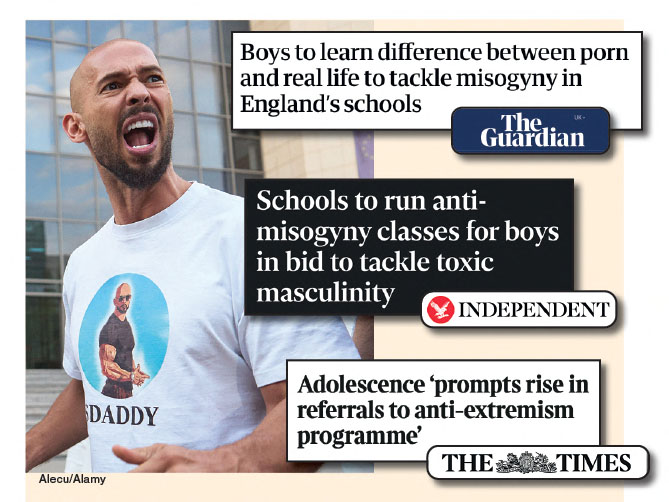
Government’s liberal campaign won’t stem Andrew Tate’s anti-woman bigotry.
Because schools are a major interface between youth and society, it is no surprise that they form a key component of the government’s strategy to deal with misogyny, and that the National Education Union (NEU) has its own campaign on the issue. To say that both are hugely ill-equipped to deal with the issue would be an understatement.
The liberal tautology
What exactly are the solutions on offer? The government wants to “empower” teachers and families to “address these harmful attitudes and behaviours”, teach young boys how to “identify positive role models and challenge unhealthy myths about women and relationships”, “arm children against disinformation, fake news and conspiracy theories”, place children “displaying harmful behaviours…in behaviour change programmes” (!) and give police (unfortunately) and social services more “tools they need to intervene”.
The NEU, for its part, does not put forward anything fundamentally different. “It’s Not OK”—its campaign against sexism and sexual harassment—is a toolkit for educating young boys about healthy masculinity, how to challenge gender stereotypes, and how to make collages about masculinity or facilitate a session on body sculpting. (Don’t worry, we are as confused as you are.)
Sounds good though, right?
Wrong. Both the NEU and the government view everything in terms of “teaching” misogyny out of the heads of boys. (The difference is that the government is willing to throw the “bad ones” into behaviour change programmes.) And as far as where that behaviour comes from, both agree that it’s due to bad influences, exacerbated by social media.
We are left with a tautology: bad ideas (of the manosphere) are causing bad ideas (in the heads of boys). And, we will get good behaviour by modelling good behaviour. Simple, as if kids were lab monkeys. This logic perhaps explains why the government only pledged a measly £20 million for its solution, and why the union demands nothing and instead suggests nice charities which can come in to give workshops.
Let’s get real for a minute
A lot of education workers would welcome much of what is on offer. Partly because so little is done to deal with these problems, we’re happy something is being done at all, and partly because we stay true to our vocation and genuinely think everything can improve through education. But the efficacy of these solutions must be judged by looking at the broader social and political context and with a clear understanding of what exactly is driving the growth of misogynistic attitudes.
Let’s start with the broader context. The education system is crumbling from chronic underfunding. Academy trusts leech off school funding to pay their CEOs to turn schools into prisons. They implement completely draconian behaviour management regimes which are designed to instil submission but in fact breed defiance. Learning needs are through the roof, but there’s not enough funding for Teaching Assistants. The number of students eligible for free school meals, meaning those from low-income families, continues to rise year on year, sitting at 25% of all students as of 2025. A lot of students in inner-city schools don’t even have paper at home on which to do their homework!
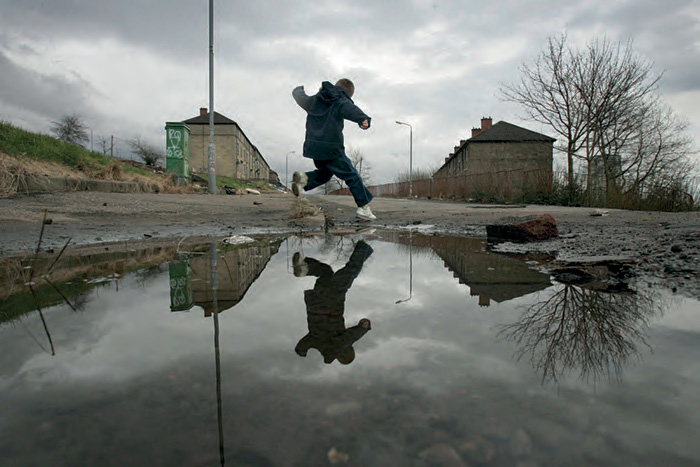
Housing estate in Maryhill, Glasgow. One in three children in Britain grows up in poverty.
Schools are simply not fit for purpose. As youth experience more hardship, school budgets are being slashed. They are not places where young people thrive. In fact, despite teachers working themselves to the bone, the education system is failing the majority of young people. Youth have few prospects after they finish school—good jobs are few and far between in Britain’s stagnant economy. Youth crime is on the rise. On top of all this, going to university to stand a chance traps them in lifelong debt. The growth of misogynistic attitudes is taking place in the context of an entire society rotting from within. Youth in particular experience the brunt of it. And of course, it’s the children of the working class who get it the worst.
The problem of misogyny is also inseparable from the rightward shift in politics nationally and internationally. It’s no coincidence that the popularity of Andrew Tate parallels that of Reform UK and Tommy Robinson here. Or that the manosphere played a major role in getting Trump re-elected in the US, with harebrained bigots like Sneako attending the inauguration of the president of the most powerful country on the planet.
In this context, teaching “good ideas” and spreading “good vibes” in isolation from the crumbling education system, the rightward shift and the general decay of society is a complete non-starter. No amount of good role models at school is enough to pull huge layers of youth out of the social and economic rot which surrounds them. For all the workshops teaching boys how harmful anti-woman ideas are, they leave school and go right out into society where everything we are trying to unteach them is reinforced.
This vicious cycle won’t be broken by ideas alone. If teachers could change the world through just teaching, we would have done so by now. We are dealing with a deep-going social problem. To moralise at young and often defiant boys without going to the root of the problem will not work. In fact, it will very likely backfire and push them further into the arms of the very reactionaries who grow their clout by rejecting the do-gooder vibes the government and the union are pushing. We cannot win this battle if we keep using tools which are clearly broken. To save boys from the manosphere, something will need to give.
Why so much misogyny?
Before we proceed to what that is, we need to take up social media, the culprit everyone loves to blame for all the ills of youth. Yes, social media has made it easier for red-pill content to proliferate amongst young boys. But young boys are not idiots who will believe anything they are told.
There is a reason why such content strikes a chord with them, why it’s popular, and why it pulls them deeper into the manosphere. It’s because their social and material circumstances are driving them to look for a “red pill” for something which explains why everything is stacked against them—from detentions every day to poor grades, terrible school dinners, pressures around dating and being liked, disappearing social spaces, neglect, family problems, an overcrowded flat, lack of privacy, impending social media bans and a whole host of other things.
They are looking for an escape, for a quick way out. (Ever wonder why young boys from nice liberal middle-class homes are usually not the types who like the manosphere, but it’s the ones from the estates?) So, when bigots like HSTikkyTokky talk about “the system” and “the colluding powers at the top of the world that want to keep everyone down, keep everyone broke, keep the slave mindset going”—this rings true for them. Hell, he’s right! The problem is that this one piece of truth gets laced with misogyny, chauvinism, anti-Semitism and scam trading schemes which give these reactionaries their millions.
With everything working against them and nothing to pull them back, young boys get sucked deeper into the manosphere pipeline, ultimately buying into the poisonous misogyny which tells them that their masculinity rests on the submission and humiliation of girls and women. It can go from inane things like rage-baiting teachers for banter during lessons to using homophobic and transphobic slurs against others to assert their own manliness, to upskirting and sharing nudes because for them, girls become mere playthings.
To blame social media for the growth of misogyny is not only dim but serves a political purpose: if the problem is only based on bad ideas and social media, then there’s no need to spend any real money on fixing anything. Instead, the government can entertain banning social media to save girls, or just extol the virtues of having good role models to fight the manosphere, and if all else fails, give the police more powers. In other words, it can get away with doing nothing that’s good and more of what’s terrible. Social media is a symptom, not the cause. And to fight the cause we need to qualitatively improve the lives of young people so they have no need to turn to reactionary answers. This means improving the entire country, starting with schools.
The union needs to get it together!
This is where the NEU comes in. It wants to “save education”. Good. But what does this look like and how will the union fight for it? Education will only be saved through massive funding, which can provide children with what they need to succeed—smaller classes so they can have real attention from teachers, additional support for all their learning needs, free meals, enough leisure time, etc. It will be saved when education workers have a huge reduction in workload and better conditions so that they don’t quit due to burnout. It will be saved when schools are back in public hands and not under the control of parasitic academies. It will be saved when behaviour regimentation is no longer the means to stem the social crisis engulfing Britain.
All of this requires a fundamentally different game plan. Annual campaigns for more pay simply won’t cut it, nor will liberal campaigns promoting teaching good ideas to bad boys. Teaching is a woman-dominated sector. This means the union must take up the fight against misogyny as one of its core planks, not just go along with government plans to train already overworked teachers to have more empathy for boys taking the mick. Yes, we want to fight misogyny. But this shouldn’t be through our emotional labour. Rather, it should be through a struggle against the existing set-up of education linked to the fight against the social crisis confronting youth.
This is not as impossible as it sounds. The fight against the current education set-up starts with your school, and it starts with building the union at your school:
- Join the union, recruit others and make the union your voice on the job.
- Take a collective stand against workload creep—if you refuse together, management can’t do anything about it.
- Fight against strict behaviour policies—giving a million detentions will only fuel more tension between teachers and students.
- Oppose senior management being in the union—and pressure the union to agree to this.
- Build teacher-student unity—schools are failing both of you, and you are natural allies in fighting to change them.
Of course, these on their own do not solve the problem of misogyny in schools, let alone society. Misogynist attitudes must be challenged. Our problem isn’t that the government and the union seek to do this. It’s that they do this with methods which breed cynicism and invite a conservative backlash. In the case of the government, it pushes a cheap moralising propaganda campaign while overseeing the destruction of living standards. The NEU, for its part, echoes the government’s campaign and offers no challenge to the status quo in schools.
The fight against misogyny will succeed to the extent that the fight for better schools, a better future for children and a better society succeeds. Only in the course of such a struggle will progressive ideas about gender actually find fertile ground. For this, the NEU needs to get it together and rethink its strategy to save education.
This article also appeared in: