
https://iclfi.org/pubs/wh/257/rmt
At the risk of sounding like a bad joke: How many workers does it take to maintain the railways? Nobody knows. From the Tories’ privatisation of the national rail system to Labour’s privatisation of the London Tube, the goal was to bring down wages and weaken the unions, and it worked. The railway system is now a patchwork of public and private operations with dozens of contractors and subcontractors lording over everything from full-time employees to tens of thousands of workers on zero-hour contracts or considered self-employed contractors. Wages and conditions, once negotiated nationally with a single employer, now vary massively among regions. And that is just for those lucky enough to still be directly employed and in a union at all. For the tens of thousands on tenuous contracts or “self-employed”, it’s back to Victorian times, only then the trains and tracks were new.
The response of the RMT to this state of affairs has been to urge successive governments to re-nationalise, go after subcontractors and ease anti-union laws to make it easier for them to organise. The problem is that for the City of London, whom Tories and Labour both serve, putting unions like the RMT on their knees was exactly the point. They will not be convinced to reverse course by fine arguments; they must be forced by hard class battle. Carrying that out will require industry-wide struggle, which must be prepared by industry-wide organising. That is exactly what the RMT is not doing.
Going off the rails
Rightfully, at the heart of the RMT’s arguments for nationalisation have been workers’ rights, public safety and re-industrialisation. In a policy paper to the government last year, they noted: “These employment conditions are obviously bad for workers but they are also bad for service quality and safety. Outsourcing companies create profits by driving down on staff costs, cutting jobs and pressuring workers to cut corners.” They cite numerous examples of rail accidents—many fatal or nearly so—and investigations linking them to the chaos of outsourcing.
In another study from last year, the RMT note how bringing back national production of trains and replacement track would help revive the steel and manufacturing industries. This is absolutely true—a big part of deindustrialisation was the privatisation of rail.
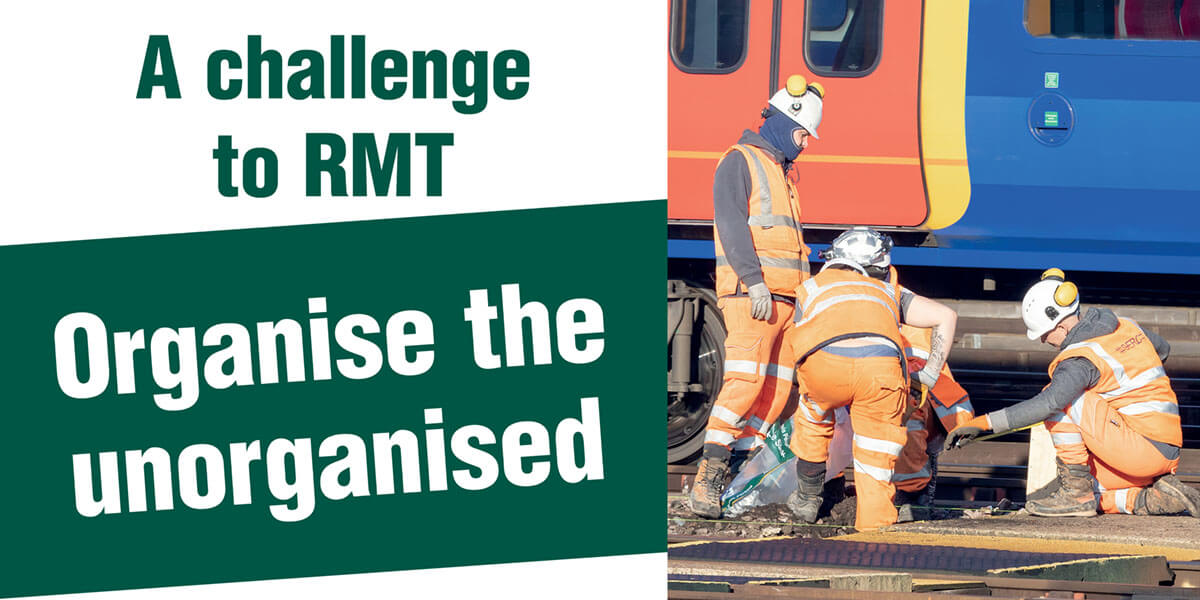
Subcontracting is a shadowy world and real numbers are hard to find, but in 2013 the RMT noted: “Of some 88,000 PTS cardholders [those licensed to do rail maintenance], 67,000 are not directly employed by Network Rail. RMT believes that less than 10% are full-time employed and that the remainder may well be working under bogus self-employment on zero-hours contracts.” Things have likely only got worse since then. This is a massive pool of unorganised workers. There have been attempts to organise small pockets of these workers here and there, but no serious push to unionise the whole field of subcontracted labour.
A rose by any other name...is still full of pricks
The question then is what has the RMT proposed to end these horrific conditions? Well, of course, government intervention, by yes, governments of the exact same parties that imposed privatisation precisely to break the union.
This is central to how the RMT leadership views building the union. Excited by the creation of Great British Railways (GBR), they write in one 2025 paper: “GBR could also undertake joint work with the unions to create job security and a framework within which future workforce and training needs can be identified”.
The creation of GBR was never about bettering workers’ conditions or growing the unions. It is the state intervening to bail out failing private operators and partially address the chaos of transport, which is becoming too widespread to ignore. This is essentially what already happened with London Underground.
In the Tube, the cost overruns of the private companies and chaos on the tracks were too great to bear in the political and economic capital of the country. But what followed was not renationalisation. It was the rail lines coming back under public oversight and ownership. Crucially, the trains remain privately built and rail maintenance is still carried out largely by private contractors and subcontractors. The RMT’s own position papers admit this is what is planned with GBR.
GBR is not a return to the public ownership of the past. When rail was nationalised in 1947, it was one of the measures to shore up declining British imperialism at home as the empire crumbled abroad. At that time, the ruling class also faced an insurgent working class and needed to buy class peace. That is fundamentally not the case now.
You could say that the union’s strategy has it backwards. The unions will not be built by some gift of nationalisation. Rather, only building the unions and confronting the government will be able to force such concessions.
We can’t play by the bosses’ rules
But treating the government (particularly Labour) as a partner rather than the enemy is how all union leaders, including the RMT’s, view organising. The basic idea is that by law, if the union meets the legal threshold, then the company has to recognise the union. So it’s just a matter of gradually convincing individuals to be a member and then, presto, you have a union. Of course, things are never this simple.
In the first place, the government places all sorts of restrictions on the union’s efforts, such as anti-union laws. One thing we’ve heard from RMT members is their officials saying that the current government will change the laws, making it easier to organise. Not only is this not very likely from the same Labour Party working to crush the Birmingham bin strike, but it ties the unions’ hands behind their backs. Seeking to put the government on your side means not upsetting them, playing by their rules, no matter how rigged.
Secondly, the bosses have a thousand ways to crush organising, even when they do play by the rules (which they rarely do). The entire system of subcontracting is set up to do just this. Breaking up the workforce into dozens of supposedly independent companies makes gaining union recognition of the majority of workers by normal means nearly impossible. Creating smaller and isolated groups of workers makes it easier for the bosses to simply fire anyone they see as a troublemaker (or just stop hiring those supposedly “self-employed”). In fact, there have been efforts among these workers to organise themselves that have been smashed in just this way.
Piecemeal methods cannot work in this environment. Underground organising and strikes demanding a betterment for every rail worker are the only way to bring in the whole of the rail workforce. The situation calls for organising class war on the rails.
But the RMT has barely done anything to organise subcontractors, even by the piecemeal approach. When they do, they take a worker who volunteers to join and set up a unit where a few workers join, hoping to meet the legal threshold. Then, outside, they lobby the government to renationalise rail, hoping it will help organise the workers. The whole point of their latest position papers is to convince Keir Starmer’s broke and hated Labour government to finally do this with GBR. Simply put, the RMT is playing by the bosses’ rules, which not only guarantees failure but also threatens the union’s survival.
A castle on a sandbar
The selling off of rail, along with the general deindustrialisation of the country, was a massacre of the working class of Britain. RMT members, especially those in bastions like the London Tube, are seen as a relatively privileged sector. Many members of other unions look at the pay and benefits (like public pensions) that some RMT members have held onto as a sign of what a strong union can achieve. But many also see them as living the high life at the public’s expense, especially compared to the conditions of the rest of the working class. The ruling class sees them as a central target, a vestige of public sector unionism to be destroyed.
All of this played out in last year’s Tube strike. The capitalist press was able to undercut public support for the strike by attacking the union’s demand for shorter work hours. As justified as the union’s demands were, many workers are working overtime just to survive. Rather than being seen as fighting for the betterment of all workers, they were seen as fighting for the privilege of a few. This problem will present itself again in the new, upcoming round of strikes the RMT has announced in the Tube.
This is also clear in the various “in-housing” campaigns of the union. These are not built as industrial action drives, but as PR campaigns to convince MPs, and they have focused almost exclusively on workforces already organised by the RMT, like caterers and cleaners. For major sections of outsourced workers, like rail repair, these campaigns have little or no meaning. They are neither a real challenge to outsourcing nor a promise of improvement of these workers’ conditions, and the union has made no effort to even talk to them and get them involved.
And the fact of the matter is that all of this has hurt RMT members. Even in strongholds like the Tube, their pay, benefits and conditions have all fallen in the decades since privatisation. Up to 300 unionised Tube workers are currently facing possible deportation as part of the government’s anti-immigration drive. This is an outrage which points to the urgent need for industrial action. Instead, the RMT has a protest every couple of months.
The RMT is now a castle surrounded by a sea of degraded labour. The ground around that castle is what’s left of organised labour and is being eroded every day. If this ground is not shored up and expanded, the walls of your citadel will eventually collapse.
Convince the workers, not the bosses
To quote RMT head Eddie Dempsey: “I hate to say this: People aren’t paid according to what social value they bring to society. If they were, you wouldn’t see nurses going to food banks. Your wages depend on the strength of the union and your preparedness to take militant strike action.” We could not agree more. But the RMT is not taking this class struggle approach to the vast majority of rail workers. To change course is all the more necessary against the system of privatisation, which is not a matter of this or that contract, but a multi-generational scheme of the City of London to destroy the living standards of the whole working class.
Enough PR. We need industrial action.
For the RMT to combat this, there needs to be a struggle to organise every worker on the railways, regardless of employer (or, for that matter, “self-employed”), and put union resources into it. The union has already made many of the arguments for the advantage of being in a union, but they need to be made to these workers, not the government.
To do this will mean a sustained campaign of both inside and outside work. On the one hand, the union must dedicate resources and organisers to reach out to subcontracted workers. On the other hand, it must become part of these workforces. There is hiring and training going on now for these jobs. Put your members in! This is a task for the socialist left as well. Many youth are joining apprenticeships instead of uni, get your members into them and help to build the union.
This won’t be easy work, the jobs themselves are hard and the employers hate unions. This is exactly why the RMT’s resources, skilled organisers and the money to back them up are so needed to accomplish it.
But the precondition for this must be a fight within the RMT against its current strategy. So long as the leadership of the RMT continues to rely on the government and on the bosses’ rules, the union will go nowhere.
To RMT members, we say: fight with your leaders to take a new course, and if they will not, get leaders who will. The fight to turn this country around isn’t going to start in Westminster, it is going to start on the job site!