
https://iclfi.org/spartacist/en/71/myanmar
We print below an excerpt from a conference presentation on Southeast Asia by comrade Elizabeth Johnson.

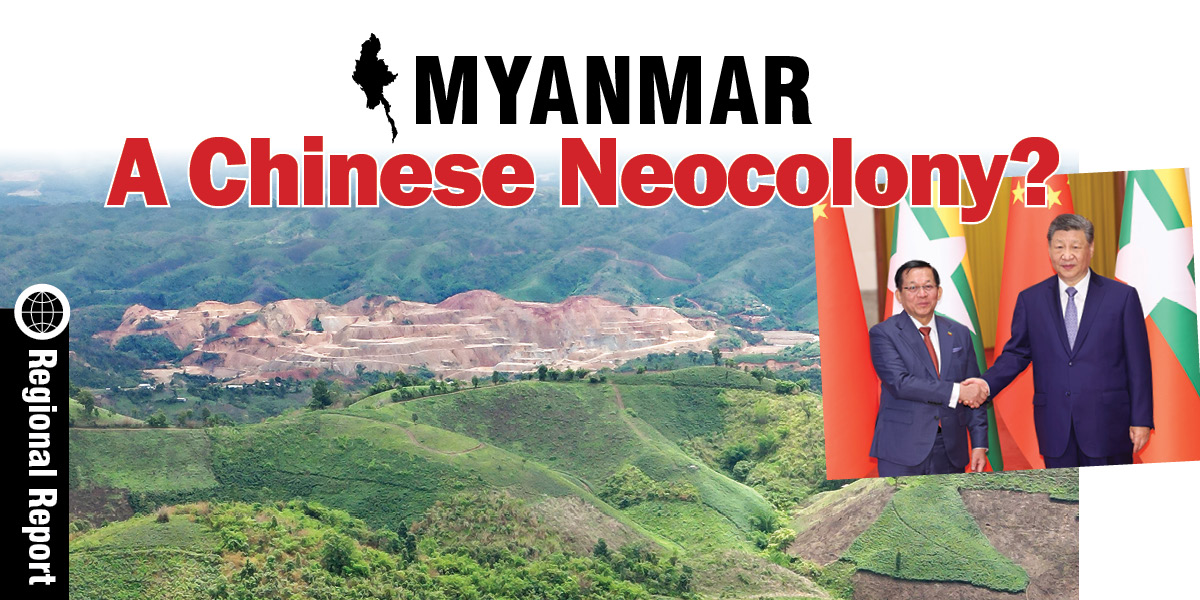
Myanmar is one of the main examples socialist organizations use when they want to argue that the People’s Republic of China is an imperialist power.
To give some context: Myanmar’s borders were established when the country was a British colony. It’s a prison house of peoples, inhabited by over 100 ethnic groups speaking different languages and practicing different religions, including the descendants of South Asians who were recruited by the British to act as a labor and police force. The dominant ethnic group, the Burmese, comprises about two-thirds of the population.
A brief neoliberal interlude in the early 21st century, symbolized by pro-imperialist democracy leader Aung San Suu Kyi, produced explosive economic growth but also widening inequality and a rapid increase in foreign ownership. This provoked a nationalist backlash, leading to anti-Muslim pogroms, the rise of ethnic militias and a military coup. The junta closed off the country, took control of the economy and massively repressed the democracy movement. In response, the democracy movement constituted itself as the National Unity Government (NUG), declared war and formed the People’s Defence Force as its military wing.
There are now an estimated 1,200 armed factions fighting in Myanmar. The junta controls about 20% of the country, the NUG about 40%, and most of the rest is held by various ethnic militias. The economy has broken down, with the poverty rate estimated at 50% and more than half the country’s children no longer attending school. There has been a mass exodus from junta-controlled areas as youth flee conscription. To compensate for the weakness of its ground forces, the junta relies heavily on airstrikes and Chinese drones, targeting hospitals, schools and infrastructure in rebel territory.
So what are the PRC’s interests here? One is resources: over half of China’s heavy rare earth imports come from Myanmar. China also has a geostrategic interest in overland access to the Indian Ocean, bypassing the chokehold at the Strait of Malacca. To this end, it has been developing the China-Myanmar Economic Corridor, a network of transport, energy and industrial projects linking China’s Yunnan Province to a deep sea port in the Bay of Bengal.
We all know that imperialism is dependent on military force, so what is China’s military role in Myanmar? The PLA carries out border patrols—but that’s on the Chinese side of the border, to keep the warring factions out. Reportedly on pipelines and other infrastructure, there are Chinese security guards, not PLA soldiers. The fact is that China is not attempting to impose military control on Myanmar.
China’s main role in the civil war is arming forces that are fighting on opposite sides. On one hand, the CPC arms the junta to stop the chaos in the ethnic Burmese heartland, and on the other it arms the ethnic militias to maintain order along the Chinese border. The CPC has attempted to build good relations with the NUG, trying to win it away from U.S. influence. It is even calling on members of the U.S.-controlled ASEAN alliance to intervene to stop the civil war. Why is the PRC’s policy so crazy? It’s because China is not trying to dominate Myanmar. Instead, it’s trying to find some other force that can stabilize the country.
Before Trump was re-elected, U.S. policy was to let Myanmar self-destruct as a barrier to Chinese influence. Now that rare earth minerals are a major focus of strategic rivalry, the White House and ASEAN are rebuilding ties with the junta, seeking to bring it into the U.S. camp. For its part, the CPC’s Myanmar strategy depends on buying the loyalty of the junta and the warlords, not on making an alliance with the country’s oppressed masses. The CPC’s conservative, bureaucratic outlook is an obstacle both to the defense of China’s interests and to social progress in Myanmar.
China is playing a plenty reactionary role in this conflict. By supporting the junta, it is trampling on the democratic aspirations of the Burmese majority and the national sensibilities of the ethnic minorities. The policies the CPC is pursuing are contradictory and conservative. But Myanmar is not a Chinese neocolony.