
https://iclfi.org/spartacist/en/71/iran
This presentation, edited for publication, was given by comrade Badr of the ISA-R at our Ninth International Conference.

The goal of my report today will be to explain the current dynamics of the region, why the Axis of Resistance’s strategy is still set to fail, and lay a basis for how communists would put forward an alternative program.
There are a few things that I cannot cover today, but which are quite essential for developing a communist program for the Middle East: namely, the legacy of the Arab Spring and the dynamic of class struggles within the industrial centers of the Middle East—Egypt, Türkiye and Iran. However, due to both the time constraints and the wide geographical scope of the U.S. and Israel’s war, I will only be focusing on the question of Iran’s strategy of resistance, its network of allies and dynamics in the Levant.
History of the Islamic Republic of Iran
Before looking at the current war, it’s worth looking at the history of the Islamic Republic and its attitude towards U.S. imperialism to know how we got to where we are today.
The Islamic Revolution was always a contradiction. One of the main banners of the new regime was opposition to the U.S., but there was also opposition to communism. This meant that the methods of resisting the U.S. would come at the expense of the independent action of the working class and peoples of the region. While the regime became isolated from the world economy, it was forced into left-nationalist-type reforms—nationalizations, state intervention, provision of public services, etc. At the same time, it was waging a reactionary war against Iraq, while massacring the communist movement, also with the blessing of the imperialists.
After the end of the war and the destruction of the workers movement, the regime did not move back towards its anti-U.S. orientation—the opposite. In combination with neoliberal reforms and privatization, the 1990s and early 2000s were an era of détente between the U.S. and Iran.
But despite the Iranian regime making continued overtures towards reconciliation with the U.S., the U.S. would not accept anything but a full return of U.S. control over Iran. However, even though Bush Jr. declared Iran a node in the “Axis of Evil,” Iran-backed militias in Iraq were still collaborating with the U.S. occupation by fighting Al Qaeda, and simultaneously using anti-Sunni militias to fight the U.S. coalition. When the U.S. started imposing sanctions on Iran because of its nuclear program, the regime further ramped up its anti-U.S. rhetoric, prompting a further escalation of the U.S. sanctions regime.
“End” of Strategic Patience and the Current War
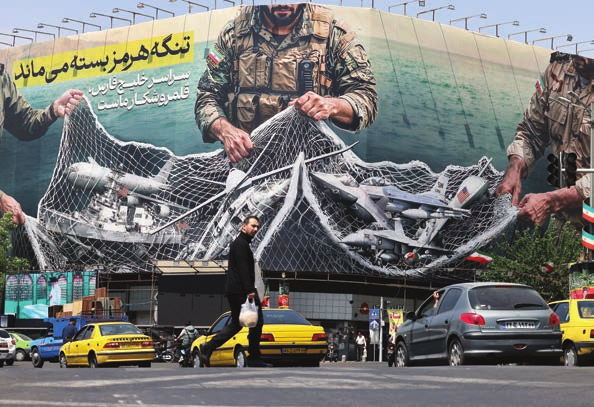
Revolution Square, Tehran: Billboard reads, “The Strait of Hormuz Remains Closed.”
What guided Iran’s new orientation towards resistance was its doctrine of “strategic patience.” This meant allowing the U.S. to escalate its sanctions regime and encircling of Iran, while Iran would build an autarkic and militarized economy, fund regional militias and hope that an overextension of the U.S. would force it into compromising. In short, if the U.S. escalates, flaunt your military capabilities, but don’t escalate in kind. The only “success” that this policy brought for the Iranian regime was the 2015 nuclear deal, which sacrificed Iran’s nuclear weapons potential in the hope for sanctions relief that never arrived.
Strategic patience has always been a failure, and this could not be seen any more clearly than after October 7. Iran did next to nothing until its Syrian embassy was attacked, and didn’t carry out a serious response until the country was attacked on a large scale in the Twelve-Day War.
Now the Iranian leadership is announcing that the era of strategic patience is over. In a very formal and official sense, this is true. The Islamic Revolutionary Guard Corps (IRGC) is not sitting back and doing nothing. It attacked numerous U.S. bases in the region, the infrastructure of its pro-U.S. neighbors and Israel. But if you look at the strategy behind these attacks, really you see more of the same. Although the U.S. has been frustrated in achieving its war aims, it has been able to set the pace of the conflict while Iran’s attacks have generally been responsive and not escalatory.
The war has become a showdown over who will capitulate first. Will global oil prices force the U.S. to relieve sanctions and concede the Strait of Hormuz, or will the destruction of Iranian civil/industrial infrastructure force Iran to concede?
It’s true that the Iranian military has fought back hard and the U.S. is in a very difficult position and unable to wage a continuous war. However, the U.S. has shown its strategy: bomb hard, formally concede in negotiations, then bomb again—rinse and repeat. After each exchange of fire, the U.S. economy gets some breathing room, while the Iranian economy remains besieged as before.
What would it take to truly drive the U.S. out of the Middle East? A mobilization of the masses in a regional war of national and social liberation. But the active participation of the masses is precisely what the regime’s war strategy lacks, because of its long-established tradition of repression, oligarchic parasitism and sectarianism. And while the war is regional, it is limited to where Iran has active and organized allies—you do not see the same kind of mass rallies in the region and around the world in defense of Iran like you saw for Palestine. The only places where this war has threatened the stability of reactionary regimes are in the small island kingdom of Bahrain and, to a much lesser extent, Jordan.
With that said, there have been mass mobilizations inside Iran in support of the war. These are largely led by the hardline Paydari faction of the regime. Its social base and its place in the regime rest on the war profiteers, those whose wealth is connected to the funding of the IRGC. Thus, they are viciously hated by a significant part of the population. At the same time, unlike the reformist conciliators, this faction has effectively mobilized mass anger against U.S. imperialism and the Iranian reformist conciliators. At Ali Khamenei’s funeral, they publicly attacked the foreign minister Abbas Araghchi and the Speaker of Parliament Mohammad Bagher Ghalibaf for signing the Memorandum of Understanding with the U.S. A lot of their rhetoric can even sound similar to what the ICL has said on condemning strategic patience and signing the ceasefire agreement with the U.S.
But what is their role? It is to take the existing mass anger against imperialism and channel it back into support for the regime. They go out in the streets, mourn Khamenei, call for solidarity with Lebanon, denounce the Arab monarchies, but then express their support for the Supreme Leader and his decision-making. They’re a pressure release valve, and the regime effectively deploys them when it costs nothing, and sidelines them when they want to make a deal.
Their tying of anti-imperialism to steadfast support of the regime is especially toxic, because it pushes the anti-regime sections of society towards more open support for imperialism. The more the Iranian people suffer in this war, and the more the hardliners are seen as incapable of fighting the capitulators, the more this defeatist, pro-imperialist sentiment will grow.
Not only this, but they have no answer to Iran’s economic destruction. Abbas Araghchi recently went on a podcast to justify his signing of the ceasefire, claiming that while Iran undermined Trump’s goals in the first few weeks of the war, signing the ceasefire earlier could have saved the Mobarakeh steel plant and other infrastructure. Obviously, he is doubling down on his capitulation, but at the same time, the capitulationist leadership of the regime is leaning on a very real and popular sentiment that continuing the war only spells more long-term economic suffering.
Lebanon, Iraq, Yemen and Palestine
So, what’s going on in the broader region? In Lebanon, Iran’s closest and historically strongest ally is facing a nadir of support. Hezbollah’s support is almost entirely limited to the Shia community, one-third of the population, as well as leftist and nationalist minorities among the other sects. Now 58% of Lebanon’s population supports Hezbollah’s disarmament. This is because their entire resistance strategy has been tied to their incorporation into the comically corrupt and sectarian Lebanese state, and their massively costly and failed intervention in Syria. When the Lebanese masses took to the streets in 2019, Hezbollah only defended the government and wrote off the protesters as pro-imperialist Western liberals.
This war has shown that Hezbollah’s historic strategy has unraveled. Previously, Israel refrained from initiating large attacks on Hezbollah, fearful of their response. After October 7 and the Iran war, this has changed: although Hezbollah still has significant tactical capabilities, this has not deterred Israel from large bombings on Dahiyeh—the Hezbollah stronghold in Beirut. Instead, what deters them is Iran’s ballistic missiles. Since Iran signed its ceasefire, Israel has refrained from striking Dahiyeh, but has continued its attacks in the South and provocations. Hezbollah has done nothing to respond to these. Hezbollah’s current strategy to fight against disarmament seems primarily to rely on its power centers in the Lebanese state, waiting for a provocation from the government in order to militarily respond. The danger of a sectarian civil war in Lebanon pushed by the U.S. and Israel is real, and Hezbollah has no means to fight against this other than by military means—as their mass support is based on sectarian affiliation.
In Iraq, the picture is even worse. Iran’s support base is restricted to layers of the clergy and people connected to the Iran-backed sectarian militias. Iraq has a new prime minister backed by Washington, but also supported by Iran. He has pledged to disarm the pro-Iranian militias, which are not widely popular. Iraq has also been key in alleviating pressure on oil prices by redirecting exports away from the Strait and exporting them through Türkiye to the north. In Iraqi Kurdistan, Iran is widely hated, and Iran’s main strategy has been to keep bombing Iranian Kurdish groups based in Iraq into submission.
In Yemen, the picture is a bit different. The Houthis had taken a beating after their face-off with the U.S. and Israel last year, losing their prime minister and half of the cabinet to an Israeli strike. At the beginning of the current Iran war, they did not intervene. But this has changed—they triggered a new confrontation with Saudi Arabia and are going on the offensive against Saudi-backed forces while imposing a blockade on Saudi trade in the Red Sea. No doubt, this is causing stress to the Saudis and the Americans, and speaks to the Houthis’ strength and resolve. With that said, the Houthis are not imposing the kind of disruption in the Red Sea that we saw two years ago, and this offensive will not decisively turn the tide in favor of Iran.
In the midst of all this, Palestine has been completely sidelined and forgotten. Israel is taking more land in Gaza and increasing the tempo of bombing, with no response from Hamas. In fact, Hamas is still committed to disarmament and plans to run in the next Palestinian elections with Mohammad Dahlan, a known UAE proxy with close ties to Israel and the U.S. And so far, Israel has been spared any attacks and involvement in the latest round of clashes.
Could the U.S. Lose?
So far, I’ve given quite a negative picture of the war, and to me the advantage seems to be with the U.S. and Israel. With that said, the potential crises of this war could be quite significant for the U.S. The fact that they had to sign a ceasefire with surface-level positive terms for Iran does demonstrate a level of military and economic exhaustion. It’s also not unprecedented for nationalist misleaders to preside over victories; the best case in point is the bourgeois Congress Party in India presiding over India’s independence from Britain, due to the sheer weakness of the British Empire.
But I don’t think we’re in this situation, at least not yet. The U.S. empire is declining—the costs of maintaining its hegemony are increasing with this war. But the resistance to the U.S., as I’ve demonstrated, is hampered by important weaknesses. Moreover, the U.S. will not simply retreat from the Middle East without fighting with all its capabilities. It’s important not to get swept up by headlines and to view this conflict in a broader historical arc. In the long run, an isolated Iran cannot stand up to the combined might of the U.S. and all its allies.
In the shorter term, the U.S. will do everything to make sure Iran is not a threat, either by forcing a regime collapse or buying off a section of the regime. I can also see a situation where the U.S. destroys the Iranian economy enough, such that sanctions relief and Iranian tolls on ships in the Strait of Hormuz won’t compensate for what was lost in this war. But beyond that, I will refrain from predictions. More important than predictions is what we as communists fight for right now.
Tasks
The main task for us should be twofold: first, to clearly stand in defense of Iran and for the defeat of U.S. imperialism. There must be an ideological confrontation with the layers of the left that refuse to take this stance. To the Iranian left, we must do the same, and tell them to turn to the working class to advance a strategy for an Iranian victory!
However, we must also be ruthless in exposing the dead-end strategy of the Axis of Resistance, specifically the hardline faction. We must say to the masses that support them: you want to defeat the U.S. and fight the capitulators? Great! To do that, you need to go against the Islamic Republic and its Supreme Leader! The war profiteering undermines the struggle your leaders claim to want to advance—put the war industries under workers control!
As I’ve mentioned before, I’ve limited the scope and depth of this report to focus on the current dynamic of the war, given its importance for the current state of the global class struggle. In the end, the points I’ve laid out are not a full program—developing this would require a deeper study of the region’s history, particularly the left and the working class, and the impact of the liberal period on them. However, I hope to have demonstrated that in this juncture, exposing the failed strategy of the current leadership will be key to deepening our work and our impact.