
https://iclfi.org/pubs/bh/27/liberalism
Trump is back in office promising to make life hell for the oppressed, and black people know they’re in the crosshairs. Trump already struck down DEI. He’s upped his war on crime, specifically targeting majority black cities like D.C. He bullied the South African president as a clear signal to black people in this country and abroad to stay in line. Yesterday, “diversity” and “cultural sensitivity” were the grand ideals to live up to. Today, the right has the upper hand and open racist reaction is mainstream. The “post-racial” society that was supposedly ushered in with Obama’s election couldn’t seem farther away.
With the rise of the right there has been an increasing backlash against the struggles of the oppressed. The liberal politicians that took a knee in kente cloths for BLM have dropped all pretense of fighting for black rights, deeming it divisive. Nearly every “progressive” politician and D.A. that was put in office on the back of BLM has been ousted and replaced with a “tough on crime” opponent. As for BLM itself, it is practically nonexistent compared to the heights it reached in 2020. Obviously, police brutality still runs rampant. But if there are protests, they are tiny and isolated. The Marxist left who were once crawling all over BLM have mostly dropped all talk about black oppression, following the liberals’ lead in leaving black people out in the cold.
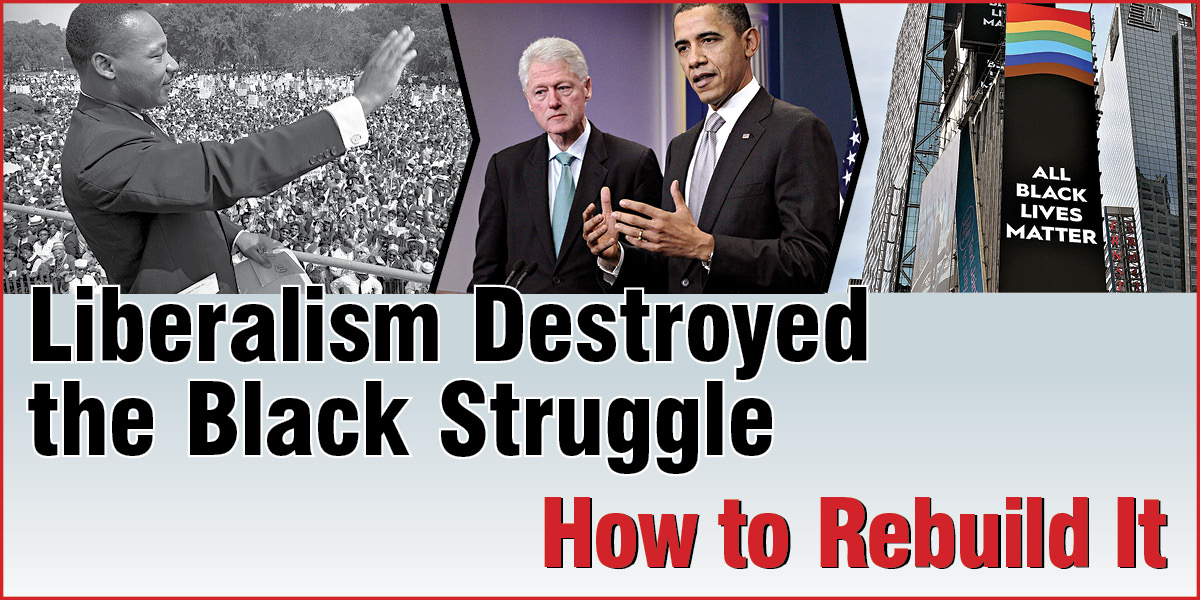
We must defend ourselves from the reactionary onslaught. But in order to fight back we must understand what got us to this point. This article will show how liberalism has betrayed the black struggle and that the best way to advance the fight for black liberation is to be a communist. From the civil rights movement to today liberalism has channeled black anger into “lesser evil” electoral politics, limiting the struggle to what is acceptable to the oppressors. The liberal bourgeoisie pretends to care about black people to the extent that it serves their interests, but they defend the capitalist system built on black oppression. The liberals deliver moral platitudes while devastating the working class, which only breeds reaction. It is a myth that the arc of history will slowly and gradually result in black freedom. Today, the ruling class is tearing up most of the token gains that were once acceptable to them but now no longer correspond to their needs.
There must be a definitive break with and fight against the forces that hold black people in bondage—the U.S. ruling class. Black liberation will require a struggle of the working class that cuts deep into the oppressor’s profits and power. The whole history of the black struggle shows that these liberal shackles must be broken in order to forge a new path forward in the fight for black liberation.
1. The Source of Black Oppression
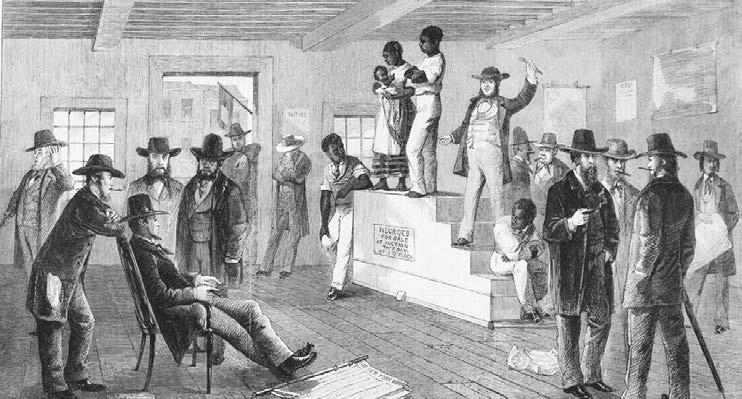
Illustration shows family for sale at slave auction in Virginia in 1861. Legacy of slavery forever disfigured American capitalist class rule.
You must understand the source of black oppression if you want to fight it. If you know the Sparts, you’ve heard us often say that “black oppression is the bedrock of American capitalism,” and that “the black question is the question of the American revolution.” To understand these statements, we must look at the historical development of black oppression in the United States—a country whose entire economic system was built on the bloody backs of the black population.
In order to better extract profits out of the American colonies, the colonizers introduced chattel slavery. This system was economically useful to cultivate the vast amount of land in the “new world,” particularly in the southern colonies. Africans were brought here in chains, ripped from their people and culture, and treated as property. Enslaving Africans specifically was useful to the masters. Many slaves did not speak a common language and their unfamiliarity with the new land made escape and rebellion difficult. Importantly, using African slaves allowed the ruling class to cultivate a racial divide in order to stop the oppressed masses from rebelling—it is still used to this day.
Slaves were identifiable by their skin color. In order to justify the barbaric system of slavery, black people were deemed inferior. Thus, the concept of race was born and with it the brutal system of white supremacy. Slavery had existed before, but it was the American system that introduced the justification of racial inferiority. This new paradigm, on which the slave trade was built, was profoundly profitable for both the colonial and European ruling classes for a very long time.
But conflicts started to emerge when a capitalist class started to develop. The needs of the budding industrial economy in the North were at odds with the agricultural slave economy of the South in terms of land, labor, economic policy, etc. The economic weight of the Southern slavocracy meant that the Northern capitalists were constantly thwarted and humiliated by the Southern plantation owners, who sought to protect their interests by expanding slavery to more states. The question at the heart of this irreconcilable class conflict, embodied in the Civil War, was: which system of production would rule?
The Civil War and Reconstruction were a turning point. The Civil War was a social revolution that smashed the slavocracy, abolished slavery, and ushered in the rule of Northern capital. To carry this out and secure their interests, the Northern capitalists made a temporary alliance with the slaves and abolitionists. This was the only time in American history that the interests of black people and the capitalist class remotely aligned.
What followed the Civil War was Reconstruction. To prevent a counterrevolution, the North sent troops, bolstered by armed black freedmen, to the South where they laid waste to the slavocracy and established black enfranchisement. This was a period where the new order was not yet consolidated and the system of racial oppression could have been truly ended.
But the capitalists, who had relied on former slaves to secure their victory, betrayed them. The measures taken during Radical Reconstruction were going to encroach upon their interests, and maintaining the system of racial oppression served them. Since they were already consolidating their national power, their alliance with the former slaves was no longer necessary. They pulled troops out of the South (to go crush a rail strike in the North), and thrust black people back into conditions similar to slavery.
This was the dawn of modern American capitalism—birthed from the betrayal of the black freedom struggle. It did not all happen because of bad ideas in white people’s heads. Rather, at each step—from slavery, to the Civil War, to the betrayal of Reconstruction—these events were driven by the needs of the ruling class at the time, be it the Southern planters or the Northern capitalists. This is the root of black oppression.
The entire foundation of American capitalism is based on the disenfranchisement, segregation, and the brutal oppression of the black masses. It is the key source of strength and stability for the ruling class, and is used to undermine conditions of the entire working class. By adopting and perfecting the system of racial oppression from the South they kept black people in miserable conditions (paid less, last hired and first fired, segregated in dilapidated ghettos, randomly murdered by police, etc.). This degrades conditions throughout all of society. The bosses can force non-black workers to accept less or be replaced. And by pitting races against each other, the bosses ensure that there will be no united fight against them.
To improve the situation for black people, there must be a struggle against the interests of the capitalist class, who are the only ones who benefit from black oppression. Bettering conditions of black people will bring improvements for all, which is why the working class as a whole has a vested interest in fighting for black liberation. Black militants must consciously form an alliance with the working class (yes, even white workers) in order to build up the necessary force to smash the system that is directly responsible for their oppression.
Black people, while segregated at the bottom of society, are now integrated into the working class. This is what gives them exceptional leverage to bring down this racist imperialist system. To be successful, this fight must be linked to the liberation of the working class as a whole. But this has not been the dominant strategy of the black liberation struggle.
2. The Civil Rights Movement
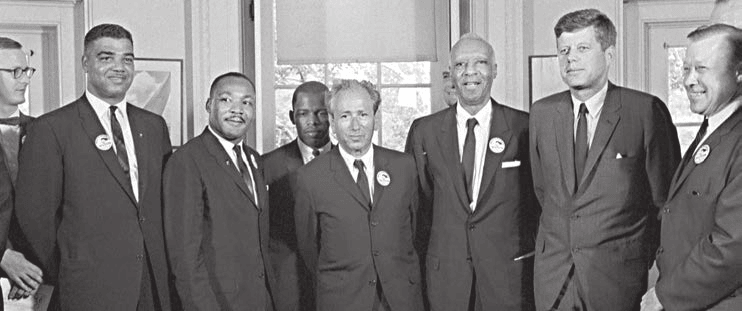
Civil rights leaders with President Kennedy following March on Washington. John Lewis (center, back) was forced to remove criticism of the president.
We have established that the source of black oppression is capitalist class rule. With this in mind, we must now examine the history of black struggle in this country in order to understand its successes, limitations and defeats. This is the only way to effectively reorient and rebuild the struggle for black liberation today.
The natural place to start is the civil rights movement, which had quite contradictory results. On one hand it is regarded as the pinnacle of the black struggle that ended brutal Jim Crow segregation. Its leaders are looked back on with pride. At the same time, the movement that was supposed to usher in black equality…undeniably did not. Many black people still live in segregated neighborhoods with the worst schools and housing. Many struggle to get jobs, while others struggle to survive, permanently marginalized and chronically unemployed. All live in fear of police violence.
So, how was the civil rights movement able to get rid of Jim Crow, but unable to liberate the masses of black people from such horrible conditions? Right-wing demagogues, like Charlie Kirk, chalk it up to something inherently wrong with the black family. Some black people say that it was wrong to fight for integration at all. Neither of these explanations actually addresses the real issue.
To understand this conundrum, we must situate the civil rights movement in the international context of the time, and analyze the main political trends of the movement.
After World War II, the United States emerged as the world’s superpower, rivaled only by the Soviet Union. At the time of the civil rights movement, the Cold War was in full swing. The U.S.’s main objectives were to stop the spread of communism and destroy the Soviet Union.
Because the U.S. was the “leader of the free world,” the racist Jim Crow system was a matter of international concern. How could American democracy be a beacon for those struggling against Soviet oppression if the U.S. brutally discriminated against minorities at home? At a time when several African countries were gaining independence and the U.S. was competing with the Soviet Union for influence over them, Jim Crow was a bad look.
As for the black community at home, intolerance for the system was beginning to reach a boiling point. Black soldiers had been sent to fight and die during the war in segregated units. Having fought for “democracy” and “against prejudice,” they came back to the brutality of Jim Crow and the reality of their second-class status. The hypocrisy was glaring and unbearable, and set the stage for the social explosion that occurred in the 1950s and ’60s.
Martin Luther King Jr.
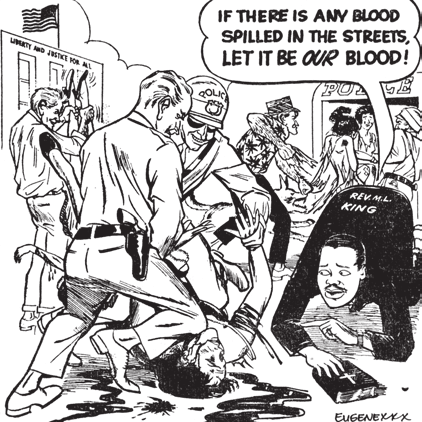
NOI cartoon captures MLK’s cringing pacifism that supported brutal repression of 1960s ghetto explosions.
The movement against racial segregation was led by the black middle class and the clergy. The most prominent leader was Martin Luther King Jr., who is regarded as a national hero. King rose to prominence after the Montgomery bus boycott, and his program of “pacifist direct action” became the dominant trend of the movement and a model for subsequent struggle.
The whole conception of King’s strategy was that racist whites and the U.S. rulers would see how horribly black people were treated and then go, “You know what? I actually feel bad for these people. Let’s stop their brutal oppression. We’ve finally seen the light.” King’s quote, “We will wear you down by our capacity to suffer,” encapsulates this.
The international situation was making Jim Crow and black oppression in general a thorn in the side of the imperialists. Jim Crow absolutely needed to be smashed. But there was an opportunity to build a movement that could advance not only the fight for democratic rights but also for real material improvements. This would have required a broader and more direct confrontation with the bourgeoisie’s interests. King had the power of a massive movement behind him but no interest in encroaching on the capitalist profit system. He kept the focus on passing civil rights bills by allying with sympathetic Democratic Party politicians. This limited the struggle against racial oppression to methods acceptable to the black petty bourgeoisie and the ruling class.
Take the March on Washington. Its purpose was to pressure the Kennedy administration to pass the 1964 Civil Rights Bill. Marxists are not opposed to putting pressure on politicians, but purpose is important. The March was not intended to expose the liberal politicians who stood as obstacles to black freedom. John Lewis of the Student Nonviolent Coordinating Committee (SNCC) was forced to remove criticisms of Kennedy or the government from his speech. The March tied the movement to the Democrats and sought to build support for politicians who had no intention of fighting for real integration. Kennedy aide Arthur Schlesinger was clear that the administration’s focus would be the right to vote because it “did not incite social and sexual anxieties” in the way that integration did.
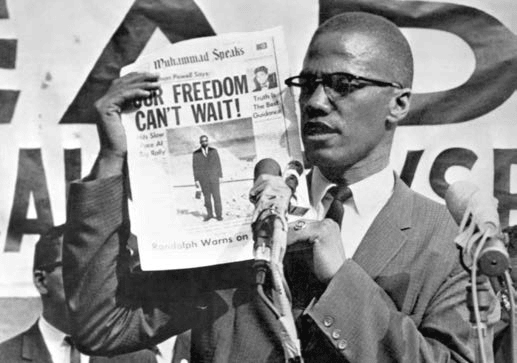
Malcolm X in New York one month before March on Washington. Malcolm saw MLK’s pacifism as obstacle in fight for black liberation; called March the “Farce on Washington.”
Malcolm X characterized the March best as the “Farce on Washington.” He saw the March, King, and the liberal civil rights movement as a valve for black people to release some steam while no substantive change occurred. Today, liberals try to present Malcolm X and King as two sides of the same coin, but this couldn’t be more false. Malcolm X hated King and correctly saw his liberal pacifism as an obstacle to the fight for black liberation.
The problem with the civil rights movement was not that it was trying to get rid of Jim Crow or that it was fighting for democratic rights and integration. The problem was its strategy. How was this fight to be waged? With a strategy that subordinated the struggle to the interests of the ruling class, or one that could push the struggle for black liberation to its conclusion? The fight for democratic rights needed to be fused with the fight to overthrow the entire racist capitalist system. Lacking this perspective, the movement remained partial, achieving mostly token gains and leaving the conditions of the ghettos untouched.
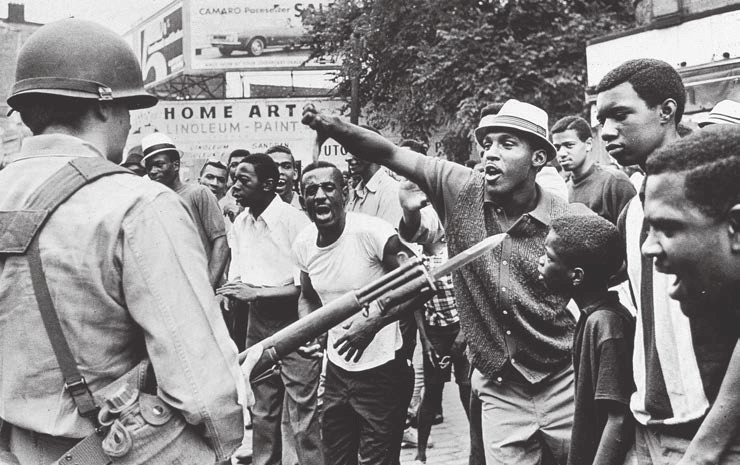
National Guard in Newark to repress 1967 ghetto upheaval. Poverty, unemployment and racist cop terror triggered ghetto upheavals in the North.
After the 1964 Civil Rights Act was passed, supposedly marking a watershed moment for black equality, there were ghetto uprisings all across the country in response to the reality of black life. Poverty, unemployment, and rampant police brutality all remained and showed the limitations of the movement’s liberal program. The problems facing the black masses required more than a Civil Rights Act to fix. This reality was especially clear outside the South, where black people had been living without Jim Crow, but still in terrible conditions.
Deep desire for a program that could actually solve the problems of the black community led to the formation of a left wing in the movement that could challenge King. Repulsed by King’s pacifist musings and his conciliation of the ruling class, activists in SNCC started looking for answers outside of the liberal boundaries they were forced to work in. When King and the rest of the liberal establishment condemned the ghetto uprisings and disgustingly called for the strongest police force possible to stop them, it was the last straw for SNCC and other youth.
Disgusted by the dominant liberalism of the civil rights movement, the most militant elements turned to black nationalism because it seemed to offer an alternative. It was the job of Marxists to intersect these elements and show them that a Marxist program was the only strategy for black freedom. Our forebears in the Revolutionary Tendency fought inside the Socialist Workers Party (SWP) to make this perspective a reality. But the SWP abstained from the struggle (expelling us in the process) and an opportunity that could have won hundreds of militant black youth to socialism was lost.
Black Power!
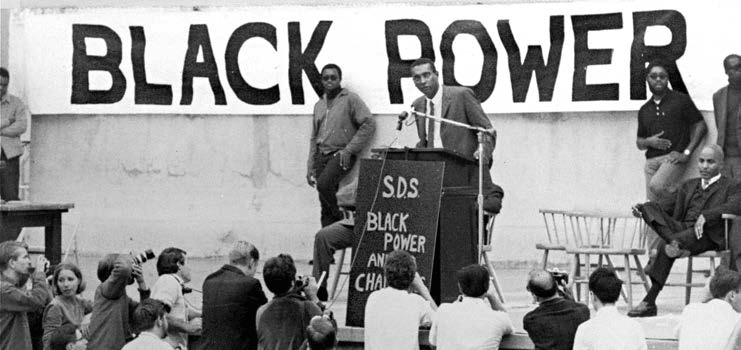
October 1966: Stokely Carmichael, who popularized call for Black Power, denounces the draft during Vietnam War at UC Berkeley mass rally.
Black Power militants wanted to address the needs of the black community without bending to the bourgeoisie. They saw that, despite the passage of numerous civil rights laws, conditions for the black community had not changed. Liberal integration methods had done nothing for them and the “dream” that King had was nothing more than a nightmare. There were several black nationalist groups that sprouted up in the aftermath of the civil rights movement, but the most notable has to be the Black Panther Party for Self Defense.
Huey Newton and Bobby Seale formed the Panthers in Oakland, California in 1966. They were inspired to form the group by the ghetto uprisings that swept the nation, largely in response to police violence. Newton recognized the need to fight against police brutality and came up with the idea of forming armed patrols to monitor the cops. They wanted to mobilize the black community to take matters into their own hands. The Panthers saw themselves as the vanguard of the ghettos and wanted to mobilize the unemployed black masses to take power. The downtrodden masses desperately needed a solution to their problems; the question is what force can provide it?
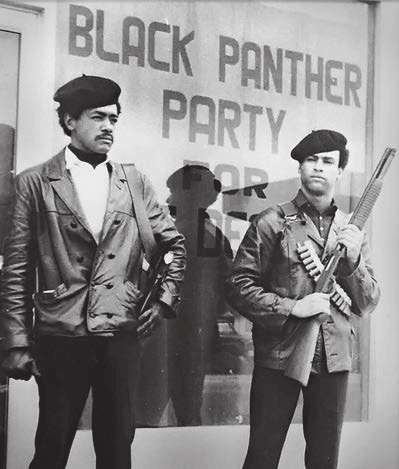
Bobby Seale and Huey Newton founded Black Panther Party in Oakland in 1966. Links to the working class could have countered state repression and murder of the black radical vanguard.
Marxists look to the working class because it has the social power and objective self-interest in overthrowing the oppressors. It’s not because of some weird fetish. The working class makes everything run and is exploited by the same masters responsible for black oppression. Workers’ leverage is their labor, and when they withhold it, all of society stops—it scares the crap out of the capitalists. To have this force on your side gives you an effective weapon to do battle against the capitalists. The Panthers were anti-imperialist and connected their fight to that of the Vietcong against U.S. imperialism, which is all good. But without winning over and mobilizing the class that has the power to actually defeat U.S. imperialism, you leave yourself isolated and at a dead end. Which is exactly what played out.
While the Panthers were militant and ready to sacrifice their lives for black liberation, their lack of working-class connection left them open to extreme state repression and murder. As one confidential 1968 memo to J. Edgar Hoover put it, “The negro youth and moderate[s] must be made to understand that if they succumb to revolutionary teaching, they will be dead revolutionaries.” The FBI was hysterical about a group of armed black militants who wanted to take down the system and they feared the rise of a “black messiah” that could unleash the anger brewing in the ghettos. The state assassinated at least 28 Panthers, including 17-year-old Bobby Hutton, and Fred Hampton, whom they shot as he slept next to his pregnant fiancée.
Mobilizing mass working-class support could have been a protection against the state’s murderous plots. It would have at least made it harder for the Panthers to be wiped out so quickly. Imagine if every time a Panther was killed, striking workers shut down cities across the country, or even picked up arms themselves. Sadly, this did not happen and the Panthers experienced a rapid decline under the weight of the government’s deadly COINTELPRO.
In addition to state repression other external factors contributed to the Panthers’ fall. They had become popular by tapping into the rage of the black community that was fed up with being stepped on. Their anti-imperialism and opposition to the Vietnam War resonated with youth and leftists. After the U.S. began to lose in Vietnam, the war effort was scaled back and antiwar sentiment dissipated. Affirmative action programs began to provide opportunities for some, and black electoral representation began to rise. Many began to ask, “Why look for revolutionary answers if the war is ending and black people have greater access to things like jobs and universities that had barred them for decades?” This left the Panthers even more isolated as their liberal allies dropped them in order to cozy up to the capitalist system.
When the liberals left, a wing of the Panthers, led by Huey Newton, chased them. They sanitized themselves and dropped all talk of armed defense or overthrowing the system. They stopped the armed patrols and focused all their activities on fundraising and solving problems through the courts. They no longer saw the immediate possibility of armed struggle against the state. What did seem possible was to run for office as a Democrat, which is exactly what Bobby Seale did when he ran for Oakland mayor. To support this, Newton called to close every Panther office outside of Oakland and told everyone to come to Oakland and support the campaign.
On the other side was the Eldridge Cleaver wing, which hated this sanitation and wanted to push armed struggle today. They knew the system was the enemy and it needed to be defeated. They hated the Newton wing’s cozying up with liberals. They resorted to guerrilla warfare and adventurist acts. Obviously, this did not lead to insurrection, but left them either dead or in jail. As for Cleaver, he fled the country and found God.
In the end, neither Newton’s liberal liquidationist wing nor Cleaver’s adventurist wing could advance the fight for black liberation. The struggle for black freedom had to be tied to the fight for the emancipation of the entire working class. Otherwise, the options were appealing to liberals or being gunned down by the state.
What About the Working Class?
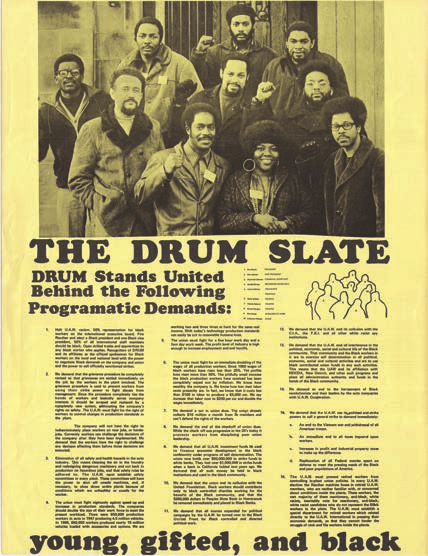
1968 slate of Dodge Revolutionary Union Movement (DRUM) and 16 demands on UAW leadership. DRUM and others formed the League of Revolutionary Black Workers. They attracted militant whites, but rejected their support. Only integrated struggle will bring black liberation.
During this period, the working class was quite passive on the question of black oppression. While UAW head Walter Reuther gave tepid support to the civil rights movement, he was despised by black workers because he condoned the racist conditions prevalent in the auto plants. He stood alongside King, but his own house was a racist hellhole.
The most militant working-class element in the fight for black liberation was the League of Revolutionary Black Workers. They originated in the Detroit auto plants in response to the white racist labor bureaucracy and the need to provide a working-class alternative to the Panthers’ organizing of the “brothers on the block.” They knew they had social power in the auto plants and wanted to wield it in defense of their black brothers and sisters on and off the job. However, they rejected the need to organize with white workers in the factories. This left them vulnerable to the bosses’ attacks. You can’t shut down a factory in defense of black rights when half the factory stays inside. While the League had a working-class orientation, their rejection of integrated struggle undermined their fight.
3. Liberal Integration Fails
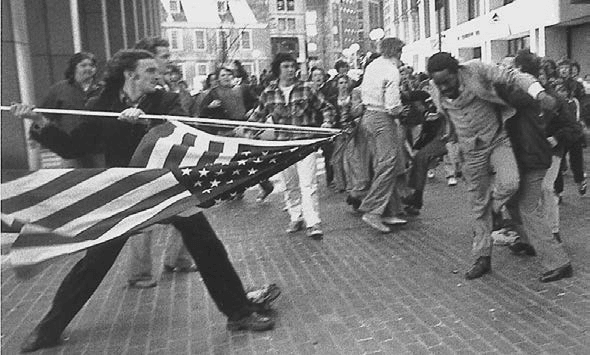
Boston, 1976: Racist anti-busing mob attacks black lawyer Ted Landsmark.
The black radicalism of the ’60s died with the defeat of the Panthers. The civil rights movement had established formal equality, and many of its liberal leaders integrated nicely into the Democratic Party. By the mid 1970s, it seemed at least superficially like integration might actually stand a chance. Overt racists, like George Wallace, no longer defiantly denounced desegregation. Jim Crow signs were gone and some black people got middle-class jobs through affirmative action programs. Black mayors and politicians were popping up all across the country and the ghetto riots had ceased. The illusion that black freedom could come through gradual reforms under capitalism seemed to hold some water.
But liberal integration schemes were destined to fail. There was no integrated class struggle that cut into the power and profits of the oppressors and could expand the available resources for workers and the oppressed. The masters simply squeezed a small part of the black population into a decaying hellscape. During the ’70s the U.S. economy was racked by the most severe economic recession in decades (i.e., stagflation). The bills for costly military adventures and the defeat in Vietnam were adding up and, as always, workers would have to pay. Faced with a shrinking pool of resources, liberal integration just meant different groups constantly being at each other’s throats in competition for them.
From the beginning, the ruling class stoked these anxieties and wielded the inflamed racial tension to their benefit. In 1968, Nixon’s “Southern Strategy” promised “law and order” to white voters angry about desegregation. In 1976, Jimmy Carter campaigned with George “Segregation Forever” Wallace in Alabama to denounce welfare. Republicans and Democrats alike scapegoated black people for the white economic plight, which contributed to the re-emergence and growth of the Klan. In 1979, the Klan (aided by federal agents) murdered five activists in an integrated, communist-led, anti-Klan protest in Greensboro, North Carolina.
Affirmative action allowed black people access to higher education for the first time and had to be defended. But as time passed, this became an institutionalized part of academia or the workplace. It is not a solution that gradually improves the conditions of black people but at best a Band-Aid and at worst it sets up black people for racist backlash.
Busing was set up to fail, too. The idea was that black kids would be bused to white schools and vice versa. Voila! Desegregation! But black children weren’t bused to affluent white schools in wealthy areas, but to working-class and poor schools with minimal resources. They were thrust into hostile environments primed by the dog whistle politics of the ruling class. As for white students, a number of them were shipped to crumbling ghetto schools. Obviously, this outraged parents.
Segregation is the material basis of black oppression and has been cemented in the foundation of American capitalist society since the beginning. Separate is never equal and the physical separation of black and white only breeds racial tension. It obstructs social cohesion and class unity and makes it easier for the cops to terrorize the ghettos. White workers and the black masses must fight for integration because segregation strengthens their common enemy. But this doesn’t mean fighting to share the crumbs from the masters.
Revolutionary integration means linking the black struggle to the working-class struggle against capitalism. The capitalists want black and white workers to think that the only way to get more is by taking from each other. The truth is, the only way to get more for anyone is to take from the capitalists. Fighting for more and better integrated schools, housing, etc. at the masters’ expense is the way forward. Anything else will only breed reaction.
4. Reagan Reaction
The “stagflation” crisis of the ’70s eased in the early ’80s, and the ruling class needed to reorient and improve its economic, military and political position. This began the neoliberal era of privatization and economic liberalization. U.S. imperialism had regrouped from the defensive posture of the ’70s and had to go on the offensive. In 1980, Carter launched an anti-Soviet crusade in the name of “human rights,” paving the way for an all-out reactionary offensive against the USSR: Cold War II. To shore itself up and to pay for this campaign, the ruling class had to slash social spending—the New Deal order had to be dismantled.
In the 1930s, FDR’s New Deal was used to stabilize the U.S. economy after being rocked by the biggest economic crisis in history, the Great Depression. It stood on three core pillars. 1) State regulated capitalism was meant to help calm the unstable market. 2) A class compromise: the capitalists granted heavy concessions to labor at the bosses’ expense in order to stop the growing class battles and undermine the influence of communism. 3) The welfare state came into being. The purpose of the New Deal was to calm a tumultuous situation for the ruling class. This direct state intervention was their means to fortify themselves against the backdrop of growing tensions in Europe. This restabilizing was necessary to win the coming world war and set up a stable base for their empire. The ideology that was pushed with it was that the capitalist government supposedly worked to benefit the people and had a duty to take care of its citizens.
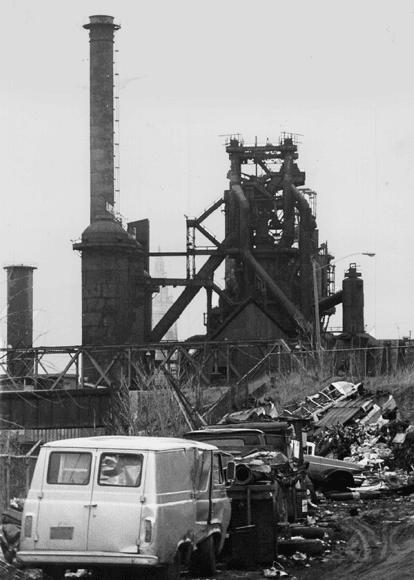
U.S. Steel central furnaces in Cleveland abandoned in 1980. Deindustrialization under neoliberal order destroyed millions of jobs.
But the New Deal order was established when the U.S. was a rising superpower and could afford to make such concessions. In subsequent decades, as the U.S. began to decline, racked by crisis after crisis, it was no longer in the interests of the ruling class to maintain such expenditures. Ronald Reagan promised to tear it up. This meant crushing labor, slashing welfare and tearing up the U.S. industrial base by offshoring jobs to maximize profits for the capitalists. Accompanying this was an ideological shift toward “personal responsibility” and “pull yourself up by your bootstraps.”
Reagan was a total reactionary who waged a frontal attack on black people and labor. But he smoked Carter in the election. So what was his appeal? Reagan was able to win a large section of the white working class who were suffering from economic misery, and locked in competition with black people for jobs and resources. They hated affirmative action and busing and saw the token gains that black people had made as an attack on their livelihoods.
Black people knew that Reagan was a direct threat to them. The central political characteristics of the 1980s were a conservative reaction to the civil rights movement and the scapegoating of black people for the economic squeeze the ruling class was putting on workers. Gutting industrial jobs spiked unemployment, especially in the black community. Many turned to crime and drugs that the government helped flood into the ghettos. Reagan made it his mission to get the black “underclass” out of society and mass incarceration became a permanent fixture of American society.
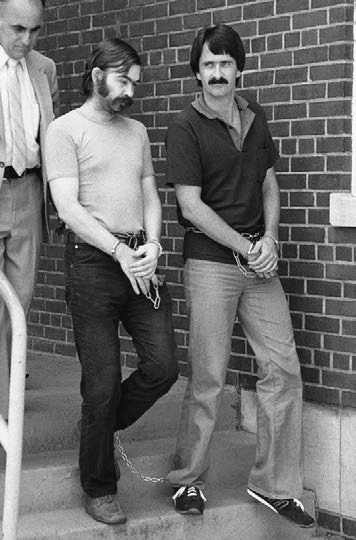
PATCO air traffic control union leaders hauled off in chains during 1981 strike.
As for labor, it was still reeling from the recession when the bosses shuttered factories and destroyed millions of jobs. Having caught wind that the Soviets were in crisis, the bosses felt less need to pacify the workers with the compromises of the New Deal order, and a sharp turn was made against the unions. To compete with Japan and Germany the bosses slashed wages and benefits. When PATCO, the air traffic controllers union, went on strike demanding better wages, conditions and a shorter workweek, Reagan called the strike illegal and fired more than 11,000 workers. The union bureaucrats refused to fight back by shutting down the airports and the PATCO strike was crushed—a blow that the labor movement has not recovered from to this day.
Workers and the black masses needed to unite and fight back against their common class enemy. But the treacherous union misleaders didn’t fight to integrate black people into the unions and left them trapped in the worst jobs. Black activists fought against this. But they mostly did so by attacking seniority and suing the unions in the capitalist courts that exist to defend the “right” of the bosses to oppress black people and smash the unions.
The economic attacks and inflamed racial divisions in this period fueled the growth of the Nazis and the Klan. This scum always festers in the cracks of capitalist society. When fascists attempted to rear their heads, the Spartacist League joined with the vanguard of black and trade-union militants to stop them. The mobilizations showed on a small scale the type of integrated struggle that was necessary. This required a fight against liberal politicians and the union misleaders who opposed militant independent working-class action against the jackbooted thugs. In 1980, when the Nazis tried to publicly celebrate Hitler’s birthday in San Francisco, 1,200 came out to stop them. In 1982, when the Klan announced a march against “illegal” immigrants in D.C., 5,000 union members, black youth and anti-racist militants swept them off the streets. Earlier in ’82, when the Nazis planned a provocation against the Gay Pride Day march in Chicago, an SL-initiated labor/black mobilization thwarted them.
5. From Reaction to “Inclusion”
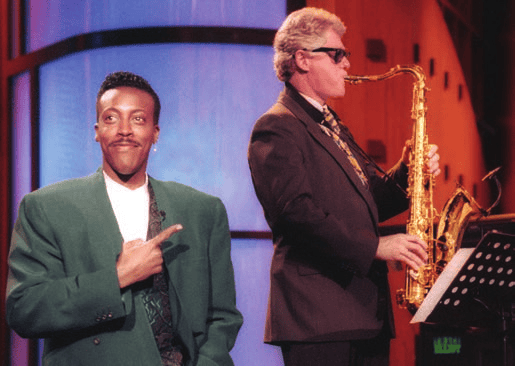
Bill Clinton playing saxophone on Arsenio Hall Show five months before being elected president. Clinton presided over mass incarceration; ended welfare as we know it and signed the crime bill all while being the “first black president.”
The ’90s solidified the death of the New Deal order and the triumph of neoliberalism. Counterrevolution in the Soviet Union gave the imperialists a new lease on life and a temporary reprieve from their cycle of crises. Now able to expand into previously untapped territory, globalization allowed the imperialists to spread their tentacles all across the globe.
Communism was said to be dead and liberal triumphalism reigned. To justify its global domination, the U.S. ruling class proclaimed that the liberal capitalist model was the pinnacle of human history. Supposedly, under the guidance of the U.S. empire, it would spread around the world and bring untold progress. This meant that the imperialists would assert their interests under the watchwords of “freedom and democracy” and “defense of the defenseless.” They plundered the world and destabilized whole regions while claiming to help poor people under the guise of “progressive values.”
The strengthening position of U.S. imperialism meant that the free flow of capital and cheap labor across borders corresponded to the ruling class’s interests, and the Immigration Act of 1990 facilitated this by dramatically expanding immigration. The rulers began to talk about “diversity” and “multiculturalism” to peddle their plans, which would have devastating consequences for the working class and even further inflame racial divisions. Amid massive deindustrialization, the rulers used the huge influx of cheap immigrant labor to drive down union density, wages and working conditions. In the South, black workers were pitted against newly arrived Hispanics, particularly in meatpacking, reinforcing divisions that stand as obstacles to unionization. Because the labor leadership was unwilling to direct a struggle against the class responsible for the immiseration of domestic and foreign-born workers, workers’ anger could find only a reactionary expression. In the construction trades, for example, it was not uncommon for the carpenters union to call immigration authorities on non-union job sites.
In the ’70s and ’80s, when the Soviet Union stood as a counterweight to imperialism, the U.S. ruling class had less room to maneuver. Talk of “diversity” and “equality” would quickly run up against the reality of racist oppression in this country and risk sparking a radical movement that might sympathize with the communist opponents of the U.S. Economically in that period, the capitalists could not afford the luxury of pacifying layers of the oppressed with some crumbs. They had to crack down and enforce a strong and rigid sense of national identity by stoking white racist reaction. After they triumphantly proclaimed the “death of communism,” they could be more flexible about how they pursued their interest, and what they could allow at home.
Under Clinton, the oppressors’ patriotism carried a message of racial reconciliation. They celebrated the diversity of the “melting pot” as the essence of Americanism. Clinton’s “multiculturalism” was tailored to advance the neoliberal agenda of a “world without borders” where the export of U.S. finance capital would be unencumbered. In his 2000 State of the Union Address, he saluted California for leading the nation in multiculturalism,
“Within ten years there will be no majority race in our largest state, California. In a little more than 50 years, there will be no majority race in America. In a more interconnected world, this diversity can be our greatest strength. Just look around this chamber. We have members from virtually every racial, ethnic, and religious background. And America is stronger for it.”
Clinton gushed that American diversity was a “Godsend” and “a huge gift in a global economy and a global society.” This dramatic shift in tone from the U.S. rulers is less surprising when one considers that San Francisco and New York City, two of the most diverse and liberal cities in the country, just happen to be major centers of finance capital and are central to the neoliberal order.
Clinton launched the One America Initiative, which set up talk shops so people could “dialogue” about “racial differences.” And he defended affirmative action in speeches. Of course, none of this lofty rhetoric improved material conditions for black people. Its purpose was to unify the nation around the new world order. It also gave birth to modern identity politics, which was compatible with and nourished by the ideology of the liberal world order.
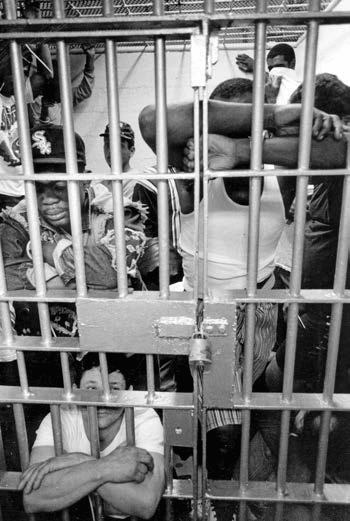
“War on drugs” and mass incarceration meant war on black people.
Clinton certainly made a show of celebrating diversity but he didn’t give black people much to celebrate. Instead, he ramped up mass incarceration and slashed welfare. The ruling class wanted to clean up the big cities to make them more attractive as global financial centers, so they swept black people off the streets en masse over the most minor offenses. But compared to the ’80s there was much less pushback against skyrocketing arrests because crime was down, employment was up, and Clinton didn’t come off like Reagan, the repulsive racist.
Despite being targeted by Clinton’s policies, lots of black people supported him. Some neighborhoods were getting slightly better and there was job growth—even though a majority were not high-paying union jobs but low-paid gig work. The new liberal lip service of the ruling class even allowed Clinton to pass off his “superpredators” crime bill and the “end of welfare” as helping the black community not disparaging it.
The imperialists’ new liberal veneer was quite effective at neutralizing and pacifying their victims and opponents. It allowed them to claim global moral authority while locking up black people and pillaging the world. Regarding the fight for black liberation, liberalism replaced struggle with symbolism, power with “representation,” and freedom with “inclusion.”
Liberalized Labor
For the most part, labor fell in line in the ’90s. When John Sweeney took the helm of the AFL-CIO in ’95, after having promised to bring more “diversity” to the labor movement, some black labor leaders thought he might be the one to make the unions respond to black needs. However, this only marked labor’s adaptation to the liberalism pushed by Clinton. Some more black people were included into union leadership under Sweeney, but union density continued to drop.
The NAFTA and WTO trade deals caused a big stir during the ’90s. Clinton pitched his trade policy as a “force for social progress.” NAFTA would supposedly “promote more growth, more equality, better preservation of the environment, and a greater possibility of world peace.” But of course, the gloomy prophecies about a “giant sucking sound” taking jobs out of the country were more accurate.
At the end of the day, while labor leaders made some noise against the deals, they did not actually wage a struggle against the bosses to save jobs. The previous AFL-CIO president and veteran Cold Warrior, Lane Kirkland, opposed the deals on a chauvinist basis. But Sweeney’s objections to the WTO took a different angle. While he worked closely with Clinton and actually endorsed the WTO, he found himself at the large Seattle anti-globalization demonstration denouncing China’s admission on an anti-communist basis. His complaint was essentially that Clinton’s commitment to neoliberal “human rights” imperialism wasn’t sufficient.
The left tended to denounce objections to offshoring as protectionist and nativist, echoing the liberal condemnations of workers’ genuine concerns for their jobs. There needed to be an anti-imperialist fight against the bosses who were hellbent on hollowing out industry in pursuit of profits. Many black workers’ lives would be ruined. But the forces that could stand against the bosses were disoriented by the new liberal world order.
Farrakhan Despair
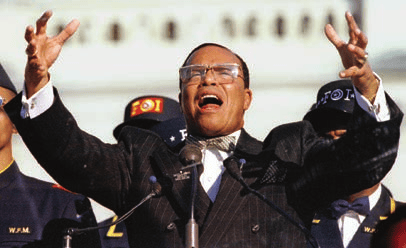
16 October 1995: Louis Farrakhan, leader of NOI at Million Man March. His message of black pride countered despair, but “atonement” does not challenge capitalist system.
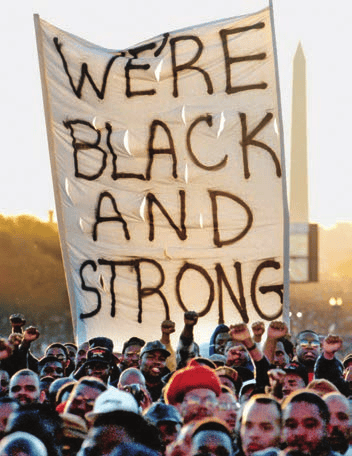
The biggest black movement in the ’90s was the Nation of Islam’s (NOI) Million Man March. NOI leader Louis Farrakhan repelled many mainstream liberals with his religious conservatism. But he attracted many black people who were desperate to do something for the black community.
In the late ’90s, some upper layers of the black community saw an increase in jobs, but the situation in the ghettos was still desperate. In 1992, L.A. exploded after the acquittal of the cops who beat Rodney King. The rage was not just about the sadistic police violence that plagued the ghettos, but also the miserable conditions and few job prospects from deindustrialization. The righteous anger of the black masses was justified. But the upheaval showed that there was a vacuum of leadership to direct it effectively against the oppressors.
Farrakhan filled that vacuum. His preaching of black pride was electric to people who had nothing. But the slogans of his march were about black men “taking responsibility” and “atonement.” A far cry from the optimistic radicalism of the ’60s—the mood had dramatically shifted to hopelessness and despair. You still see ideas like this in the black community all the time: “Racism will never end,” or “Others can do it, but we can’t. Must be something wrong with us” or “It’s on us to work harder and be better to build the black community.”
Farrakhan’s ideas are still articulated today, even outside the NOI. They are and were compatible with Clinton’s downplaying racial oppression as a systemic issue and his preaching of personal responsibility as the main obstacle. They reflect a false consciousness that now that there is formal equality, all you had to do was “pull yourself up by your bootstraps” and everything should work out for you.
6. Post Racial Society?
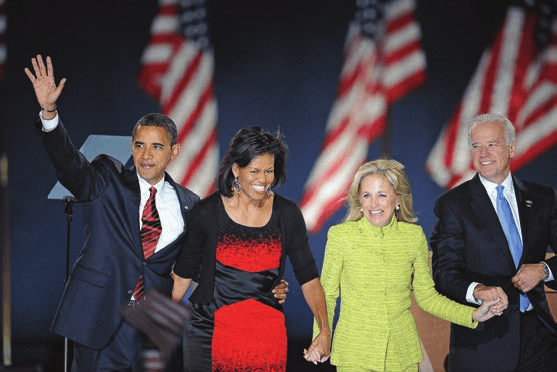
Obama and Biden celebrate 2008 election victory (above). Milwaukee, 2010: Evicted woman with belongings. Liberal imperialist order was hell for workers and black people (below).

For almost two decades, the liberal world order seemed almost indestructible. But the shot of adrenaline that U.S. imperialism got from globalization did not cure its disease. In fact, the very system that put them on top was now undermining their position. For a while, the rulers enriched themselves by propelling world trade with extraordinary foreign investment. They raked in obscene cash but in the process built up the economies of their enemies, allies and victims abroad. They dismantled domestic manufacturing, decimating good jobs, and let infrastructure rot.
In 2008, the financial crisis rocked the world hard and workers and black people got screwed. Tons of people lost jobs and homes. The rulers bailed out the banks and left regular people to try and survive on low-paid gig work. They started printing money like nothing mattered, setting the conditions for an even bigger collapse later.
Then, the impossible: Barack Obama, enter stage left. In racist America, a black man in the White House was just a joke or a dream to many. Just the sight was enough to spark hope that small change might bring a post-racial society. He was liberalism in the flesh and many believed that perhaps this presidency was different. Perhaps Clinton’s vision of diversity was finally being realized. Smoke and mirrors.
As it turns out, the election was not the end of racism or oppression, but a cheap trick by the ruling class. In the face of economic crisis, the imperialists had to do something. Leaning into liberalism had worked so well for years. So they took a giant leap down that same road. U.S. imperialism desperately needed a facelift after Bush’s war in Iraq had deeply damaged America’s moral reputation. A black man overseeing the carnage was the perfect ploy to lull the masses.
But as Obama played out his term—eulogizing a Klansman, launching drone strikes and war, overseeing rising poverty and an assault on education—his reign proved more of the same. He deported millions of immigrants. He propped up banks and auto bosses on the workers’ dime. He carried out anti-worker attacks for the racist ruling class, aided dutifully by the liberal labor misleadership, of course. All the while, excuses were made and passes were given in no small part because liberal identity politics demanded that criticism of a black president be more muted.
Meanwhile, MAGA was brewing. A liberal, black enforcer of capitalist austerity grinding workers to dust was sure to breed white reaction. And discontent was not limited to the laboring masses. Inside the masters’ ruling parties, differences emerged over which way forward for their empire. Straight ahead down the old liberal road, despite the crumbling surface beneath them? Or take down the order they’d erected?
7. Here Comes Trump
This is what set the stage for the election of Donald Trump (the first time). Many white workers, fed up with their worsening economic situation, went for Trump in 2016. Plenty of others, especially black people, stood by the Democrats out of fear of reaction. Trump’s election sent the liberals into hysterics. His brazenness was incompatible with liberal sensibilities and, even worse, he threatened the very world order that had done them so well for the last 30 years. They quickly got together the #resistance and amped up the moral righteousness to 1000. Armed with pussy hats and a dream, they quickly defined the battle lines as either you’re with the Dems or you’re a Trump-loving fascist. They painted “Trump’s base” as solely deplorable white supremacists and spit on anyone who was concerned about his worsening economic conditions.
However, some fascists were emboldened after the election of Trump, e.g., the fascists in Charlottesville. And Trump’s rhetoric invoked fear because he was going to attack minorities. The left needed to fight for better conditions and link that struggle to the necessity of defending minorities. In order to succeed it needed a class-independent character. This required the left to participate in the various “resistance” movements to expose the bankruptcy of liberalism and point the way forward for workers and the oppressed. They had to make clear that any real improvements could be won only through confrontation with the interests of the ruling class, including its liberal wing.
The left needed to break the liberal grip on the anti-Trump resistance and split it along class lines. But this didn’t happen. The left echoed the liberal hysteria and joined the crusade against “Trump’s base.” White workers who voted for Trump were branded irredeemable racists, their real and worsening conditions dismissed. This was political poison. It deepened racial divisions. White workers moved toward reaction. Black workers went to the Democratic Party, convinced that winning white workers to black liberation was impossible.
8. The George Floyd Protests
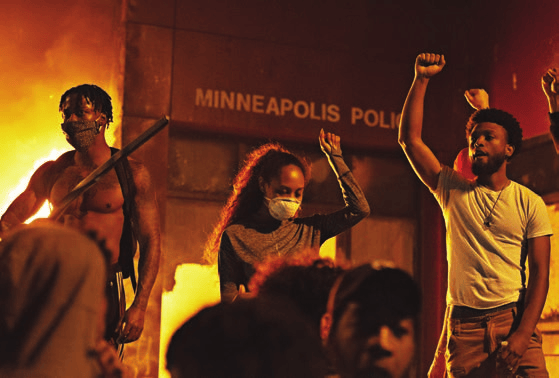
Above: Protesters in front of burning police precinct, Minneapolis, 28 May 2020. Below: Los Angeles protest at City Hall, 6 June 2020. May 2020 cop killing of George Floyd sparked massive protest wave across country. Marxists needed to fight to split militants from openly pro-capitalist wing of the movement.
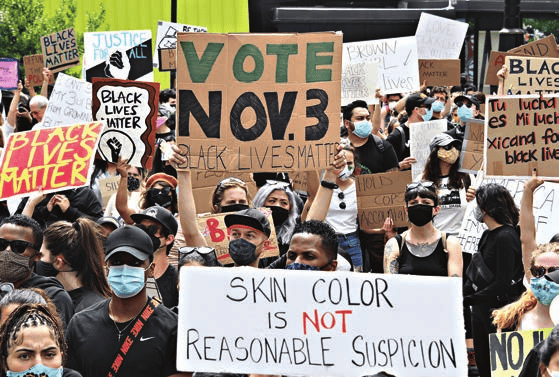
The largest movement for black rights since the civil rights movement was BLM. While BLM started in 2013 after the murder of Trayvon Martin, it blew up in 2020 after the murder of George Floyd. It was an eruption against the rampant police brutality that plagues black life in this country. Protesters in the millions took to the streets demanding justice and “defund the police.” BLM was a defining moment that gained international attention and politicized a generation of youth. So why is it that in 2026 police brutality still runs rampant and BLM is nowhere to be found? There are many different explanations that come up. The main one is that the leaders of BLM, Inc. were sellouts who screwed the movement over by stealing money and going off to buy fancy new houses. While this may have happened, this doesn’t explain why a movement that was so huge wasn’t able to win any of its demands.
The real problem here, as this whole article has tried to stress, is political. In order to stop police brutality or to effectively advance the fight for black equality you must aim to go up against the interests of the capitalist class. But BLM was a liberal movement for cop reform that proved to be compatible with the liberals’ resistance. Those who supported BLM ranged from black activists to politicians to unions to Jeff Bezos. An alliance with capitalist forces necessarily means that aspirations of the oppressed masses will have to be subordinated to the interests of the ruling class. Marches, speeches and symbolic action (blacking out your Instagram profile pics) might be acceptable to one’s ruling-class “allies,” but anything that can actually cause any harm to the existing system will of course repel them.
The movement was politically dominated by calls for cop reform, but concretely what does this mean? It means calling for more black people in impotent civilian review boards, trying to tweak city budgets, trying to get ineffective body-cam and choke-hold laws passed in Congress and trying to elect a new police commissioner (probably a black one). All this does is get black people involved in managing the very system that is repressing them. History shows these measures are completely ineffective at stopping police terror. But they lend an air of legitimacy to the violent machinery of black oppression, which only pacifies the masses with the illusion of control (see “How to Get Real Community Control”).
The main slogan of BLM became “defund the police.” The idea usually meant that city budgets should reallocate funds from the cops to pay for things like housing and social services, which would eliminate the root causes of crime. It’s true that the misery of life under capitalism breeds crime. But the capitalists’ budgetary priorities are not a mere accident or moral failing. As we’ve established, black oppression—which cop terror is a key part of—serves the fundamental interests of the ruling class. The rulers have no interest in the massive investment it will take to fix the ghetto. Nor do they have any interest in weakening the armed thugs they use to break strikes, disperse protests and otherwise violently enforce their rule.
Despite these facts, enormous effort was put into pressuring Democrats to “defund.” How did that turn out? Bigwigs like Biden simply opposed the call, while trying to spin opposition with a bit of sympathy. By the time of his 2022 State of the Union Address, he called to “fund the police.” Bernie Sanders openly opposed the call too, and insisted that cops be “well-paid.” The “Squad” (AOC, Ilhan Omar, Rashida Tlaib, etc.) were some of the few who embraced the slogan. But all this really amounted to was support to the George Floyd Justice in Policing Act, which proposed granting federal aid to police departments conditional on meeting standards of “decency and honorableness,” as Biden put it. The bill died in 2021.
Karen Bass, then Congressional Black Caucus chair and author of the “George Floyd Act,” condemned the “defund” slogan as “one of the worst slogans ever,” while allowing that she thought police budgets could be reduced. After becoming mayor of L.A., she proceeded to increase the LAPD budget. BLM-LA continues to court her on the issue and when they asked her in 2025 how “the people” could get her to scale back the cops’ budget, she answered frankly, saying, “It’s not going to happen.”
Thirteen days after Floyd was murdered, the Minneapolis City Council voted to dismantle the police. Nothing of the sort happened, and within a few months the plan was dropped, with Council members explaining that they were confused and didn’t really mean it. Other cities like New York, L.A., Baltimore, Austin and others voted to reduce police budgets. Overwhelmingly, the cuts were made by shifting some costs, like forensics and support, to other parts of the city budget with no discernible impact on the number of pigs in the street. In almost all cases, whatever pitiful budget tinkering was done got quickly reversed. NYC’s “socialist” mayor Mamdani quickly reversed his position too. He went from calling to defund the police to licking Zionist police commissioner Tisch’s boots the second he got into office.
But what could have been done? BLM didn’t just have craven, pro-Democratic Party politicians in its ranks. It had a number of young activists who were anarchists, socialists, or some type of leftists who hated capitalism, the cops and the Democrats. They burned down a police station, which was pretty militant. What was necessary for the movement to succeed was a political split with the openly pro-capitalist wing of the movement. This would have opened the road to winning radicals to a revolutionary program that could actually advance the struggle against police brutality.
What was necessary was more than telling people that reforming the state was impossible. One had to fight to change the movement’s course by showing how the liberal politics that dominated it were an obstacle to black liberation. But this didn’t happen. Pretty much all of the Marxist left participated in BLM, but most cheered on the movement while offering some leftist critiques, building a left flank of BLM instead of trying to split it on class lines.
Leftists often cite the 2020 ILWU Local 10 Juneteenth shutdown as a model for mobilizing labor in defense of black people. But this demonstration was completely in line with the liberal politics that chained BLM. While the speakers tried to put on an independent face for leftist consumption, the reality is that the ILWU International had endorsed Biden the month prior. This was no independent class mobilization, but a moral commemoration featuring Democrats, their celebrity boosters and the bosses. Leftists who hail this hide the fact that unchaining labor’s power in defense of black people will require a fight against labor’s misleaders, who shackle workers to the Democrats.
At the demonstration, ILWU president Willie Adams called on “good cops” to “start checking those bad cops.” But a cop is a cop, and their role in society is to enforce the racist rule of the capitalists. The only force with the power to fight the rulers is the working class organized in its own independent class interest. It’s good that many workers wanted to do something. But to advance the fight for black liberation, labor action must be directed against the ruling class and seek to break illusions in all its parties.
9. The Biden Blip
BLM’s liberal program meant that “success” could only be expressed in ways compatible with the capitalist system of oppression. As such, its energy was channeled into the Democratic Party. Its highest “achievement” was helping propel Biden into office. Biden didn’t even have to embrace the demand “defund the police.” Despite having eulogized staunch segregationist Senator Strom Thurmond, Biden seemed pretty tame compared to Trump’s racist rants.
Four erratic years under Trump and the catastrophe of the Covid pandemic made Biden a welcome return to “normalcy” for many, including elements of the ruling class. The pandemic had accelerated the further breakdown of the liberal world order and exposed its utter inability to meet the basic needs of working people. Biden selected a black woman as his VP, did his senile impression of a statesman and the heat was turned down.
But Biden’s presidency could not reverse the trends at work, or translate into real change for black people. He fueled inflation by printing money to recover from Covid and fund the unpopular imperialist adventures from Ukraine to Gaza. The end of draconian Covid restrictions lowered black unemployment some, but cops continued killing black people unabated. The administration pretended to care about black people and launched DEI programs, but they did little more than fuel racial divisions. Little progress had been made, but with the overt racist out of office, the black struggle was sapped of energy.
At the same time, as the pandemic faded many workers felt it was time to cash in on what they thought was owed to them. They had given the bosses major concessions and risked their lives to keep capitalism running through the crisis. In 2022, Biden and Congress spiked a rail strike before it began. Then in 2023 a wave of labor unrest culminated in the “hot labor summer.” UPS Teamsters and then the ILWU threatened strike action, but both leaderships took a bribe from the White House before workers even went out. Then, in September the UAW head Shawn Fain called a strike in auto.
All three of these workforces wield enormous social power and are heavily black. A hard fight by any of them had the potential to turn things around in the country. But to do that their leadership had to be willing to cause a real crisis for the bosses and the Biden administration. The auto bosses were struggling to compete internationally and the fragility of the supply chain was on full display during Covid. The bosses were not going to concede easily and economic struggle alone could not galvanize the force necessary to land a real blow and win significant improvements.
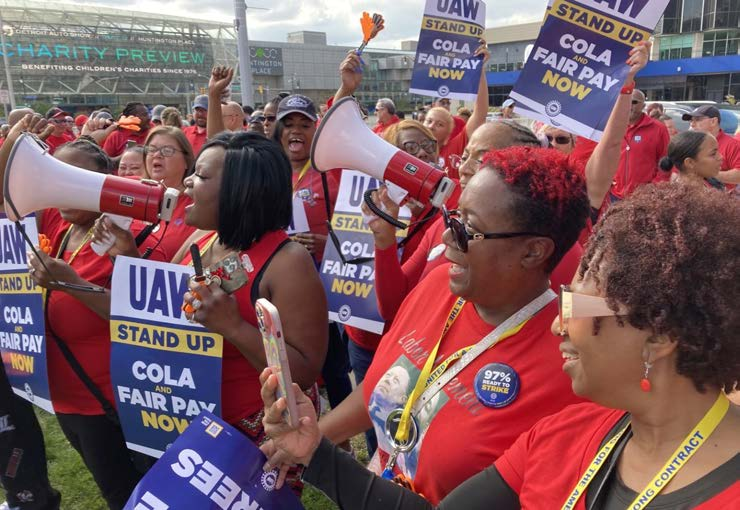
Detroit, 15 September 2023: Contingent from Louisville Ford plant at UAW strike rally. Spartacists fought for black liberation to be at center of battle.
The UAW strike was centered in Detroit, the most segregated city in America. Deindustrialization had made life a living hell in the Midwest, especially for black workers. Having no further use for workers in the region, the bosses had poisoned Flint’s water and destroyed black Detroit. Linking the auto workers’ struggle to the fight for black liberation could have drawn workers and the oppressed across the region into the battle. A general strike in Detroit to abolish tiers, reindustrialize the country and fight for black liberation was a real possibility.
But this is not the perspective of liberal labor leaders like Shawn Fain. While capable of militant rhetoric, Fain only sought to rebalance the scales between capital and labor and was unwilling to take measures that might jeopardize his connections to the Democratic Party. His “Stand Up” strategy minimized impact on the bosses, he refused to stop scabs, and he avoided racial topics during the strike for fear of being divisive. But racial segregation is at the heart of auto workers’ problems. It defines the miserable conditions in Detroit and it is the main obstacle preventing organizing in the “open shop” South.
In the end, despite having the upper hand going into the 46-day strike, the settlement secured some temporary relief for workers but fell far short of their demands. There was an opportunity to not only win what auto workers needed, but to cohere a fighting alliance between all the workers and oppressed in the region. This would have been a beacon for all labor and had the potential to change the course this country is on.
At the time, and to this day, many leftists revere Fain for his militancy. But the fact of the matter is that he sacrificed the initiative because of his liberal, pro-capitalist program. This is just one example of the syphilitic chain that destroys both the workers movement and black struggle. Militant-talking labor misleaders subordinate the workers to the bosses’ parties, and the left refuses to fight against them. The duty of revolutionaries is to expose these bootlickers and replace them with a leadership that will put the fight for black liberation at the center of all labor’s battles.
But no such struggle was waged and the upper hand that labor had was lost. The capitalists were able to regroup and go on the offensive.
10. Trump: The Return
Trump defeated Kamala Harris (after the Dems forcibly retired Biden to even have a shot). Trump’s return to the White House marked the end of the neoliberal world order. His first election was seen as a fluke and the liberals went at him hard, but Biden’s four years proved to be a catastrophe for working people and accelerated the bleeding out of U.S. hegemony.
The more the Democrats doubled down on liberalism as it was reaching its material and ideological limits, the stronger the forces hostile to it became. The ruling class is now consolidating around a radical shift in strategy to advance its interests. The conditions that made liberalism its dominant ideology are gone and not coming back any time soon. The liberal mask has slipped off and Trump does what he wants when he wants—no moral justification needed.
Liberals have fed right-wing reaction by, among other things, driving a wedge between the working class and oppressed groups. They preach tolerance while pitting different sectors of the oppressed against one another in a scramble over an ever-shrinking pool of resources. This only breeds resentment and division, and has caused the working class to shift to the right.
So, What Now?
Decades of liberal betrayals have led to this. Trump is back, revitalized and on a rampage even worse than before. Everything is dystopian and for now the black struggle has been defeated. The liberal “allies” of black struggle have turned their backs. The liberal world order of yesterday is being dismantled. Many workers have come to see the struggles of the oppressed as against their interests. And the left has become irrelevant to the working class, who see them as either liberal, crazy, or both. The same is true for the black masses, who also see the left as irrelevant, and uncomfortably white. Today, many black militants believe that the left’s focus on class comes at the expense of race, and that communism has nothing to offer black people.
The new period that we are in screams out for a new strategy. Black militants must understand that the historic problem with the black struggle has been the question of leadership. For decades the movement’s liberal leadership has only derailed, disoriented, and destroyed the black struggle—chaining them to the ruling class, which will never get rid of black oppression without a fight. Today, token gains that were won are being swept away. And every liberal politician and labor leader that claimed to give a damn about black people now has every excuse in the book when told to turn their nice words into action.
To go forward there must be a decisive break with liberal politics. Communist politics must be embraced. Black militants must consciously form an alliance with the working class, and fight to overcome the divide that exists. This is the only way to mobilize the force that has the power to end black oppression. And it is the way to defend both workers and the black community from the reactionary onslaught today. This does not mean trying to revive “wokeness,” but building a fighting alliance of workers and the oppressed. This does not mean to give any concessions to backward consciousness, but to show in practice how the fight against black oppression is urgently necessary to strengthen the workers movement. History has shown that both the workers and black struggle have been catastrophically weakened without this perspective. Labor and black rights either go forward together or fall back separately. We cannot afford for this to continue. For Black and Red Power!