
https://iclfi.org/pubs/bh/27/assata
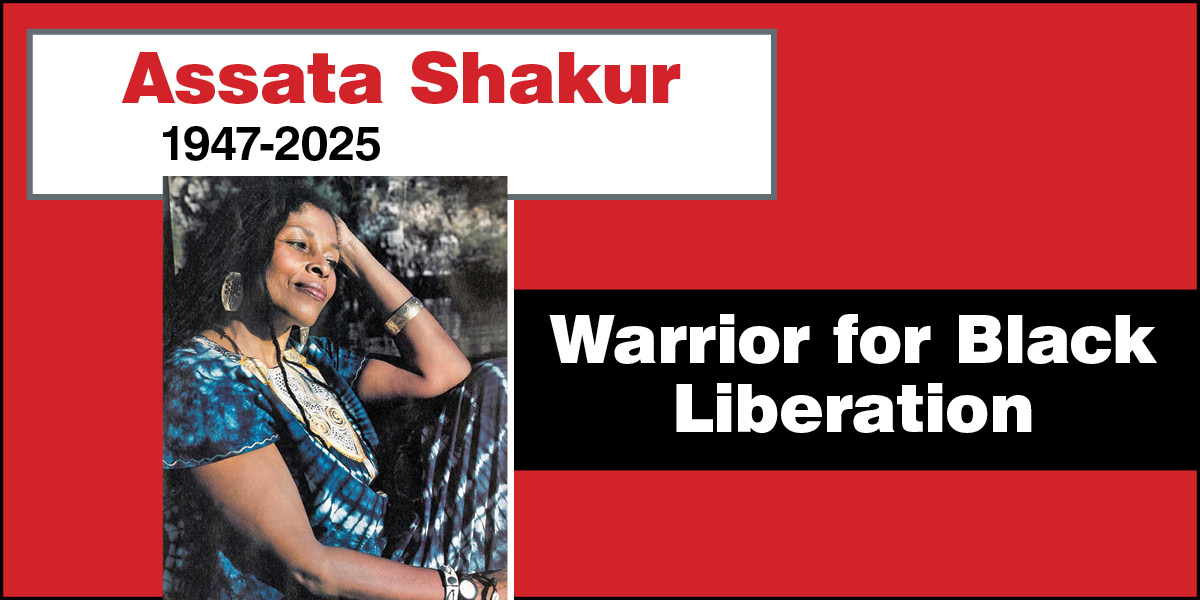
Assata Shakur, iconic black freedom fighter, former Black Panther Party and Black Liberation Army militant, died last September 25 in Havana, Cuba. Pursued relentlessly for decades by the U.S. rulers, the first woman on the FBI’s “Most Wanted Terrorists List,” framed repeatedly on false charges, shot, imprisoned, tortured—Assata remained unbroken. She has inspired generations, especially militant black women, with her courage and revolutionary spirit. Despite vast political differences, we honor Assata as a fearless enemy of the capitalist/imperialist order and a warrior for black emancipation.
Growing up with her mother and aunt in Jamaica, Queens and with her grandparents in segregated North Carolina, Assata experienced the realities of race discrimination. She came to political activism as a student in New York City in the 1960s, spurred by a keen awareness of black oppression, but also a broader understanding of class oppression under capitalism. As she wrote in her powerful 1987 autobiography:
“…it didn’t take too much brains to figure out that Black people are oppressed because of class as well as race, because we are poor and because we are Black. It would burn me up every time somebody talked about Black people climbing the ladder of success. Anytime you’re talking about a ladder, you’re talking about a top and a bottom, an upper class and a lower class, a rich class and a poor class. As long as you’ve got a system with a top and a bottom, Black people are always going to wind up at the bottom, because we’re the easiest to discriminate against.”
In the fall of 1970 Assata joined the Black Panther Party (BPP), which represented the best of a generation of black militants who rebelled against the pacifism of the liberal-led civil rights movement. Formerly known as JoAnne Chesimard, in 1971 she adopted her new name, Assata Olugbala Shakur. Assata for “she who struggles,” Olugbala meaning “love for the people,” and Shakur out of respect for her comrade Zayd Malik Shakur and his family. Assata’s close friend Afeni Shakur was a Panther leader, and Assata was godmother to Afeni’s son, rapper Tupac Shakur.
The black nationalist groups of the 1960s and 1970s attracted black women like Assata, who formed the backbone of the Panther organization and played leading roles despite the prevalence of macho views among male comrades, which reflected the attitudes of the lumpenized ghetto youth they were recruiting. Panther women, over half the membership, were often rankled by the chauvinist disdain of male comrades. Opposition to birth control and abortion rights reflected these backward views. That said, Assata felt “the BPP was the most progressive organization at that time…many of the other organizations at the time were so sexist, I mean to the extreme.”
Savage Repression of Black Militants
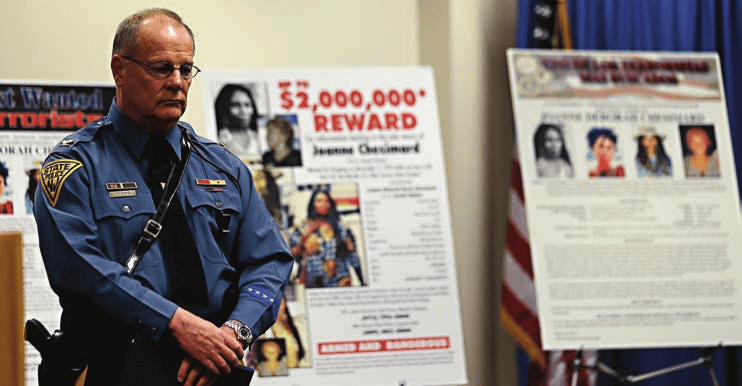
New Jersey State Police press conference on 2 May 2013 announced police/Feds bounty on Shakur increased to $2 million.
FBI director J. Edgar Hoover called the Panthers the “greatest threat to the internal security of the U.S.” As we wrote in “FBI’s Racist ‘Anti-Terror’ Vendetta Against Assata Shakur” (Workers Vanguard No. 1024, 17 May 2013): “In the eyes of the capitalist rulers, the great crime of the Panthers was not only proclaiming the need for a revolutionary solution to the oppression of black people but advocating the right of armed self-defense against the racist terrorists, whether in the white robes of the KKK or the navy blue of the police.”
Hoover described the aim of the FBI’s deadly “counter-intelligence program” COINTELPRO: “to expose, disrupt, misdirect, discredit, or otherwise neutralize the activities of the black nationalists.” Assata and her comrades were targeted for assassination by the FBI and cops under the deadly COINTELPRO, which led to the murder of at least 28 Black Panther militants. Fred Hampton, Bobby Hutton, Mark Clark, Bunchy Carter, John Huggins—these are only a few of the Panthers murdered in the bloodthirsty drive to destroy the BPP.
The entire New York Panther leadership was jailed, facing absurd charges of planning to blow up NYC sites like the Bronx Botanical Garden. Known as the Panther 21, they were imprisoned on these phony charges; once they went to trial, the jury acquitted them immediately.
The BPP shattered under this murderous state repression. Shakur became disillusioned with the infighting, machismo and lack of direction. She left the party and joined other militants, primarily from the militant Cleaver wing of the Panthers, in the loosely organized group of underground black militants known as the Black Liberation Army (BLA). Following a string of cop killings and bank robberies in NYC which were blamed on the BLA, her image was displayed throughout New York post offices, banks and subway stations, as she was made the target of a nationwide manhunt with shoot-to-kill orders.
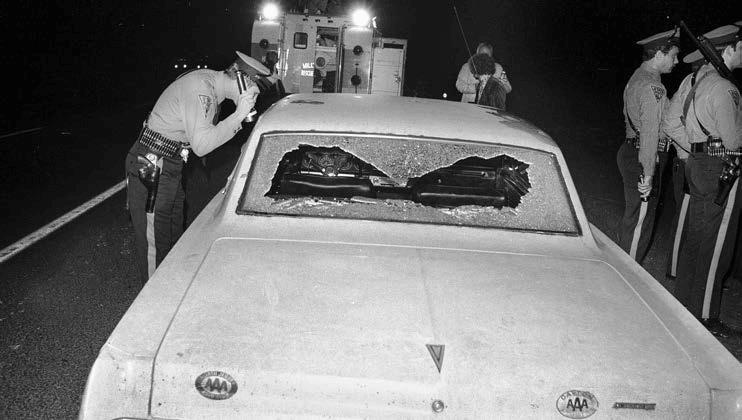
3 May 1973: Assata’s car after deadly stop by NJ state troopers. Cops shot Assata twice, once in the back, and killed Zayd Malik Shakur.
On 2 May 1973, Shakur, Zayd and Sundiata Acoli—former Panthers, then with the BLA—were stopped by two state troopers on the New Jersey Turnpike, supposedly for a “faulty taillight.” Moments later, Zayd Shakur was shot dead by one trooper. The second trooper died in the crossfire, shot with a bullet from a police revolver. Assata was shot twice, once in the back.
Sundiata Acoli’s case was carried forward, while Assata’s was delayed because she was pregnant. Sundiata had been finance minister of the Harlem BPP, and was one of the Panther 21 defendants. He was convicted of murder by an overwhelmingly white jury, and was imprisoned for 49 years until finally being paroled at age 85 in 2022.
Assata’s injuries showed she had been shot while her hands were raised. Physical evidence proved she had not held or fired a gun. One bullet shattered her clavicle and median nerve, paralyzing her right arm, making it impossible for her to have fired the fatal shot. Unable to convict her of firing the shot that killed the trooper, an all-white jury, five of them relatives or personal friends of NJ state troopers, railroaded her to prison as an “accomplice” on grotesque charges of killing her own comrade Zayd as well as the state trooper.
But while awaiting trial on these trumped-up charges, Assata faced nine other frame-up indictments, winning acquittals and dismissals in all nine cases. A 1989 book by Kenneth O’Reilly, Racial Matters: The FBI’s Secret File on Black America, 1960-1972, cited documentary evidence suggesting that Shakur was targeted with an investigation called CHESROB, which “attempted to hook former New York Panther Joanne Chesimard (Assata Shakur) to virtually every bank robbery or other violent crime involving a black woman on the East Coast.”
Assata was imprisoned for more than six and a half years altogether, including over two years in solitary confinement, largely in men’s prisons. Held under appalling conditions, she was beaten, tortured physically and psychologically, denied medical care and visits by her attorney and family were monitored. And she suffered the pain of separation from her daughter, born while Assata was in prison.
Assata escaped from prison in New Jersey in 1979 with the assistance of activists with the BLA and the May 19th Communist Organization. Several of those aiding her paid a high price. Mutulu Shakur, jailed for the 1981 Brinks robbery as well as his role in gaining Assata’s freedom, spent 37 years in prison; he was paroled in 2022 for ill health and died soon thereafter. Marilyn Buck also faced a RICO indictment for these actions and was sentenced to 80 years; she died of cancer within a month of her release in 2010.
Eschewing the integrated working class as the force for revolutionary change and failing to rally the ghetto masses behind them, the Panthers found themselves isolated, to be picked off by the forces of police terror. A similar tragic fate befell the BLA, which engaged in symbolic acts but remained divorced from mass struggle.
We vigorously defended the Panthers against the capitalist state’s murderous drive to crush black radicalism. In the 1970s we defended Assata and her comrades, and protested her horrendous treatment at the Middlesex NJ prison. We denounced her conviction on false charges, and continued to defend her courageous stance during her years of exile in Cuba.
Refuge in Cuba
Assata was granted political asylum in Cuba in 1984, where she lived until her death last autumn. She continued to speak out against U.S. imperialist crimes and in support of political prisoners. In a 1998 open letter she declared, “I am a 20th century escaped slave. Because of government persecution, I was left with no other choice than to flee from the political repression, racism and violence that dominate the U.S. government’s policy towards people of color.”
Living and working as a teacher in Cuba, Assata became fluent in Spanish, took part in many political and cultural celebrations, and worked with the Cuban Communist Party. She was finally able to reunite with her daughter Kakuya Shakur.
The U.S. rulers did not end their relentless persecution of Assata after she reached Cuba. And this persecution was always bipartisan—both Democratic and Republican administrations targeted her. Congress passed a resolution demanding her extradition from Cuba; her presence there was linked to continuing the embargo aimed at starving the Cuban population. It was the administration of Obama, the first black president, and his black attorney general that put Assata on the FBI’s list of “Most Wanted Terrorists” and offered a $2 million bounty for her capture. In 2013 a senior FBI official complained that in Cuba she had continued to voice her “anti-U.S. views” advocating “revolution and terrorism,” and called her “a danger to the American government.” In the 2013 Workers Vanguard article, we explained that this campaign had “a dual purpose: to settle the score against those who fought for black freedom over 40 years ago and to warn that radical activity would be treated as ‘domestic terrorism’.”
Today, we see the label of “domestic terrorist” again used to smear anyone who dares to protest against the murderous ICE raids, genocide in Gaza, and police terror against the black population. The ICE murder of Renee Good in Minneapolis is justified by Trump’s DHS secretary Noem and by Vance immediately labeling this innocent mother of three as engaging in “domestic terrorism.” Today the connections are clearer than ever: bloody repression of protest and intensified oppression of black and brown populations at home, while the imperialist military’s full might is wielded against Venezuela to prepare the way for capitalist counterrevolution in Cuba.
In 1991, the two of us were fortunate to meet Assata during a visit to Havana. As we wrote in Workers Vanguard No. 531, 19 July 1991:
“We heard a moving talk by black militant Assata Shakur.… For her, the survival of Cuba’s revolution is a matter of life or death. She spoke of the many others who find refuge here, like young Salvadoran guerrilla fighters blinded or maimed in combat against the death squads. To a visitor from the U.S., she said, things may look hard down here. But to a Palestinian from the West Bank, to a Latin American slum dweller, Cuba looks very different.”
Our conversation with Assata was a chance to update her on the defense work of the Spartacists and Partisan Defense Committee, and especially our campaign in defense of Mumia Abu-Jamal. After our talk, she asked us to deliver a letter of solidarity with Mumia. It was our great honor to meet Assata, this remarkable warrior, grandmother, teacher, poet, fearless black revolutionary.
Today, in the belly of the imperialist beast, Shakur’s words live on, known widely among fighters for black liberation as “Assata’s Chant”:
“It is our duty to fight for our freedom. It is our duty to win. We must love each other and support each other. We have nothing to lose but our chains.”
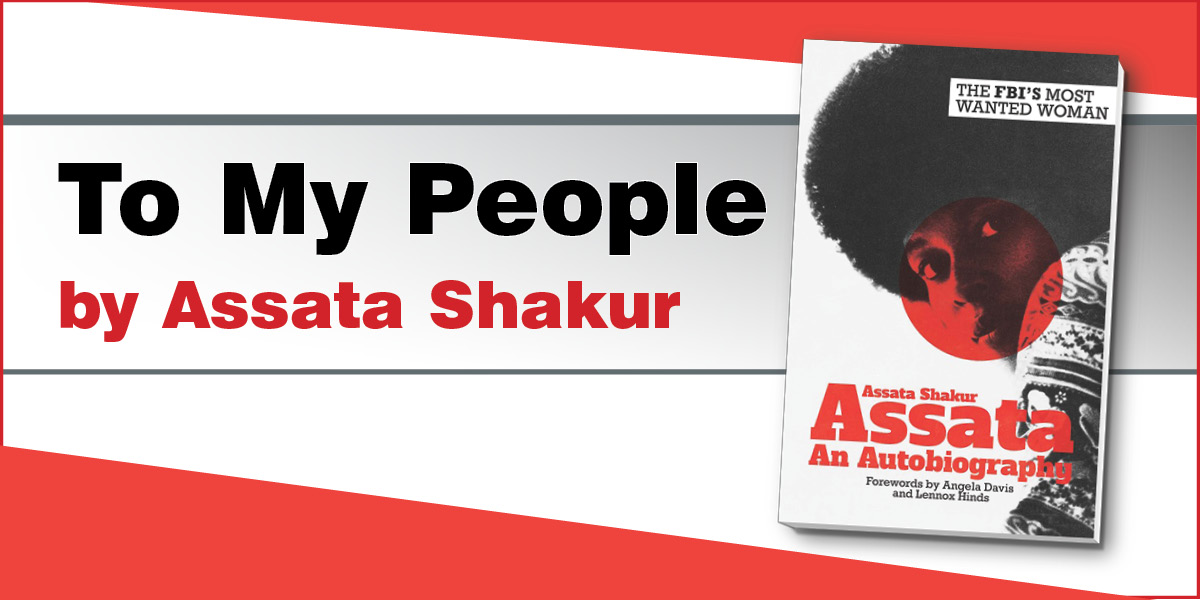
We reprint below the communiqué “To My People” written by Assata Shakur while in prison, 4 July 1973.