
https://iclfi.org/spartacist/en/2026-korea
We print below the English version of an article published in Korean Spartacist No. 2 (October 2026).
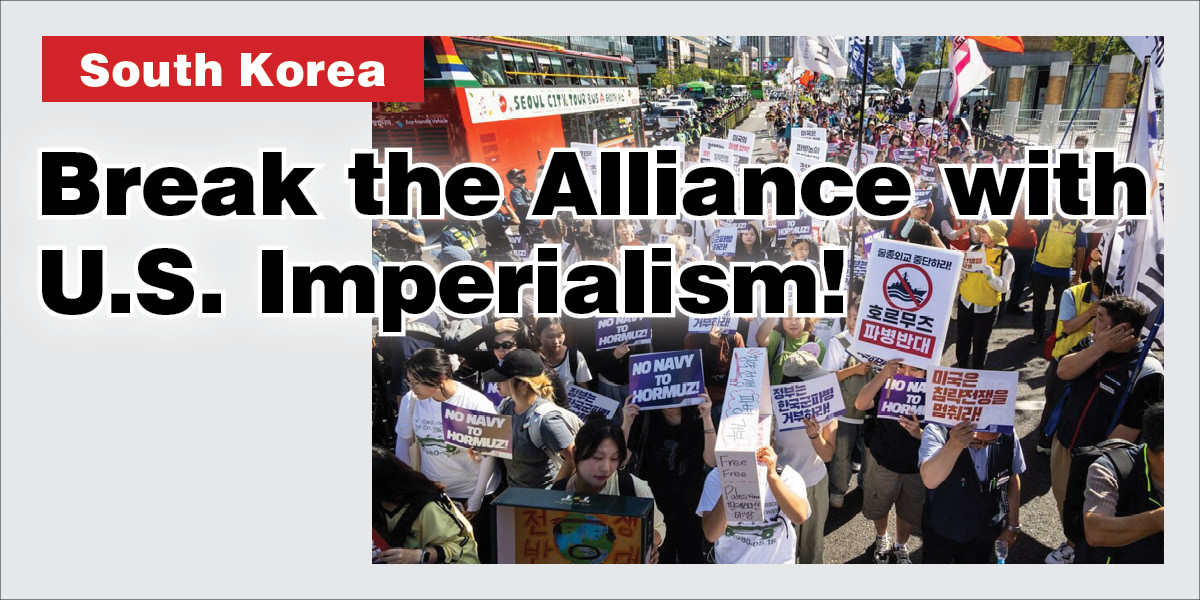
Amid skyrocketing housing prices, youth unemployment and multiple scandals, the Lee Jae-myung regime is increasingly unpopular. Thousands have taken to the streets to protest the government’s announcement that it planned to send naval forces to the Strait of Hormuz to aid the U.S. against Iran. These protests, which were supported by the KCTU leadership and smaller parties that backed Lee Jae-myung in the presidential election, followed large demonstrations in the summer against the U.S.-South Korea war games targeting China and North Korea.
The Blue House has pulled back from the deployment, for now. But its aim was clear enough. By showing yet again South Korea’s readiness to cooperate with the U.S. military, the government seeks to win more favorable terms for trade and investment, notably a reduction in tariffs. It wants to strengthen the U.S. alliance, though with greater operational control for the South Korean military in wartime. And it aims to increase the profits of the chaebol capitalists on the backs of the workers, particularly in areas crucial to military supply chains like semiconductors, shipbuilding and armament production.
The protests over the war games and Hormuz were important. But they fall far short of what is needed: a thorough break with the Lee Jae-myung government. While opposing the U.S. military, the KCTU leaders continue to seek an alliance with a regime that is beholden to the U.S. They push the dangerous illusion that the Democratic Party can uphold so-called South Korean “national interests,” seeking only to pressure it to be more progressive and pro-labor. A clear example is their push for “social dialogue” with the government over the proposed new semiconductor cluster in the southwest. This involves trillions of won in aid for Samsung and SK Hynix accompanied by further threats to labor rights, like extending the workweek beyond 52 hours. Rather than polite discussions, the union leaders should be preparing serious struggle against the chaebol and the government that stands behind them.
In the absence of a credible left-wing alternative to the government, the right-wing People Power Party is again growing in popularity. The Democratic Party’s rhetoric differs from the PPP, but it has always been just as much a tool of South Korean capitalism and the alliance with U.S. imperialism that threatens to drag Korean workers into the abyss. It was the “progressive” Kim Dae-jung regime that waged IMF austerity attacks on workers after the 1998 financial crisis. Five years later, Roh Moo-hyun sent troops to support the U.S. occupation of Iraq. Today’s Lee Jae-myung administration stands squarely in this tradition. The government’s common interests with the chaebol were driven home by its threat to ban the Samsung workers’ strike last spring.
To advance the workers’ interests, the labor movement and the deeply divided South Korean left forces need to reorient around two fundamental issues: a fight to break the U.S. alliance and to oppose all wings of South Korean capitalism. For decades, most of the left has pushed the idea that right-wing reaction can be defeated by supporting a more “progressive” wing of the capitalist class. This strategy, which Marxists call the popular front, has only produced disaster. Whenever the Democratic Party has come to power, its betrayals have only paved the way for the return of the right.
Last year, the top KCTU leadership and several socialist groups openly called on workers to vote Lee Jae-myung into office. Today one of these groups, Workers Solidarity, regularly publishes articles opposing the KCTU leaders’ popular front with the Democratic Party. But Lee Jae-myung’s betrayals were entirely predictable: he made clear from the start that he would uphold South Korean capitalism and the U.S. alliance. Workers Solidarity’s call to vote for him only fostered illusions in the Democratic Party, thus creating barriers to successful workers’ struggle.
The fight to build a revolutionary trend in South Korea requires a very different, militant perspective:
-
Mobilize labor’s power to defend jobs, working conditions and migrant workers!
-
For a complete break with the Lee Jae-myung government—Build a workers party!
-
U.S. troops and bases out! Oppose all military provocations against China, North Korea!
-
No military forces to Hormuz—Defend Iran against U.S. imperialism!