
https://iclfi.org/spartacist/en/2026-albania
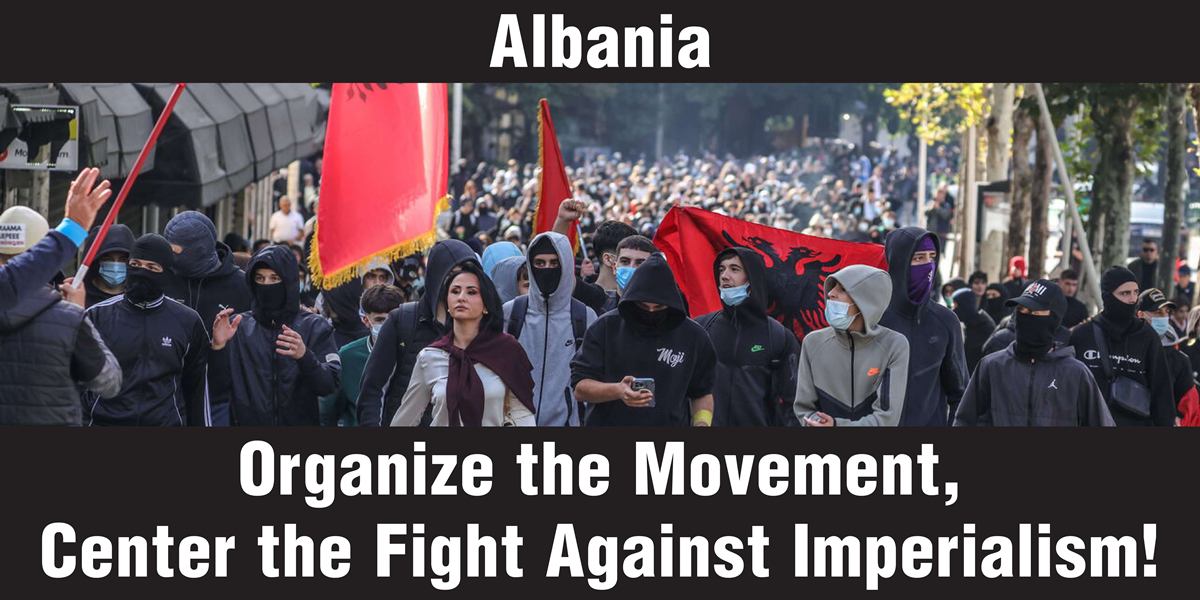
24 October — For over ten days now, Albania has been shaken by mass protests initiated by students and youth, drawing thousands of others into the streets to demand the resignation of Edi Rama’s corrupt Socialist Party government. What began in the capital of Tirana rapidly spread to other cities across the country, with high school students quickly joining the movement. On 21 October, the Trade Union of University Employees of Albania (SPUSH) began boycotting classes and participating in the daily protests, while yesterday doctors and nurses joined the demonstrations. These protests are a continuation of the months-long demonstrations known as the “Flamingo Revolution.”
As government buildings and a police station were set on fire, Rama declared that “a red line has been crossed with the attack on the police station.” The government has responded to the protests with brutal repression, using rubber bullets, tear gas and water cannons while injuring and arresting hundreds of young people. Edi Rama clearly said that he is not willing to resign and he has alleged foreign interference behind the protests, pointing the finger at Iran and Russia. Now, as the protests continue and fear of social and political instability grows, Rama is calling on the students to enter into dialogue. But the students have no faith in his government and insist that he must resign.
At the same time, the conservative opposition, led by Sali Berisha’s Democratic Party, is attempting to capitalize on the legitimate anger of the youth. On 14 October, Berisha declared that they “would not abandon the students,” calling them “lions.” However, the youth refuse to be used as a weapon by the right-wing opposition, correctly recognizing Berisha as a co-architect of the very system that has degraded their living conditions. This sentiment is encapsulated in their unifying slogan: “Rama in prison, Berisha in prison!”
The anger directed against both Rama and Berisha reflects the deep discontent among youth, but the question remains of how this anger can be transformed into a movement capable of going forward. It is necessary to defend the youth and demand the release of all those arrested. The explosion of anger among young people is a direct result of police violence, as well as the intolerable conditions in which they are forced to live. However, it must be clear that burning public buildings, smashing storefronts and other chaotic actions are counterproductive to what the movement seeks to achieve. This strategy risks alienating potential allies, isolating the youth movement from the workers, whose active participation is essential for the struggle to advance, while also making the youth more vulnerable to police repression.
The importance of winning broader support is already evident in the attitude of small shopkeepers, many of whom have closed their businesses in solidarity with the students while also calling on protesters not to destroy their shops. While supporting the students, they are also concerned about protecting their livelihoods. This underlines the need for the movement to win the support of broader layers of society and bring the working class actively to its side. The answer to state repression is not to retreat but to strengthen and broaden the struggle through methods capable of mobilizing the greatest possible number of people. To achieve this, the movement must immediately organize democratic university assemblies to coordinate actions, expand its reach directly into the labor unions in order to build a unified front with the working class, and establish joint struggle committees in every neighborhood and workplace.
A Caretaker Government: Why This Will Not Work
Youth in this small and tormented Balkan country see no future. The high cost of education, the systemic lack of jobs, exorbitant energy prices—among the highest in the region—and a crushing cost of living are bleeding them dry. Renting a home has become almost impossible for many, while young people and their parents are forced to emigrate in search of a better life. Albania lost almost a quarter of its population in 25 years, the highest decline in Europe, with emigration being the main factor influencing this trend. The demands of youth to end corruption and for transparency and democracy are entirely legitimate, given the intolerable conditions in which they are forced to live.
However, demands inside the movement for a caretaker government to organize new elections will not resolve these problems. Changing the government and holding elections - even under more democratic rules - cannot guarantee an end to corruption, unemployment, poverty or mass emigration. Recent struggles elsewhere in the Balkans illustrate this in the clearest way. In Greece, the mass protests following the Tempi train disaster, which killed 57 people in February 2023, brought hundreds of thousands into the streets - including the organized working class - demanding justice and accountability. In Serbia, the deaths caused by the collapse of the railway station canopy in Novi Sad in November 2024 sparked a huge student-led movement against corruption and government impunity. In both cases, mass anger raised fundamental questions about the political system and those responsible for it. Yet the challenge remains of translating mass mobilization into a force capable of bringing about lasting social change rather than allowing the struggle to be channeled back into a parliamentary framework that leaves the underlying power structures intact.
The lesson is not that the demands for justice, democracy and accountability are misplaced, but that these demands cannot be secured through a change of government alone. The question is whether the struggle can challenge the social and economic conditions that reproduce corruption, poverty and exploitation.
To Fight Rama, Fight Against Imperialist Plunder
This is the question that any serious strategy for the movement must confront. The poverty, corruption and misery confronting Albanian youth, workers and poorer layers of the population in the cities and the countryside cannot be understood separately from the devastation and subordination of Albania and the Balkans as a whole to U.S. and European imperialism. At the heart of this situation lies precisely this problem: it is the imperialists who keep Albania and the whole region underdeveloped and in a state of destitution. The poorer the country, the greater the corruption and the less there is for the masses, while the wealth and resources of the region serve the interests of the domestic elites and foreign capital.
This plunder is clear today. While the working class is left with nothing, the nation's sovereign land is being handed over to foreign oligarchs—exemplified by the Trump family and Jared Kushner’s multibillion-dollar luxury real estate projects on Sazan Island and the coastal area of Zvërnec. Youth and students poured into the streets out of pure anger over their unlivable conditions, their failing education system and the blatant theft of public land. By shouting "Albania is not for sale!", they are fighting a government that acts as a broker for foreign capital. This is the true face of western integration: keeping the country as a permanent playground for foreign businessmen.
Edi Rama is worried about this situation because he wants to enter the EU and needs to maintain an illusion of "stability." To enforce this stability and protect the interests of foreign capital, his regime uses brutal police violence to crush the youth movement. The EU’s lukewarm condemnations of this violence are a farce; European and U.S. imperialists pretend to care about democratic standards, yet they are the very forces bankrolling and sustaining the corrupt regime that enforces their dictates, controlling every aspect of economic and political life.
The catastrophic devastation of Greece by the IMF, the EU and the Eurozone provides a chilling warning of this reality. It proved to the entire region that European integration is a trap designed to enforce brutal austerity, destroy public infrastructure and mortgage the future of youth to western banks while crashing the workers movement and enslaving the country more to U.S. interests. What is the role of the local bourgeoisies in this situation? Being historically weak, they know they cannot survive or maintain power without the backing of Washington and Berlin, causing them to act as mere puppets of foreign interests. Consequently, they actively fuel nationalistic rivalries—pitting one country against another, from Kosovo to Serbia, Greece and Macedonia—in order to prevent any unified resistance from below. To enforce and maintain these divisions, the imperialists have heavily militarized the entire region through NATO bases in Kosovo, Greece and Romania, the Kuçovă Air Base and SOCEUR Headquarters in Albania, etc. This massive military buildup turns the Balkans into a powder keg, placing a constant threat of chauvinistic wars over the different nationalities. All of this war infrastructure comes at the direct expense of social needs, draining resources that should fund decent education, healthcare and living conditions.
To advance the movement, students, teachers and hospital workers who have joined the demonstrations to fight against Rama must place the struggle against the root cause of all evil—imperialist domination—at the very center of their fight. Precisely because this plunder is behind everything, it is impossible to secure decent education, healthcare and human living conditions without destroying imperialist control. Centering the fight against imperialism is the only way to unite the working masses within the country.
Crucially, the struggle against imperialist subjugation must be conducted under the principle of class independence from all wings of the bourgeoisie. Furthermore, this struggle is the only weapon that can defeat the local elites and foreign powers who actively use national divisions to split the masses. As Leon Trotsky pointed out during the Balkan Wars, the only positive program capable of liberating the region from foreign oppression and national conflict is the revolutionary unification of the area. For the Balkan peoples, uniting across borders in a Socialist Federation of the Balkans is the only path toward true prosperity, economic development and lasting peace.
Shut Down All NATO/U.S. Bases!
Get Out of NATO!
Reject the EU Trap!