
https://iclfi.org/spartacist/en/2026-bolivia-march
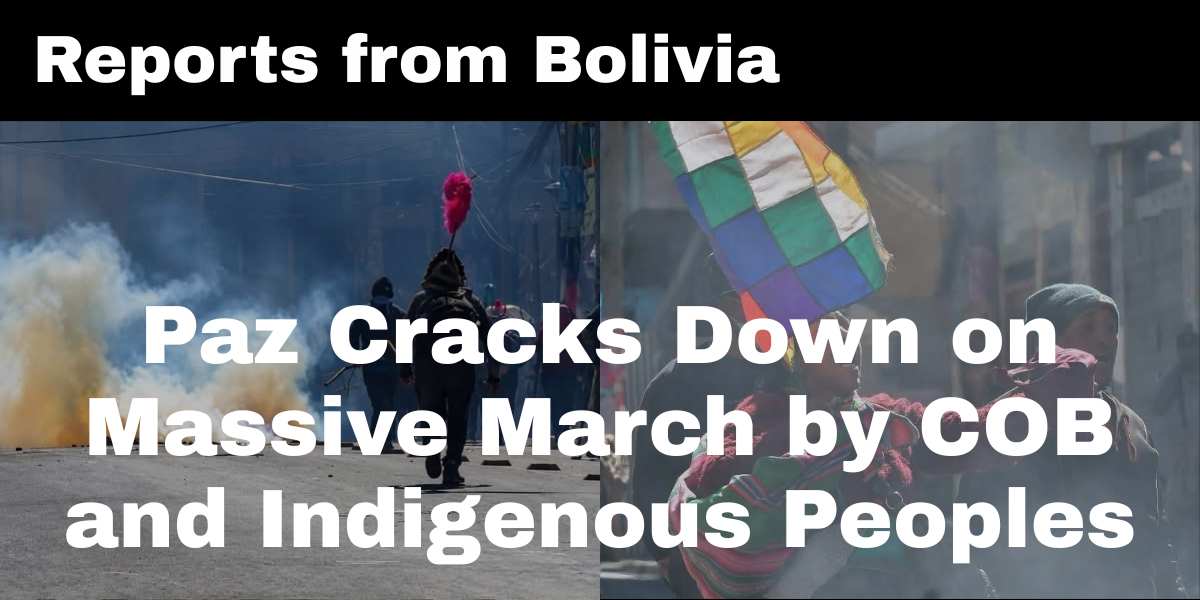
The COB called for a massive march from El Alto to La Paz this Wednesday to demand Paz’s resignation and the release of all detainees. The gathering was scheduled for 8am near the Multifunctional Building in the lower-class neighborhood of La Ceja, the heart of El Alto. We took the cable car up to the meeting point amid the hustle and bustle of La Paz. When we arrived, we could see large crowds of indigenous workers and peasants waiting for the march to begin. Throughout the gathering, here and there, small groups were holding assemblies. The Wiphala flag fluttered over the people’s shoulders as their unwavering symbol of identity and struggle. According to press reports, some 40,000 people attended. We could see for ourselves that it was massive, probably larger than what the press reports.
Along its route, the contingent was well received in various places. Some applauded as they passed; others gave them water. There is sympathy from the population, which is selflessly enduring the consequences of the blockade. However, many have not actively joined the fight because they do not see where it is headed, while they barely have enough to survive. A clear and decisive policy from the COB is needed to lead the fight, through its organizations, in such a way that people’s basic needs are secured and the fight is coordinated and carried out in an orderly manner. This includes restarting production, under its control, at the companies that have shut down due to a lack of supplies, and seizing from the imperialists the resources necessary for this. This would mobilize unemployed workers and could galvanize the enormous force that sympathizes with the movement, convincing it to join the battle.
When the march arrived in downtown La Paz, it was ambushed by the police. The police split up the contingent and attacked both sides, charging and firing tear gas. In particular, the attack targeted the peasants from Chayanta, Potosí—one of the most militant sectors—as well as those carrying the Wiphala or wearing hard hats.
Violeta Tamayo, a correspondent for La Izquierda Diario, was seriously injured by a tear gas canister that shattered her arm. She is hospitalized. They also beat and arrested Vicente Salazar, a leader of the Túpac Katari organization, in the middle of the demonstration. They even stole his chicote (traditional whip), an important symbol of indigenous leadership. Enough of the abuses against the Aymara and Quechua peoples! Return his chicote! Although he was later released, as he himself noted, what they did was try to “teach him a lesson.” The police arrested 63 protesters who remain in custody. Immediate freedom! Drop all charges!
We witnessed a clash between peasants from Chayanta and the police. We were able to take cover on one of the city’s busiest streets thanks to protesters who managed to keep the police charge at bay. After dispersing the march, the police launched a manhunt through the city with motorized squads to continue intimidating and arresting people.
Amid a tense atmosphere, we overheard a conversation among several indigenous women. For them, it was very clear that Paz must go because he governs only for the rich and grants huge privileges to the agro-industrialists of Santa Cruz while giving nothing to small farmers. They felt outraged and humiliated by the vicious repression against the dispossessed. The day ended, but the crisis and indignities didn’t.
The Bolivian government cannot quell the rebellion, and the movement has been strong enough to hold its ground but not to achieve its goal. In this situation, Paz is inciting the population against the protest movement and seems to be betting on wearing it down. Mobilizing the power of the working class would be decisive for victory.
Workers took to the streets last December to fight against Decree 5503, which sought to sell the country’s resources to transnational corporations, particularly those from the U.S. Although the decree was repealed, the subsidy on hydrocarbons—a central target of the decree—was eliminated. The COB’s industrial and mining sectors stopped fighting after the repeal. But for the peasant movement, this was not enough, and they want Paz to go. This disparity is what must be resolved.
Miners working at state enterprises do not want to go on strike or take to the streets to fight because they fear the government will use that as an excuse to declare the mines insolvent and impose their privatization under that pretext. For their part, private-sector miners and industrial workers fear putting their jobs at risk. Both concerns are legitimate. Amid the poverty plaguing the country, having a job and a livelihood is vital. But the issue is that if Paz manages to wear down the peasant movement, he will have the backing of imperialism and a free hand to launch a large-scale privatization offensive and a brutal attack on the already horrific living conditions, which will impact the miners in one way or another. Faced with this, miners in the state sector run the risk of being left alone, without peasant support, and, worse still, facing suspicion for not having mobilized.
It is true that in the struggle one might lose, but if one does not fight, one will surely lose. The COB can unify and mobilize the miners. Likewise, drawing on its traditions, it has the power and structure to provide the protests with a course of action and an organization that only the organized labor movement can offer.