
https://iclfi.org/spartacist/en/2026-lula
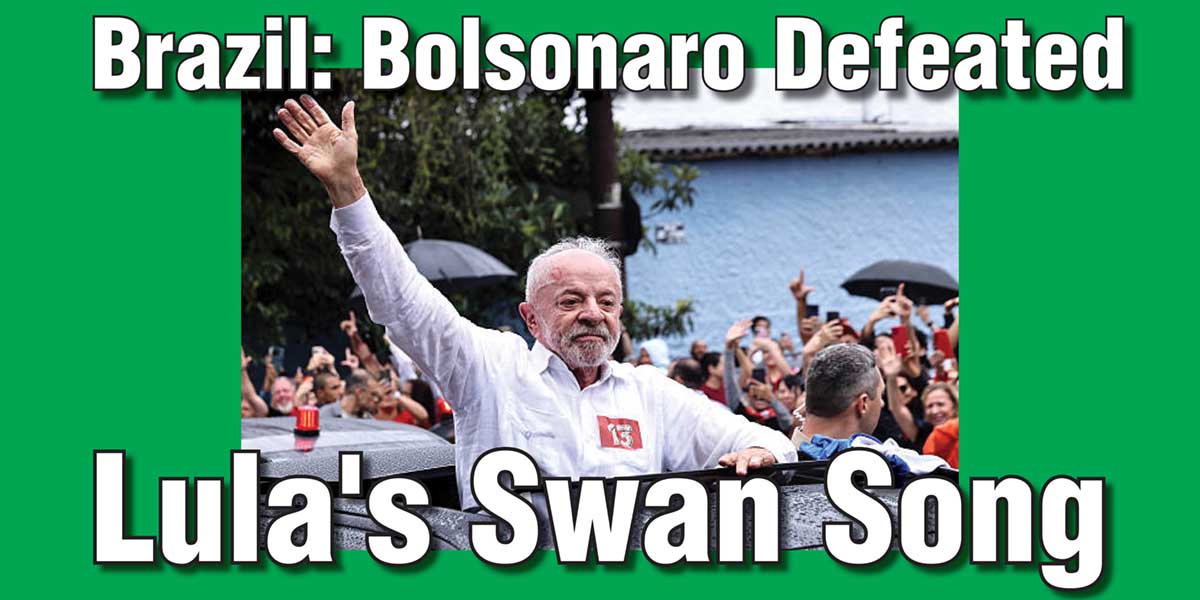
29 October—Much of the left has been over the moon since President Lula snapped victory from the jaws of defeat last Sunday, after trailing by two points in the first round. His strong showing resulted from a forceful mobilization between the two rounds of PTers and activists for minorities’ rights who feared the election of Flávio Bolsonaro. They indeed had plenty to fear if this extreme right-winger had been elected.
However, Lula’s victory should not conceal that the parliament (both Congress and Senate) moved even further to the right, with Bolsonaro’s Liberal Party coming out strongest and the right winning a majority of the state governors in the 4 October election. So, Brazil’s October elections are at best only a partial exception to the general right-wing shift that has swept nearly all left-wing governments in South America, installing dedicated stooges for the U.S. imperialists.
The choice for Lula lies now between seeking renewed alliances with bourgeois MPs further to the right than during his previous term or leaning on the popular support expressed in the huge demonstrations in recent weeks (some of the largest in the history of the country). Well, Lula has chosen already. He declared on the night of his election that the president “was elected to govern based on respecting the Constitution regarding Congress…it was the people which elected it, and it is with it that I am going to vote, to work and approve things.”
And he had chosen already before Sunday, not only during the entirety of his first three terms but also with his slate, which included several bourgeois parties and his vice president Geraldo Alckmin of the PSB, a bourgeois party with landowners and capitalists. This means that the politics of Lula’s new government will necessarily be constrained by what is acceptable to these parties of the class enemy, or rather by what is demanded by them.
Lula has done a lot of talking about BRICS and says that he does not want to be a lackey of the American imperialists. Meanwhile, he has privatized huge chunks of national property for the benefit of imperialist corporations. Just this year, he did not lift a finger to support neighboring Venezuela when Maduro was abducted by U.S. special forces; he has not sent one gallon of oil to besieged Cuba despite Brazil being a major oil producer; he sent weapons to the right-wing Bolivian government when it faced a peasant insurgency—all so that Trump would like him.
The American imperialists keep trying to squeeze Brazil and bring it back more solidly into the U.S. courtyard. Meanwhile, Lula’s capitalist allies are tied by a thousand knots to imperialist capital, with joint ventures and other business partnerships in Brazil, assets parked in Wall Street and real estate in imperialist centers, etc. A fight for Brazilian national sovereignty requires a break with the bourgeoisie and mobilizing the working class against the imperialists.
With his conciliationism toward the imperialists and national capitalists, Lula will inevitably attack the working class and oppressed, leading to broad demoralization and the further rise of the far right. This scenario is not a doomsday fantasy of pessimistic sectarians: Brazil went through it already, as recently as ten years ago. In 2014, a vote for Lula’s candidate Dilma Rousseff was sold as a lesser evil than the right-wing liberal Aécio Neves from the bourgeois PSDB. To satisfy financial markets, Rousseff plunged the economy into its worst recession in modern times. Then when she became hated enough by broad layers of the population, she was impeached by a parliament that was less right-wing than today. Her vice president, who came to power after stabbing her in the back, unleashed a series of reactionary attacks against unions, social security and job stability, leading to Jair Bolsonaro’s election.
This apocalyptic scenario shows that supporting the lesser evil against the right invariably backfires. It should not be repeated! If the left had united in the first round instead of running four different slates (two of them Stalinist and two Trotskyist) to offer a solid proletarian opposition to Lula’s popular front, it could have been viewed as a left alternative and would certainly have gathered a more significant vote than its minuscule 200,000 (less than 0.2 percent of votes). And if it had called to refuse a vote for Lula and to abstain in the second round (to our knowledge, only the tiny and politically erratic PCO did so, and some smaller groups like the Trotskyist POR), the working class would have somebody to turn to when it is faced with the need to fight back against Lula’s upcoming attacks.
The task for the left is now to draw a balance sheet of this election and, better late than never, fight for class independence. The tidal wave of youth and the oppressed between the two voting rounds to prevent Flávio’s election indeed shows that there is a deeply felt need to fight the rise of reaction. This can be unleashed only if the working class takes the lead, fully independently from the class enemy. Lula himself will not grant anything unless he is faced with a mobilization in the streets and in the factories against his policy of conciliating capital. Break with Lula’s popular front! This is the only way the working class can really fight for its own interests and those of the oppressed against the imperialists and the bourgeoisie.