
https://iclfi.org/pubs/rb/3/storm
What in the world is going on? Tariffs and wars, bubbles and potential crashes; keeping up with world news over the past year makes one’s head spin. Yet, the all-too-common refrain is of the chaos and craziness “over there”—that is, far, far away from Australia’s shores. For the Labor government, and the ruling class it administers for, this is the natural course of events. As Treasurer Jim Chalmers repeats over and over again: “Australia is an island of reliability and opportunity in a sea of global economic uncertainty.”
On the surface there is some reason to believe this. It is true the cost of living and housing crises continue, with real GDP per capita and real wages cratering. Nevertheless, compared to the world at large, Australia almost seems rosy. Amidst murmurs of global economic collapse, the Australian Financial Review blithely declares “The economy is roaring back to life.” Internationally, you hear of an ascendant right-populism with millions on the street to match. In Australia, anti-immigration marches are still relatively small and Pauline Hanson, while increasingly popular, is still incomparable to Nigel Farage. While overhyped by the left internationally, in Australia there is no semblance of a “Gen Z revolution” or ascending left that one can easily point to.
To the contrary, the left remains as weak and divided as ever and the working class very much on the backfoot. The CFMEU has now been under state control for over a year, with national secretary Zach Smith confident enough to carry out a ruthless purge in the Victorian branch. Though it is a testament to the militancy and vitality of the base that the union has not yet been gutted to the extent building developers dreamt of, it is clear that the CFMEU will not throw off the administration any time soon. The Palestine movement has exhausted itself too. Even groups like Socialist Alternative (SAlt), who have long chased after the Maritime Union of Australia bureaucracy, openly admit “the fact remains that not a single branch of a single union in this country has authorised industrial action in opposition to the Australian government’s role in arming Israel’s genocidal military.” The working class’s bubbling discontent has, for now, in large part acquiesced to Albanese’s promises to keep the good times good—an alternative not to the status quo but rather the trouble overseas.
It would be easy to forget that the liberal order globally is in existential crisis. Instead of the Coalition’s leadership struggles being seen as attempts to keep up with a new post-liberal order, much of the bourgeois commentariat ridicule them as a waste of oxygen dithering towards the political fringe. The ALP has tightened its vice on workers and the oppressed—bleeding the CFMEU by a thousand cuts, increasing repression, pushing stringent anti-protest laws and banning young people from accessing social media—but even this has been doled out under liberal watchwords like “maintaining social cohesion.” Even certain token liberal reforms, which in other countries have been done away with, are still occasionally pushed forward, such as the recent Aboriginal Treaty in Victoria.
Australia in some ways feels frozen in time. It was by pledging to maintain the status quo and promising they could navigate future difficulties that the Labor leadership came out of the national elections riding high, decisively beating the Coalition who offered only a rip-off of the banal Albanese vision. But these illusions are just that: illusions. Their material basis is the relative stability of Australian capitalism, a holdover of the liberal world order which is poised to crumble in the coming period. While the ruling class still hold onto and propagate dreams of Australian exceptionalism, the coming storm will be a rude awakening. This will upend the liberal status quo, and thrust forward forces who stand opposed to it. The short to medium term beneficiaries will likely be right-wing demagogues. To fight back and resist the coming blows, the left and workers movement must stop hanging on to the coattails of the decaying liberal order, and pursue a fundamentally different strategy.
World in turmoil…
Contrary to what the ruling class peddles, Australia is not some little island insulated from the rest of the world. If we are to understand where Australia is going, it is imperative to place the country in an international context.
Recent shake-ups in world politics are not an accident of history, much less the result of the blind actions of a madman, but the product of a changing strategy of US imperialism. Since the ’90s, the world has been defined by the unchallenged hegemony of the American empire. From this position of overwhelming power, it was able to set up a world order under the calling cards of free trade, democracy, and other liberal values, sinking its roots into every corner of the world. But those days are over.
The economic power of the US is in steep decline, and the globalised liberal order it set up and dominated has spawned threats to its dominance. To keep itself on top, the US is ripping up this status quo and lining the world up to bow to new diktats, ultimately with the aim of encircling and defeating China—the biggest obstacle to American hegemony. The political conduit for this goal is Trump. To quote Clinton Fernandes in his book Turbulence (2025):
“Trump is trying to accelerate the pace of the global restructuring. There is less need for US ‘soft power’ now that the neoliberal project is exhausted and the liberal international order as a global project has collapsed. The Trump agenda at home and abroad follows the Golden Rule.... His goal is economic control over China.”
Fernandes outlines three “frontlines” that Trump pursues to this end: “Europe, the Middle East [it should be added: the Global South as a whole] and China.” For this he has bullied, blackmailed and twisted the arm of friend and foe alike to take any advantage he can get. The results thus far have been mixed.
Trump’s “Liberation Day” tariff regime has proven to be but the opening salvo of his agenda. While the liberal elites of Europe are still holding on for dear life, Trump’s moves have put hot coals beneath their feet to accede to a new order in which the European imperialists are expected to “hold their own,” be a key auxiliary to America’s anti-China war drive and jettison the liberal baggage that remains a barrier to this goal. Victory after victory by the Russian military signals not just a coming collapse of the Ukrainian army but of the political order in Europe which has thus far been eking by.
As for the Global South, even the pretence of America playing a helpful hand has been done away with. Aid programs have been gutted, tariffs are imposed and concessions are demanded. This has further tightened the squeeze and will impose massive cuts on countries that already have little fat to cut. And if these countries do not like the taste of the poisoned carrot of American diplomacy, Trump is happy to unleash the stick. Having waged a relentless genocidal war against the Palestinians, Israel is preparing its next offensive with US blessing, continuing to pierce a dagger in the region to maintain it under American auspices. Venezuela is threatened with full-scale military invasion: a clear message to the entirety of Latin America.
Thus far, these moves have been effective against countries which are heavily dependent on the US. But they have proven useless in the face of those with real hard power to resist bully-boy tactics. No amount of cajoling on Trump’s part can reverse the Russian advance in Ukraine wrought by blood and iron. And the tough talk, tariffs and trade wars have been relatively ineffective against China— which today holds industrial supremacy and dominates rare earth mineral production, key to the US military-industrial complex.
The US is currently in no position to wage war against China, for now seeking avenues around this, which may take years to eventuate. This has been made easier by the one-year trade deal inked with a Communist Party of China which, rather than pressing their advantage, are eager to vie for an American détente, under the illusion of maintaining the liberal world order which once allowed the Chinese economy to boom. This has afforded the US some breathing space to subdue allies and potential opponents. While this means a conventional war is not immediately on the table, and that economic war has temporarily cooled, it is no secret that China remains the ultimate target of all these machinations.
…Australia to follow
It is in this crevice, between two mighty tectonic plates whose movements have temporarily stalled, that Australian stability clings. Australian capital was a massive benefactor of the old liberal world order. It was through “enmeshment with Asia”—that is, the opening up of Asian markets to free trade and the penetration of finance capital—that the Australian economy was able to find a lucrative market for mineral exports, most critically with China as its economy soared. Last year Australia exported $196 billion worth of goods to China. To the next biggest destination, Japan, Australia exported less than half of that. In turn, cheap goods imported from China have kept the Australian cost of living down. Last year Australia imported $116 billion worth of goods from China, compared to $32 billion from its next biggest source of imports.
It was thanks to these two pillars—a hegemonic US and a China rising on the back of the American system—that Australian capital was able to prosper, weathering the storm of the Global Financial Crisis. This enabled it to maintain the illusion that Australia could inoculate itself from trouble overseas. But today, in spite of whatever ebbs, these two forces are on a collision course. This portends catastrophe for Australia’s liberal order. But for the ruling class such a prospect appears as distant as the projected delivery of AUKUS submarines. It is in this context that the Labor government has its day.
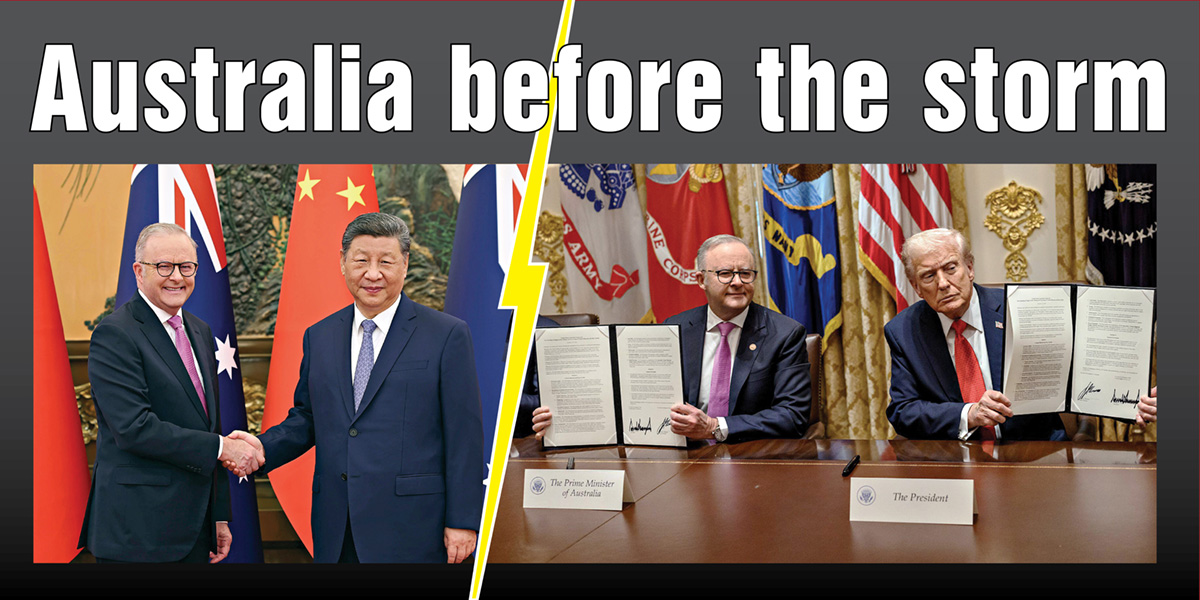
The current strategy of Australian capitalism is summed up by Warwick Smith, former head of the Australia-China Business Council, as “dancing between two elephants.” On one hand, Albanese, surrounded by a posse of business leaders, makes trips to Beijing, receiving the red carpet from Xi Jinping. On the other hand, he heads to Washington to kiss the ring, affirm AUKUS and sign a critical minerals deal to bolster America’s drive towards encirclement and war against China. Since then, Albanese has met with Chinese premier Li Qiang, doubling down on Australia’s deals with America while preaching the good word of free trade, China-US engagement and Australia’s commitment “to the stabilisation of the relationship [with China], to progressing practical co-operation in areas of shared interest.”
For now, there are plenty who indulge the illusion of indefinite engagement-sans-confrontation. Xi Jinping for instance, pursued a charm offensive during Albanese’s most recent trip to China, hosting him for a special lunch featuring a band performing covers of old Australian favourites including Paul Kelly, Powderfinger and Midnight Oil, after which he proclaimed relations as “stable and constructive.”
Many in this country also dream of an independent Australian capitalism. Has-been ex-Labor prime minister Paul Keating, who has repeatedly proclaimed his opposition to AUKUS, now paints Trump as a “peacenik,” declaring “He has the peace consciousness, and he is too street smart to pick a fight with Beijing”—concluding that the Labor government’s “independent” diplomacy is set to keep chugging along. Joining the choir are all sorts of little Australian nationalists, pacifists and liberals who litter the Australian workers movement. Clinton Fernandes, for all his acute analysis of the vested interests behind the actions and strategy of this sub-imperial power, believes that with enough “public discussion” Australia can steer itself clear of rocky shoals.
Bolstering such illusions and posturing as an independent statesman, Albanese, citing the tradition of WWII Labor prime minister John Curtin, has proclaimed his commitment to “follow our own course and shape our own future.” But the myth of an independent foreign policy for Australian capitalism is as much a folly today as it was in Curtin’s time. Indeed, it was Curtin who, seeing the decline of Britain, hitched Australia’s cart to the US empire. Beneath the perennial whining about their subordinate status, Australia’s rulers have always bent the knee to their master.
Australia’s place in the world order depends on being a junior link in the American imperialist chain. It has been with the blessing of the US that Australia has been able to play deputy sheriff in the region, helping to cow the Pacific and Asia to suit American, and with it Australian, interests. Australia today holds neocolonies from Timor Leste to Tonga, not in spite of the US, but thanks to its support and on its behalf. Investments in the region are tightly bound up with American finance capital, and protected by American guarantees. Even Australia’s banks are dominated by American capital.
Australia’s domestic industries are also tied by a thousand strings to American capital. The mining industry is sometimes touted as a bulwark against anti-China moves due to its vested trade interests. In reality, Australian capitalism’s development of its mining industry has long been dependent on vying for foreign, principally American, investment. It is not by accident that almost all “Australian” mining companies (BHP, Rio Tinto, Newcrest Mining, South32) are majority, or close to majority, owned by Wall Street.
If they do not toe the line when the time comes, Trump will not be afraid to give Australian capitalists a reminder of their position. Though barring a fightback by the working class it is clear that the US will not even need to go that far. The fact that Australia is barely an afterthought for Trump, who couldn’t even remember what AUKUS was, goes to show how confident American rulers are in Australian servility.
Australian military, intelligence and economic “interoperability” plays a critical part in the US war drive against China. Under AUKUS, Australia has already handed over hundreds of millions of dollars, and pledged hundreds of billions more, for nuclear submarines that America is not even contractually obligated to deliver. The top end of Australia has been increasingly transformed into a US military stomping ground, while the Pine Gap spy base serves as a critical node for American intelligence.
Meanwhile, Australia holds the dubious “honour” of harbouring some of the only foreign industries that Trump is looking to develop. The south-east is gearing up arms production to serve as a reserve for American industrial power away from potentially hostile, or otherwise precarious, countries in the Global South. The New York Times labels Australia the “51st state for defense production,” set to produce weapons “no different from the ones built in the United States.” Perth is poised to become “the largest submarine maintenance and shipbuilding hub in the southern hemisphere,” with the war industry even beginning to compete with Western Australia’s mining industry—perhaps offering a glimpse into Australia’s industrial future when trade with China is cut off.
Coming off Albanese’s deal with Trump, the US has committed to developing $13 billion worth of critical minerals projects in the country. This is on top of the Labor government’s “Future Made in Australia” agenda which has pledged billions to dig up critical minerals and subsidise faltering smelters. Industry Minister Tim Ayres envisions Mount Isa becoming “the Silicon Valley of critical minerals processing.” More bluntly, Trump boasted Australia will “have so much critical mineral you won’t know what to do with it.”
The fact is, Australia has long been “all the way with the USA.” There is no middle route for Australian capitalism, and the vice is tightening all the time. Even during the Obama era, the US complained of Australia’s relations with China being too close. As things heat up, Trump will not be afraid to give the directive for Australia to go hardline, sending the country into economic kamikaze well before any war proper begins. If the ruling class wants a slice of the plunder, if it wants to secure its position in this new world order, when the time comes it will not just follow America’s diktats but go above and beyond to demonstrate its relevance. Already, while Europe and Canada threatened retaliation, Australia’s response to Trump’s tariffs was to send hundreds of millions in AUKUS money in a bid to demonstrate subservience and usefulness to its American master.
Even before this juncture arrives, Australian guarantees of stability have greatly diminished. China is no longer growing at the pace it was, much less pumping massive investments into infrastructure and housing, which Australian mineral trade once depended on. Today, the international economy is held up by speculation and an AI bubble. The question is not if this bubble will pop, but when. When this does happen, alongside a receding mining industry, we will see how “stable” the Australian economy is.
Beneath the deep illusions held by the ruling class and peddled by Labor, the base of Australian stability is rotting. Albanese’s mandate depends on maintaining a stability that is untenable. All the conditions are in place for the rug to be pulled out from under him. This will send political jolts throughout the country. The working class, thanks to the yeoman’s work of the union bureaucracy, has for now been subdued by empty promises and occasional scraps from the bosses’ table. When the Australian dream is exposed for the nightmare it is, discontent will thrust forward those who present themselves as alternatives to this rotten status quo. Thanks to the betrayals of the current-day leaders of the workers movement, those best placed to take advantage of this are One Nation and right populists generally.
Growing reaction
In the period leading up to, and following, the “Building Bad” hitjob against the CFMEU, there were real opportunities for the working class to launch a fightback. War was declared on a crucial section of the working class by the so-called “Labor” government. Working class anger was real, and the workers movement seemed prepared to flex its muscles. The workers of the CFMEU and other construction industry unions poured out their outrage against Albanese and even the union bureaucrats pledged a struggle “to the ends of the earth.” There was lots of talk of building a real working-class alternative to Albanese and to “shut the city down.” If made real, this had the potential to bring the Albanese government to its knees. Even after the CFMEU was put under administration there were a smattering of strikes, from Woolworths warehouses to the docks and Sydney rail, which if successful could have changed the political landscape of this country.
But at each juncture these struggles were betrayed by a union leadership whose allegiance was, directly or otherwise, tied to the Labor government. The CFMEU was put under administration without a shot fired. Since then, all the horse-trading schemes of the leadership-in-exile have proven fruitless distractions. Hamstrung by their ties to the leadership-in-exile or the Labor machine, remaining officials are caught between either following in the grovelling footsteps of Zach Smith or being purged. Working-class actions have either fizzled out or faced humiliating defeat thanks to “Fair Work”-toeing bureaucrats. This was the case with the Woolworths warehouse strike around this time last year. Each time, when it mattered, the union bureaucracy capitulated and kowtowed to the Labor government that it helped put into office in the first place.
This came to a head at last May’s federal elections. Despite all the talk of “burying Labor” and fighting for a real working-class alternative, the union bureaucracy lined up in support of the union-busting Albanese government on the excuse that the Coalition are…union-busters! After months of tirelessly funnelling discontent back into the Labor fold, and despite the anger of wide layers of the working class, Albanese was able to pull off a landslide victory. Lacking an alternative, the quiet blackmail of avoiding the end of the Australian exception prevailed.
Far from stopping the rise of the right, this has only paved the way for forces more reactionary than Dutton. Despite the best efforts of the union bureaucracy, the working class has not flocked to Albanese. It has temporarily acceded to him out of a lack of alternate options. What has been achieved, however, is the continued discrediting of the workers movement as a viable alternative in the eyes of many.
Sooner or later the growing discontent will be channelled somewhere. As things stand the trend will be rightwards. Already, One Nation is polling record highs and anti-immigrant protests continue to be organised in major cities. These stand as a taste of what is to come.
Today, the bourgeoisie, imbued with illusions that liberal tinkering can maintain the status quo, are certainly not convinced of any right-wing solution. Think-piece after think-piece has been written warning against any “political lightning rod” and of the “political system’s capacity to transcend the nation’s rising polarisation and fragmentation.” Some pundits have even argued that Australia’s longstanding anti-“boat people” policy (for which Trump once declared to ex-PM Turnbull “You are worse than I am”) has staved off right-wing populism.
That this has uniquely inoculated Australia from anti-immigrant sentiment is wishful thinking for one of the economies in the imperialist world most reliant on immigrant labour. Nevertheless, such talk speaks to the reality that channelling discontent against “illegal immigration” in Australia will prove only a fraction as effective as Farage’s Reform UK. Meanwhile Hanson’s old refrain of being “swamped by Asians” threatens the immigration numbers that Australian capitalism needs to remain economically viable.
Only time will tell how the political jolts of the coming period will express themselves. But the death of any hope of “engagement” with China will make it increasingly likely that attempts will be made to channel working-class discontent into anti-China jingoism, “Red Alert” 2.0. There is an increasing need for the ruling class to regiment society for war, to line up the population against China, militarise the economy and gut social services for this most reactionary cause. Veteran Canberra bureaucrat Mike Pezzullo cut to the chase, remarking that “We can have social benefits or we can have a country. This is the new world Australia has to live with.”
With the erosion of the material basis of Australia’s liberal order, the ideological project of multiculturalism so integral to the past decades of advancing Australian capitalism is under increasing pressure. The cracks have already begun to show, with Muslim and Asian immigrants the increasing targets of a deepening rupture with liberal multiculturalism.
What is clear is that it will be workers, women and oppressed minorities that will bear the brunt of this reaction. This course, while increasingly likely, is not inevitable. But for us to fight back, the left and workers movement must stand as a real alternative to the Albanese status quo.
The languishing left and the tasks ahead
Unfortunately, the left stands disarmed, frequently imbibing the ruling class’s illusions and fatuous optimism. Today, in articles such as “A new international political situation,” SAlt waxes poetic on the “crisis of the global liberal order” while discussion of Australia’s liberal order is completely omitted! A truly myopic article by James Eisen, published in Partisan!, declares Albanese “Son of the Century,” adding that “The Labor party seems well prepared to rule for the rest of the decade.”
For much of the left, this fatuous optimism has been reflected in “the fight goes on” rhetoric—which serves to amnesty past mistakes and denies the need to draw any lessons altogether. As late as June, close to one year after the CFMEU was put into administration, Solidarity put on the order of the day mass meetings and even a national strike as a “first step” of a potential “industrial campaign to beat Administration.” Around the same time, many groups on the left were declaring that the tide has turned in the Palestine movement following protests which saw an ephemeral increase in numbers and union recognition.
When coming crises are addressed by socialist groups they are generally projected to favour an immediate resurgence of the left. SAlt writes that “The world is rapidly changing—2025 has provided us with the strongest signs in years that the space for socialist politics is opening.” When the rise of the right wing is not downplayed, declarations of a “wake up call” are matched with very little waking up. More often than not, left groups have continued to tail the union bureaucracy or otherwise double down on liberalism—keeping the left as little more than attachés to the status quo.
Take the response to the right-wing demonstrations by the left. SAlt has repeatedly declared that there are no “legitimate concerns” amidst the right-wing protesters, that they are just “racist dogs” and “pigs” “to be crushed, not ‘understood.’” This is pure liberal moralising. Behind rising anti-immigrant sentiment is deep frustration with the liberal order of Albanese and his predecessors. Many of those pulled into supporting the right wing’s reactionary “solutions” are workers faced with declining conditions and the absence of a left alternative. They need to be won over. Liberal politics and moral outrage, denouncing all protesters as racists animated purely by bigotry, only pushes these layers further into the arms of reaction.
Workers have every interest in defending immigrants—many of whose present position on the bottom rungs of society have been used as a battering ram against organised labour, as well as supplying an ample population for the maintenance and enforcement of a casualised job market. To its credit, Solidarity recognises “that the far right feeds off real concerns about housing and the cost of living results” and that moralising is not a response to their arguments. It goes so far as to say that “Today, a Labor government has no answers to the cost of living crisis, higher rents and falling living standards.” But Solidarity’s arguments don’t go beyond common economic struggle mixed in with some platitudes against racism. Declaring “don’t let the bosses divide us” and preaching for workers to focus on class struggle ignores the central question that dominates these protests. Without a struggle to win Australian workers to the understanding that defence of immigrants is also in their material interests, it will be impossible to build unity in the working class and undercut the rise of the right.
Furthermore, Solidarity has another problem. Against these demos, it puts forth a perspective to work “with Greens, unions and Labor Party members” or more forthrightly, to “approach union leaders and left-wing Labor figures.” It is no crime to “approach” union bureaucrats, but this must be on the political basis of sharp opposition to the status quo, making such bureaucrats choose a side. Instead, Solidarity’s strategy has been to build bridges towards Albanese’s gang and liberals like the Greens, the very forces which have fuelled the growth of the far right. Despite Solidarity and SAlt arguing over this question, their strategies converge in seeking to draw together “progressives” of all stripes on the basis of moral appeals and liberal platitudes, against the “bad ideas” of the far right. The result is a left which continues to be seen as agents of the status quo rather than a real socialist alternative to it.
This strategy is mirrored in the Palestine movement. Two years of weekly demonstrations were characterised by moral outrage and liberal speechifying. Instead of fighting to forge bonds with the working class on the basis of shared interests against their common oppressor, US imperialism and its Australian lackeys, these protests ended up a vehicle to draw in and promote “friends of Palestine” union bureaucrats. These figures were more than willing to come up to the stump to make moral appeals and put up empty motions, but would never do anything that would fundamentally frustrate their patrons in the genocide-aiding Labor government. The result is self-evident. The Trade Unionists for Palestine formation is moribund. Protests have exhausted themselves. There has not been a single meaningful union action in defence of Palestine in this country. The so-called return of the Palestine movement has proven a last hurrah.
Despite this reality, some have clung on to projections of a left on the march, citing some visible growth among socialist groups. While this growth is real, it has been largely drawn from a small layer of disenfranchised petty bourgeois—not resulting from a leftward surge in the working class and society at large. The left remains as detached from the workers movement as ever, a fact which will only grow more acute in the context of an increasing rightward shift in society.
Already, optimistic “the fight goes on” pretensions on the left, from Palestine to the CFMEU, have proven largely farcical, with many downplaying or back-pedalling from grandiose predictions pushed some months ago. The coming period threatens to smash the left’s illusions in a much more startling fashion. Those who don’t take stock will either double down on their current liberal strategy with greater hysteria or agitate for grand offensives or isolated activism detached from the working class (or a combination of all of the above). This will only worsen the blows, potentially leading to significant burnout of the already limited cadre of the radical left. To struggle against such a disastrous outcome, we must change course:
1. Sever ties with liberalism! Fight for a political break! Do not be fooled with the few token reforms still being pushed though, it is a matter of time before the political centre collapses. The Coalition is already reading the room, haphazardly groping their way into a new political niche. When liberalism finally does crash and burn in this country, it will further discredit the left if we remain hanging on to it. This can only leave us weak and disarmed in the fight against coming reaction.
A recent example of the impotence of this course is Rising Tide, in which environmentalists and their left tails pit themselves against the mining and dock workers of Newcastle in a bid to stop the shipment of coal. The climate crisis is real, and it is imperative for us to take it on. But blockading coal ports antagonises not only some of the most critical sections of this country’s proletariat but also the working class as a whole. Liberalism of this type only confirms workers’ suspicions that the left are a bunch of anti-working class greenies who don’t care about some of the only half-way decent jobs remaining in the country following deindustralisation. Ironically, this alienates the one force capable of fighting for a real solution to the climate crisis.
2. Turn to the working class! In the coming period, the left is on course to be even more isolated and detached from the working class than it already is. Instead of continuing to console ourselves in the reflecting pool of campus radicals, left groups should aim to root themselves in the proletariat, sending cadre into industry wherever possible. Of course, it is crucial we win radicals wherever they are, but the aim of a revolutionary organisation must be to forge the proletarian militants the class struggle desperately needs. This would provide a powerful antidote to the petty-bourgeois radicalism embodied by groups such as SAlt, and solidify a core of proletarian revolutionaries. Not only will this make us more resistant to future blows, it puts us in a better position to lead coming struggles when the tides eventually do turn in our favour.
For now, defensive struggles are increasingly the order of the day. But here too we must not attach ourselves to the union bureaucracy, who at every turn betray, as seen in their conduct in the lead-up to, and during, the CFMEU takeover. However small our actions are, socialist workers must put no faith in these false friends of the working class, and instead advance an alternate strategy counterposed to Laborite class collaboration. This is especially true in unorganised industries. If we are to establish ourselves here it cannot be on the basis of the union bureaucracy’s strategy—it is no mistake that most workers in these industries have not joined a union.
The working class is the only force armed with the social weight to defend all who will be put under the gun in the coming period. Advancing these struggles requires placing ourselves on a firm proletarian basis. An ascendant right-wing is a threat to not just the working class, but to all the oppressed. Winning the defensive struggles necessary in the coming period will depend on overcoming the divisions between the oppressed and forming a united front against our common enemy. Advancing the cause of minorities, women, LGBTQ+ people, etc. can only be fought and won as part of the fight to advance the struggles of the working class. Likewise, advancing the class struggle cannot be separated from the liberation of all the oppressed.
3. The anti-imperialist struggle is key! Break the American connection! In the period of its declining hegemony, the American Empire is squeezing the neocolonial world tighter than ever, ensuring countries remain under its boot while extracting all the advantages it can. If US imperialism is to succeed here, it will redound on the working class in this country. Before the ruling class is able to enforce shock therapy on a defeated China, it will need to do so against the Australian proletariat, lining the population up for death and misery—today’s attacks are just the start.
The defeat of this offensive, and US hegemony with it, will depend on an international fight by the toiling masses in common struggle against the American Empire. Forging this revolutionary unity requires taking a firm stance in defence of national liberation of the neocolonial world in its struggle against imperialist domination. We cannot be neutral. In a war against Iran or Venezuela, or any offensive against the gains of the Chinese Revolution, we must stand unabashedly in their defence. We are not supporters of these regimes, but not taking a side only strengthens their hold on the masses and gives credence to their self-proclamations as the best fighters against imperialist attack.
The fight against imperialism in this country does not consist of blindly cheerleading events in the Global South. Today, Australian capitalism is an increasingly critical part of the American war machine which continues to play the role of deputy sheriff in the region. It has in recent months signed defence treaties with Papua New Guinea and Indonesia, aiming to curtail Chinese influence in the region and further corral them under the American umbrella. As American imperialism’s capacity is stretched thin, Australia’s role, while junior, will be increasingly significant. The Australian working class has a decisive part to play in the struggle against this. A blow against the ruling class and its alliance with the American behemoth would be a gain for the working class of this country and the world. In turn, blows against US hegemony dealt by the international toiling masses will strengthen the position of the Australian proletariat.
While the left generally opposes the US alliance, making the struggle to break this alliance central is often rejected as a “nationalist” distraction from the fight against Australian capitalism, arguing that it is something that downplays Australia’s role as an imperialist power. Nothing could be more disorientating. Australia’s place in the sun is completely dependent on the US, and backing its big brother is central to the strategy of the Australian bourgeoisie. Imagining an independent Australian imperialism enacting its own designs decoupled from the US only reflects illusions that Australian capitalism can “go it alone.”
The time will come when militant working-class sentiment will be directed against Australian capitalism’s support to US imperial machinations. If we are to break workers from the “little Australia” nationalists, we must expose the folly of an independent road for Australian capitalism—not decry the working class as chauvinists who should instead focus on the crimes of an illusory Australian imperialism independent from the American Empire.
We recognise that the fight to arm the left with this perspective is an uphill battle, to say the least. Nevertheless, we see this task as most critical. The left’s forces are small, and ours even tinier. A workers movement further eroded by right-wing ascendance will hurt all of us. We cannot advance in sectarian isolation from one another. It is for this reason, among others, that we are merging with the Revolutionary Communist Organisation. We urge workers and militants who agree with our perspective to join us to fight for an RCO steeled and ready for the coming struggles. To those already in left groups, we encourage you to fight to change course within your own organisation and with others on the left and in the workers movement.