
https://iclfi.org/pubs/wv/1191/paul
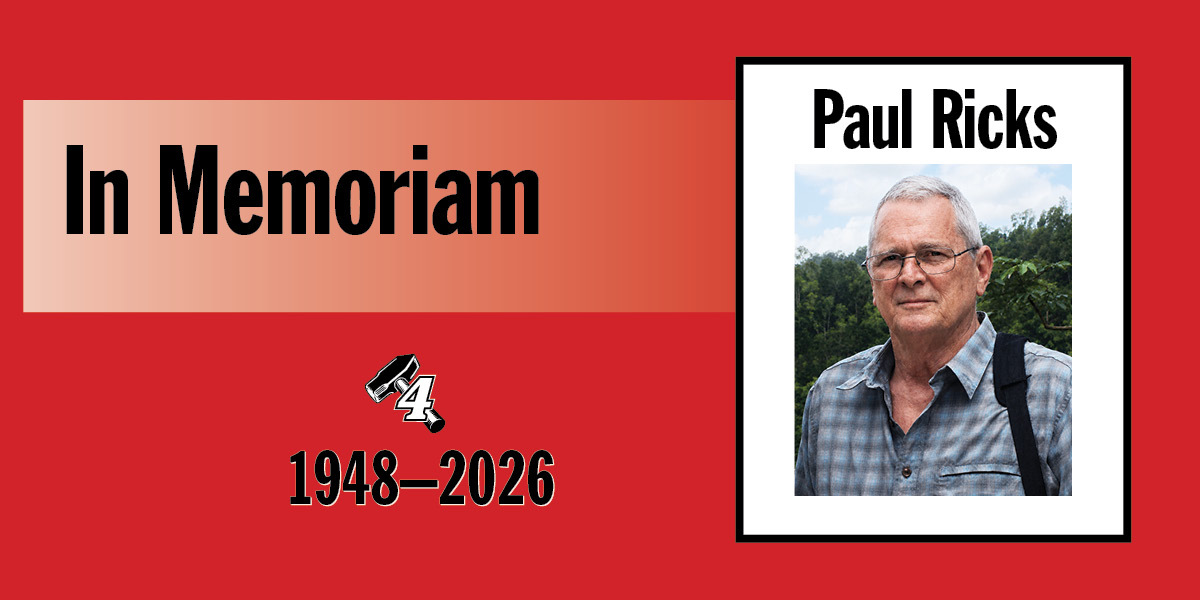
Paul Ricks, known to all his comrades as Collins, died on June 17 of cancer. Paul was a “lifer,” a veteran Trotskyist who never gave up on the revolutionary purpose he dedicated his life to as a young man. Like many of his generation, he was radicalized by the struggle for black freedom and the Vietnam War. Drawing a very low draft lottery number, a fair certainty that he would be deployed to Vietnam, he took a calculated risk and joined the Coast Guard because he didn’t want to kill Vietnamese people or become cannon fodder himself. While still a junior officer, he was won to Trotskyism and in 1971 joined the Bay Area Spartacist League to fight U.S. imperialism.
Paul’s talents were recognized early on, and party elders invested time and attention to train him as a Marxist. A serious reading program of basic Marxist texts gave him a head start in developing the depth of knowledge required to sustain a lifetime of commitment to building a revolutionary party. Reminiscences by Paul’s ICL comrades around the world testify to his drive to study the history of the workers movement and its struggles in specific countries.
Paul always recommended good books to comrades and expected them to be read, because he wanted to talk about their relevance to current struggles and areas of party research. His last assignment in the party was working in the Prometheus Research Library (PRL), where he made invaluable recommendations for expanding our collections on Southeast Asia and Vietnamese Trotskyism. Uncannily, the last book about Vietnamese Trotskyism he ordered, Revolutionaries They Could Not Break, arrived the day he died.
Raised in Texas as a young child and later in Southern California, Paul was a high school varsity basketball and tennis player, as well as a gymnast and avid surfer. He also served as senior class president before attending UC-San Diego on a scholarship. After Paul’s death, his younger sister wrote a letter with tender memories of the brother who enticed her to become a lifelong reader with gifts of beautifully illustrated books when she was a child. Later in life, Paul became a marathon runner whose fortitude could be measured by how many finish lines he crossed while still enjoying his smokes and drinks.
Paul’s contributions to building an international revolutionary party spanned decades and continents. He organized multiple party branches, managed the first Spartacist election campaign in New York City in 1978, wrote for several party publications, edited Australasian Spartacist, served as a public party spokesman and worked in the International Secretariat as well as the PRL. Paul put his military training to use to defend the party in many dangerous situations. He understood military command to be a political task and applied himself to it with imagination and resourcefulness against attempts to silence revolutionary Trotskyists.
At a gathering to salute Paul, one comrade recalled his brilliant leadership in a protest against the Israeli butcher Moshe Dayan in 1975 at UCLA. The Maoist Revolutionary Communist Party, which called the demonstration, threatened violence if we showed up; an Iranian Maoist group did the same; the Jewish Defense League threatened all anti-Zionists, including us. Paul drilled and mobilized a phalanx of disciplined comrades who marched right into the demonstration. The RCP didn’t dare lay a hand on us, so they attacked Progressive Labor (PL) instead. Paul announced, “We are now going to defend PL!” Then a group from International Socialists approached and asked us to defend them, too. Paul replied, “Fall in at the rear.” Each tendency had the right to express its views under its own banners in the Spartacist contingent, and nobody got hurt.
In early 1979, Paul and his wife and comrade Rita were transferred to our Australian section, then called the Spartacist League of Australia and New Zealand. Paul seriously studied the struggles of working people and the oppressed in Australia and throughout Southeast Asia. Maintaining a close relationship with the section, he became deeply knowledgeable of the region. As a comrade from the Philippines wrote, Paul helped them plant the banner of Trotskyism in that repressive country.
In 1985, Paul played a leading role in a campaign against craft unionism and for industrial unionism at Sydney’s Cockatoo Island against the dockyard bosses and Bob Hawke’s Labor Party government. Neil Florrimell, a union militant and supporter of the Spartacist League, was sacked from his job as an ironworker-rigger after refusing to work with apprentices brought in as scabs to break a strike by electricians. This struggle, which began with one militant taking a principled stand, was enthusiastically taken up by workers in other divisions who mobilized and won Florrimell’s job back (see Australasian Spartacist supplement, 3 April 1985).
As that campaign wrapped up, Paul led the defense of a meeting in Melbourne commemorating the 10th anniversary of the U.S. defeat in Vietnam. With hundreds of Vietnamese émigrés howling for blood outside, police first tried to get comrades to open our doors to the fascist gusanos and, when the meeting was over, to make participants walk a quarter-mile gauntlet to waiting buses. Facing down the police commissioner on both counts, Paul led a disciplined defense guard that ensured the integrity and safety of the commemoration.
The year before, the SL/ANZ had worked with Aboriginal peoples from Wollongong to organize a united-front protest against the acquittal of cops who murdered 16-year-old John Pat in custody. This set the precedent for significant annual protests against black deaths in custody. Paul spoke powerfully at a big public meeting hosted by the Committee to Defend Black Rights. Warning that asking the Australian government, a “master race democracy,” to defend black people was as absurd as asking a pickpocket to watch your wallet, he pointed out:
“When do you get justice? Well, you get justice when you got power. And the power in this country that can be mobilised, in defence of black rights and the rights of other minorities, is the working class, the organised labour movement…. We noticed we’ve got union speakers here tonight, the Combined Unions Against Racism. Fine. Let’s see a little less talk and see some action, let’s see those unions come out in protest, on the streets.”
Paul soldiered through decades of rough and tumble political fights and could give as good as he got. He also had a gentle side, especially shown in his attention to younger comrades. At the gathering for Paul, several spoke about his keen interest in helping new recruits become party cadres. He took the time to seek them out, hang out and informally impart party history. One young party leader who was schooled in basic Marxism by Paul wrote that he was not a man of softness, but the fights he waged showed a toughness born of conviction. A message from another comrade recalled his straight-talking advice when, as a new youth member, she blew an intervention in a public meeting: It is not a crime to try and fail if you learn something.
Paul worked hard to understand the major changes in the ICL over the past decade, the critical reviews and corrections of some key positions we have had since our inception. He avidly supported the need to recognize national liberation struggles as key levers for socialist revolution. His interest in the Trotskyist movement in Vietnam was particularly focused on the period from the 1930s until immediately after WWII, when the Trotskyists, who had a fairly broad following in the Saigon proletariat, were massacred by the Vietminh.
Multiple cancers sapped Paul’s physical strength, but neither disease nor ravaging medical treatments could shut down his active mind, his iron will and his gallows humor. Paul submitted two documents and a reading list on Vietnamese Trotskyism before the ICL’s Ninth International Conference as part of our project to review the history of the Fourth International. The heroic struggle of the Vietnamese people was key to his political awakening. He stressed that many of those lessons seem to be forgotten today on the left, and he was determined to transmit them. If you were on the other end of the phone in the last weeks of Paul’s life, you would never have guessed that this comrade was so gravely ill.
Paul gave 55 years of his life to the Trotskyist movement. ICL veterans and youth members alike felt that strong and unique bond of comradeship with him. Our hearts go out to our comrade Rita, and to Paul’s family and hers.