
https://iclfi.org/pubs/wv/1191/frank
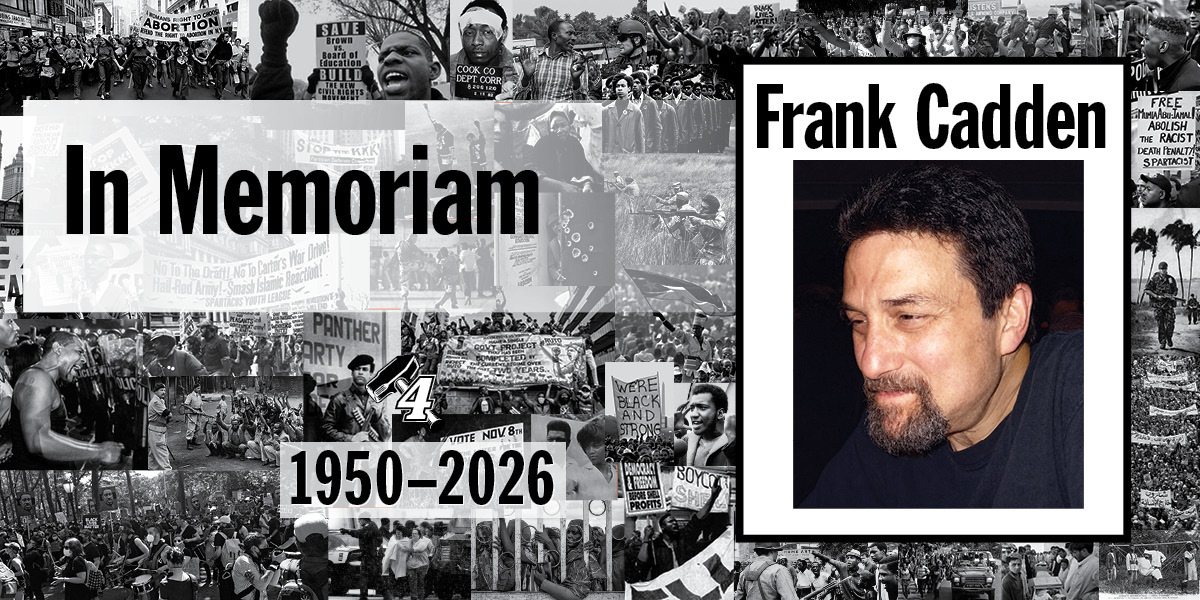
Our beloved comrade Frank Cadden died from a fall on June 20. He leaves behind Susan, his comrade and wife of nearly 50 years.
For decades, Frank was a mainstay of our composition department, which produces the publications of the Spartacist League/U.S. and the International Communist League. From the mid 1970s until his sudden death, he managed our photo archives, helping shape the look and political direction of Workers Vanguard, Young Spartacus, Spartacist and our many other publications. A picture tells a thousand words, and Frank was instrumental in filling the pages of our newspapers and journals with countless pictures.
Frank’s devotion to our publishing endeavors grew from his love of photojournalism and, above all, his dedication to building an international revolutionary workers party based on the program of Trotskyism. His path in life was no accident. Of German and East European Jewish descent, his parents became left-wing activists in the 1930s. His father was a leading figure in the American Youth Congress, while his mother was a member of the Young Communist League. With the onset of the Cold War against the Soviet Union after World War II, his parents stood with their comrades facing the full force of state repression. They opened their home and held fundraising parties for victims of the anti-Communist Smith Act, the McCarthyite witchhunt and the House Un-American Activities Committee. It was in this political environment that the young Frank Cadden grew up.
At the same time, as is often the case with young people searching for direction, Frank’s road to communism was anything but straight. Amid the freewheeling and tumultuous 1960s and early ’70s, he traveled the globe, spending long stretches in India and Afghanistan. After returning to New York City, he landed a job at Sound One and worked his way up to become a sound engineer. He developed a library of sound effects for the motion picture industry and became a proud member of the International Alliance of Theatrical Stage Employees. From the analog era to the digital, he was an archivist and earned a reputation throughout the industry as the guy to turn to for a particular sound effect. His family was proud to see his name in the movie credits.
During his period of youthful trial and error, Frank spent over a year at the University of Wisconsin in Madison, a hotbed of social and political radicalism at the time. In this tumultuous atmosphere marked by widespread opposition to racial oppression and U.S. imperialism’s war against the Vietnamese workers and peasants, he found his way to the SL and became a member in 1976. As his sister Joan remarked at a memorial in New York City, at that point, “he became less my Frank and our Frank, and more your Frank. Because this guy, who never would have talked about a concept like the meaning of life, really found meaning in his life. He found the Spartacist League, and he found Susan and he found a group of colleagues, comrades, working for a vision, a cause, that you all share.”
Before the internet, photo archival research was painstakingly laborious and hands-on work. There was no Google, AI or Photoshop to locate, purchase and resize photos. Frank was a genius archivist who closely followed the news. He brought the skills he learned on the job into the party, patiently training comrades in the art of archiving and retrieving. They gathered images from newspapers, magazines and archives and made trips to libraries. Clippings and photocopies were organized in metal file cabinets by subject, event and person. A comrade noted, “We were always looking for photos that might one day prove useful, whether or not they were relevant to the current issue of the paper.” Despite the mass of materials and lack of a database, Frank always knew where to look for a specific photo. He also collected photo books on major historical subjects, from the Russian Revolution to black liberation and the labor movement.
For Trotskyists, there is no division between mental and manual labor—between editorial and production. Frank and the production crew worked hand in hand with the editorial staff to help frame the political line of the party. File cabinets filled with thousands of images would have been useless except in the capable charge of dedicated communists who knew how to use them to convey our program and polemics. Upon hearing of Frank’s death, a former WV editor wrote that in the photo sessions for each publication, “political considerations had to be weighed alongside technical and ethical/aesthetic questions, as well as the logistic feasibility of access. And more than once, the photo discussion in that small circle would lead to political and editorial reconsiderations of the articles in question.” Frank, in defiance of serious health problems, played a leading role in this process.
Quiet, shy, mellow, good-humored, gracious, a jazz aficionado and extremely generous with his time—that was Frank. Although a man of few words, his words mattered. When learning of Frank’s death, the owner of a digital imaging center, with whom Frank had developed a working relationship, expressed not only great sadness but also admiration for his solidarity with the oppressed—particularly his defense of Iran against U.S. imperialism. To echo our Bay Area comrades: “Frank Cadden—Presente!”