

https://iclfi.org/pubs/wh/2026-false-hope
The entire left is ecstatic over the historic win for the Greens in Gorton and Denton. We have to admit: the Greens managed to run an effective campaign which captured the hatred of Labour and Reform UK, particularly but not only among Muslims. The new MP Hannah Spencer, a worker and Mancunian, was thus able to take this rock-solid Labour seat, driving another nail into Starmer’s coffin. In response, the Greens faced vile attacks from both parties. But while Reform lost, they did come second with a huge increase in their share of the vote. Now, these sore losers are claiming election fraud with bogus claims of “family voting”—an anti-Muslim trope.
The joy at Reform’s defeat is understandable. For years, Reform has been steadily rising unopposed—thanks to Labour’s disastrous government. Now, many on the left think that, while the Greens might be far from perfect, we finally have a left-wing vehicle that can stop it. However, we must warn that this is a dangerous illusion. While the Green Party can win some elections, it cannot defeat the insurgent right wing.
Liberal idealism fuels the right

13 September “Unite the Kingdom” rally. Workers have turned to the right because left propped up liberal status quo.
The steady rise of right-wing, anti-immigrant reaction—embodied in Reform, as well as Rupert Lowe’s Restore Britain, Tommy Robinson, etc—isn’t simply an electoral phenomenon. It reflects a deep anger among layers of the population—particularly in working-class areas—at the status quo of “Broken Britain” and the liberal political establishment. This isn’t something that can be stemmed merely by tactical voting and electoral calculations. No. Rather, what is necessary is to channel this anger—currently mobilised against Muslims and immigrants—and redirect it against those who actually broke Britain: the City of London, capitalists, aristocrats and the liberal establishment which defends them. This is how working-class support for Reform can be fundamentally undermined.
Obviously, the Green Party cannot and will not do this. Its programme and outlook are a more radical, and frankly utopian, version of liberal ideology. The Greens are staunchly pro-EU, pro-Ukraine, ecologists, advocates of identity politics and social liberalism. Despite Polanski’s rebranding of the party, it offers no serious answers to the problems of Britain, other than a series of feel-good slogans about “togetherness”, “hope” and “humanity” and policies based on wishful thinking. Anti-immigrant bigotry is countered with “love thy neighbour”. Polanski wants to solve the Ukraine war by evoking Nelson Mandela, the UN and nuclear disarmament. And for the Greens, bringing Britain back on track largely means undoing Brexit.
The issue with this mish-mash is not that it “isn’t perfect”. It is that it will push workers further into the arms of the far right. Working people are rebelling precisely against this type of “progressive” and moralist stuff. They are turning to the right wing because it offers some sort of a break with the liberal status quo. Therefore, clinging to the values of the liberal era—and cranking them up a notch—will not solve this problem but only make it worse.
This does not mean that the Greens cannot win some seats, particularly where there are immigrant communities who rightly fear Reform, or enough middle-class voters. But ultimately, for working people who have seen their lives destroyed, the Greens’ appeal for “peace, love and hope” will be no match for the insurgent calls of the far right to smash liberals, immigrants and Muslims.
You can’t tweak Broken Britain
What confuses many leftists is that Polanski is transforming the Greens. From a middle-class, “Tories on bicycles” image, the Greens now barely talk about the environment. Instead, they campaign on the cost of living, nationalisations of public utilities and taxing the rich.
Whatever people may think of the Greens’ promises, very few outside the leftist bubble seriously believe that their economic policies will fix this country. In Gorton and Denton, the main driver of the Green vote was a desire to give the finger to Labour and keep Reform out. Not confidence in the Greens’ plan.
Manchester itself is a snapshot of what this country has become. The city centre has glitzy banks and luxury apartments with sky-high rents. These sit side-by-side with some of the most deprived areas of the country, ravaged by shuttered factories and generations of unemployment and poverty. Under the watchwords of Blairism, Britain has become a deindustrialised wasteland, made to fatten the City of London, with entire areas of the country literally left to rot.
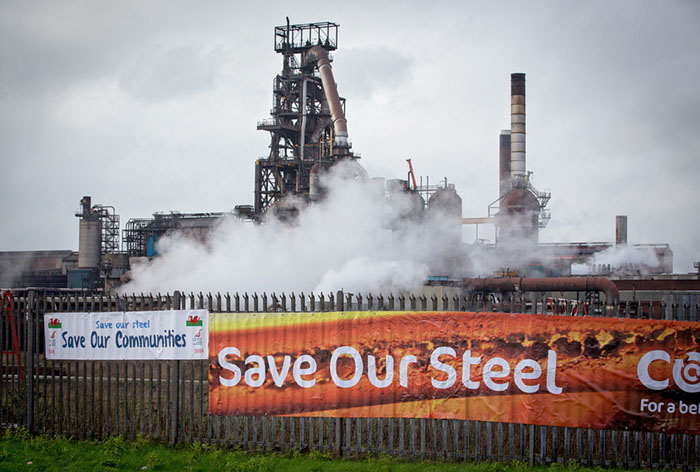
Above: Hundreds have lost jobs at Port Talbot steelworks, Wales. City of London (below) destroyed industry, ruined Britain. Greens won’t confront financial barons.

So how on earth is a 2% tax on the billionaires, or nationalising the utterly decrepit public utilities, supposed to fix this? And how will the Greens even get those measly measures? Through Parliament, of course. But the City of London, the establishment and their media mouthpieces will put up the most determined struggle against any attempts at touching their stolen wealth.
Any substantial wealth tax requires a powerful mobilisation of the working masses of this country in a head-to-head confrontation with the City of London. Only if they fear losing everything will the rich cough up some money. And it is by organising such a fight that the far right can be seriously undermined and the deep racial divisions among workers bridged. But this is not what the Greens are about. Rather, they fuel the illusion that tinkering with the tax system can fix this country—a notion which will crash on contact with reality.
Indeed, until now, the ruling class had pretty much ignored the Greens. This is changing, and we will soon see a torrent of attacks and dirty tricks aimed at putting maximum pressure on the party for it to capitulate and abandon its most radical demands. As the Greens seek to become a serious and respected force, and since they are not based on a working-class opposition to the entire system, their political direction of travel will be to the right, not to the left.
Stuck between the radical aspirations of a part of their new base, and the requirements of the ruling class’s system in which the Green leaders want to work, they will dither, hesitate and compromise. This is what happened to Corbyn before. And this is the kind of weakness that fuels the far right, which is increasingly confident and ready to use radical and extra-parliamentary means to achieve its aims.
A “progressive” coalition?
The British ruling class will never let green hippies take command of the country. In turn, Zack Polanski himself does not really expect to become PM. So, what is the plan exactly? Starmer’s days are numbered, and Polanski wants to become kingmaker in a new “progressive” coalition aimed at Reform, consisting of post-Starmer Labour and the Greens, undoubtedly with the support of the trade-union leaders, and maybe even the Lib Dems. Polanski has expressed his readiness to form such a coalition, and we already see it taking shape with the Together Alliance. (Of course, a special place will be reserved in this lash-up for Corbyn, who will happily hand over his crown as icon of the left to Polanski and get back to his allotment.)
Of course, as we noted, such an alliance will require that the Greens drop their most radical (and utopian) demands. But more importantly, the prospect of a Labour-Green, anti-Reform coalition would be the greatest boost for Reform and the far right. It might get some electoral wins, but an alliance of socialists, Greens, all the way to Labour and the very people who broke Britain is the surest way to discredit the entire left, and strengthen Reform’s credentials as the only anti-establishment option. This is what the New Popular Front in France was—and the result has been a massive strengthening of the far right.
The socialists who are today all gaga about the Greens—from Novara Media and Owen Jones to the SWP—are failing to see further than immediate electoral results. This will prove disastrous in the long run.
Tasks of socialists
The road ahead for the socialist left will be difficult. The Greens’ victory in Gorton and Denton came the morning after the Corbyn faction defeated the Grassroots Left in the Your Party CEC elections. With the Corbynite wing firmly in charge, they will further align Your Party behind wishy-washy liberal politics virtually indistinguishable from the Greens, while purging the left-wing. The truth is that the Greens have now occupied the space that opened up on Labour’s left flank, with Your Party now a near-irrelevant factor in the landscape. This means that the window for socialist politics getting mass appeal is closing for now.
For socialists, it is absolutely vital to resist the Polanski-mania. What is still needed is a fighting, working-class and socialist party, able to fight Labour and Reform, and offer what the liberal Greens can’t. This isn’t easy or quick, but there is no other road.
How to get there? What is needed is to regroup all those elements who still want to fight for this and draw serious lessons from the last period. One of the main reasons the far left hasn’t been able to make any breakthroughs is that it has failed to counterpose a coherent political answer to the Greens, as well as to Corbyn, who, in fact, has almost identical views.
Rather, the far left has remained stuck in endless talks about internal “democracy”, abstract propagandising, and a paralysing fear of fighting the Greens (and Corbyn). As we can see now, this has only served to sideline us. We must rearm. For this, we should not quit Your Party. Rather, the Grassroots Left should elaborate a serious political answer to Reform, Labour and the Greens. We should fight inside Your Party for a programme that can really tap into working-class discontent, and offer what Corbyn and the Greens can’t: a fighting perspective for a government of the working class against the City of London.
All the immediate issues facing workers in Britain—decrepit public services, deindustrialisation, the broken immigration system, the housing crisis, imperialist wars—are connected to the fact that the City of London dominates this country. By focusing on the City—that is, expropriation of big banks for the reindustrialisation of the country according to a plan—we can forge real unity among workers—both native and foreign-born—against their common enemy in a way liberal platitudes can’t.
Only by putting forward a coherent programme can the socialist left fight the Corbyn wing in Your Party, distinguish itself from the Greens and build what is actually needed to defeat Reform.
This article also appeared in: