
https://iclfi.org/pubs/wv/2026-uf-class-3
The following is comrade Jon Brule’s third presentation in a five-part Spartacist class series on the united front. Readings for this class can be found here.
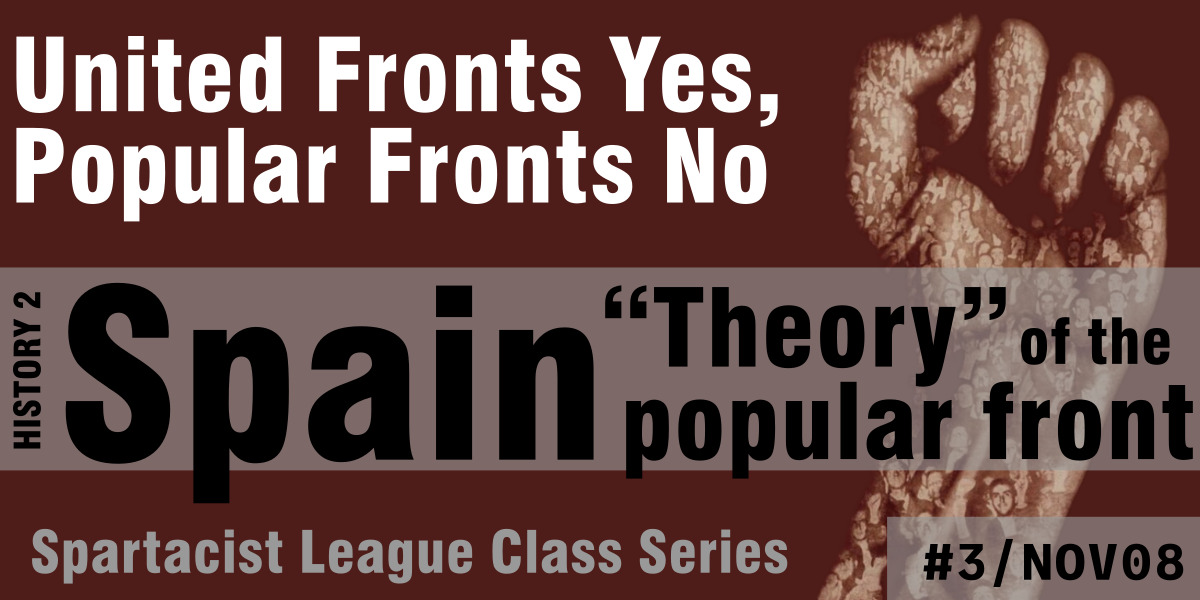
This class deals with the Spanish Civil War, fought between 1936 and 1939. This was, like Russia in 1917, clearly a revolutionary situation. However, unlike the Bolsheviks, all the more substantial left parties in Spain—from the Stalinists to the Socialists and the anarchists and the Workers Party of Marxist Unification (POUM)— supported the Popular Front. Indeed, all of them at one time or another joined the bourgeois Republican government.
As the Trotskyist Felix Morrow wrote in his book Revolution and Counter-Revolution in Spain (1936), “No civil war as profound as the present one in Spain has ever been won without advancing a revolutionary social program.” But the program of the Popular Front was the opposite: it claimed that the fundamental social and political ills of Spanish society could not be addressed until after achieving military victory over Franco. This, in fact, served only to demoralize the Spanish working masses. As we saw in the previous class, Lenin drew a clear distinction at the time of the Kerensky-Kornilov conflict between siding militarily with a bourgeois government versus giving it political support. This position was honored in the breach by the left parties in Spain who combined taking up arms against Franco, which was of course correct, with the false policy of supporting the bourgeois government. The end result was the victory of Francisco Franco, the Spanish Kornilov, who imposed a crushing military dictatorship for decades.
Let’s look more closely at what happened in Spain. The abdication of King Alfonso XIII in 1931 set off several years of social and political struggle. In February 1936, a popular-front government was elected. The program on which the government was elected was explicit in its opposition to any infringements to the rights of private property. The program asserted that “The republicans do not accept the principle of the nationalization of the land and its free distribution to the peasantry….” Also the program stated that “The republican parties do not accept the measures of nationalization of the banks proposed by the workers’ parties” and even opposed the payment of unemployment benefits, proposed by the workers’ delegation. The left parties mentioned above all signed on to this program.
However, the working masses did not passively agree to abandon class struggle. The elections in February 1936 were followed by a wave of worker strikes and land seizures by the peasantry. An alarmed bourgeoisie resolved to smash this insurgency by military means. On July 17 Franco staged his rebellion, which began in Morocco and spread to Spain. This attempted coup had the support of almost the entirety of the bourgeoisie. The government responded to the coup by trying to give assurance that it had the situation in hand while rejecting requests from the trade unions that they be given arms to fight Franco. Meanwhile the government frantically sought to contact the coup leaders and come to an understanding with them, i.e., capitulate. However, the coup leaders saw no reason to negotiate with a weak government that refused to fight.
Fortunately, the working class wasn’t having it. In Barcelona the workers raided stores for rifles, construction jobs for sticks of dynamite, fascist homes for concealed weapons. Then they successfully seized the fascists’ barracks. Within a few days, all of Catalonia was in their hands. In Valencia, soldiers within the garrisons shot the officers and gave arms to the workers. The Asturian miners outfitted a column of five thousand dynamiters for a march on Madrid. It arrived just after the barracks had been taken and took up guard duty in the streets. So began the civil war.
What is notable is that the Spanish bourgeoisie, almost in its entirety, supported Franco. As Trotsky expressed it:
“Politically most striking is the fact that the Spanish Popular Front lacked in reality even a parallelogram of forces. The bourgeoisie’s place was occupied by its shadow. Through the medium of the Stalinists, Socialists, and Anarchists, the Spanish bourgeoisie subordinated the proletariat to itself without even bothering to participate in the Popular Front.”
—“The Lessons of Spain: The Last Warning,” December 1937
As Trotsky stated, only “insignificant debris from the possessing classes,” “political attorneys of the bourgeoisie but not the bourgeoisie itself” joined the popular front. But the inclusion of even the “shadow of the bourgeoisie” was significant, inasmuch as the workers parties committed themselves to accepting the limits imposed by the liberal wing of the capitalist class. The reformist misleaders constantly sought to explain their refusal to fight for a revolutionary outcome on the grounds that it would alienate their bourgeois bloc partners.
The answer was to break the Popular Front. Trotsky wrote:
“A civil war is waged, as everybody knows, not only with military but also with political weapons. From a purely military point of view, the Spanish Revolution is much weaker than its enemy. Its strength lies in its ability to arouse the great masses to action. It can even take the army [of Franco] away from its reactionary officers. To accomplish this, it is only necessary seriously and courageously to advance the program of the socialist revolution.”
As we have discussed previously, this is exactly what the Bolsheviks did, enabling them to lead the masses to victory in the October Revolution and later triumph against the counterrevolutionary Whites and the imperialists in the civil war. “Peace, bread and land” --the Bolsheviks gave land to the peasantry, ended the predatory imperialist war and put the working masses in charge of the economy.
However, this is exactly what the Popular Front would not do in Spain. Franco’s army could have been ripped away from him. There were many conscripts from the peasantry. In Spain some 70 percent of the population lived on the land, and the division of the land was among the most unequal in Europe, with five million peasant families owning only a third of the land. The peasants constantly asked: “what has the Republic done for us?” The burning need was to seize the property of the wealthy landowners and distribute it to the peasants. But to do this meant breaking with the Popular Front, which was committed to maintaining the existing division of the land.
The Popular Front coalition took over the Spanish colony in Morocco and ruled it, as had the monarchy, through the Foreign Legion and native mercenaries. Many of those serving in Franco’s army were oppressed colonial subjects. Had the Republic come out for independence for Morocco this could have undermined Franco’s army. Withdrawal of all Spanish troops and immediate independence for Morocco were demands in the interest of both the oppressed Moroccans and the Spanish working masses. But fearing the revolution more than Franco, the chauvinist government rejected this. In particular, it rejected a proposal from the anti-imperialist fighter Abd-el-Krim to incite revolution in Morocco under the banner of a declaration of independence for Morocco.
The Civil War
Following the successful repulse of Franco’s initial attempt to seize all of Spain in July 1936, the workers were emboldened and proceeded to make incursions on the bourgeois state. While this was not as a comprehensive as what was thrown up in Russia, embryonic forms of dual power were established. In Catalonia, which was the heart of the revolution, the peasants did in fact occupy the land, organizing committees that took charge of feeding the militias and the cities. Every district, town and village created its militia committees to arm the masses and drill them.
On July 21 a “Central Committee of Anti-fascist Militias of Catalonia” was established. This was in fact a good example of a united front, whose purpose was to organize the military struggle against Franco. Of the fifteen members of this body, five were members of the anarchists, who were the dominant force among the militant proletariat of Catalonia. The other workers parties had representatives, as did the small bourgeois parties. But control rested with the workers organizations and militias. It eventually took on broader functions, organizing a department of worker-police and a department of supplies, whose word was law in the factories. The Catalan militias marched into Aragon, conquering it as an army of social liberation. Village anti-fascist committees were set up, which turned over all the large estates, crops, supplies, cattle, tools, etc., belonging to big landowners and reactionaries. Captured reactionaries were placed before the general assembly of the village for trial. All property titles, mortgages, debt documents in the official records were consigned to the bonfire.
The weakness of the Central Committee was that it operated by consensus of all organizations from which it drew its members. After a few weeks, the bourgeois parties and the Stalinists began increasingly to obstruct the work of the militias. The anarchists made concessions to them. From that point on, the Central Committees could only have functioned progressively by abandoning the method of mutual agreement and adopting the method of majority decisions by democratically elected delegates from the militias and factories. That is how the system of soviets operated in Russia. However, even with its weaknesses the workers militias were perceived by the bourgeoisie as a threat. When the Anarchists and the POUM entered the Catalan government, the Generalitat, in September 1936, they agreed to dissolve the Central Committee of the Militias which were replaced by bourgeois local administrative bodies. These bourgeois cops were later used to suppress the revolt of the workers in Barcelona in May 1937.
In the revolutionary days in July, the Catalan workers took over transport and utilities. Factory committees were established that operated abandoned factories, increasing production for wartime need. However, respecting the program of the Popular Front which they had signed, the anarchists had no intention of taking over the banks. Thus, the bourgeoisie continued to control credit necessary for the operation of industry and economically strangled those factories where there were strong factory committees.
Gradually the bourgeoisie reasserted control throughout Catalonia and the rest of Republican Spain. Censorship became increasingly common, workers in the rear were disarmed and their functions taken over by bourgeois cops, the militias of the anarchists and POUM on the front lines were threatened with liquidation and being absorbed into an army under bourgeois state control. Things came to a head in May 1937 in Barcelona. On May 3 the government moved to take the Telefónica building out of the hands of the workers in the Anarchist union who ran it. Assault Guards commanded by the Stalinist Rodriguez Salas arrived at the building and on behalf of the Popular Front government demanded that the workers abandon it. They put up resistance and an exchange of fire began. Within four hours a general strike was declared and the city was engulfed in street fighting with barricades being erected. By May 4 the city was under control of the workers, except the center of the city, where battles continued until dusk.
Once again, however, the workers in the ranks of the anarchists and POUM, having shown their revolutionary mettle, were betrayed by their leaders. Anarchist leaders were dispatched to the city and ordered the workers back to their homes. The POUM, when push came to shove, said they couldn’t go against the Anarchist leaders. While the standoff continued for a couple more days, the workers were ultimately demobilized and defeated. Five hundred died and over a thousand were wounded during the May events. The POUM’s paper, La Batalla, was banned and its main leader, Andrés Nin, as well as anarchist leader Camilo Berneri, died at the hands of the Stalinists. These events were a watershed. The defeat was massively demoralizing. From this time on one defeat followed another. In January 1939 Barcelona surrendered, and two months later the Republic was gone.
What all of these events demonstrated was how deluded the left was in thinking that they could enter the Popular Front government and make it serve the interests of the working class. This is fundamentally counterposed to the Marxist understanding of the state: The working class cannot simply lay hold of the state machinery and wield it for its own purpose. Instead, it must break up and shatter the existing capitalist state and put in its place a workers state, i.e., the dictatorship of the proletariat. To carry out the latter task, that is, to carry through a workers revolution, was entirely possible in Spain. That this was not accomplished speaks to the depth of the betrayals of the socialist parties.
The Parties
As we discussed in the first class, the People’s Front policy was adopted in the 1930s by Stalin’s Comintern in an attempt to appeal to the bourgeois democracies—Britain, France, U.S.—in light of Hitler’s taking power in Germany. This represented an abandonment of the only true strategy to defend the Soviet Union, which was the program of spreading socialist revolution internationally. Supposedly these bourgeois democracies would then defend the USSR against Nazi Germany as well as halt the growth of the fascists and the right generally. These appeals to the democratic imperialists were futile. It is worth noting, for example, that in France the socialist government of Leon Blum under its “non-intervention policy” refused to ship armaments to Republican Spain. And as we have seen, the Popular Front in Spain itself, far from stopping Franco, paved the way for his success and the smashing of the workers movement there.
The Stalinists were the most resolute force within the Popular Front in Spain that sought to suppress social revolution. As Trotsky summed up their role:
“The most consistent policy in the ruling bloc was pursued by the Stalinists. They were the fighting vanguard of the bourgeois-republican counterrevolution. They wanted to eliminate the need for fascism by proving to the Spanish and world bourgeoisie that they were themselves capable of strangling the proletarian revolution under the banner of ‘democracy.’ This was the gist of their policies.”
The Stalinists hounded the Trotskyists, POUMists, revolutionary anarchists and left socialists. Of course, their dirty work was no secret to those who fought in Spain—the slanders, false documents, tortures in Stalinist prisons. But they were considered indispensable by the Popular Front regime precisely because they defended the interests of the bourgeoisie against the proletariat more consistently than the others.
Unlike in many other situations, anarchism in Spain was not a fringe phenomenon but had deep roots in the proletariat, particularly in Catalonia. The anarchist workers represented a much more serious core of the Spanish proletariat than the Stalinists. However, the anarchist leadership at crucial moments, when the question of power was posed pointblank, such as July 1936 and May 1937, proved crucial in saving bourgeois rule. These leaders repeatedly bragged that they could have taken power had they wished at these times. This in itself serves as a total condemnation of their politics. To repudiate the conquest of power is to leave the power with those who wield it, the capitalist exploiters.
Anarchist theory proved to be worthless when put to the test. Denouncing all dictatorships—proletarian as well as bourgeois—the anarchists demonstrated that they couldn’t tell the difference between the two. They railed against the Marxist concept of the dictatorship of the proletariat. But instead, they ended up supporting the dictatorship of the bourgeoisie, in the form of the popular front. They denounced all states as oppressive. But the anarchist leaders took their place in the capitalist government, offering their services to the bourgeois state.
Some anarchist theoreticians claimed that under “exceptional” circumstances such as war and revolution it is necessary to renounce the principles of one’s own program. But as Trotsky observed, “Such revolutionists bear a close resemblance to raincoats that leak only when it rains, i.e., in ‘exceptional’ circumstances, but during dry weather they remain waterproof with complete success” (“The Fifth Wheel,” January 1938).
The POUM was the left wing of the popular front. While some people call the POUM Trotskyist, it was not. A wing of the POUM had formerly constituted the Trotskyist Left Opposition in Spain. However, it then merged with a right wing split from the CP. Trotsky had broken definitively with the POUM before the Civil War. He had in particular denounced the POUM for signing the electoral platform of the popular front, discussed earlier. As the most left supporter of the popular front, the POUM was politically speaking the biggest obstacle. Unlike the other parties, the POUM could write, in the abstract, that the struggle in Spain was between socialism and capitalism, and not limited to the framework of counterposing democracy to fascism. But in entering the bourgeois popular front government, in practice it rendered that assertion hollow. There was a discord between its words and its deeds. That is what defines centrism.
Throughout this period the POUM consistently capitulated to the anarchist leadership, as was the case in May 1937. In order not to have to criticize this leadership, it refused to build nuclei in the anarchist trade unions. For the same reason, it set up its own militia rather than integrating its supporters into the larger anarchist militias or the Republican army. In failing to expose the misleaders of the working class, the POUM assisted the reformists in maintaining their hold over the proletariat. This was a far cry from the strategy of the Bolsheviks, who exposed the treachery of the Mensheviks and Social Revolutionaries, thus enabling it to win the leadership of the toiling masses.
Leadership
In response to the defeat in Spain, some left pundits attributed this to the immaturity of the working class and the lack of independence of the peasantry. But this was false. To blame the masses is a way of diverting attention away from those really responsible for defeat: the leadership, or more accurately the misleadership of the proletariat. In fact, the workers in Spain were far to the left of their leadership. It was the workers who spontaneously rose up to defeat Franco’s coup in Barcelona, Madrid and Valencia in July 1936. It was the workers who armed themselves, set up militias, established factory committees to regulate production. And it was the misleaders who undid all that, as part of their shabby support to the Popular Front government.
What was missing, however, was a revolutionary party. Workers do not easily break with their established leadership. As Trotsky said, “A great historic shock is necessary to reveal sharply the contradiction between the leadership and the class.” And then only gradually, on the basis of their own experience through several stages, can the broad masses be convinced that a new leadership is more reliable and firmer than the old.
But such a new leadership—a party—must be available prior to the revolution since the process of educating the cadres requires time, and the revolution itself does not provide much time. One cannot wait until a revolutionary situation arrives and then proclaim oneself to the masses. Cadres are trained in reactionary periods as well as revolutionary ones. This crucial process of constructing a Leninist vanguard is what we in the ICL are engaged in and is in fact what this class series is all about.
Class #3 Readings
- Trotsky, “The Lessons of Spain—The Last Warning,” December 1937
- James Burnham, The People’s Front—The New Betrayal, 1937, Chapters III and VII
* Recommended: For comrades interested in doing additional reading, an excellent book on the Spanish Civil War is Revolution and Counterrevolution in Spain by Felix Morrow, available on the Marxist Internet Archive.