
https://iclfi.org/pubs/wv/2026-spin
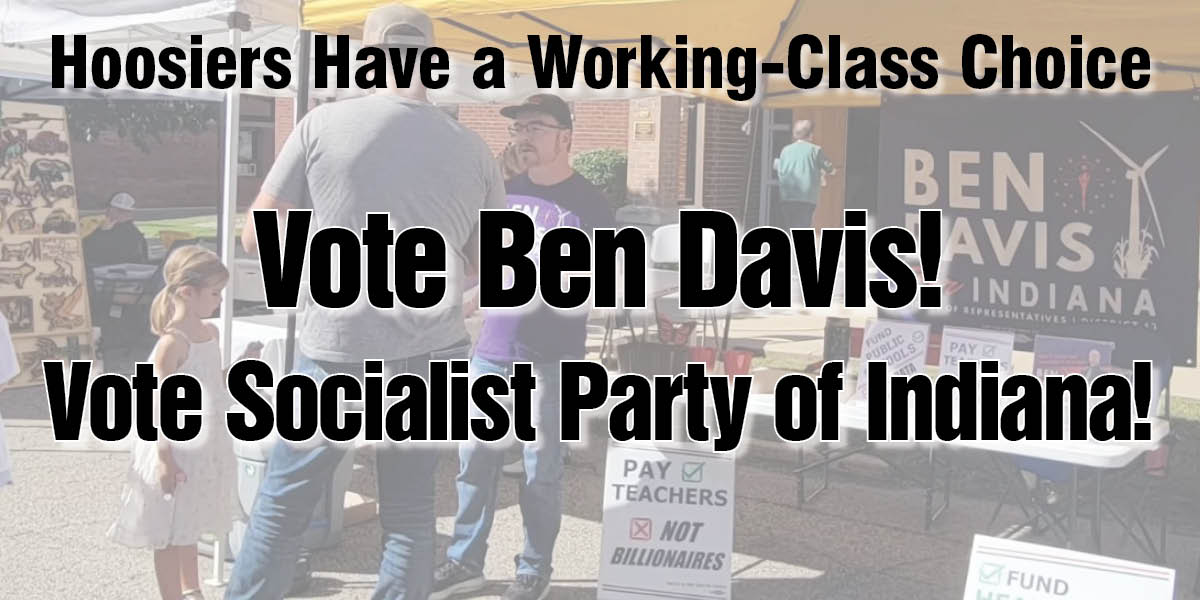
The one glaring constant in the endless cycle of electoral politics is that working people keep getting screwed over. Today, they are forced to spend ever more of their shrinking paychecks on basic necessities, as Trump’s tariffs and “forever wars” add to the pressure. Life under Biden was no picnic either. Working folks are fed up and looking for answers. Their problems won’t be solved at the ballot box, but elections provide an opportunity to coalesce the kind of working-class fightback needed to get results. Ben Davis’s campaign for Indiana House District 13 could help do just that. Running on the Socialist Party of Indiana (SPI) ticket, Davis offers a working-class alternative at a time when the Democratic and Republican parties’ popularity is sinking like lead balloons. Nearly 70 percent of Hoosiers surveyed in a 2025 poll said that the two-party system fails to represent most people’s views.
Dissatisfaction with Trump is growing, Congressional Democrats remain highly unpopular and far-right figures are gaining influence. The left needs to stake out distinct ground and organize to advance working-class interests. Building Davis’s campaign is one place to begin. It recognizes that “the Democratic Party has abandoned rural Indiana” and describes itself as “a grassroots effort by working class Hoosiers who are tired of the two-party system and are ready to start building something else.” Its opposition to the capitalist parties and capitalism could make it a rallying point for workers who want to fight to improve their position on and off the job.
Working-class Hoosiers have taken one hit after another in a state shaped by anti-union “right to work” laws and stark racial oppression. Wages are low and the few remaining centers of labor power are under attack. The bosses are choking the very life out of the USW union in Northwest Indiana, where the once-thriving steel industry is a ghost of its former self. At the Whiting oil refinery, BP’s lockout of USW Local 7-1 is about to enter month eight!
A strong turnout for Davis could signal public opposition to union-busting; his campaign can build support by taking a clear stand against the lockout and connecting with workers who are getting squeezed by anti-union bosses. Major manufacturing facilities, including Subaru and Caterpillar, lie in or just outside House District 13. The several thousand workers at these plants could be a collective force to change things for the better, but they lack union representation. Both Davis and rank-and-file UAW organizers would strengthen broader working-class activism by finding ways to support one another.
On this score, the SPI and its independent ballot line represent a real advance over the DSA, which is attached to the Democrats. Davis and SPI founder Jesse Brown learned the lesson of the Democratic Party’s intolerance for socialism the hard way. Davis, a DSA member, first approached Democratic leaders for access to the party’s ballot line but was summarily rejected. Then-DSAer Brown was elected to the Indianapolis city council in 2023 as a Democrat, only to be expelled from the Democratic caucus early last year for openly and routinely challenging his colleagues on issues from an Israeli arms embargo to charter school funding. To their credit, after this break with the Democrats was forced upon them, Davis and Brown did not fold up their tent and go home but struck out on a path separate from the Democrats, flying high the socialist flag.
Still, the SPI risks entangling itself with the Democrats if it is not careful, a risk that could prove fatal. Brown remains a registered Democrat and, like Davis, advocates an inside-outside approach for socialists toward that imperialist party. According to this view, declared socialists should consider running on the Democratic ticket when feasible, even though the SPI offers an alternative. But SPI’s very origins demonstrated otherwise. As the Davis campaign and SPI more broadly recognize, the Democratic Party is controlled by big money. Any socialist who takes on its label will eventually hit a wall and face a stark choice: capitulate or exit. Brown’s socialist politics earned him a one-way ticket out of the Democratic circle.
Many other DSA electeds, including Mamdani and AOC, have made a home in the Democratic Party at the expense of whatever socialist ideals they may once have held. They rode into office on the capitalist Democratic ticket as rising socialist stars, then proved how impossible it is to serve two masters. They promised working people the sky, only to dash hopes for real change out of deference to party bosses and billionaires. The more these electeds talk about socialism, the more damage they do to the socialist cause when they fulfill their duties as Democrats and betray workers and the oppressed.
The SPI’s independent ballot line exposes the hollowness of the DSA’s argument that socialists have no way onto the ballot except through the Democrats. The Central Indiana DSA’s hostility toward SPI underscores the DSA leadership’s commitment to maintaining the organization as an electoral engine for Democrats—and the need to fight for the DSA to make a clean break with them. By building support for Davis, other socialists can strengthen both his campaign and SPI’s broader opposition to the Democrats, while also encouraging the clean-break fight in the DSA.
Davis’s platform includes generally supportable demands (a thriving minimum wage, single-payer Medicare for all, an end to government oppression) that working people may find attractive. However, his message comes up short in places. For example, he sidesteps the pervasive problem of racial oppression, even when advocating for closing prisons. In Indiana, as elsewhere, black people are vastly overrepresented behind bars because the machinery of repression is geared toward enforcing their subjugation.
The recent two-week blackout in Gary vividly illustrates the devastation afflicting the black community; socialists ignore that devastation at their peril. This treatment gives the country’s rulers an excuse to trample on everyone else’s conditions. The black struggle and the workers struggle must be joined. Appeals to human rights will not accomplish that. Only by emphasizing workers’ material interest in fighting for oppressed groups will it be possible to bridge divisions and wage the most effective struggle for the reforms in Davis’s platform and, ultimately, for socialism.
These concerns are no reason to turn away from the Davis campaign. Quite the opposite. They are reason to engage with it more deeply. The same is true of other independent socialist campaigns, such as Ed Hershey in Chicago, Greg Levy in Ohio and many more. The SPI represents a step forward for working people, and that progress must not be sidetracked.
Socialists everywhere should lend their support. It is impossible to lay a foundation of full organizational and political independence for the working class from the sidelines. Class independence will not arise simply when conditions are right; Marxists must help bring it about through their intervention and leadership. Honoring the best tradition of Eugene V. Debs and his intransigent fight against all wings of the capitalist class, we say: All out to support Ben Davis! Vote Socialist Party of Indiana!