
https://iclfi.org/pubs/wv/2026-crockett-lessons
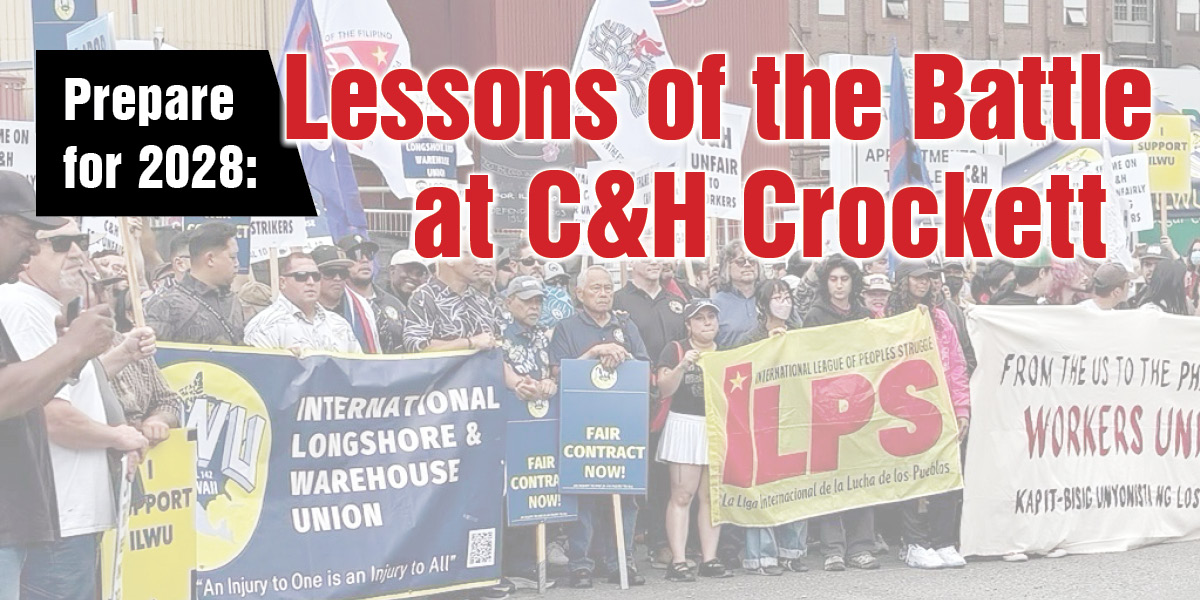
The strike by ILWU Local 6 warehouse workers against C&H in Crockett ignited one of the year’s most important working-class battles. On July 21, longshore workers from ports across Northern California walked off the job, poured into Crockett and built mass picket lines that shut down C&H’s scab operations. Their action showed that the union had the power to win. But after one shift, the ILWU leadership ordered longshoremen back to work, giving up the advantage. In short order, the union tops took down the picket lines altogether and proceeded to negotiate a sellout contract. Had the union ranks not been sent into retreat, the strike could have ended very differently.
Shipping bosses across the country were paying close attention. Supply chain consultants have already published a study providing their “Lessons from the C&H Strike.” Focusing on the July 21 port shutdown, it presents a game plan for the shipping and terminal bosses to curb longshore workers’ power to shut down the supply chain in future battles. Longshoremen need to draw up their own balance sheet and learn the lessons to prepare for the crucial 2028 contract negotiations with the PMA.
Longshore jobs were on the line in Crockett too—it is longshoremen who unload the sugar ships. Local 10 longshoremen honored Local 6 picket lines from the beginning. But C&H eventually hired scabs to replace them. It is important for longshoremen to recognize what a sellout the Crockett deal is. Local 6 members leaving the contract vote meeting were hopping mad. They told Workers Vanguard that the contract was voted up 2-1, but that was because ILWU president Bobby Olvera told them it was the best they were going to get. They realized this meant the ILWU leadership would not mobilize again as it had on July 21. Without that support, Local 6 was never going to prevail against ASR, the giant sugar monopoly that owns C&H. Even so, about one-third of Local 6 members voted “no.”
The strike’s central issue was the defense of retiree medical benefits. C&H agreed to fund these benefits for only eight more years. The majority of C&H workers were hired after 2008 when a deal negotiated by local leaders eliminated their pensions and retirement medical benefits. Under the new agreement, the few workers hired before 2008 are entitled only to paltry buyouts to pay for their own insurance.
All Local 6 members are going to take a pay cut. At C&H, overtime is compulsory, but workers will now receive overtime pay only after ten hours, instead of eight. The company is also getting away with reprisals for strike activity. Two workers fired during the strike were put on indefinite “final notice,” which means that C&H can fire them under any pretext.
The ILWU leadership’s surrender at C&H leaves the union in a much weaker position going into the 2028 contract negotiations. ILWU militants who want to fight must reject the leadership’s losing strategy, which sacrifices the union’s enormous power to keep the peace with the bosses. There is another way, one based on the class struggle methods that built the ILWU in the first place.
Picket Lines Mean Don’t Cross!
For most of the C&H strike, the union leadership ran straggly picket lines of little more than a handful of workers. These picket lines lacked the numbers to stop scabs, and in any case picket captains had explicit instructions to only delay scab workers and trucks, not to stop them. Picketing like this, day after day for five weeks, just demoralized Local 6 members, as well as the Local 10 longshoremen who helped man the lines. That changed on July 21, when longshore workers used their power. They showed what a strike is all about: a battle in which labor gains leverage by exercising its ability to stop the bosses’ operations and cut off their profits.
But longshoremen were ordered back to work for the night shift. A few days later, the ILWU tops sold Local 6 on the necessity of a “cooling off” period, holding up the threat that C&H would otherwise lock them out. This betrayal enabled the company to get Local 6 members to clean up the mess the scabs had made of the plant. Local 10 members went back to unloading ships and C&H’s sugar silos filled up. By the time the ILWU International sealed a tentative agreement, the union had weakened its hand.
Why didn’t the leadership keep up the fight of July 21? It didn’t want a confrontation with the PMA, which had, unsurprisingly, charged the ILWU with an “illegal” work stoppage. There’s a law against just about every weapon the workers have to defend their interests. For decades, union leaders have hidden behind these laws while unions have been gutted. But the ILWU wouldn’t even exist if the workers who fought in 1934 hadn’t mobilized all the forces they could in defiance of anti-union laws and the cops enforcing them.
No Reliance on the Democratic Party!
Everyone remembers what went down in the 2023 contract negotiations. Then-International president Willie Adams promised Biden that the union wouldn’t strike, keeping longshore workers on the job for over a year without a contract. Just as other powerful unions like the UPS Teamsters threatened to strike, Adams surrendered to the PMA’s contract bribe of a hefty wage increase, even though much more could have been won. He did so to protect Biden’s sinking Democratic Party administration, squandering a golden opportunity to put labor on a stronger footing at the ports and beyond.
Bobby O. took office saying that the union’s support to the Democrats would no longer be automatic. That statement was merely a recognition that Trump now has the final say over who gets the scraps from the rulers’ table. Throughout the Crockett strike, Olvera and the rest of the ILWU leadership played the same hand as Adams, courting support from Democratic Party politicians. They gave particular praise to Democratic Senator Adam Schiff, who sent some of his reps to the Crockett lines. Reportedly, Schiff helped broker the deal that got the ILWU leadership back to the bargaining table with federal mediators brought in to force a deal.
End Tier Divisions
In addition to the casual workers at C&H, Local 6 members are further divided into tiers by the 2009 giveback contract negotiated by their leadership. Workers hired before 2008 got pensions and retiree medical benefits; those hired after 2008 did not. The divisions surfaced at the contract vote meetings, where workers hired before 2008 complained to WV that newer workers weren’t up to the fight. Those hired after 2008 pointed their fingers back, saying that the more senior workers care only about themselves.
Tier divisions have existed in longshore for decades. It takes years to work up to full membership in the ILWU’s longshore division, with casuals denied equal pay and benefits, and B-men denied equal work opportunities and a vote in union affairs. These tiers pit worker against worker in a dog-eat-dog struggle to get or stay ahead, undermining union solidarity and its capacity to struggle.
The union leadership negotiated the tiers and, together with the PMA, enforces them. But the shipping bosses are the only ones who benefit. They save billions by withholding full wages and benefits from a large part of their workforce. In 2024, the Committee to End Tier Segregation in Local 10 launched a fight against the tiers. Militants who want to strengthen the union should look for ways to make that fight part of the 2028 contract negotiations. If this fight is not taken up, the PMA can use the divisions as a crowbar to rip the union apart.
Organize the Unorganized!
The ILWU is an increasingly isolated outpost of union power on the West Coast supply chain. The union cannot survive as a thin layer of well-paid workers surrounded by thousands of underpaid, non-union workers scrambling to get by. After its founding, the ILWU launched a “march inland” to organize warehouse workers. But when the warehouse companies moved their operations further inland to escape unionization, the ILWU never followed.
ILWU leaders have been talking up a new “march inland.” The C&H strike could have been a launching pad for that effort. Most of the C&H workforce belongs to Sugar Workers Union No. 1, whose leadership colluded with the company and ordered its members to scab during the strike. Even so, one-third of the members voted to honor the picket lines, a base of support the ILWU could have built on. Amazon workers fighting to unionize were among those who came out to man the pickets, recognizing that a win at C&H could aid their efforts. But why would workers want to join the ILWU after its leadership gave away many of Local 6’s few remaining gains at C&H? To strengthen the union, militants need to start building toward a campaign to organize the unorganized up and down the supply chain, starting with the port truckers who are a key link between the ports and the inland warehouses.
International Solidarity vs. U.S. Imperialism
For years, union leaders have argued that what’s good for the U.S. rulers is good for the U.S. working class. But the cost of U.S. imperialism’s global marauding is taken out of workers’ hides. Longshore jobs depend on the labor of workers throughout the vast international supply chain, and the U.S. rulers’ drive to preserve their global domination is tightening the vise on many of these workers.
This was brought home during the Crockett strike. Filipino organizations rallied their forces on the picket lines, linking Local 6’s fight to the defense of impoverished peasants and sugar workers on the Philippine Island of Negros. During the strike, the first ship handled by scab labor at C&H carried sugar from Negros. In April, 19 people were murdered there by the Armed Forces of the Philippines.
Filipino organizations’ solidarity was recognized in motions passed by ILWU Local 10 and Local 19 in Seattle condemning the Negros massacre. The motions also recalled the historic ties between the toiling masses of the Philippines and the ILWU. After World War II, the ILWU organized Filipino, Japanese, Puerto Rican and other workers in Hawaii, who had labored under slave-like conditions on sugar plantations. Decades later, sugar barons shifted production to the Global South in search of cheaper labor.
Local 19’s resolution calls on the ASR sugar monopoly that owns C&H to recognize and negotiate with the sugar workers union on Negros Island. It also urges the ILWU to invite representatives of that union to its 2027 International convention to speak about wages, conditions and workers’ rights across the Pacific sugar supply chain. Militants in other ILWU locals should add their voices by passing similar resolutions.
An Injury to One Is an Injury to All!
In retaliation for the union’s shutdown of C&H, sheriff’s deputies moved in at the end of the day on July 21. Declaring the pickets an “unlawful assembly,” they manhandled and arrested five ILWU members and five other strike supporters. Black workers, as always, faced the most brutal treatment. One was thrown to the ground and pinned face down beneath a cop’s knee. He had to be taken to the hospital for medical treatment before being thrown into the holding pen overnight.
Several Bay Area unions and other organizations took up the cause of those arrested (the “Crockett 10”). Militants in ILWU Local 10 got the local’s executive board to pass a motion in their defense. BART workers in ATU Local 1555 and members of two AFSCME divisions also joined the effort. On August 19, about 140 union members, community activists, Filipino organizations and leftists rallied at the Richmond courthouse in defense of the Crockett 10. Speakers included well-known rapper and film director Boots Riley. Terry Lovett, a former member of Local 6 whose son Jalani was found dead in his cell at the L.A. Men’s Central jail, connected the attack on the unions to the police terror directed against black people.
Faced with this outpouring of support for the Crockett 10, the D.A. announced at the hearing that they would not pursue the charges that day. Now that the strike is over and there is no longer the same need to intimidate union militants, the D.A. has dropped the charges against the five ILWU members. But the threat of charges still hangs over the heads of the other five, who are all supporters of the Internationalist Group. ILWU militants, leftists and all other defenders of the rights of labor need to keep up the fight to clear their records of all charges.
Longshore Workers: Prepare for the Battle Ahead
The ILWU leadership has so far rejected the PMA’s demand to extend the current contract past 2028, and it talks about a real battle ahead. But the International’s retreat and sellout in Crockett shows that they can’t be trusted to prepare the kind of fight that is needed to win substantial gains. There is a road available for ILWU workers who want to fight:
- Get ready to mobilize the power you showed on July 21, building on the solidarity of other unions that defended the Crockett 10.
- Maintain the connection with Amazon workers, including those who are Teamsters, as part of fighting to organize unorganized workers in the West Coast supply chain.
- Combat the tier divisions. Let the Bs and casuals know you have their backs and will fight for them.
- Appeal to longshore workers worldwide for solidarity in action and build on the support shown by Filipino and other community organizations. The ILWU needs to fight for recognition of the sugar workers union in Negros and develop allies along the international supply chain.
This article also appeared in: