
https://iclfi.org/pubs/wv/1190/solidarity-center
Dear Workers Vanguard,
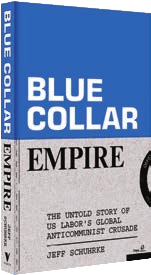
After retiring from the ILWU longshore union, I joined a workers book club founded a few years ago by some IBEW electricians. We read Blue Collar Empire: The Untold Story of US Labor’s Global Anticommunist Crusade (2024) by Jeff Schuhrke. I want to bring the book, which will likely be popular among the Labor Notes crowd, to your readers’ attention. It provides an invaluable history of the AFL-CIO bureaucracy’s longstanding collaboration with U.S. imperialism to subvert militant workers movements and support CIA-engineered military dictatorships around the world. But readers should also be cautioned that Schuhrke’s liberal prescriptions are an obstacle to building the class-struggle, anti-imperialist labor movement that can bring real gains for the working class, here and abroad.
Today’s young labor activists grew up in the liberal post-Cold War era and may not be aware of just how embedded the AFL-CIO has been in U.S. imperialism’s heinous international crimes. Schuhrke documents much of it. How in the aftermath of World War II, the AFL’s “Free Trade Union Committee” under Jay Lovestone and Irving Brown forced splits in many European trade unions, working to stabilize pro-U.S. capitalist regimes to fight communism on that continent. How Brown and other operatives went on to Asia and Africa, working to split nascent trade-union movements in order to head off radical struggles for independence, combat Soviet influence and shore up leaders friendly to Washington. How AFL-CIO “training” schools in Latin America and the Caribbean produced the agents who worked with the CIA to undermine leftist-led trade unions, crush popular movements and create “labor” support for bloody military coups. These subversive activities on behalf of U.S. imperialism were undertaken by a dizzying array of AFL-CIO-backed organizations and programs. It’s hard to keep track of all the acronyms Schuhrke uses, but the best known was the American Institute for Free Labor Development (AIFLD), which targeted Latin America.
After the victory of capitalist counterrevolution in East Europe and the Soviet Union, U.S. imperialism opted for a more liberal facade to mask its global empire. The AFL-CIO duly followed. The “New Voice” slate under SEIU president John Sweeney took over in 1995. Two years later, all of the AFL-CIO foreign programs and institutes were consolidated under one big umbrella and the “Solidarity Center” was born. Funded by grants from U.S. government agencies, including USAID, the National Endowment for Democracy (NED) and the Department of Labor, it has functioned as the foreign arm of the AFL-CIO up to the present day. These agencies have been freely used by the U.S. government for purposes of foreign subversion. The NED worked with the AFL-CIO to funnel money to reactionary Polish Solidarność in an effort to undermine the Polish Stalinist regime.
Soft Power, Hard Power: It All Serves U.S. Imperialism
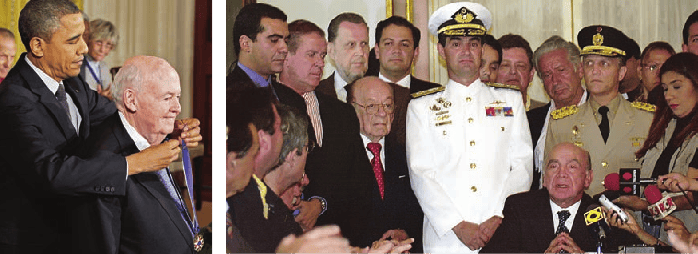
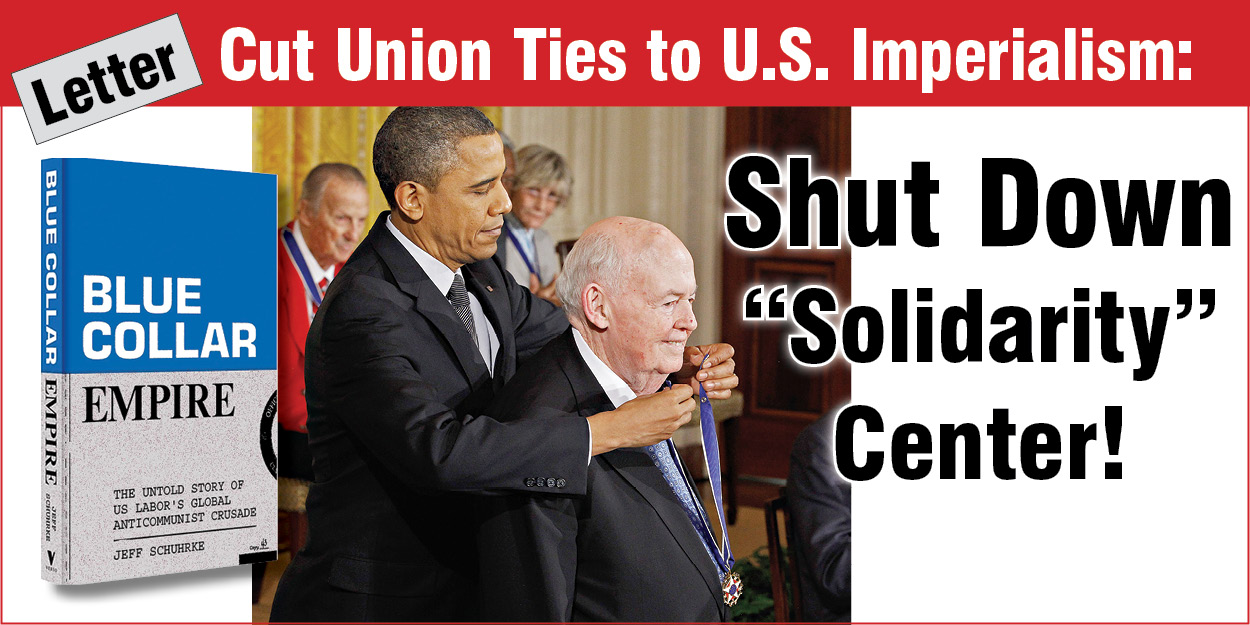
Left: In February 2011, Obama awards Medal of Freedom to John Sweeney, former AFL-CIO head who set up pro-imperialist “Solidarity” Center. Right: Venezuelan military brass who led the failed CIA-backed coup against Hugo Chávez, Caracas, April 2002. Solidarity Center aided pro-coup CTV union.
Schuhrke praises the Solidarity Center, writing that it:
“does commendable work like promoting enforceable safety standards in Bangladeshi garment factories, amplifying the voices of South African domestic workers at the International Labour Organization, bringing together hotel housekeepers from the United States and Cambodia to share stories and strategies, and supporting Mexican auto workers challenging the stranglehold of corrupt union officials.”
Schuhrke calls on trade unionists to “take an active interest” in the Solidarity Center’s work. Here is where Schuhrke’s liberal politics blind him to the obvious lessons of the history he recounts. Blue Collar Empire reports that all Solidarity Center employees are required to pass a U.S. government security check. Doesn’t he wonder why? If his book illustrates anything, it’s that there has never been a hard line between CIA-sponsored cloak-and-dagger activities and the kind of USAID- and NED-funded “soft power” initiatives that Schuhrke describes in the above quote. He who pays the piper calls the tune. All of the AFL-CIO’s foreign programs are designed with U.S. imperialist interests in mind. That is as true today as it was during the Cold War.
The CIA itself has always combined “social initiatives” with military subversion. The AIFLD, which became notorious throughout Latin America as an arm of the CIA, had its own “Social Projects Department” and even an “Agrarian Union Development” program, which established peasant “unions” to combat communist influence among the hideously oppressed Latin American peasantry. Soft power and hard power were both wielded to ensure docile foreign labor movements responsive to Washington’s needs.
The “soft power” programs were insidious. Schuhrke details how the African American Labor Center (AALC) opened its doors in early 1965 to “encourage labor-management cooperation to expand American capital investment in the African nations.” The AFL-CIO leaders who lead AALC had already taken great efforts to nurture the Kenyan labor leader Tom Mboya. He made multiple trips to the U.S., speaking to trade-union conferences. As head of the Kenyan Federation of Labor, Mboya became one of the leaders of the Kenyan independence struggle and helped ensure the installation of a pro-Western, neocolonial regime in Kenya.
Through it all, Schuhrke’s sympathies lie with so-called “progressive” labor leaders like A. Philip Randolph and the UAW’s Reuther brothers, who pushed these “soft power” programs and sometimes clashed with rabid defenders of the CIA connection like long-time AFL-CIO head George Meany. But the differences were only ever tactical. Having purged the communists from their own unions, all the AFL-CIO tops were fervent supporters of imperialism’s efforts to destroy anything that smacked of communist influence abroad. It was only when the Vietnam War began to rip apart the domestic Cold War consensus that cracks began to appear. In 1966, Victor Reuther publicly exposed the AFL-CIO’s role in the CIA’s atrocities in Vietnam, much to Meany’s fury (and adamant denials). But later, Reuther had to admit that—as the CIO’s European representative in the early 1950s—he himself took CIA money to “support” European trade unions.
Central America and PATCO
Shortly after its 1975 defeat at the hands of the heroic Vietnamese workers and peasants, U.S. imperialism faced what it regarded as a communist threat on its doorstep in the form of insurgent workers, peasants and indigenous people in Central America. The AFL-CIO bureaucrats were knee-deep in the CIA’s counterinsurgency efforts against the Sandinistas in Nicaragua and leftist guerilla forces in El Salvador, as they had been in Vietnam. According to Schuhrke, AIFLD spent more money in El Salvador than in any other country in the 1980s.
Blue Collar Empire hails the “National Labor Committee in Support of Democracy and Human Rights in El Salvador” (NLC)—which formed in 1981 to counter the AFL-CIO’s support for imperialist-sponsored rightist forces—as “one of the most significant developments for U.S. labor internationalism since the start of the Cold War.” Schuhrke spends pages describing the NLC’s fact-finding delegations and efforts to save imprisoned Salvadoran unionists. But if the NLC ever sought to expose—let alone end—the AFL-CIO’s relationship with the CIA and other U.S. imperialist agencies, he doesn’t mention it.
Far from recognizing that the American working class had a side against their own rulers and for the insurgent workers and peasants, the NLC operated within the framework of U.S. imperialist policy. Advocating an end to U.S. military aid to El Salvador and a “negotiated solution” to the civil war, the NLC’s position dovetailed with the one staked out by elements of the Democratic Party who saw these measures as a more effective way to defeat a popular insurgency. Of course, the words “Democratic Party” rarely, if ever, appear in Schuhrke’s book (there is not even an entry for it in the index). But unwittingly, Schuhrke provides telling evidence that the NLC was never much more than an adjunct to this imperialist party. The blood-soaked forces supported by the U.S. mowed down tens of thousands of Central American workers, peasants and indigenous people and caused countless more to flee to relative safety in the U.S. But the horror that these depredations generated in the American population was channeled safely back into bourgeois electoralism. In the end, Washington used a combination of military force and negotiation to stabilize Central America under U.S. domination.
A victorious workers and peasants insurgency in Central America would have weakened U.S. imperialism in its own backyard, furthering the ability of American workers to make inroads against the country’s capitalist rulers on their home terrain. The possibility of actions to aid the rebel forces in El Salvador was palpable. My union, ILWU Local 10 in the Bay Area, briefly boycotted a shipment of military cargo bound for El Salvador in late 1980. Militants in Local 10 around the Longshore Militant Caucus continued to fight for such actions; in 1983, after the Reagan administration announced a major military escalation, caucus member Stan Gow initiated the call (signed by 23 other ILWUers) for a 24-hour port shutdown in protest. The call was so popular that the Local 10 executive board was forced to recommend it to the ILWU convention, where it was squashed. The ILWU president went on to join the NLC.
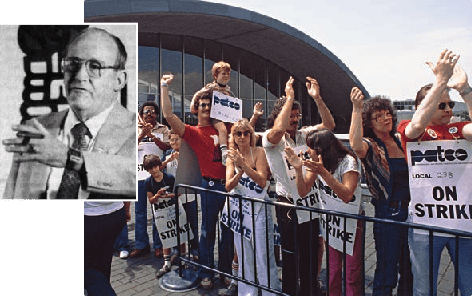
IAM top and DSA member William Winpisinger (left) refused to shut down airports to stop mass firing of striking PATCO air traffic controllers in 1981.
In 1981, the same year the NLC was founded, Reagan arrested the leaders of PATCO (the air traffic controllers union) and fired the entire union membership for daring to strike. One of the NLC’s founders, William Winpisinger, was head of the International Association of Machinists (and also a DSA member). It was within Winpisinger’s power to call out the mechanics and other airline workers and shut down the airports to beat back Reagan’s union-busting. But “Wimpy” turned his back on PATCO and joined other labor traitors who covered their asses by calling for an impotent consumer boycott of the airlines. Reagan smashed PATCO, setting the stage for defeat after defeat for labor.
Schuhrke laments that, by working with the CIA to weaken the labor movement in other countries, the American labor misleaders “unwittingly helped lay the groundwork for organized labor’s near decimation at the end of the century.” You can say that again. But it wasn’t “unwitting,” and it wasn’t just the outright CIA stooges, as the no less pro-imperialist Winpisinger demonstrated.
Trump Rips Up the Liberal Order
Of course, Donald Trump has now ripped apart the liberal world order, including whatever deal the AFL-CIO leaders had struck with previous masters in Washington. Trump sees no need for any kind of “labor” cover for imperialist butchery. The sudden abolition of the USAID in early 2025 caused massive budget cuts and layoffs in Solidarity Center programs. Lately, the Center has been advertising for an “enthusiastic fundraiser” to be its new program director. Funding by private capitalist foundations will not wash out the imperialist stench. The Center continues to be a major recipient of money from the NED, along with the U.S. Chamber of Commerce and the Democratic and Republican Parties (!!).
Solidarity Center activities in Venezuela prove once again that there is no hard line between covert operations and “soft power” social programs. For years, the Solidarity Center backed the Venezuelan Workers Confederation (CTV), representing the more privileged professional workers in that country. Following the blueprint set by previous CIA “destabilization” campaigns, the CTV called a “general strike” in 2002 to back a made-in-Washington coup against Hugo Chávez’s government. The coup was unsuccessful, as thousands of Venezuelans poured into the streets to defend Chávez. Now that Trump has seized control of Venezuelan oil in the aftermath of the Maduro kidnapping, you can bet that the CTV will ensure labor peace in the Venezuelan oil fields so that Chevron can get on with the business of extracting massive profits.
It will be a crime if disgust with Donald Trump’s rampages around the world is once again channeled into labor support for the Democrats. Genuine international labor solidarity can only be built on the basis of irreconcilable opposition to U.S. imperialism and all its parties and agencies. Those fighting against the pro-capitalist bureaucrats and for an anti-imperialist labor movement should raise the demand: Shut Down Solidarity Center!
Emily Turnbull
3 May 2026