
https://iclfi.org/pubs/wv/1190/meatpackers
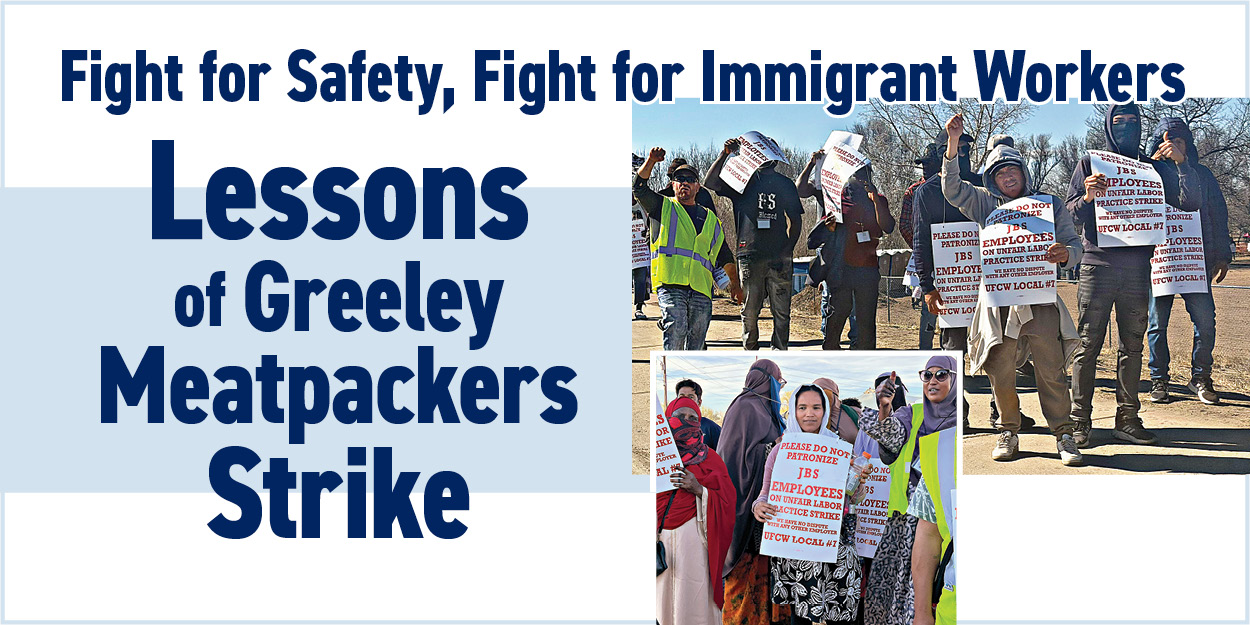
The three-week strike of 3,800 UFCW meatpacking workers in the small town of Greeley, Colorado, has a lot to teach us about the kind of fightback that is truly needed in this period. As the Iran war continues, inflation soars and Wall Street rakes it in, the working class in the U.S. is slowly being bled dry. From the NYC nurses strike to Minneapolis to Greeley, there have been some significant struggles already this year, but little to nothing to show for it. If the way that the next class battles are waged does not change, workers will face further division and defeat.
Many workers at the JBS beef processing plant in Greeley know that UFCW Local 7 president Kim Cordova sold the strike out behind their backs. Then, she presented them a contract offer at the last minute prior to the vote and without any discussion. Only a fraction of the membership could read it untranslated or even had the opportunity to vote. The offer, which passed, fell way short of union demands, especially on the issue of safety, and it eliminated pensions.
UFCW members, the vast majority of them immigrants, stood courageously on the picket lines willing to risk it all. Threats of company retaliation, arrest and deportation hung in the air. But even more deeply felt was the threat of the day-to-day slave-like conditions workers are subjected to. This is what propelled them to walk out. Weeks after the strike ended, the meatpackers bitterly describe how nothing has fundamentally changed on the job or in their standard of living.
Some workers are wondering what more they can do to improve their situation after having gone on strike. Others are questioning whether union membership is worthwhile. Workers who stood side by side on the picket lines have reverted to blaming one another for the conditions created by the bosses. The strike did little to ease the divisions between Muslims and Christians, men and women, black and Latino or white Coloradans and immigrants, not to mention the over 50 language groups. JBS intentionally recruited a workforce from around the globe to keep their wage slaves incommunicado and at each other’s throats instead of united against the meatpacking giant.
UFCW Needs New Leadership
It would be self-defeating if workers were to now write off strikes or the union itself. Without these basic measures of protection, they would be totally exposed to the bosses’ abuse. Plus, the main reason the strike went nowhere was the Cordova leadership’s strategy. The UFCW officers ran the strike as a PR campaign, rather than to cause damage to JBS’s profits, guaranteeing that the gains for the union would be minimal. They let the scabs enter the facility at will, except for a few disruptions instigated by the strikers themselves. They failed to appeal to the maintenance union working inside the plant to come out. They did not instruct other UFCW meatpacking workers to refuse to process diverted cattle.
UFCW pork and beef workers at the Denver JBS plant not far from Greeley have been without a contract since last year. All these workers should have been out in one solid strike. On May 2, the Denver workers voted by 97 percent to strike. This time, the UFCW bureaucracy pulled the rug from under the feet of its membership before the strike even started by outrageously overruling the strike authorization!
Cordova and the rest of the UFCW leadership held back the strike not merely because they are inept and have contempt for the workers they claim to represent. They did so because they are always looking to help the bosses and politicians keep the rest of the union in check in order to preserve their own privileges. Cordova & Co.’s six-figure salaries have them living high on the hog compared to the meatpackers, and they organized the strike like labor brokers. On its first day, Cordova assured JBS that the strike would only last two weeks. When union members refused to go back, she caved to this pressure, while working out a deal with the company behind the scenes to pull the plug.
By the third week, workers lacking an alternative way to fight their strike battle started to become demoralized with the same ineffective picket rituals. They wanted a more militant strike but were hamstrung by their own vulnerability to state forces. Workers agreed with Workers Vanguard reps about the need to block the plant gates and stop scabs, but they were worried about getting plucked off by ICE. They were open to the idea of sending a delegation to get the maintenance union to join the strike but were worried about retaliation by the bosses and the UFCW leadership. All workers complained about the inability to communicate with fellow union members, which further inhibited their capacity to organize among themselves.
During the strike, WV offered a battle plan to cut through the meatpackers’ gut-wrenching isolation and overcome the obstacles to victory. We urged workers to elect reps from each language group, who could then hold meetings on the picket lines to coordinate the fight. We advocated that delegations of striking workers and their supporters reach out to other unions and the wider working-class community in the Denver area. Targeting immigrant strikers for standing up and fighting is an attack on the entire working class. There is power in numbers, and unions like the Teamsters or even a group of ranchers (who JBS is also squeezing) could have provided the meatpackers with a shield against retaliation. The strike could have ended very differently if other unions had been mobilized to build mass picket lines.
All working people would have much to gain from beating back a big billion-dollar company in these dismal and uncertain times. Nowadays, everyone is working harder, longer and under increasingly piss-poor conditions. Winning core safety demands would be a big deal not just for JBS meatpackers, but also for all other workers in the meatpacking industry and beyond. Workers at the Greeley plant can and must renew the fight to improve conditions. But to get anywhere, they must proceed very differently from the UFCW leadership.
The Union Has No Friends on Capitol Hill
Now that they buried the strike, the UFCW leadership tells workers to leave the fight for safety to Congressional Democrats like Cory Booker and Bernie Sanders, who wrote letters shaming JBS. The word of these Democrats is as useless as the paper it is written on. If you got a dollar every time Sanders said he would stand up for workers and fight the billionaires, you would probably be a billionaire yourself. The Democrats are not the answer to safety enforcement. They have not stopped any anti-union attacks under Trump and are not about to start trying, because they are just as wedded as he is to protecting the bosses’ bottom line. They just want to look good to workers going into the midterms. The union bureaucracy’s appealing to the Dems only instills false hope in these bankrupt politicians and distracts workers from fighting for safety.
The union withholding its labor is where its collective strength lies. When on strike, UFCW members had real leverage to force concessions from the bosses. Rather than squarely confront JBS to establish union control of line speed, Cordova sabotaged the strike. Now, rather than lead a fight for the right of shop stewards to dictate proper break time, she tells workers to look to Congress for bathroom breaks. Basically, telling them to go buy diapers.
The union leadership’s ties to the Democratic Party undermined the strike. The Democrats have proved time and again that they always defend the bosses’ interests. The problem isn’t just the Democrats either. There are a handful of veteran white workers at the Greeley plant, and they liked what we said about the union needing to take control of the line speed. Many of these workers were the first ones to tell us how Trump was in bed with the JBS bosses because he increased line speeds. In response to the new regulations, a retired USDA meat inspector and whistleblower, Jill Mauer, exposed slaughterhouse conditions:
“Working in chronic pain is the reality of a slaughter plant worker. People don’t believe me when I tell them this, but most days, the smell of Icey Hot and Aspercreme overpowers the smell of the blood and guts. Beyond chronic pain, I have seen serious injuries occur on the line, including situations where workers were hurt performing tasks that were already difficult at standard speeds.”
The company-men politicians don’t give a damn if a meatpacking worker sacrifices a limb or worse. In their eyes, these workers are completely expendable, as long as JBS, Tyson, Cargill and National Beef make a killing. Workers must rely on their own strength and knowledge to improve their situation.
The Strike Is Over, the Fight Is Not
The question is, how to keep up the struggle after the union leadership sold out the strike? The meatpackers in Greeley must take full advantage of their organization in the union, which makes it easier to fight as a collective to change their conditions. They are the union. Once workers walk through the long tunnel and into the plant, they are all there for the same reason, facing the same horrible bosses. The answer is not to give up on the union, but to get it to go in a new direction under new leadership. To begin, the union must fight for control of safety and operations.
The key thing now is to build collectivity within the union. The meatpackers won’t succeed if they are divided. Instead, they must have each other’s backs. Every shift should elect a safety committee with reps from each language group to ensure proper communication among all workers in the plant. Then, whenever JBS tries to crank up the line speed or commits other safety violations, these committees could coordinate the appropriate action to take in response. They also would put pressure on elected union officials to enforce safety, including by intervening to get JBS to slow the line down when needed.
The union must step it up to ensure all workers get adequate rest and personal breaks. Otherwise, management will just keep stealing personal time and using prayer breaks to drive a wedge between workers of different faiths. For everyone’s safety, the union must also ensure that all workers receive training in their native language. It is crucial to fight to lift the newly arrived immigrant B-shift workers out of the most brutal jobs and living conditions, which JBS uses to drive down the conditions of all its other workers.
All this will be possible only if the union actively defends its immigrant membership against victimization and deportation. This country’s masters plunder and impoverish other countries across the world like Haiti, Mexico and Somalia. Desperate workers are forced to flee their homelands, only to be viciously exploited in the U.S. itself. The JBS bosses lured immigrant workers to Greeley to take maximum advantage of their vulnerability. The fact that many workers hold only JBS-issued work visas makes them even more susceptible to being treated like slaves. U.S.-born workers at JBS are not subject to the same type of blackmail. In this situation, they truly have a leading role to play.
The best defense is joint action. If the bosses retaliate against any worker who stands up for safety, knives should be downed. If any worker is threatened with deportation, the disassembly chain should grind to a halt. All this is doable. It just takes a leadership that understands that workers will get ahead only if the union becomes a force that can make JBS bow down. Demand union reps take the initiative to do that and, if they refuse, give them the boot and bring in union reps who will.
Where’s the Left?
The striking meatpackers in Greeley got precious little backup from the broader workers movement. The would-be union reformers of Labor Notes simply whitewashed the UFCW bureaucracy’s strike betrayal, declaring that the workers “have struck a blow to the heart of the modern jungle.” Taking another kind of political dive, most left groups said almost nothing about the strike despite all their talk about stopping ICE and defending the unions. This silence was deafening because these two questions were posed pointblank in Greeley. JBS traffics in immigrant labor so it can impose the most abysmal, slave-like conditions on the union, and leans on ICE if need be to do its dirty work. Rather than build support for an actual strike in defense of immigrant workers, left groups were busy giving credence to a fictional May Day general strike called by Democratic Party organizations.
Socialist Alternative was particularly notable on this account. They did zero to try to influence the Greeley strike’s outcome. Their newspaper’s one mention of this important class battle was a call to link it to the May Day non-strike of the 50501 liberals. What a big help that would have been! There were plenty of well-meaning liberals handing out water and doughnuts to strikers on the picket lines. But what they really needed was the mobilization of other unions and working-class communities to back them up! But SAlt was too wrapped up in chasing after May Day Strong union bureaucrats and liberal activists to pay any mind.
If SAlt had actually been serious about building toward a general strike, Greeley would have been a great place to start. A general strike is a serious affair that must be prepared by combating all obstacles that stand in the way, from the divisions in the class to the bureaucracy’s hold on the unions. This is best done in the course of actual struggles, where Marxists can intervene to point a concrete way forward to workers. But that’s not possible if the left is playing make-believe.