
https://iclfi.org/pubs/wv/1189/dr-haiti
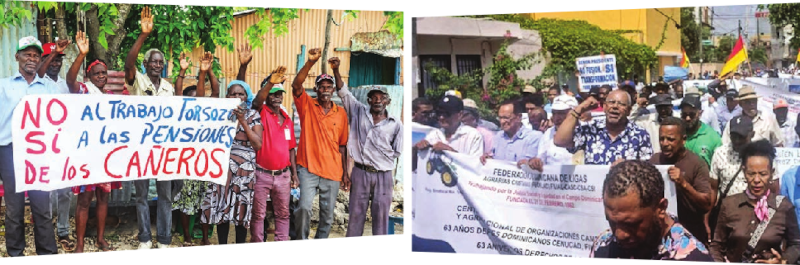
Left: Haitian sugarcane workers protest slave-like conditions on plantations in DR, May 2024. Right: Dominican trade unions and small farmers protest proposed government attacks on rural population, July 2025.
Haiti has been left to collapse into complete chaos. Riots, murders and gang violence are a part of everyday life. Many Haitians have attempted to leave, spilling into the Dominican Republic in search of safety and work. While the Dominican Republic might look like a paradise, it doesn’t take much to scratch the surface of palm trees and beautiful beaches and see a country plagued by stifling poverty, crime and crippling unemployment. President Luis Abinader has told the Dominican masses that invading Haitians are the source of their problems. Haitians are blamed for stealing jobs, ruining the Dominican identity and preventing the country from developing because of their blackness and Voodoo. The Dominican ruling class says all this as it sells the country off to the American imperialists, making DR increasingly dependent on foreign aid.
Abinader’s lie that throwing all the Haitians out will make things better for the Dominican working masses has inflamed racial and national antagonisms. Emboldened fascist scum like the Antigua Orden Dominicana, most of whom are black themselves, have organized protests with the help of police to target Haitians in mixed Dominican-Haitian neighborhoods. This has resulted in beatings and public executions not only of Haitians, but also of black Dominicans, paralyzing these neighborhoods with fear. With no organized resistance to these right-wing attacks, the Dominican president’s call for deportations of Haitians has only gained popularity, especially among poor Dominicans who are desperately looking for an escape from poverty.
No amount of deportations of Haitians will solve the problems that the Dominican masses face. That’s because Haitians aren’t the cause of the horrible conditions in the Dominican Republic. It’s U.S. imperialism and the local ruling class that are responsible for keeping the Dominican masses so poor. It’s the same for Haiti, which from its very birth has been exploited by foreign powers, only to be completely taken over by the U.S. colonial overlords. The imperialists then installed puppet presidents who, with the help of the Haitian elite and repeated U.S. military invasions, plunged the country further into chaos.
The U.S. has exploited racial and national divisions, causing massive explosions of violence. This hostility benefits the colonial masters, because it prevents any united anti-imperialist struggle of Haitians and Dominicans, allowing the U.S. to keep a firm grip on both nations. The only way to overcome the racial and national divisions is to fight U.S. imperialism, the main enemy of both Dominicans and Haitians. Without a united fight against the colonizers, neither side of the island will progress, and the divisions will continue to eat the island from the inside out.
The last couple of months have shown that U.S. imperialism is looking to dig its claws into Latin America. From invading Venezuela and starving Cuba to meeting with all the region’s right-wing leaders (Shield of the Americas Summit), the imperialists are trying to rebuild their slipping dominance at the expense of the entire region. Pitting one country against another, robbing oil reserves and intervening in elections are all just part of the plan to bring Latin America under complete U.S. domination.
Haitian Revolution: Huge Victory But Contradictory
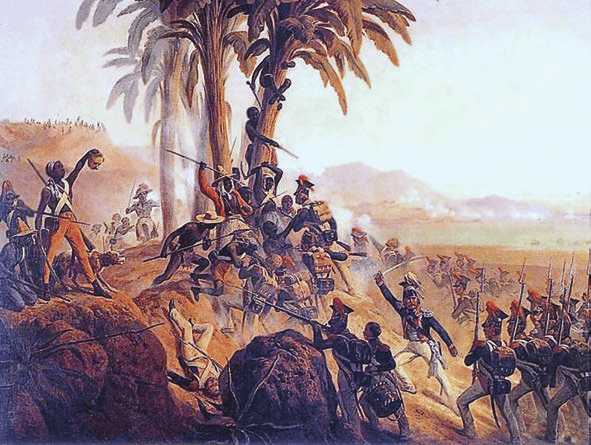
Battle for Palm Tree Hill between Haitian forces and Polish mercenaries during successful slave revolt.
The question is: where do today’s racial and national antagonisms come from? A good portion of the Dominican population sees Haitians as invaders. For Haitians and many other black people throughout the Americas, the problem is simply that Dominicans are racist. But responding to the situation on this level lets the American and other imperialists off the hook. To understand where the bad blood comes from, we have to look at history. And when looking at this complex history drenched in blood, it would be a huge mistake to overlook the Haitian Revolution and how from then on each colonial power, especially U.S. imperialism, fueled the racial and national hatred that exists today. The reason it is necessary to go through this history is that it has been bastardized over the last two centuries to serve the political interests of those in power. Exposing those interests while laying out the real history will show why anti-imperialist resistance is the only way to bridge the racial and national divisions among the oppressed of Hispaniola.
The Haitian Revolution, a massive slave rebellion that successfully overthrew the slave system in French Saint-Domingue, rocked the colonial world. The revolution made Haiti the first black republic in the Western Hemisphere, and it terrified slaveowners throughout the Americas. They feared that news of former slaves brutally and justly killing their white masters and waging a war to free themselves would inspire other slaves to do the same.
Slaveowners in the Spanish colony of Santo Domingo felt the political and social heat of the 1791 slave revolt in Saint-Domingue the most and needed to do all they could to prevent a similar situation from taking place on their side of the island. Toussaint L’Ouverture was clear that he wanted to unify the island and rid it of slavery. In 1801, he marched his army into Santo Domingo, forcing much of the elite to abandon the city. By 1802, Napoleon had sent his men to recapture Saint-Domingue and restore slavery. In 1804, after a two-year battle, Toussaint’s army finally defeated the French troops.
Although the French had been defeated in Saint-Domingue, the Haitians did not completely take over the island. They were pushed out of Santo Domingo, which left an opening for some of Napoleon’s forces to stay put on the eastern part of the island. The Spanish army was very much outnumbered in comparison to the Haitian army. Unable to put up a real fight, the Spanish colonialists allied with the French to assist in putting down any slave revolts inspired by the black Jacobins. This gave the French time to rebuild their forces and attempt to reinstall slavery in Haiti. News spread quickly to the Haitians, who understood that the Spanish elite bringing in the French threatened their re-enslavement, and they made it clear that they would never be enslaved again.
The Haitians had no choice but to push to unify the island, as doing so would ensure protection against being put back in chains. After learning that the Haitian constitution abolished slavery island-wide, many slaves in Santo Domingo were in favor of unification because they would be liberated too. Under the leadership of Dessalines, the Haitians marched back into Santo Domingo in 1805, hoping to completely defeat French forces, but they were not successful and needed to retreat. In their retreat, they destroyed cities and the countryside, massacring people along the way. This event was later used by the Dominican elite, intelligentsia and historians to fuel anti-Haitian bigotry among the country’s working class and peasantry.
Another reason that Haitian leaders pushed for unification was the burden of the French-imposed reparations on Haiti. This economic blackmail was set up to compensate the French slaveowners who lost their “property.” It was the literal price the Haitians had to pay to gain recognition as a free nation from France and a constant pressure on the black republic to force its collapse. Having the island’s eastern side under Haitian control enabled the government to tax citizens there and pay France. While the Spanish and the rising Dominican elite did not want to pay a tax for a situation they had no part in, the main reason they resisted unification was that they could not handle being ruled by former slaves, a people they considered inferior.
Organizing for battle, the Spanish tried to convince slaves to defend Santo Domingo by claiming that the Spanish form of slavery was much more benevolent than the French form and that the Haitians would brutalize them. The Spanish played on the fears created by the devastation of the 1805 Haitian retreat. Battles were fought, but the successful unification of the island didn’t come until 1822. As a result, slavery was completely abolished on the island. The Haitians, now in control of all Hispaniola, did all they could to maintain that control. This included repressive measures like banning the Spanish language and customs. These measures played right into the hands of the colonists, who were looking for any opportunity to brand the Haitians as invaders.
Unification of the island was absolutely revolutionary and progressive, because it overthrew the Spanish and French slave masters. But the revolution had contradictions. It was damaging to the revolution to ban the Spanish language and customs, kill innocents during the retreat and impose taxes to pay off France. All this gave the colonists ammunition to reinforce the idea that Haitians were savage invaders, laying the groundwork for anti-Haitianism and building up resentment against the revolution. The Dominican elite tied this animosity to race, fueling sentiment for Dominican independence to preserve a separate Hispanic identity. Taking advantage of political and social turmoil that erupted in Haiti, a resistance was organized, and Dominican independence was won in 1844.
Separating from Haiti put the Dominican Republic under political and financial strain. In 1861, President Pedro Santana brought DR back under Spanish rule. This unpopular move caused rebellion, as Spain enforced high taxation while its military stole supplies and food from the Dominican masses. Spain also tried to take back land from Haiti. This only angered the Haitians. President Fabre Geffrard stepped in to help Dominican rebels, sending arms and Les Tirailleurs de la Garda to fight alongside them against the Spanish. DR finally won independence in 1865. Today, DR celebrates its independence not from Spanish domination, but from Haiti—the nation that overthrew slavery on the island.
What was needed to bridge the racial divisions created by the Spanish and French and successfully unify the island in the fight against colonialism was a genuine and equal partnership of the island’s oppressed masses. That would have meant Haitian revolutionaries maintaining Spanish language, customs and religion as part of organizing slaves against their oppressors in Santo Domingo. Partnership also would have helped by the planning of an organized retreat in 1805 to regroup with slaves and others who wanted to be free.
To be as clear as possible: the Haitian Revolution was revolutionary. The fight for unification was revolutionary. And it was revolutionary to have a constitution written by freed black people that ended slavery on the entire island. But the Haitian liberators undermined their own just fight by using repressive tactics against the general population instead of taking every opportunity to pit the newly freed people against the colonial elite in Santo Domingo.
U.S. Imperialism Establishes Its Domination
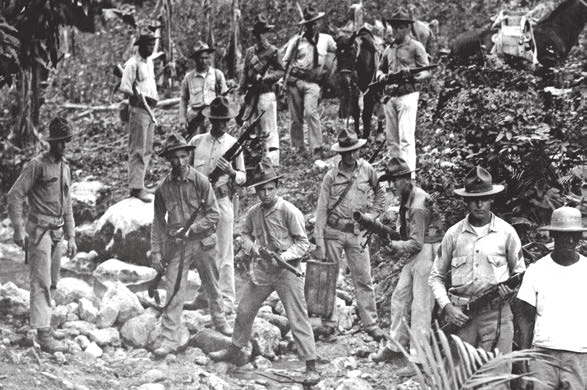
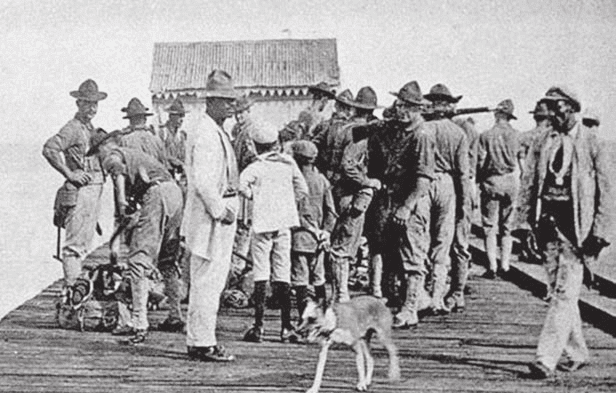
U.S. cemented domination of Hispaniola through military occupations of Haiti (above) and Dominican Republic (below), while European imperialists were embroiled in World War I.
Colonialism left both sides of the island politically and economically unstable even after formal independence was won in each nation. At that time, multiple presidents had been assassinated in both Haiti and DR, and both owed lots of money to European powers. This debt gave the European colonial vultures economic leverage over the Caribbean. This was bad news for the U.S. as it attempted to expand further into the region after having taken Puerto Rico in 1898.
The chaos in Hispaniola was something the U.S. wanted to exploit for its own interests, but it couldn’t just invade the island. It needed to cover up its imperialist appetite with the justification that entering Hispaniola was a civilizing mission necessary to restore stability and modernize the island since the savages there couldn’t do it themselves. But imperialist promises of progress always mean subjugation. Predictably for a country whose ruling class consolidated power through enforcing brutal racial divisions (Jim Crow), the U.S. pushed anti-Haitianism and white-supremacist values to establish its domination on the island.
Many think that American domination of Haiti only happened in 1915. But the reality is that once the U.S. recognized Haiti’s independence in 1862, its rulers looked for any opportunity to control Haiti’s finances, labor, ports and other resources. This was all to benefit American banking and business interests. Making these moves took time, but by 1905, the U.S. replaced France as Haiti’s main trading partner. In 1909, National City Bank of New York (now CitiBank) secured the controlling interest in Haiti’s Banque Nationale.
U.S. Marines later seized $500,000 in gold from Banque Nationale and transferred it to National City Bank in New York. It wasn’t until August 1915 that Haiti would feel the full brunt of imperialist occupation as 3,000 Marines invaded the western part of the island. The imperialists seized the customs houses, set up a white military leadership of the Haitian army and rewrote the constitution, eliminating the ban against foreign ownership of land that had been a major protection against slavery.
Dominicans also revolted against the U.S., which they saw as ripping away their sovereignty when the Americans invaded in 1916. And what the imperialists did in DR is very similar to what they did in Haiti. Marines landed and established a direct military government, effectively suspending the constitution and disbanding the Dominican Congress. They took over the Dominican military and set up the Guardia Nacional, the same military apparatus that would train Rafael Trujillo. The American rulers took control of the Dominican house of customs, handing DR’s finances over to the National City Bank of New York, which aided in the takeover of sugar plantations.
But the imperialists took a slightly different approach to the Dominican Republic. While they deemed both Haiti and DR to be full of savages, they considered DR to be capable of some economic and political progress because a portion of its population was white or mulatto. But this progress could only happen with the help of the imperialist saviors. The imperialists pushed the idea of white racial superiority and black inferiority by enlisting lighter-skinned Dominicans in high positions in the Guardia Nacional. This military force would go on to crush rebellions of dark-skinned Dominicans and revolts in mixed Haitian-Dominican communities.
Depicting Haitians as thieves, the U.S. evicted them from land they cultivated alongside Dominicans in the rural regions and forced them onto sugar plantations. The U.S. sugar companies would then steal the land Haitians were evicted from. Forcing Haitians onto sugar plantations was useful not only to tear up mixed Dominican-Haitian communities in the countryside, but also to create more division. As job opportunities for Dominicans dried up under U.S. occupation, the only real work to be found was on the plantations.
Dominican sugar workers fought back by demanding higher wages and better conditions. The sugar companies’ response was to fire combative Dominican sugar workers and replace them with Haitians, who were paid much less than the already miserable wages paid to Dominicans. To ensure a steady and cheap labor force for the booming sugar industry, the imperialists made a deal with the Haitian government to import Haitians straight onto the plantations. Many Haitians were desperate to leave the chaos of their home country and find work.
The hostile situation on the sugar plantations, cost of maintaining a military government and pressure of international criticism forced the imperialists to end their occupation of the Dominican Republic in 1924. While some roads and schools were built, the U.S. put DR in more debt, left many of its people in poverty and installed a government that vowed to protect American interests. Haiti was even more economically and politically devastated than DR, and the border treaty of 1929 only made things worse. The treaty gave the Dominican Republic a great portion of the island, leaving Haiti with the most barren areas. It also gave “shared access” to rivers Haitians used for irrigation, setting up future conflicts. Even though a supposedly rigid border had been set up, the U.S.-made destitution of Haiti forced many of its people to go into DR. This pissed off the Dominican elite, who argued that Haitians coming in would dilute the white race and were the reason for the Dominican Republic’s lack of progress.
Trujillo Perfects Anti-Haitianism
Although the Dominican ruling class did what they could to keep the Haitians out, the central government had little authority over the rural areas like the border region. The border was fluid in places, where Haitians could cross without issue. The Guardia Nacional under U.S. direction was able to enforce some repressive measures but was still not able to control all of the border region. This was a problem for Rafael Trujillo, whose goal to establish total control of the rural areas would lead to a border massacre in 1937 and fully ingrain anti-Haitianism as an ideology in the Dominican Republic.
Trujillo tried to implement policies that would restrict the movement of Haitians across the border under the cover of protecting Dominicans from the “passive invasion.” The aim of his policies wasn’t to protect rural Dominicans, but to bring the country firmly under his rule. He first attempted to carry out mass deportations of Haitians but failed because local communities opposed this. Haitians and Dominicans lived together all over the country and were often openly hostile to attempts by the central government to intervene in their lives. Both countries had limited paved roads and communication systems. This included the rural areas, which had very few connections to the cities where the Dominican elite lived.
Because of their limited interaction with the ruling class, Haitian and Dominican peasants saw that they had more in common with each other than with the elite in the cities. It’s said that Trujillo ordered the 1937 Parsley massacre because of his hatred of Haitians. This may be true, but the whole point of the massacre was to break down these deep-rooted connections between Haitians and Dominicans that constrained his power over the country.
No matter how much Trujillo tried, he did not have the resources to completely remove the Haitian population from DR. The U.S. government and the sugar owners stopped him too, but only because Haitians provided the cheap labor necessary to extract massive profits. In response, the Trujillo government took a page from the imperialist playbook and began to isolate Haitian immigrants throughout the country, once again forcing them onto sugar plantations. This pleased the U.S. sugar bosses. But the Trujillo government faced resistance from local leaders in the rural region and Dominican peasants, who opposed the forced relocation of their neighbors. Government officials then pressured landlords to evict Haitians and threatened to withhold immigration documents until the migrants relocated.
After seven years of trying out one harsh anti-Haitian policy after the next, Trujillo’s dictatorship still did not have absolute control over the country. Feeling pressure from the Dominican elite and to further his own aspirations for dominance, Trujillo decided on more drastic measures. On 2 October 1937, he ordered the massacre of 15,000 to 20,000 Haitians. No matter what Dominican officials say, this massacre included the killing of Dominicans who either stood up and fought back or were thought to be Haitian because they were dark-skinned. The massacre sent shock waves throughout the rural regions as its brutality tore apart Dominican-Haitian communities and forced local leaders to bow down. This is exactly what Trujillo needed to consolidate political and social control of the border region and the nation.
After thousands of Haitians were killed, many fled back to Haiti. This opened up the border region to “dominicanization.” Priests, teachers and officials from the cities were sent in. With rural communities in shock and destroyed, Trujillo rewrote the Parsley massacre as a justified government response to the invasion of Haitians. There was no one willing to question his authoritarian and genocidal measure, so Trujillo took it a step further. Part of the “re-education” was to make a truth out of the lie that the bad blood between Haitians and Dominicans came entirely from the 22 years of unification, which was called a Haitian occupation that threatened the Dominican nation. This completely erased the fact that U.S. imperialism, in partnership with the Dominican ruling class, had just devastated DR and deepened racial divisions. Trujillo’s massacre and dominicanization campaign made anti-Haitianism the dominant ideology in DR.
Duvalier: Another Accomplice of U.S. Imperialism
The U.S. occupied Haiti (1915-34) longer than it did the Dominican Republic (1916-24). The imperialists left after the rebel Cacos formed a mass movement against them. But the U.S. made sure to leave behind a highly centralized state with an extensive military trained by the imperialists for the specific task of suppressing any resistance by the Haitian masses. Although the U.S. “withdrew” from Haiti, its corporations still had control of the Haitian economy, exploiting the working class as much as they could. This widened the already massive gap between the oppressed and the wealthy elite. This gap was so massive because the working class and the oppressed paid the bill on reparations to France—a debt that totaled 150 million francs (well over half a billion dollars today) and that wasn’t paid off until 1947.
The crushing impoverishment of the Haitian masses brought François “Papa Doc” Duvalier to power. Papa Doc campaigned using populist pro-black rhetoric against the light-skinned elite, but not against the U.S. imperialists responsible for the wretched conditions in Haiti. Once in office, Duvalier turned on the impoverished population by working with the light-skinned elite to maintain their interests. To prove he would be a good ally, Duvalier began a reign of terror that violently eliminated political opponents, union leaders and any potential left-leaning opposition, creating the Tontons Macoutes to get this done.
His terror campaign was designed to maintain complete control of the masses and allow the U.S. to invest in Haiti with little to no issue from the population. Duvalier also aided imperialist interests by pledging to be an anti-communist counterweight to Cuba. This was more than acceptable to the U.S., which was looking to crush the left-wing populist and pro-working class politics that had come out of the 1946 uprising in Haiti. In exchange for his obedience and repression, the imperialists gave Duvalier weapons and millions in aid and trained his security forces to more effectively repress Haitians.
Duvalier’s commitment to U.S. interests had very damaging economic effects on both the working class and the peasantry. American corporations wanted Duvalier to shift the nation’s economy from agriculture to low-wage manufacturing. This created a huge population of impoverished workers while devastating the peasantry, which couldn’t compete with the American agricultural goods coming in or get jobs in the urban centers. Duvalier’s commitment didn’t stop there. His regime kept the economic structures set up by the U.S. during its 19-year occupation to force Haiti to pay its debt to foreign banks. But Haiti had no money, so it borrowed from U.S. banks to make good on its debts. This kept the nation dependent on the imperialists, creating a harsh cycle of subservience it could never escape. Papa Doc’s legacy was carried on by his son Baby Doc, who was just as brutal to Haitians and just as committed to the maintenance of imperialist interests on the island.
Both the Haitian and the Dominican elite have shown that they are responsible for the degraded state of the island and racial and national divisions. Almost every leader in DR and Haiti has leaned on the imperialists at the expense of the working-class and peasant masses. This has paved the way for the U.S. to maintain its hold on the island and dominance in the region. Because of this, any fight against American imperialism needs to be tied to fighting the domestic ruling classes too. They must be replaced by a workers government made up of Haitian and Dominican working-class and peasant leaders committed to the anti-imperialist struggle.
Imperialist Domination of the Island Today
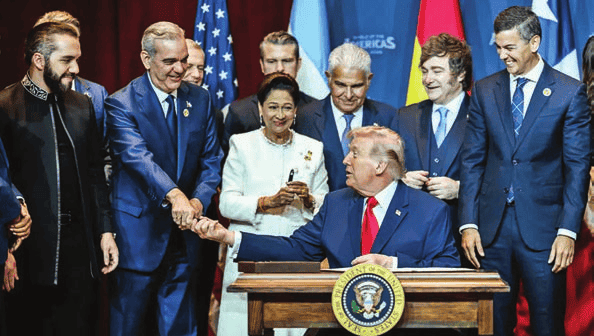
Shield of the Americas Summit in Florida, March 7. Right-wing leaders do bidding of imperialist master, fawn over Trump. Dominican president Abinader is second from left.
The Dominican Republic has one of the fastest growing economies in Latin America, with its GDP doubling from 2000 to 2020. The Dominican ruling class holds up the country’s economic growth and the willingness of foreign capitalists to invest in the nation as what sets DR apart from Haiti. It is true that DR is more economically and politically stable than Haiti. But while the Dominican ruling class pushes the illusion that the country is the “Pearl of the Caribbean,” DR is in extreme debt and plagued by impoverishment. How has its relationship with the U.S. brought DR to this point?
The U.S.-engineered Dominican Republic-Central American Free Trade Agreement (CAFTA-DR) was first enforced in DR in 2007. CAFTA was promoted as an agreement to produce economic growth that would benefit all trade partners and the peoples of the participating countries. But for DR, the agreement made the U.S. its primary trading partner, allowing the imperialists to flood the Dominican market with cheap goods and food. For instance, the U.S. saturated DR with cheap rice, making it impossible for Dominican farmers to compete. The imperialists did the same to Haiti. Many farmers, whose livelihoods depended on selling rice, were crushed under the weight of this subsidized food. While the U.S. is able to pump cheap stuff into the Dominican market, Dominican sugar (one of its main goods) was denied access for three years to U.S. markets, further choking agriculture in DR.
Things got even more difficult when the 2008 financial crisis hit, because DR is so tied to the U.S. economy. DR had to borrow money from both the IMF ($1.7 billion) and the World Bank ($80 million). As of 2023, DR’s total external debt was $52.26 billion. Although Abinader has not taken cutthroat austerity measures, his plan to pay back the debt is to actively invite foreign investment by promising generous tax exemptions and committing to keeping wages low.
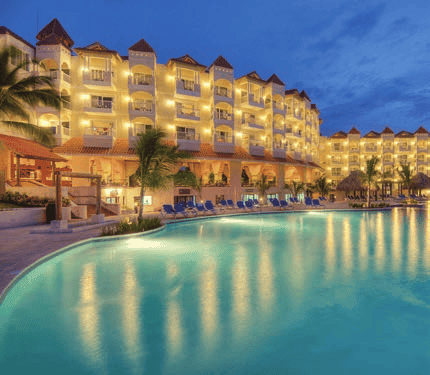
Tourists luxuriate in resorts, such as Punta Cana (above), while Dominican children grow up in poverty (below). DR government pours large sums into tourism industry, lets countryside rot.
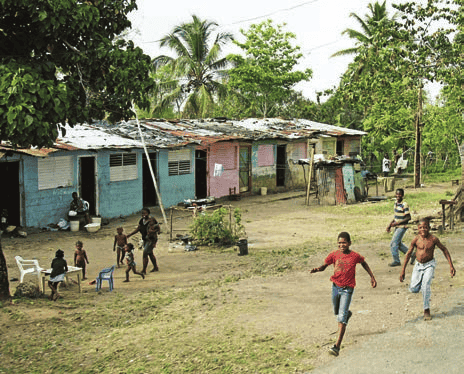
This has worked out perfectly for the tourist, real estate and mining companies, which have made record profits. While wages rose from $300 a month to $450 under Abinader’s administration, DR still has the third-lowest average wage in the Americas. As of 2024, the urban poverty rate in DR was at 20.1 percent, and the rural poverty rate was at 24.7 percent. While studies make it seem like the poverty rate is decreasing, the mix of low wages and few job opportunities has Dominicans fleeing to Puerto Rico and the U.S. DR’s heavy dependence on American aid, remittances and tourism also makes its sovereignty unstable. Yet Abinader has vowed to Washington that he will keep U.S.-DR relations strong. In other words, he will keep DR under American imperialist domination.
As for Haiti, the conditions are far worse. The 2010 earthquake and its aftermath is a graphic example of what U.S. imperialism does under the cover of humanitarianism. The deaths and social decay were the result not just of a natural disaster, but also of centuries of imperialist abuse. U.S. intervention into Haiti is nothing new. But military occupation always leads to more social and political devastation, especially if the American vultures are involved. The imperialists made sure to flood Haiti with NGOs that would influence the course of political events while giving imperialism the cover of kindness and concern for a country in need.
Before the 2010 earthquake, there were 3,000 to 10,000 NGOs in Haiti. All these NGOs and repeated military invasions had undermined Haiti’s national sovereignty and gave the U.S. and European imperialist powers the ability to swoop in at a moment’s notice. When the earthquake hit, the U.S. military established emergency control, took over the Haitian state and enforced a series of policies that favored U.S. interests. From there, the U.S. was able to take the aid money meant for Haiti and invest it in corporations and parasitical NGOs that supported U.S. domination of the island. The devastation forced thousands to flood into DR, causing more pressure there.
Years after the earthquake, thousands of Haitians still slept in tents while foreign aid was funneled into private industries like luxury tourism and mining and the expansion of sweatshops. It is clear that what was passed off as U.S. humanitarianism was actually a money laundering scheme meant to place millions back into the hands of the imperialists who caused the social disaster in the first place. Haiti has not had a functioning government since the assassination of President Moïse, and the country is in a state of complete disorder. As of 2024, about 60 percent of the population lived below the official poverty line, with 1.3 million Haitians displaced. And still the NGOs funnel money back to the imperialists. The destabilization of Haiti has made way for gangs to take over much of the country. This isn’t an accident either. The U.S. provides these gangs with guns to keep the country unstable.
The Left and the Working Class
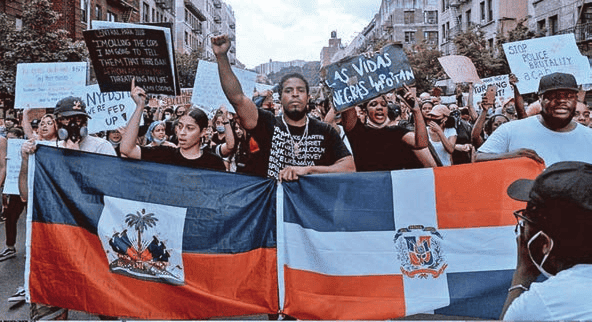
NYC, June 2020: Protesters against police brutality hold flags of Haiti and Dominican Republic. Communists seek to unite oppressed peoples of Hispaniola in anti-imperialist struggle.
The Dominican left is outraged at the deportations of Haitians and wants an end to these programs set up by Abinader, because they send Haitians back to even harsher poverty and certain death. Leftists have written not only about the deportations, but also about the overall racist and deadly treatment Haitians face throughout society, from healthcare and housing to the bateyes (company-owned villages) and the sugar plantations. Many groups have called for an end to the brutal subjugation of Haitians, speaking on the need for solidarity between Haitians and Dominicans. MST-RD wrote an open letter to Abinader, saying:
“The mass deportation of a marginalized community is a practice condemned by international law. Since October 2, following his order, Haitians and Dominicans of Haitian descent are being violently persecuted, families separated, houses raided, communities terrorized. The fact that the state deportation machinery focuses on pregnant women shows how far the inhumanity of their plan is willing to go. There is no respect for life, no place for empathy…. We urge you to stop this massive deportation plan immediately. We urge you to end this state-sponsored hatred.”
—Movimiento Socialista de Trabajadores de la República Dominicana, 11 October 2024
Stopping the deportations and building the strongest possible defense of Haitians is a must. But the question is: how do you do it? The MST-RD’s appeal to Abinader to stop the deportations is a losing strategy. Abinader ties DR to U.S. imperialism by a thousand threads and benefits from the nation’s exploitation. You cannot expect the same person who has a material interest in maintaining this repressive measure to do something to dismantle it. Moral appeals won’t cut it.
To stop the deportations will require organizing a fight against Abinader and his bosses in Washington. You need to place the fight against U.S. imperialism at the center of the issue. Without this, you let the colonial masters off the hook. They pull the strings behind Abinader, so both need to be fought at the same time.
To gather the forces needed to stop the deportations, you have to win over the Dominican working class to the fight against Abinader’s plans. But many workers have fallen for the lie that throwing Haitians out of DR will mean more jobs for Dominicans and economic stability for the country. This lie is also accepted by the leadership of different unions, like CASC, CNTD and CNUS, which fully support the Abinader administration.
Every day, the situation for Dominicans becomes more unlivable. Wages can barely cover the cost of basic goods, inflation is on the rise and there’s nothing but dilapidated housing with poor plumbing for most of the impoverished masses. The mix of the degraded position of Dominicans and the use of Haitians as cheap labor has deepened hostility between these two oppressed peoples. The situation has only become more explosive as both fight over what little opportunities exist on the eastern side of the island.
The MST-RD’s solution is the creation of “non-racist” unions to fight to improve wages and working conditions. Workers who hate anti-Haitian bigotry might see nothing wrong with this, because racism in the unions needs to be fought. But having a few non-racist unions does nothing to challenge U.S. imperialism. In fact, it would reinforce the imperialist status quo on the island, because splitting the Dominican and Haitian workers along racist and anti-racist lines would weaken their ability to defend against attacks.
What’s needed is to bridge the divisions by linking the day-to-day struggles of the Dominican working class to the need for Haitian liberation. Both Haitian and Dominican workers are under attack by the same enemy. It would be far better to have a joint fight against that enemy than to fragment workers even more. And that will happen only by bringing forward union leaders who introduce an anti-imperialist attitude into the class and patiently show why deportations do nothing to benefit Dominican workers.
Deporting Haitians out of DR will not create more jobs or economic stability for the country. It only drags down conditions at existing jobs and brings greater economic instability. That’s because the degraded situation of DR and the oppressed Dominican masses is not the fault of the destitute Haitians, but of the imperialists who rob both sides of the island. The chaotic mess in Haiti was created by the U.S. The situation then drips into DR, where there already isn’t enough to go around. The colonial masters then fan the flames of racial and national hatred among the Dominican and Haitian oppressed masses. Because Haitians make up a good portion of the working class in DR, it is not a moral question, but a question of working-class self-defense for Dominicans to fight for Haitian rights.
While both peoples are distracted and at each other’s throats, the imperialist bosses, like those who own construction, sugar and tourist companies, eat up DR’s resources, keeping it under their domination. The imperialists are helped by the Dominican ruling class, which pushes the lie that economic advancement will happen independently of Haiti. But this couldn’t be further from the truth. The Dominican Republic will not advance economically, socially or politically if Haiti is kept down. That’s because the whole setup of U.S. domination of the island is to pit the working oppressed of DR and Haiti against each other so that the imperialists can drain both of their countries’ resources.
Anti-Imperialism Is Key
A fight by the Dominican working masses against the imperialist oppression of Haitians would be a fight to free Dominicans from poverty and oppression too. That’s because the shackles on Haitians are intertwined with the shackles on Dominicans. And the colonizers are the padlock on those chains. Joint struggle against U.S. imperialism is the key. It is the only way to defend the livelihoods of both Dominicans and Haitians and put an end to the divide-and-conquer games the colonial masters play.
It’s only on the basis of anti-imperialism that you can unite these two peoples who have been made into mortal enemies and transform the unions. Hispanic academics lecture Dominicans about coming to terms with their “collective shame” as a way to stop the brutal genocide of Haitians. But this won’t work, because the Dominican masses are starved of economic opportunities and then made to see Haitians as the problem. Collective shame will only further inflame the already bloody divisions between Haitians and Dominicans because it blames oppressed Dominicans for the degraded position of Haitians. It is the task of communists to expose the root cause of the racial and national divisions between the peoples of Hispaniola and set a correct strategy to defeat imperialism.
The anti-imperialist struggle has to be understood like this: if the advancement of an oppressed country doesn’t happen at the expense of the imperialists, it will happen at the expense of workers and oppressed minorities. The stronger the peoples of DR and Haiti stand in opposition to imperialism, the closer the unity between them will grow. Without this, the relations between the oppressed Dominican and Haitian masses will continue down the path of barbarism.
There is no time to waste either. With U.S. imperialism in decay, it is looking to stabilize its position by invading or squeezing the countries of Latin America. We don’t have to look any further than the invasion of Venezuela for its oil, the colonial subjugation of Puerto Rico or the starvation blockade of Cuba. The colonial masters will tighten the screws on DR and Haiti, continuing the cycle of racial and national hatred, because the whole point is to make Latin America fall completely at the feet of American imperialism.
The Caribbean and Latin America cannot fight imperialism alone. Their working and oppressed masses need to form an anti-imperialist alliance with the American working class, which also faces crushing attacks from the Trump administration. The working class in the U.S. is also divided over the question of immigration and deportations, as Biden and the Democratic Party told workers to feel bad for immigrants and sacrifice their already shrinking resources for migrants. This increased anti-immigrant sentiment in the class and support for Trump. He has since directed ICE to go into neighborhoods of workers and immigrants, resulting in public deaths. Mass protests have erupted, but ICE is still terrorizing neighborhoods because the working class has not been mobilized to oppose them.
The problems that result from the brutal divisions in DR-Haiti don’t just stay there. They find their way into places like New York City, where people who have never set foot on either side of the island have been raised to hate each other. This has caused huge street fights, the breaking up of romantic relationships and even instances of Dominicans targeting black people. The tensions have only created more pressure in a city where intense racial divisions are everywhere.
The situation finds its way into the working class too. In many workplaces, conditions have declined so much that workers are at each other’s throats. The infighting leaves the class unable to effectively go after the people who are responsible for their miserable situation. Even if nothing negative happens directly between a Haitian and a Dominican worker, the divisions are so rough that just one small inconvenience causes the racial hatred to rush up. This has set up the working class to be more intensely victimized by their bosses, who are looking for any chance to keep dividing workers so that they can weaken and smash unions. This makes it even more critical to put a path forward that will bridge the gap between Haitian and Dominican workers so they can fight more effectively together against the bosses.
No matter how small the island of Hispaniola, we cannot underestimate the inspiration that would be caused by a successful fight against imperialism by the Dominican working class in defense of Haitian liberation. A struggle like that could spark the masses in the U.S. to defend the oppressed in the imperialist center. Throwing off American domination of the island would loosen the grip of the ruling class on workers in the U.S.—and vice versa. If workers in America took the lead of the fight against Trump and won some victories, it would allow the anti-imperialist struggle by Haitians and Dominicans to go forward.