
https://iclfi.org/pubs/wh/2026-yp-grassroots-left-what-next
18 March 2026
Dear comrades,
The CEC elections in Your Party resulted in a big win for Corbyn’s The Many (TM) slate. It secured a solid majority on the body (14 of 24 seats), with the Grassroots Left (GL) winning only seven. For those of us who campaigned for the GL and want a radical, socialist party, this isn’t good. With a clear mandate, the Corbyn wing will proceed to build a party based on vague liberal politics indistinguishable from the Greens, go after proto-branches and purge the far left. To go forward, the GL needs to draw serious lessons.
Not just a matter of resources
Many in the GL have tried to explain our defeat by pointing out that TM had more money, resources and access to larger mailing lists. Of course, this is true. But this is just stating the obvious. If the only lesson the GL draws is that the other side was stronger, then there is no point in critically reviewing what the GL actually did.
This is similar to those who explain Corbyn’s downfall as Labour leader by saying that the right wing was stronger. Such explanations might make us feel better, but they are disorienting and false. Corbyn’s leadership of Labour ended in disaster primarily because of key political mistakes he made. Similarly, in our opinion, the GL’s results are primarily due to political blunders that ended up undermining its campaign. This is what we must debate and understand.
Members’ democracy
The first mistake the GL made was to centre its campaign around “members’ democracy”. While members’ democracy is important, everyone in the party claims to be for it, including Corbyn’s side. With Your Party members fed up with factional struggle and demanding a clear vision to make Your Party work, GL’s central appeal for “democracy” offered no clear way forward. Moreover, as TM made “turning outward” one of their central planks, the GL’s insistence on “internal democracy”, rules and structures only helped to strengthen TM’s claims to be the only ones wanting to end “navel-gazing”.
The GL should have focused its campaign on its radical positions and criticised TM on this basis. The GL’s platform contained clear opposition to NATO, Zionism, the monarchy, as well as a call to expropriate key levers of the economy. These were GL’s strong cards. And Corbyn’s side was silent on those questions precisely because they do not want a party taking an explicit stance on those issues, as they sought to rally the most conservative elements. What was confusing to many members was that TM carefully avoided saying this openly.
Therefore, the task of the GL was to force TM out into the open on key political issues and expose their reformist and liberal politics in front of the membership. This was the only way the GL could have scored serious points against TM, while also making the lines of division much clearer to all.
But this was impossible so long as the GL’s main appeal was based on internal party structures, which only made the differences between TM and the GL confusing. Now, members’ democracy has spoken, and the GL is in a minority.
The fight for democracy
Some comrades in the GL often say that “without a democratic party, we cannot build a democratic society”. This is a disorienting abstraction. The structure of a party flows from its goal. If your goal is to manage capitalism and appear respectable to the liberal middle class, you will build a bureaucratic party—because you will have to repress the radical aspirations of the base. This is why the trade unions and the Labour Party are so bureaucratic. And this is why the Your Party tops are such control freaks, obsessed with purging the far left.
How do we fight this? You cannot fight a bureaucracy based on “democracy”. Ultimately, rules on paper cannot restrain a bureaucracy. Furthermore, campaigning for “democracy” will inevitably lead you into an incoherent bloc with people who have opposite political aims. We undoubtedly saw this in the GL. The only way for socialists to actually fight for party democracy is by waging a political struggle against the reformist and liberal politics that drive bureaucratism. This is how to cohere a solid opposition and actually win support among the base.
Conciliating Jeremy
In the TV show The Wire, Omar Little famously said: “You come at the king, you best not miss.” The GL took on Corbyn, the king of the left, and…missed. This is another key mistake the GL made: it refused to take the fight directly to Corbyn and constantly conciliated him to “prove” we are not splitters. For example, it was a mistake to endorse Corbyn on the slate. This only helped to give him a huge majority, while TM did not bother with such fake diplomacy.
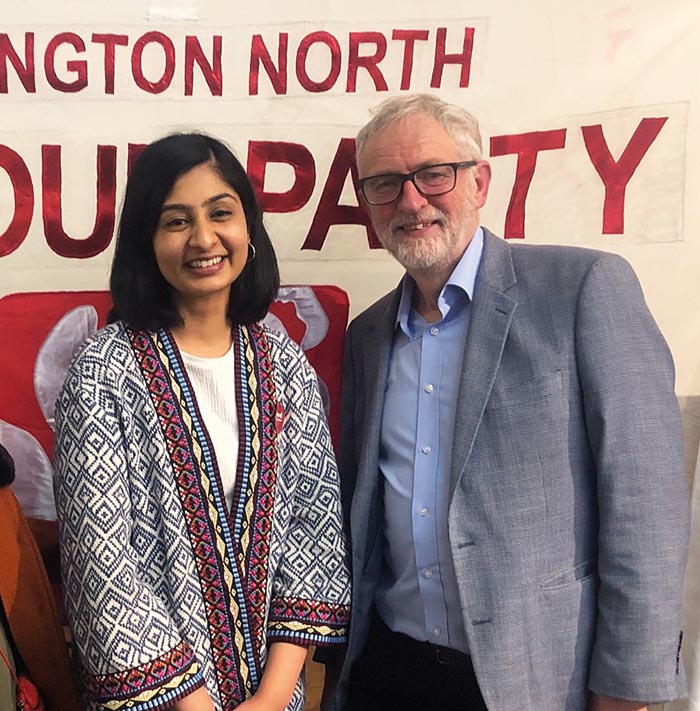
Sultana opposes Corbyn’s purge from Labour in 2020. How times have changed…
Everyone in the GL knows that Corbyn’s tepid speeches for “peace” and “social justice” are just liberal. We all know that Sultana’s radical speeches against capitalism are qualitatively different. Yet no one in the GL wants to say this openly—Zarah Sultana in particular. Rather, throughout the campaign, GL candidates too often went out of their way to declare their support for Jeremy, entertaining the illusion that our politics were compatible with his.
It was perfectly possible to take on Corbyn, provided that our attacks targeted his politics and avoided any demagogy or personalism. Again, attacking Corbyn on the terrain of “democracy” was never going to work. But exposing him for defending a liberal vision of “socialism”, closer to the UN charter than class-struggle politics, could have resonated among a broader layer of the party. It is also by focusing on Corbyn’s politics and explaining why they will not work that the accusation of being “splitters” can be easily dismissed. We just had to make our case, letting TM respond and inevitably expose themselves.
The GL’s conciliation of Corbyn is the classic left Labourite mistake: subordinate your socialist politics to unity with the right wing. This is exactly what happened in Labour. Back then, Corbyn’s camp (the left) refused to organise a real struggle against the Blairites. The argument was the same: the need for “unity” in the party. Corbyn himself learned this from his mentor, Tony Benn, who would not break from Denis Healey. In the end, this always serves to strengthen the right, which then goes on to purge the left.
The GL’s non-aggression pact with Corbyn (which was always one-sided, by the way) strengthened TM. The GL got none of the rewards of its diplomacy while also missing a prime opportunity to make a serious criticism of Corbynism—something desperately needed on the left.
Incoherent politics
Because the GL built itself primarily around “members’ democracy” rather than a solid programme, it sometimes reacted to events incoherently, falling into TM’s traps.
For example, on the Green Party. The GL statement on the Gorton and Denton by-election was correct to oppose the Greens, but it did so in a sterile and unconvincing manner. This only maximised the backlash against the GL. Then Sultana broke ranks and endorsed the Greens, giving the green light to others in the GL to do the same. The GL ended up with two contradictory positions, with the benefit of neither. It was absolutely correct to resist the Green-mania, and Sultana was just being opportunist. However, to arm comrades in the face of strong pressure, the GL had to develop a serious argument against the Greens—something which is obviously still needed.
Another example: one of TM’s central planks was mending relations with the Muslim community. Of course, this was totally empty, but it did point to a real problem. The left does need to develop a strategy to win over Muslims, including socially conservative ones, which does not consist in throwing trans people under the bus. Of course, TM had no answer to this, but neither did the GL. To simply say that socially conservative Muslims have “no place” in Your Party is liberal and deepens the divide. This is a question that still needs to be resolved and will continue to be a problem for the left. (We wrote about this multiple times. See, for example, “Sultana’s disastrous comment”, Workers Hammer supplement, September 2025).
Lastly, the final weeks of the campaign saw a sharp increase in slander. It was necessary to keep a cool head, stick to politics and not stoop to this level. As non-white comrades (Candi in particular) faced racist abuse online, it was necessary to strongly condemn this rubbish. But the GL statement on racist bullying was vague and did not mention any names or concrete instances. Rather than a sharp and clear denunciation of racists, it vaguely criticised a whole array of attitudes which may (or may not) be racist, from not listening to criticising strongly. Frankly, this was liberal identity politics, which discredited the GL. But more importantly, it failed to properly defend comrades from actual racist abuse!
For us, each of these points shows how the GL’s lack of political coherence, as well as softness on liberal politics, undermined its campaign at various stages.
What next?
TM has a clear majority. No doubt they will go after the far left and proto-branches. Furthermore, Your Party is now marginal. The vacuum to the left of Labour has decisively been filled by the Green Party. What should we do?
The GL needs to develop and offer what it did not during the election campaign: a clear, socialist programme which can tap into working-class anger. When we say programme, we do not mean a detailed policy proposal to enact when we take power. This isn’t what we need right now. The issue we confront is how to break our isolation and become a real factor in the workers movement. A good programme should draw clear socialist lines on the decisive issues and answer what to do in today’s struggle. It should attack Reform UK and Labour but also the Green Party, sharply distinguishing itself from the liberal politics of Corbyn and Zack Polanski.
It is by putting forward such a programme that we can cohere the GL on solid political foundations. And it is also how we can resist purges and bureaucratic measures. If the GL continues to abstractly campaign for internal democracy, the CEC majority will be able to present us as mere obstructionists with nothing to offer. If, on the other hand, we put forward a path to make Your Party work, it will be much harder to move against us.
Lastly, we must resist the pressure of mindless activism. There is a real risk of burnout and demoralisation among many. But crucially, the problems confronting the left in (and out of) Your Party will not be overcome by more activism. What is needed is serious thinking and debate.
Comradely,
Vincent David
for the Spartacist League
This article also appeared in: