
https://iclfi.org/spartacist/en/2026-postwar-swp
We publish below a subreport on why Trotskyism fractured after World War II, given at the July 2026 Ninth International Conference of the ICL.
As comrade Vincent has laid out, the Trotskyists confronted a new order after WWII, one in which the U.S. imperialists were overwhelmingly dominant. At the same time, the Stalinists emerged from the war with enhanced authority in the working class by virtue of the victory of the Soviet army over the Nazis and the leading role of the Communist parties in the anti-fascist resistance in Europe. In both Europe and the U.S. the Stalinist parties constituted the fundamental political obstacle that had to be defeated.
However, this was not the strategy of either the Cannon leadership of the SWP or the European FI leaders like Pablo and Mandel, who in the first years of the postwar period worked closely together. They presumed that the working masses were already deserting the Stalinist and social-democratic parties. They wrongly held that bourgeois democratic regimes could not be stabilized in Europe. If such democratic regimes were set up, they would be transient and unstable. The choice would be between bonapartism or fascism, on the one hand, or proletarian revolution.
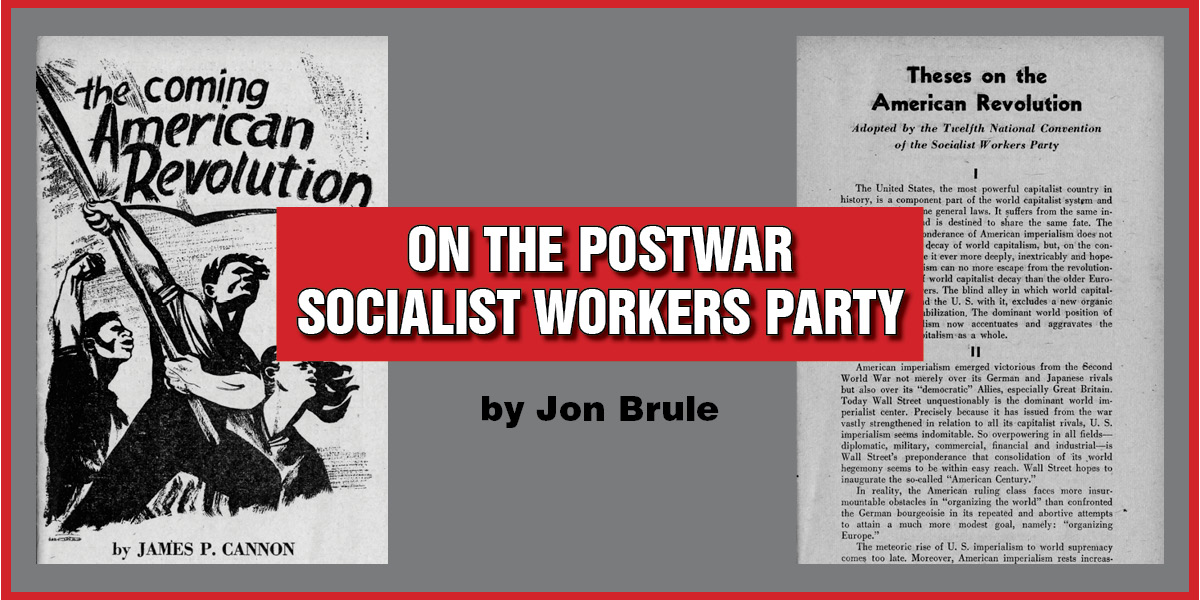
In the U.S. the SWP pushed an equally catastrophic view. Its fundamental perspectives were laid out in “Theses on the American Revolution,” adopted in November 1946. This was a prime example of sterile orthodoxy. The Theses wrongly projected that the U.S. economy was fundamentally unstable and would collapse in a crisis that would dwarf the Great Depression. This would supposedly lead to a mass radicalization that the SWP, as the only revolutionary party, would capitalize on. Given that the U.S. had emerged from the war as the overwhelmingly dominant imperialist power, this projection of the imminent collapse of American imperialism made little sense.
However, it was not simply a question of a wrong analysis. The Theses refused to acknowledge the political obstacles that stood in the way of advancing the interests of the proletariat, let alone show how they could be overcome. It essentially ignored the much larger Communist Party, by far the SWP’s major competitor in the workers movement. The SWP’s recruitment targets would be the less political workers. The Theses sought to justify this, claiming that “The class as a whole has not been infected with the debilitating poison of reformism, either of the classic ‘Socialist’ variety or the latter-day Stalinist brand.” This alibis the political backwardness of the U.S. workers, who had not even reached the level of independent political organization. Cannon himself argued a form of American exceptionalism, claiming that while it might be okay to have an orientation to the Stalinists elsewhere, in the U.S. they were simply Kremlin hacks and hand-raisers.
The SWP’s disdain for the Stalinists dovetailed with various Stalinophobic positions. Along with FI leaders in Europe, it called for withdrawal of Soviet troops from east and central Europe, which would have been an invitation to the imperialists to march in. The Trotskyists had lost a dialectical sense of the contradictions of Stalinism, concluding that it could only betray.
This Stalinophobia also made it much more difficult to attract black workers, whose most class-conscious elements were concentrated in the CP. The Theses vastly understated the degree of black oppression, pointing to the alleged “increased cohesiveness and homogeneity” of the American working class. Yet it is obvious that this “cohesiveness and homogeneity” excluded black workers. The SWP concentrated on doing work inside the liberal integrationist NAACP, whose main activity was filing suits against discrimination.
The SWP’s sterile orthodoxy gave rise to two oppositions in the decade following the end of the war. The Theses in part were a polemic against the Goldman-Morrow group, who led a small opposition in the SWP in the period 1943-46. Goldman and Morrow were denounced as incurable pessimists and capitulators because they refused to accept Cannon’s enthusing over a “coming American revolution” and the equally overly rosy prospects for revolution in the short term in Europe. Goldman-Morrow were not a revolutionary alternative—their Stalinophobia eventually took them out of the workers movement. However, to simply dismiss them as “right-opportunist critics,” as “Genesis of Pabloism” does, is wrong. They challenged the false projection of a catastrophic collapse of the U.S. economy and argued correctly that the likelihood was that the European countries would go through an initial phase of bourgeois democracy. Morrow pointed out that the reformist parties there had not been discredited; they could not simply be ignored or denounced in a shrill sectarian fashion. However, the FI leaders disregarded these correctives.
The second opposition was the Cochran-Clarke faction. This consisted of two groups, Clarke’s group in New York and the Cochran group, which comprised the party’s Midwest trade union fractions. By now the Cold War had been raging for several years. Both the Stalinists and the Trotskyists were targeted by vicious state repression and a red purge in the unions. The situation was very different from when the Stalinists were backing American imperialism in the war and pushing the no-strike pledge. The crying need was for a united-front defense with the Stalinists. This is what the Cochranites called for. Although the faction fight did not come to a head until 1952-53, political skirmishes started a few years earlier when the auto fraction demanded that the SWP break its bloc with the Reuther leadership of the UAW, which was orchestrating the red purge. The SWP leadership resisted, only grudgingly conceding when faced with the solid opposition of the party trade unionists. Even then Cannon argued that making a bloc with the opposition to Reuther was only acceptable because the Stalinist influence in that opposition had diminished.
As pointed out by the Cochranites, the SWP had a pre-history of making blocs with “anti-Stalinist”—in reality anti-communist—forces in the trade unions. The Cochranites noted that in 1940 Trotsky had raised to the SWP that it give critical support to the CP’s presidential campaign. The SWP refused, arguing that this would injure their relations with their pro-Roosevelt allies in the unions. Trotsky rebuked them sharply, observing that “You are afraid of being compromised in front of the Rooseveltian trade unionists. They on the other hand are not worried in the slightest about being compromised by voting for Roosevelt against you.” Cannon stubbornly insisted to the Cochranites that he had been right in the 1940 discussion.
The Cochranites raised other examples of the SWP’s “vulgar ‘anti-Stalinism’ in practice,” charging it with half-hearted defense of CP leaders being persecuted under the witchhunt, as well as silence on the Rosenberg case for almost an entire year. They also noted the SWP’s semi-Shachtmanite initial line on the Korean War, where they didn’t take a side defending North Korea from imperialism. And as Masters pointed out, when the SWP did switch its line, Cannon minimized the problem. As stated by one of its leaders, the SWP majority line was that Stalinism was “counterrevolutionary through and through.”
The Cochran-Clarke faction was linked to Pablo. To his credit, Pablo recognized that the methods of sectarianism and Stalinophobia had led to a dead end politically. However, as we know, in junking this Pablo flipped over into a conciliation of Stalinism. This was reflected in the Cochran-Clarke faction, which could not offer a class independent road forward. They did not raise fundamental criticisms of the American Stalinists with their illusory search for a bourgeois “peace candidate” who would end the Cold War. Moreover, while still members of the SWP, the Cochran group expressed the desire to “junk the old Trotskyism,” although they didn’t put this in writing. Within six months of their expulsion for boycotting the Militant’s 25th anniversary meeting, the Cochran group renounced Trotskyism.
In conclusion, the SWP along with the other Trotskyists were confronted with a new world situation following World War II. This mandated that they undertake new political tasks and perspectives. Unable to do so, the SWP retreated behind sterile orthodoxy and sectarianism. This phenomenon should not strike us as entirely unique. While the particulars are of course very different, the changed circumstances of the post-Soviet period found the ICL wanting. Unable to expose liberalism and put forward a revolutionary alternative to it, the ICL stumbled through a few decades of dreary sectarianism covered over with sterile orthodoxy. We have, thankfully, corrected this. However, revolutionary continuity is not inscribed in stone. As the world changes, the Leninist party must assimilate that new material reality and ensure that its political perspectives correspond to this.