
https://iclfi.org/pubs/aba/3/debate
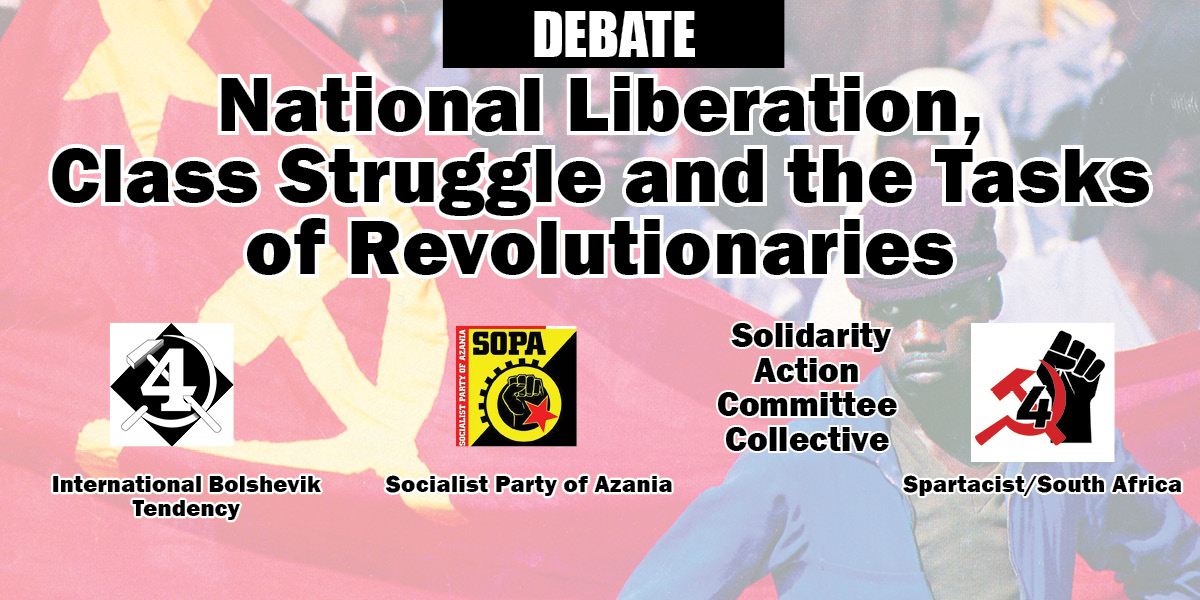
We print below an excerpted transcript of a public debate held at The Forge in Braamfontein, Johannesburg on 15 November 2025, between four different leftist organisations. The groups that took part had been working together in united-front actions recently, including the campaign to defend EFF militant Xolani Khoza (see page 17). The proposal for the debate came from Spartacist coming off of the discussions held with supporters of the International Bolshevik Tendency (see page 24). Motivating it, we emphasised that just as united-front defence is critical in the current situation where leftists and anti-imperialists are facing a massive onslaught, it is just as urgent to engage in serious political debate on the issues that are strategic for overcoming the left’s current weakness.
In that respect, this event was a success that we hope will be built on by others. Over 50 activists and militants attended, and there was a lively and lengthy exchange on the disputed issues (the transcript below is heavily excerpted due to limited space; the full audio, around 3 hours, is available on our YouTube channel, see link below). By no means did it result in agreement on the disputed issues. But we believe it certainly helped make clear what the disagreements are, presenting the arguments for serious militants to consider. Collaboration also benefited from the exchanges, with three out of the four participating groups subsequently working together on the Open Letter and united-front class-struggle contingent at the 23 January EFF protest in defence of Julius Malema.
Chairperson
Hello comrades, friends, my name’s Bobbi and I’ve been involved in activism almost all my life and I’m really pleased to see the turnout here.... I hereby open this debate officially. It’s being live-streamed on the Facebook page of AmaBolsheviki Amnyama.... Each participant will be given 15 minutes to speak. I’ve got a timer here, I’m going to be very strict, but we’d also like you to be free.... Thank you comrades for coming out, all the participating organisations and everybody else for participating in this important debate.
Jesse for Spartacist/South Africa
There’s a few things that I think all of the organisations that are taking part in this debate and probably most of the people in the audience would agree on. Number one, that the aspirations of the black masses for liberation were betrayed after 1994. Socially and economically, basically all of the old crap from apartheid remains unchanged. And, actually, economically the conditions of the masses are getting worse and they are now set for a severe shock with the onslaught from the GNU and Trump and US imperialism squeezing the whole country.
Number two, I think we generally agree that the central responsibility for this lies with the main leaders of the liberation movement, the ANC and especially its Tripartite Alliance partners, the leaders of the SACP and the COSATU bureaucracy who subordinated the working class to the 1994 sellout negotiated under the auspices of imperialism.
But I think there’s another thing that most of us would agree on, which is that in the face of all this, the revolutionary left has been unable to offer a convincing alternative. We haven’t been able to win decisive sections of the working class, but not only that, we have lost influence in the working class even as the masses have increasingly turned their backs in disgust away from the Tripartite Alliance. So I think that that is the background to consider when we look at what is happening in the face of this massive onslaught from US imperialism and the real paralysis of the working class and the left to actually resist it....
We as Spartacist believe that behind all of these problems and this reactionary development lies one main thing: The failure of the left to pursue and carry out the main task of revolutionaries, which is to compete with the nationalists for revolutionary class-struggle leadership of the liberation movement. To expose them before the masses and offer an alternative path forward. When I say the failure of the left to carry this task out, it must be said that the left as a whole has hardly even posed this as a task, or they reject it outright.
And, let me say...I absolutely include our own organisation among the left who has failed to do this. We have only recently come to the conclusion that this is actually the main task of revolutionaries, in rejecting much of our previous approach to the national question and the tasks of revolutionaries in South Africa over the course of some quite wrenching discussions and a reorientation in our international in the last few years. And so I want to make that clear, and also that’s why the debate here to actually clarify these differences and clarify what exactly are the lines of dispute is very important, we think, for going forward.
So why is anti-imperialist struggle central and why is it important to fight for communist leadership of it?... It actually flows from the material conditions in society and the dynamics of class struggle that are shaped by them. Every aspect of economic and social life is stamped by the subjugation of South Africa to imperialism, above all to the US imperialists. They are the ones who call the shots on everything from energy policy to debt to which opposition politicians get locked up. The working class and the black majority of this country continue to be subjected to national/racial oppression and superexploitation at the hands of the white big bourgeoisie, which is deeply committed to maintaining the subjugation to US imperialism....
The main difficulty [on the left] is how to deal with this, and in particular, how do you relate that to the nationalists and the black elites that they rest on? There are two main traps which the left falls into. On the one hand, there are those on the left who point out the treacherous role played by the nationalists, and that the nationalists seek to place themselves at the head of the liberation struggle in order to subordinate the masses and subvert the struggle to advance their own narrow interests, which leads to betrayals. This is absolutely true. This is what happened with the negotiated settlement.
But the problem is that this section of the left draws the conclusion from this that it is wrong for communists to put the anti-imperialist struggle and the liberation struggle at the centre of their tasks, that to do so can only be a capitulation to the nationalists and lead to class collaboration. We have one group, the IBT, who will defend this view, I think. They say that the main task of revolutionaries is actually to separate the anti-capitalist class struggle from the national liberation struggle.
Then there’s another group [on the left] that falls into the opposite trap. Which is that they look at the crucial importance of fighting imperialism and national oppression, they point out that the nationalists and the black elites are also subject to this oppression, and that it is in their interest to push back against imperialism—and the nationalists do indeed sometimes try to push back. All true enough. But from that, what they conclude is that the role of the working class and communists is to keep the nationalists on side, to turn them into a consistent anti-imperialist ally.
Now, both of these trends recognise a part of the reality, but both of them are dead wrong in their overall assessment and the political tasks that they draw from it. The fact is that the nationalists and the black elites are both oppressed by the white rulers and utterly dependent on them. And the only means that they have to push back against that oppression is to lean occasionally on the masses, which is why they pose as anti-imperialists, why they try to rally the nation behind them. But to conclude from this either that the task is to keep them consistent, or that we should reject the national liberation struggle—we think both of these are completely wrong and lead to disaster.
The task rather is to fuse the two elements together, the class struggle and the national liberation struggle, and show, in competition with the nationalists, that these tasks can only be accomplished, the struggle can only be driven forward, under working-class leadership with class-struggle methods that are fundamentally counterposed to that of the nationalists. And that the movement, as long as it stays chained under the nationalists, is going to lead to disaster. That is what we mean by competing with the nationalists for leadership of the liberation movement.
If you do not view political developments through the lens of the role of the left to fight for leadership, then you can’t make any sense of the trajectory of the revolutionary left politically since Marikana. Why has nothing come of the hopes raised by NUMSA’s break with the Tripartite Alliance and the foundation of SAFTU? Why was NUMSA’s SRWP [Socialist Revolutionary Workers Party] a complete failure, stillborn from the start? Why have groups like WASP [Workers and Socialist Party] lost even the marginal influence that they had when they were founded in 2013? Nobody has a convincing answer to this, instead what you hear is a lot of, “this guy did it, that guy did it, this conference, that conference, these words that I suggested should have been in the programme”.
And the reality is that you cannot deal with any of this in a coherent and convincing way if you ignore the elephant in the room, which is the EFF. Which is exactly the left opposition to the ANC that none of these different groups and none of the left as a whole has had any convincing answer to. The EFF’s existence posed a challenge to the NUMSA leadership (and the rest of the anti-ANC left) which they couldn’t answer, which is why they couldn’t convince workers, including most workers in NUMSA, to vote for the SRWP. Namely, the question: Why should we join your group when there is this mass party with massive influence whose radical demands are basically the same as what all you guys say? The EFF is for expropriation of land. They are for the nationalisation of the commanding heights of the economy. They even talk about socialism.
And in our opinion, as Spartacist, it’s in fact impossible to answer this challenge from the EFF unless you start by dealing seriously with the core contradiction at the heart of that party, the reason why it has attracted so much mass support and also why it is unable to actually do anything with that and is now on the decline. Which is that on the one hand the EFF’s appeal is based on a programme of demands that speak to the burning aspirations of freedom that were betrayed by the ANC. We all know what these are, the seven cardinal pillars. It’s basically a new updated and more radical version of the Freedom Charter. And it is precisely because of these demands that the EFF as a party is completely unacceptable to the white monopoly capitalists who call the shots in this country. That’s why the GNU was formed....
But the other part of the contradiction is that it’s the EFF’s petty-bourgeois nationalist leadership and strategy which are the very thing that stands as an obstacle every step of the way to actually advancing a struggle for those cardinal pillars. Because it stands as an obstacle to uniting the masses behind the working class to actually confront the white monopoly capitalists. It’s not an accident that the EFF promotes parliament instead of class struggle, that this is their main focus, actually. It’s because their whole nationalist strategy is based on winning the disgruntled sections of the black elites to come to them, by convincing them that the EFF is the means to advance their aspirations by getting the black masses behind them.
For revolutionaries, we think that the task that follows from this is we must work and fight at every step to sharpen this contradiction. To show both in our arguments but also in deeds that this is the case and that the EFF militants who look to that party because they see it as the means to advance a radical change, the cardinal pillars. That they need a fundamentally different strategy and leadership, one that bases everything that it does on the class struggle.
So, obviously, this is easier said than done. But the whole point is that to begin with that you first have to set this as your task, as your goal.
Instead, the main trend on the far left is to say, “Ah, the EFF, we don’t want to have anything to do with them. They’re a bourgeois party of the class enemy.” Right? Well, first of all, it is kind of peculiar, for a party of the class enemy, that the actual ruling class—the people who call the shots, the white monopoly capitalists—want nothing whatsoever to do with it. But it’s also peculiar, for a party of the class enemy, that its members come out singing songs about socialism; that at its conferences the leader of the party quotes Marx and Lenin for hours on end. Perhaps, comrades, these are hints that rigid, abstract categories are not really helpful to deal with this phenomenon. And that it’s better to focus on actually dealing with the EFF as it is and how to recognise and sharpen the contradiction that exists.
We’re in a situation where the EFF has been the main opposition to the ANC for the past 12 years. Now, especially after the elections last year, it is not being challenged by the revolutionary left. It’s under pressure from the right. And there are a lot of communists and Marxists who say, “Well, that’s great. Better for us. Let’s go forward to building a mass workers’ party!” But there is no way that the effort to build a mass workers’ party is going to be any different from the failed attempts like the SRWP unless it sets as its task actually fighting to compete [with the petty-bourgeois nationalists]. This is an obstacle in the way of moving the liberation struggle forward and moving the class struggle forward. Thank you.
Mandla, for the International Bolshevik Tendency
All right, comrades. Dumelang. The loss of support in the May 2024 election by the ANC represents the end or death of nationalism in South African politics, after 100 years of dominance from the white Afrikaner to the black petty bourgeoisie. And this left a big impasse on African national politics, especially the liberation of the oppressed masses after 30 years of ANC misrule, which has left the country in the hole. The country is without a political map going forward. A deadlock between the black masses and the ANC has been reached. In September 1909 the British king signed the South African Act into law, thus passing political authority over South Africa from British Parliament to the Parliament of the Union of South Africa, which was formed in 1910. South Africa has been under nationalist rule for 115 years, starting with the Afrikaner generals that were accommodationists to British imperialism....
The Afrikaner nationalists in 1910 to 1994, in order to achieve these objectives, used the state to develop transportation and communication infrastructure, as well as to establish a vast network of state-owned enterprises in broadcasting, armaments, power generation, development, finance, iron and steel, and chemicals. Afrikaner nationalists also facilitated the outgrowth of Afrikaner entrepreneurs, several of whom developed into international brands.
While consolidating the cohesion of Afrikaner population under their leadership, Afrikaner nationalists embarked on a massive drive to disrupt the cohesion of the black community. Their main instruments being the migrant labour system, single-sex hostels, forced removals, stripping blacks of whatever assets they had, and blocking them from acquiring new ones. The purpose of these measures was to atomise the black population so that it could not resist. All these methods exposed the black population to being exploited as cheap labour....
South Africa’s black nationalists, while they were an elite, they were never an elite that owned property. This was to be a crucial factor in determining the characteristics of South Africa’s democracy, especially the nature of its internal contradictions. The new black elite were therefore faced with several questions when it gained control in 1994. Should it use the newfound power to enrich itself? Should it use the new power to enrich the mass of the black people who had been exploited for the best part of 100 years? Should it do both? What about the wealth of South Africa’s rich whites? The ANC allowed the white rich to keep their wealth.
Should it be nationalised? Should it be taxed? And to what extent? Those were the questions that were asked by the nationalists when they got into power in 1994. South Africa’s big business anticipated all these questions and came up with its own solution. It offered a small part of their assets to the individual leaders of the black resistance movement in return for them leaving the country’s business environment entirely as they found it when they took power in 1994.
The leaders found this offer of instant wealth hard to resist. The co-optation of the black nationalist elite by business came to be known as Black Economic Empowerment, or BEE. This was never a policy of the ANC during exile. This was a completely multiracial organisation, including Coloureds, blacks and whites. They never proposed BEE as a policy for enrichment. This was handed over to them by the white capitalist rulers of South Africa.
South Africa’s largest companies, notwithstanding their deal with the black nationalists, realised that conflict between the black nationalists and the black masses was inevitable and would propagate even more fears than the strife between the black masses and Afrikaner nationalism. Thus, within the five years of black nationalists taking control of the state in 1994, South Africa’s largest companies, like Anglo-American Corporation...as soon as the ANC came into power, they moved their assets and started to invest overseas in London....
What were the risks that came with black nationalist rule that these large corporations identified, which led them to migrate from South Africa? We saw earlier that the Afrikaner nationalists, in order to advance its interests as landowners, had to drive South Africa’s industrialisation. The black nationalist petty bourgeoisie on the other hand, are not property owners. Their primary interests are not so much to drive further industrialisation, as they had nothing to gain from increasing investment. Their primary interest is to drive the black elite’s private consumption.
This poses two major threats to the stability of South Africa. Private consumption would be at the expense of investment, especially of investment in South Africa’s physical infrastructure. Secondly, growing elite private consumption would be in competition with the consumption of the black poor and state employees. The country ran out of electricity because despite many warnings, the state-owned power company Eskom needed to build more power plants. Governments turned a deaf ear. They did not want to make the necessary investment in power generation, or to open up power generation to independent power producers. Parastatals have become a cash cow for black nationalist elite.
Also in 2008, for several weeks, South Africa was caught up in what came to be known as xenophobic riots, which left more than 60 people dead and thousands uprooted from their homes. These were manifestations of another decision not to invest, this time to invest in the army. South Africa thus left its borders uncontrolled to a flood into South Africa’s poor neighbourhoods of economic refugees from many parts of Africa. This competition for material resources between South Africa’s urban poor and arriving foreign migrants inevitably led to violent conflicts between these two groups. With the wealth of the whites protected through BEE, the only source for enrichment of the black elite available were state revenues.
This has proven to be central in the contradiction of the era of black nationalist rule. This contradiction can be summed up as follows: Who gets what share of state revenues between the elite’s private consumption, the poor people’s welfare consumption, investment in social and physical infrastructure, as well [as] other payments such as workers in the public sector. Competition between these streams of state revenues has become increasingly explosive. South Africa, therefore, now is entering a new phase of conflict: The conflict between the black nationalist elite and the black masses over how to distribute state revenues between them....
In the first plenary session, I strongly questioned the invitation of EFF as a capitalist party, an enemy of the working class people. We will always talk to rank-and-file members of these organisations trying to break from nationalism into the struggle of socialism and overthrowing capitalism. But there’s one thing that we’ll never do. We will never give them political support in the form of the vote like the Spartacists did in the last elections, 29 May 2024.
The biggest political sickness of the left is to tail nationalism until it takes them to the grave. The Spartacists that I joined, before it became AmaBolsheviki Amnyama, taught me that you support the nationalists in the fight against apartheid. Once the nationalists get into power, they turn around and shoot and kill the working people. You saw what happened in Marikana amongst the biggest examples. Nationalism is a bourgeois ideology. What alternative under these circumstances? Fight like hell to build organs of proletarian power, to rule on behalf of the oppressed, therefore creating dual power, which counterposes the dictatorship of the proletariat to the capitalist bloodsuckers that are still running this country today. In the anti-apartheid strategy of the mass democratic movement, in the 80s, masses started building area committees as an alternative to the apartheid state.
The most complete example of this phenomenon is the soviets or workers’ councils of the Russian workers struggling against the Tsar, the workers led by Lenin and Trotsky. The International Bolshevik Tendency calls for the formation of such soviets as an alternative to treacherous bourgeois-nationalist parties, sworn enemies of the working class, armed with Leon Trotsky’s theory of permanent revolution. That is our way forward. Thank you.
Phineas, for the Socialist Party of Azania
Amandla! I want us to just observe a moment of silence. We have lost one of our icons in the struggle, Barney Mokgatle, who was the lieutenant of the 1976 uprising, together with Tsietsi Mashinini, Khotso Seatlholo and others. He is, in fact, the last of the lieutenants of the 1976 strike. So we can just bow our heads a bit. [Moment of silence]
Thank you.
I’m not going to say anything which is different from what comrades have already talked here. The Spartacists have already said part of what I wanted to say, what I have written here, that our struggle is a unit. It cannot be differentiated into compartmentalisations.
We have got the struggle of the working class and the national struggle. But during the course of the national liberation struggle, they have never been separated. And if we cannot find strength in that, we will be deviating from Marxism itself. Because the Marxists believe that the national struggle is first. Each and every nation ought to liberate itself, taking the material conditions obtaining in that particular country, and then they can fight against the bourgeois class at the national level. After fighting that, then we can be able to say, now the workers of the world unite. For there is nothing to lose but chains that bind their feet and heads.
Black Consciousness from its inception has sought to merge the two. When you look at the material conditions obtaining in South Africa, mind you, we must always remember that we were not nationalised by a particular European country. We were not actually colonised by the British or colonised by the Dutch or colonised by the French. But we were colonised by a company, the Dutch East India Company. That’s the one which invited the European powers to augment them and protect them. But basically the capitalists are the ones who actually colonised us. So we must always remember that. And Black Consciousness took cognizance of that.... We have got the white ruling class, which is oppressing the ruled class, which is the black working class. It discriminates against them, in the first place, it oppresses them politically, it exploits them economically. It is logical for that class which is ruled and oppressed and discriminated against to unite itself and then be able to fight against the class that is oppressing them.
So from the inception, the approach which was taken by Black Consciousness is dialectical. You can check all Marxists, all socialists in the world: the approach must be dialectical. It must be between the haves and the have-nots. As the Socialist Party, we know that the question of nationalism is not static itself. It moves with time, it moves with technology. When society changes, it changes. That is why we have got an ideology that leads us, apart from the national liberation struggle philosophy, which is scientific socialism.
Then the founders of the Black Consciousness philosophy arrived at the same conclusion which Karl Marx and other socialists arrived at. Maybe you can say the intelligent minds arrive at the same conclusion when they look at the same material conditions. So we then adopted scientific socialism as the solution against the imperialist or capitalist rule, which we call now neoliberal capitalism.
When all people were saying nationalism or national struggle is a means to an end, we said as Black Consciousness, nationalism or national struggle is not an end on its own. An end on its own is the egalitarian society. So socialism itself is not even the end. It’s a means to an end. Because socialism means nothing other than the dictatorship of the proletariat. COSATU was wrong in saying “socialism means democracy”. Socialism does not mean democracy. It means dictatorship of the proletariat. And its main work is to remove the contradictions in society.
If it does not do that, it’s not socialism. It’s something else. That’s why most of the socialist experiments in the world, like socialism in Russia, deviated from doing what it’s supposed to be doing. And then it became a bureaucracy. And then it became a party-only country, which is not socialism, it’s a deviation from socialism. So as the Socialist Party, we agree to an extent with the Spartacists, what they were saying. To an extent with the other comrades, which was saying here that socialism is the only way in which we can be able to solve the problem of contradictions in society.
To that effect, as socialists, we are looking at what is happening now in the country. The bourgeoisie, which is ruling, have bowed down. They agreed and admitted that they cannot rule in the same way as they were ruling before. They then are calling what they call National Dialogue, to be given direction. The dialogue which they called even before. So they are repeating themselves again. So if we, as the working class, are not actually taking that into account, that the capitalists have reached a stage in which they cannot develop human society anymore. They cannot improve the human society anymore without destruction of the means of production, the labour and other things which sustains the society. If we are not taking that into cognizance, we are going to be the spectators in the game which was supposed to be played. And then we will remain like that. It’s not that society is rejecting socialists. No. We reject them, we isolate ourselves. We ostracize ourselves from the society, from the working class itself. That’s why the trade union movement or the labor movement ceased in the meantime to be the schools for socialism.
They are stuck on the bread and butter issues. They can’t go beyond, like in the Soviet Union during Lenin’s time, where they were able to move beyond the bread and butter issues. Like in China during Mao’s time, when they were able to organise themselves beyond the bread and butter issues. So the Socialist Party wants to call upon all socialists in this country. And we are many, to tell the truth. We just need to get ourselves together. And if we get ourselves together, we will be able to move the masses together with us. Black Consciousness did that for ten years. Within ten years, they moved and they led the revolution. Led the uprising. We changed and then challenged the modalities of apartheid. So if we move according to that line, which is dialectic, and sharpen the conflict, we will be able to change the situation in this country.
We launched a campaign very recently, which identified the material conditions of the very same National Dialogue, which is being moved around here. We call the National Dialogue as the National Dialogue without ideology. The strategy of the Amakutari. The Amakutari are the fallen angels. The people who were in Parliament, the people who were ruling, now formed their own smaller parties. Because they have lost that glory, and they want to recover it again. So they want to reinvent themselves. It’s only us, as socialists, who can stop that trend.
We need to mount a protest against this strategy of the Amakutari, who are trying to reinvent themselves. And in the alternative—we discussed the strategy when we were with the community at Freedom Park—that the only solution is the sovereign National Assembly of people of this country getting together to draft a new dispensation, which will be able to be controlled by the working class themselves. So that’s the only way we can move, and then be able to capture the situation as a class. The working class of this country must stop fighting for other classes, and start fighting for themselves as a class on its own. Thank you.
Gift, for Solidarity Action Committee Collective
In real terms, from the point of the black majority, South Africa was a slave colony. The fight against imperial control and domination gives a special national character to the struggle for emancipation. Lenin and the Third Communist International placed the national question at the centre of revolutionary struggle, particularly in the epoch of imperialism. The programme of national liberation is a programme against oppression. The right of nations to self-determination implies exclusively the right to independence in the political sense, the right of free political separation from the oppressor nation. It implies only a consistent expression of struggle against all national oppression, and national self-determination is the fundamental democratic formula for oppressed nations.
Leon Trotsky, in his letter to South African revolutionaries, clarified that a social upheaval (in the first instance, an agrarian revolution) was unthinkable with the retention of British imperialism in the South African dominion. The struggle for the expulsion of British imperialism, its tools and agents, was an indispensable part of the programme of the South African proletarian revolution. Trotsky further argued that the South African Republic will emerge first of all as a black republic. This did not exclude either full equality for the whites, or brotherly relations between the two races, depending mainly on the conduct of the whites. This meant that the majority of the population, liberated from slavish dependence, would put a certain black imprint on the state. In this sense a victorious revolution would radically change not only the relation between the classes, but also between the races, and will ensure to the blacks that place in that state which corresponds to their numbers. The social revolution in South Africa will also have a national character.
The ANC and the SACP also defined the struggle against segregation and apartheid as one of “National Liberation” and argued that “The political philosophy which we profess is that of African nationalism. This, inter alia, implies … that they (Africans) suffer an alien and foreign oppression.” The struggle was to lead the Africans as the Nation to regain what they lost in the alienating process of colonisation. The struggle for National Liberation was central because of the peculiar nature of South Africa, viz. internal Colonialism, the white oppressor nation had colonised the African, Coloured and Indian oppressed nations (diluted occasionally in the official literature as national groups and nationalities). The difference between classic Colonialism and internal Colonialism was that in South Africa both the oppressor and the oppressed nations occupied the same geographical area.
Strategically they argued that the national question could only be seen as a national democratic revolution. The struggle for national liberation and political democracy was the most immediate task. To this end, all oppressed must unite and unite around their common lack of democratic rights. The countries of the world are divided into those which are mature for socialism and those which are not. Those countries not deemed to be ripe for socialism first had to struggle for their bourgeois democracy as a separate stage. The people from those countries unfortunate enough to be classified as immature or backward would in their struggle for national democracy unite all their oppressed classes (petit-bourgeoisie, peasant and workers) under the progressive bourgeoisie. In the old Menshevik tradition, the bourgeoisie is seen as the natural leadership of the democratic struggle.
And in reality, such an approach had nothing to do with Marxism as it lacked a historical materialist understanding of national developments. Economic exploitation and national oppression are part and parcel of the same social system, especially in South Africa, where capitalist development took on a racial capitalist form organised on the basis of super exploitation of cheap black labour. The struggle for National Liberation is a struggle for a formally independent country to free itself from the economic yoke of imperialism, and the resolution to this question is totally bound up with the question of the class which is brought to power. In this regard it is only the proletariat, organised as the new head of the nation that can solve the democratic question. The democratic and socialist revolution cannot be divided in time and space, and the struggle for proletarian power, the dictatorship of the proletariat, was the most immediate task (permanent and uninterrupted revolution). To this end all the oppressed has to be united under the leadership of the working class and against the bourgeoisie. It is only the seizure of power by the working class and the establishment of the dictatorship of the proletariat which could solve the question of democracy, tribalism and racism and open the road to socialism....
The class struggle in South Africa is a product of a dialectical relation between race and classes. Our struggle is an anti-racist class struggle to establish a non-racial society, a socialist society....
The two defining moments in class struggle in the post-apartheid period are the Marikana Massacre and the NUMSA Special National Congress resolutions. The Marikana Massacre revealed, like no other event before, the class character of the ANC—a party of the mining bosses in particular and the capitalist class as a whole. The Marikana Massacre accentuated the political disenfranchisement of the working class and laid bare before all the necessity for a party of the working class.
After 29 years of neoliberalism the working class is on the back foot. Deep levels of poverty and hunger, a 40% rate of unemployment (the expanded definition) and social malaise and disintegration characterise the society. The social fabric of the society is severely endangered by the breakdown of all essential services like education, health, water, electricity, sewerage, other municipal services, etc.
Furthermore, since the formation of the GNU one and a half years ago, wages, employment and services such as water has seen a deterioration in the conditions of the black working class.... The working class is in retreat.... The general level of class consciousness is low. The trade unions are weak and disorganised and divided, the civic formations have largely disappeared and most NGOs have become nothing more than feeding troughs for their leaders. The left is weak and disorganised; it is small and fragmented with limited implantation in the working class. The entire left is in crisis.
The declining voters turn-out and declining support of the ANC pointing to a serious crisis of political representation for the South African ruling class. Their political rule is based on the mandate of a minority. This is a crisis of legitimacy of the ruling classes and clearly something new has to take its place.
We note that in the last few months something is taking place in the working class. Beneath the apparently calm surface, powerful cacophonies are building up. This is a gradual accumulation of discontent and frustration in the masses, which increases as time elapses and finally boils over. Trotsky called these processes the molecular process of revolution, like molten rocks which shift slowly and imperceptibly in the depths of the society....
We are also treated very carefully by the local ANC Council as they are aware that we pose alternative power to their rule. There is no question that the deepening social and political crisis is providing the kindling of coming huge conflagrations. While all this is in the embryonic stage of development, we may quickly move from a non-revolutionary world to a pre-revolutionary one.
The task of the revolutionaries. Our task is to build the organisations and socialist consciousness of the working class through applying in our day-to-day work the method of the transitional programme, moving from today’s conditions and consciousness to a socialist consciousness and condition. In accordance with this approach, our central strategic political task is to defend the working class. We do so through the building of solidarity action committees in our areas.
These are food gardens, feeding schemes, women and children oppression empowerment, land and housing, unemployed workers committees, time to learn—after school classes, political education classes, internationalism, advice offices. This is a part of the process of rebuilding the working-class movement, its integrity and preservation, self-confidence, combativity and organisation. Through the participation in active struggle and political education, a new layer of militant working-class activists will gain experience and knowledge.
We must strengthen trade unions by taking up their struggle against bureaucratism and reformism of the trade union leadership. We build the broadest possible organised unity amongst organised workers and the other sections of the working class. A good starting point is to participate actively in the SAFTU Job Losses and Factory Closures Campaign....
What we have is a crisis of leadership, the absence of revolutionary Marxist leadership. The left is weak and exists in small groups and operate in silo’s. We think that the tactic of a Mass Workers Party is appropriate at this conjuncture as there is a need for a working class voice in the body-politic. We must start a Campaign For a Workers Party!
The only way the working class can take power is to have a centralised working class party, a vanguard party of the class. This is not going to happen through uniting small groups of Marxists. We have a non-sectarian approach to working in the mass movement and with the political groups. The condition of this work is to promote a revolutionary working-class politics and defend this at all times in united front work. While the discussion on theory, programme and practical political work is necessary and continuous, we believe that we can only find common ground and a shared revolutionary programme and platform if we struggle together and test our views and commitment in practice. Thank you.
Contributions from the Floor
Speaker from Solidarity Action Committee Collective
I remember when the ANC was unbanned in 1990, the Workers International League of South Africa broke up and split and dissolved into the one faction that said, no, we need to join the ANC so we can transform it into a mass workers’ party. And the other group, which was the minority group, stayed and said, no, the task is to build a workers’ party, and they continued with that task, so isolated, because the period had changed. Imagine discussing the question of building, transforming the ANC at the very point when the betrayal was being effected in the country. I mean, that was just crazy. As crazy, I think, is the idea that we must tail behind the EFF. The programme of the EFF, let’s talk about it. The programme of the EFF is a radical nationalist programme. The Freedom Charter, if you analyse it, is nothing more than a nationalist bourgeois programme. And I think Marxists have to be critically analysing the Freedom Charter rather than adapting to it. We need to train the working class in the character of the Freedom Charter....
Like Comrade Gift said, we work with all political formations, including the EFF. But I must tell you that in all our relations with them, they have proved to act in a dastardly way. Two years ago, I think, when they called for the big stay-aways, organised with us on the ground, and we all arranged to work together. And on the morning of the protest, when they realised that we had organised the many hundreds of militants to participate in the protest, they did not pitch up. In our local councils, the EFF counselors are rotten to the core....
We must work with them. But to adapt, to follow the EFF, and to think that the future liberation of the country lies with the EFF, is a mistaken view. And I wish to just advise our comrades from Spartacist regarding that. The question that we pose is that the defence of struggles, to rebuild the organisations of the working class, is the most important question right now....
Speaker from Spartacist/South Africa
Hi comrades, I’m a supporter of Spartacist.... We have a concrete proposal. It’s important to debate the class nature of the EFF. But, you know, what’s going on right now is that Donald Trump summoned Ramaphosa to the White House, pointed at a video of Julius Malema and said, why isn’t this guy in jail yet? A few months later, Malema is found guilty of gun charges, which are clearly bogus because we know AfriForum, who brought the charges against him, is not a gun safety organisation. They are a lobby group to shut up black militants and demonise them and put them in jail.
So we think that people need to see through what these gun charges are, an imperialist-driven campaign against Julius Malema. Whatever your criticisms of the EFF are, if you do not see this as an imperialist campaign to shut up one of the key leaders of black people in South Africa for daring to speak out about nationalisations, if you don’t take a stand on this, you are neutral or cowering in the face of imperialism. We want to make that really clear.
We have drafted an Open Letter to the labour movement: “We need unity to defend ourselves against US imperialism! Why it’s in the interest of all socialists and trade unions to defend Julius Malema”. We have copies of this at the back of our table. It’s a draft letter. We’d like organisations to take it, read it, consider it, and join with us in a joint statement to the union leadership.... [see final version of Open Letter on page 18]
Speaker from the ANC
Good afternoon everyone. And let me thank you for the invite, whoever I got it from.... I’m a regional executive committee member of the African National Congress in Johannesburg. So I guess I’m the big bad monster. [laughter] I preside over 125 branches across Johannesburg. Across five organisations from COSAS up to the ANC. I develop their political education curriculums and I ensure that they are carried out. I agree with a lot that has been said about the ANC.
And I also agree that even though we could say today that the predominant contradictions in society today are more class than they are national. But the reality is that the level of consciousness of our society enjoins us to consider the approach of my comrade there. That we still do need national liberation movements in the course of advancing our class struggle.
I just have only one question. Why the EFF and not the ANC? Because both are national liberation movements. What is it that we think we are going to find in the EFF that is not in the ANC? Because if both of them are national liberation movements, then their characters are most likely the same.
That’s why somebody raised the issue of [the VBS scandal]. If we are running away from corruption in the ANC, we are definitely going to find corruption in the EFF.Because both of them are national liberation movements. But without making anyone angry, I just think the EFF is just a little bit angrier version of the ANC. So I want you to help me, why you don’t want to work with me and want to work with the others.
Speaker from Socialist Party of Azania
I’m a bit touched about the topic of the EFF right now. I think that’s the topic that we must [be] resolute on. But I think we’re unison in most cases in terms of the class line, the class struggle. I would say comrades, we must always do a class line.
Don’t even try to collaborate with the bourgeois organisations. Because while we are trying to intensify the struggle, it’s going to get dangerous for us. When we collaborate with the bourgeois organisations. So if the EFF has got a progressive campaign that is saying those peasants in the farmlands are being killed. So we must go stop that. Yes, we must separate with them. You know, but try to fight or attack in unison. You know, by collaborating with the bourgeois organisations, it’s about how to drive it up or how much power they have in the context of the fight as I call it.
Summary by Gift, for Solidarity Action Committee Collective
This process that is going on here, there are processes taking place all over the country. Every week, we as the Solidarity Action Committee Collective, from now to the middle of December, every weekend, we are involved in one conference or another. People are beginning to search for answers. Everybody is saying, “what is to be done?” Everybody.
There are comrades of ours that are right now participating in the CWAO [Casual Workers Advice Office] Conference, a three-day conference to discuss what is to be done. Now, I think it’s all building up to a call on SAFTU and the big players, the big organisations of the working class, to call an assembly of the working class to discuss the question of what is to be done. And that’s the pressure we’re also putting on the leadership of SAFTU and in the struggles that we wage and wherever we go.
We’re calling for the formation of a united front. We’re calling for a discussion, a campaign for a mass workers’ party. But we’re doing it in the organisations that we are participating with while we continue to build independently on the ground in the working class.
Summary by Phineas, for Socialist Party of Azania
Amandla! Comrades, in summary of what we were discussing here, I think it’s very important to agree that we have agreed. Capitalism is inherently barbaric and there is no alternative to socialism but barbarism, which is capitalism. So, there is no way in which you can modify capitalism. Capitalism will modify itself and adapt. So, we need to learn the tactics of going against it at every inch. And we have discussed here around the possible scenarios which we will be able to unite ourselves.
And I think the people who make us gather here today, they need to do it again. Because we are from organisations here. We are going to report back on what we have discussed here. And then when we come back the next time you invite us. And we will have a concrete way of how we can unite ourselves against this monster.
Summary by Mandla, for the International Bolsehevik Tendency
Thank you. Dear comrades, the first question is the independent mobilisation of the working class against all bourgeois-nationalist parties including the EFF, the ANC and any other bourgeois party. Because you support them, they get into power, they turn against you.
We know about Marikana. We know about China in 1927. We know about Indonesia in 1965. Always when the working class organisations support the nationalists, the nationalists get into power, they turn around and kill those working class supporters. It is key to mobilise the workers independently.
I have proposed in the stage that already the working class and the poor in this country have reached a deadlock. The evidence of that is the last election. Where the workers are saying, we are sick and tired of it, [it] is not taking us anywhere. So what is next is going to happen is going to be a confrontation. What we need is to mobilise the workers independently. We need the soviets. That mobilises the workers independently because most of these left organisations have been discredited by supporting the ANC or other bourgeois-nationalist organisations. We need to call for the soviets. It must be based on workers, the students, the community. And they will say what do we need to do to move forward against this capitalist government here. We need to mobilise for the dictatorship of the proletariat that is going to overthrow the system. There is no way that we can meet with them. So let’s organise independently to smash these people who are running the system, killing us.
Summary by Jesse for Spartacist/South Africa
You can say “We’re for soviets. We’re for the dictatorship of the proletariat.” So are we. Great. Let’s get together and call on the workers to go out and build soviets and achieve the dictatorship of the proletariat. I don’t know really if anybody seriously believes that this, at this moment, is actually going to do anything to help arm the working class, which we do actually [need to do]. The left does need to get into the working class and deal with actually defending the working class against what is coming at it right now.
Does anybody know, for example: the largest union in the country and on the continent, NUMSA…are they getting ready to go out and build soviets and take over those factories, those auto plants? The car tyre plants [that] are being shut down by the imperialists? No. Are the workers of NUMSA waiting for us to come out and tell them to come and build the soviets? You’ve got to be kidding me! The working class is in shock. It’s US imperialism that is putting the screws to this country, just like they’re putting the screws to the entire globe, and in particular the Global South, to reassert their hegemony....
But to answer the question that the ANC member raised is, I think you don’t have to be a Marxist to tell. On the one hand, yes, the ANC and the EFF are cut from the same cloth. Their tradition and where they come from is a radical, petty-bourgeois nationalist tradition. Like I said, the EFF’s programme of the seven cardinal pillars is an update of the Freedom Charter. But just saying that, and saying that the Freedom Charter doesn’t get us to socialism, [that it] doesn’t put the working class in power—just repeating these things doesn’t answer any of the questions.
Because the masses of this country in the 1980s were rallied and mobilised because they wanted to fight for aspirations like the Freedom Charter. So, is your answer to that to say, ah, we don’t want to deal with that because those guys are bourgeois? If you’re doing that, you’re actually not helping in any way to attack the authority of the bourgeois nationalists. You’re actually helping to reinforce it.
And that is what one section of the radical left did in the 1980s. The workerists, right? They said, we don’t want to do any United Fronts with these bourgeois organisations, people who support the ANC, they’re bad, they’re for capitalism. We’re not going to have anything to do with them. What happened? Did they strengthen the left? No, they ceded the ground. And when the masses started to move in the mid-80s, it was all politically dominated by the ANC, including quite a number of the former workerists who went over to the ANC and the SACP.
So that’s not an answer. And the other answer, too, is not to say, oh, they’re great. We just need to keep them on the track. Tailing the EFF would be a very disastrous proposition. But competing for leadership of the anti-imperialist struggle to try to give it a revolutionary class-struggle basis and methods—how is that tailing the EFF? And how is that not actually dealing with the current situation? Because I’ll tell you, the capitalists, the rulers, they definitely see a difference between the ANC and the EFF. They’re not Marxists. But they can see that “this ANC, we can work with them”. But Donald Trump didn’t call to take out Malema because he heard about VBS and he’s worried about the savings accounts of all those pensioners. No, he called to take him out because he says this person represents hundreds of thousands of EFF members who are saying we want the land. We want to kill the system that keeps the white minority on top. I think we should not be indifferent to that.
Every defensive action necessarily confronts imperialism in this country. The water crisis, right? Except when you look at it, what was the last protest about water in Joburg? What programme dominated that protest? Comrades from SOPA were part of organising it. The programme that dominated that protest on November 1st was a pro-imperialist programme. It was a pro-GNU, pro-austerity programme.
And most of the left was unable to actually do anything to draw a line against that. [How can you] talk about mobilising the working class independently if you do not fight to mobilise the working class against imperialism—including not just [defending] its own economic interests, but the interests of all of the masses, the unemployed, the landless? That is a total distortion of working-class political independence. It has nothing to do with Marxism and what Lenin and the Bolsheviks and Trotsky fought for and how they made the October Revolution.
So I think it would be good, rather than try to come up with some declaration or whatever, we have proposals. The comrades from SOPA have their proposal about the constituent assembly. We have our proposal, we’ve circulated it [see Open Letter, page 18].
[The aim of our proposal is] to actually fight. [Not delude ourselves hoping] for something that is unreal, that SAFTU is going to occupy all the factories tomorrow. (They couldn’t even get the representatives [of SAFTU affiliate unions] on a Zoom call to tell us about these factories. Anybody who thinks that they are going to start occupying the factories tomorrow, that this is realistic, is actually helping build illusions in SAFTU.)
We think there should be a united front, a united defence of the working class, of workers’ economic conditions. Fight against the closures. Fight against the retrenchments. But to actually make that successful and to build unity behind the working class is impossible if you do not defend the masses and the economy against imperialism. And so that’s what our proposal is about, actually urging and trying to explain and pushing these organisations—including AMCU, including NUMSA—that they should actually do something to defend the EFF. And that does not mean because we think Julius Malema is God’s gift to humanity.... It’s because we know what is at stake. If the imperialists are able to lock him up, all of our struggles are going to be set back. So we have that proposal, and we think that these are concrete proposals which the organisations should take back and discuss.