
https://iclfi.org/spartacist/en/2026-bolivia
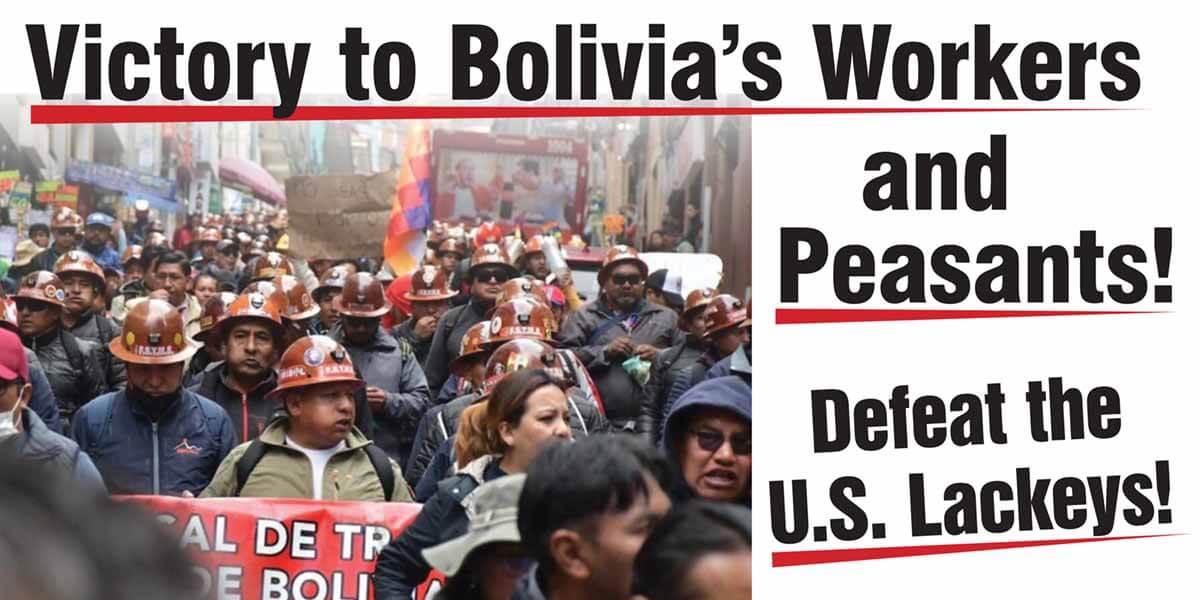
After six months in office, U.S. puppet President Rodrigo Paz is facing a revolt by the masses who are fighting for his resignation. In recent weeks, protests, blockades and strikes by miners, peasants, teachers, transport unions and other sectors of society have spread like wildfire in opposition to the government’s attacks on living standards and its attempt to sell the country’s resources to the imperialists. Paz and his clique first made a few concessions and then unleashed a bloody campaign of repression, with the police and army sent to crush the blockades and protesters.
In an attempt to decapitate the movement, the government has issued arrest warrants against Mario Argollo, leader of the Central Obrera Boliviana (COB), Bernabé Gutiérrez Paucara, leader of the peasant organization Ponchos Rojos, as well as others. This is in addition to the months-long campaign to jail former President Evo Morales on charges of human trafficking and statutory rape. Whatever the truth of these allegations may be, it is obvious that the U.S. imperialists are directly behind them. They want to do to Morales what they did to Maduro in Venezuela, crush once and for all the workers and peasants of Bolivia and open up the country for unbridled exploitation of its vast natural resources. It is up to the Bolivian masses to judge their leaders, not the U.S. and their puppets. We condemn this repression and demand that all charges be dropped!
We salute the heroic struggle of the Bolivian workers and peasants! They are once again earning their rightful place as the vanguard of the anti-imperialist movement on the continent. A successful struggle to bring down the hated Paz government and defeat its murderous repression campaign would give a black eye to the Yankee imperialists. It could halt the right-wing tide across the continent and ignite a broader struggle against the U.S.’s tightening grip on Latin America. Indeed, the recently elected U.S. puppets—in Argentina, Chile, Ecuador, Honduras, Costa Rica, Panama, Paraguay, and Peru—have all declared their support to Paz. Thus, what is being fought over in Bolivia is not only the fate of workers and peasants there, but that of all oppressed masses in Latin America.
It is urgent that the movement coordinate itself and not fall prey to the attempts by the government to weaken it by giving concessions to this or that sector. There is a real danger of this. Already, the government has announced a deal with a section of the miners. Some small and medium-sized enterprises, including layers of peasants and workers cooperatives, are pushing for moderation as road blockades are preventing them from getting their products to market. The government is also trying to manipulate the anger of informal workers in order to fracture the movement. This is classic divide-and-rule.
The movement cannot let its fate be decided by leaders who are looking for accommodation with Paz and the forces of reaction—be they in the COB, the Movimiento al Socialismo (MAS), or the peasant organizations. Committees must be formed to take matters into their own hands in order to prevent separate deals and impose the will of the masses. This is also needed to reach the informal sectors in order to show them that the struggle of workers and peasants is also their own. It is crucial to resist any attempt to disarm the masses as well as to appeal to the rank and file of the army, which the government is mobilizing.
The danger ahead is real. For decades now, the powerful movement of workers, peasants and indigenous peoples has been a thorn in the side of the U.S. and its Bolivian lackeys. While the election of Paz gave hope to the U.S. and the ruling class that the masses could be crushed through “legal” means, the current turmoil shows that this has failed. The class struggle is now in a stand-off: the ruling class cannot rule and Paz is widely hated, but the oppressed masses do not hold power either. Advised by Washington, the bourgeoisie and the generals will seek to move against the masses in a much more brutal and violent manner, as they have done multiple times in Bolivia’s history.
While there is significant sentiment to defend Morales against the pro-Yankee Paz government, neither he nor the MAS (the party he helped found) has any solution to Bolivia’s crisis. For decades, the MAS entertained the illusion that the interests of the masses and the country could be served without a sharp break with the white possessing classes and their imperialist masters. But this only served to demobilize the people while enabling the forces of reaction to raise their heads. Now, with the U.S. determined to crush any popular resistance in Latin America, and with Bolivia deeply shocked by an economic crisis, any illusion of conciliation, of a peaceful resolution to the fundamental conflict between the masses and imperialism, is suicidal. The masses must move decisively against the ruling class and march towards a workers and peasants government. The alternative will be the naked dictatorship of the U.S. and the bourgeoisie.